SCI 201 Chapter 1 - Introduction to the Scientific Process (Questions)
 Call Kai
 Learn
 Practice Test
 Spaced Repetition
 Match
 Flashcards
 Knowt Play
1/11

There's no tags or description
Looks like no tags are added yet.
12 Terms
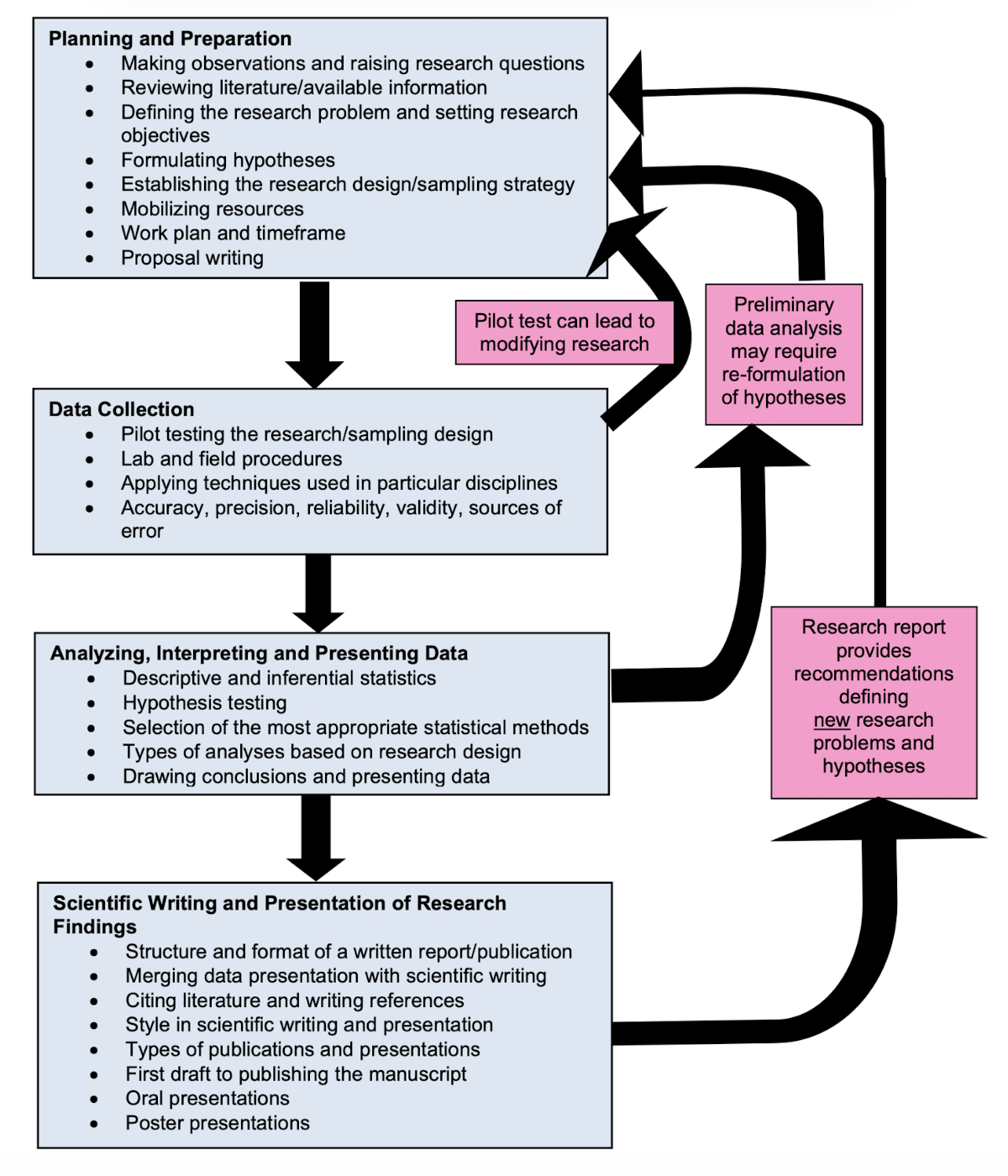
Describe how the steps of the scientific process can overlap with one another, and how this is beneficial to the overall process.
Feedback: pilot testing methods/hypotheses may lead to modifiying the research plan. Provides quality control
Feed forward: earlier steps provide criteria for evaluation in future
Explain how the concept of experential learning shows the scientific process as a cycle.
Act, reflect, conceptualize, apply → testing what you have learned in new situations
Thus it is possible to start at any of the 4 stages of the process
How would we classify the humanities (history, religion, philosophy, fine arts, languages) under a scientific branch?
Not part of science: humanities knowledge cannot be scientifically proven or tested
Can science prove a theory/hypothesis to be “correct”? Why or why not?
Science cannot prove a theory “correct,” only support it using evidence. Theories remain as theories even if they are very rigorously supported (ex. theory of evolution)
Ex. experimental results being consistent with the theory support the idea that it is correct, but there is always probability of an error. The theory is supported if the assumed error is very low (study does not give exact same result but very similar)
When does a theory become accepted as scientific knowledge?
When it has been verified by rigorous scientific studies
What is the difference between a hypothesis and a theory?
Hypothesis: single prediction or explanation
Theory: a set of hypotheses that combine to produce a theory
Are scientific laws proven absolute?
No evidence to prove it wrong, but it is never proven absolutely correct
Derived from experimental study → there is a chance that more accurate experimentation can occur
Compare descriptive and hypothesis testing research based on experimental design and purpose.
Descriptive: collecting and analyzing data. Describes a phenomenon but does not test any hypotheses → often preliminary to hypothesis testing
Hypothesis testing: collecting and analyzing data, testing hypotheses. Variables are manipulated to draw conclusions
Compare basic and applied research based on experimental design and purpose.
Basic: formulation of theories regardless of whether they are currently applicable. Often used as a starting point for information that may be applied much later on or further study leads
Applied: using knowledge and theories to fix a problem. Useful applications should be used to solve existing societal issues
Describe the results of observational and experimental studies. Can conclusions be drawn?
Observational: no cause and effect relationship can be drawn
Experimental: can draw cause and effect conclusion
Compare meta-analysis and review studies as types of secondary research. How can they lead to different discoveries?
Meta-analysis: re-analyzing data using a large data set from different sources. More comprehensive study → more in-depth results.
Review study: synthesizes data from multiple sources but no analyzing of data. Original concepts, theories, trends may be derived from previous research. May obtain information from secondary sources.
Both are secondary research and do not obtain original data, make use of information from many primary sources. More comprehensive results than studies that info is obtained from
What benefits can be gained by doing multidisciplinary research?
Multidisciplinary research involves several fields of study.
Advantages of multidisciplinary research: it can broaden the scope of the study and lead to more comprehensive discoveries or solutions to an issue, methods of investigation used in the different fields can strengthen the findings (Each field can help strengthen or check out the findings of the other fields), multiple methods can determine which findings are well supported with evidence and which are not very certain (can help to gain stronger evidence for the final conclusions being made)