kidneys
 Call Kai
 Learn
Learn Practice Test
 Spaced Repetition
 Match
Match Flashcards
 Knowt Play
1/101

There's no tags or description
Looks like no tags are added yet.
Name | Mastery | Learn | Test | Matching | Spaced | Call with Kai | Chat |
|---|
No analytics yet
Send a link to your students to track their progress
102 Terms
how does the volume of a cell depend on osmosis
if there are greater solute concentrations outside the cell than in, free water will flow out at cause the cell to shrink
if there is less solute concentrations outside the cell than in, free water will flow into the cell and cause it to swell
what is osmolarity
the number of moles of osmotically active solute per liter of solvent
what do excretory systems do
it controls the osmolarity and composition of extracellular fluids by excreting excess solutes while conserving valuable solutes and by eliminating toxic waste products through urine
what are the three processes of an excretory system
filtration
secretion
reabsorption
what is filtration
blood plasma is filtered from capillaries into associated tubules. filtered extracellular fluid contains no cells or large molecules like proteins
important fact about the movement of water
there are no mechanisms for the active transport of water. the movement is due either to filtration or osmosis
who are osmoconformers
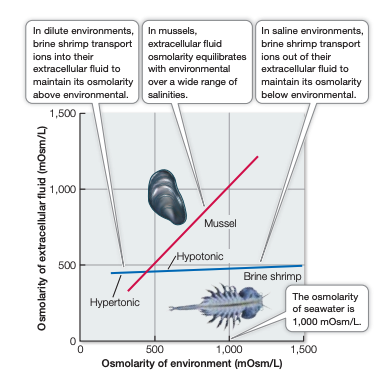
most invertebrates that live in seawater conform to the osmotic concentration of their environment over a fairly wide range of salinities
why do freshwater animals have to expend more energy than seawater animals in osmotic regulation
osmoconformity is not an option for freshwater animals. no cell can do without ions or nutrients, so freshwater animals always have to expend energy to conserve salts and excrete water
hypotonic regulation
marine invertebrates that maintain a constant osmotic concentration considerably below that of the environment
hypertonic regulation
marine invertebrates that maintain a constant osmotic concentration, and when they live in estuaries, seawater is diluted and thus will have osmotic concentrations above that of the environment

how can some marine invertebrates survive in a range of osmolarities
at high solute concentrations they are able to regulate hypotonically by actively transporting NaCl from their extracellular fluid out across their gill membranes.
at dilute concentrations they reverse the direction of transport of NaCl across their gills to maintain the osmolarity above that environment
what do all aquatic vertebrates regulate their osmolarity to
300 mOsm/L
how do terrestrial vertebrates regulate ionic concentrations
by conserving some ions and excreting others.
a herbivore conserves sodium because plants are low in it, marine animals are high in sodium, so the birds that feed on that must excrete the excess
what is the most common nitrogenous waste
ammonia
what is the problem with ammonia being a common waste product
ammonia is highly toxic
how is ammonia dealt with
ammonia is highly toxic, so it must be excreted continuously to prevent its accumulation or it must be detoxified by conversion into urea or uric acid
Why do fish excrete ammonia instead of converting it into another less toxic waste?
Fish excrete ammonia because it is highly soluble in water and diffuses easily, allowing for simple continuous removal from their bodies.
what do mammals and amphibians excrete as their nitrogenous waste product
they excrete urea
why do some animals excrete urea
urea is quite soluble in water, but its excretion uses lots of water. mammals get around this issue by producing urine with a high concentration of urea, decreasing the water loss associated with its excretion
why do some animals excrete uric acid as their nitrogenous waste product
uric acid is not very soluble in water therefore uric acid tends to precipitate out and form a semisolid excretion. through this excretion system, water can be reabsorbed from the urine and reduce water loss.
what is the main excretory organ and functional unit of vertebrates
the main excretory organ is the kidney
the functional unit of the kidney is the nephron
what are the two components of the nephron
blood vessel component
tubule component
what does the blood vessel component of the nephron begin with
a knot of capillaries that are highly permeable and filter blood into the tubule component
what happens in the tubule component of the nephron
secretion and reabsorption in the tubules produce urine
how do marine bony fish conserve water
they minimize water loss by producing very little urine
what problems do marine bony fish experience
water loss and salt gain through gills
how do marine bony fish conserve water and get rid of salt
drink sea water
spend energy to actively transport ions out
produce very little urine
avoid uptake of certain ions in gut
what problems do freshwater fish experience
water gain and salt loss through gills
how do freshwater fish conserve salts and get rid of water
produce copious dilute urine
spend energy to transport salts in
does not drink
what problems do terrestrial animals have
lose water continuously
how do terrestrial animals conserve water
body coverings that reduce water loss
drinking and eating moist foods
kidneys can concentrate urine
what are the three main processes of the nephron
filtration
tubular reabsorption
tubular secretion
what happens in the filtration process of the nephron
each nephron has a glomerulus. the glomerulus is highly permeable to water, ions, and small molecules but impermeable to large molecules. Blood pressure drives the movement of water and small-molecular-weight solutes out of the glomerular capillaries
what is a glomerulus
the dense knot of capillaries on each nephron
what happens the in the tubular reabsorption process of the nephron
the filtrate from the glomerulus flows into the renal tubule. Cells in the renal tubule modify the filtrate by reabsorbing specific ions, nutrients, and water, returning these to the blood, and leaving behind and concentrating excess ions and waste products such as urea.
what happens in tubular secretion process of the nephron
the filtrate in the renal tubule is further modififed by tubule cells transporting substances into the tubule. These are substances that the body needs to excrete
how does blood enter the glomerular capillaries
via an afferent arteriole
how does blood leave the glomerulus
in an efferent arteriole
what is Bowman’s capsule
it contains the glomerulus
what are podocytes
highly specialized cells with numerous extensions, each with hundred of find precesses
where are podocytes
they are in direct contact with the glomerular capillaries. they wrap around the capillaries so that their processes interdigitate and intimately cover the capillaries
what does a glomerulus do
it filters the blood, producing a fluid that lacks cells and large molecules
what causes things to flow out of the glomerular capillaries
the arterial pressure of the blood entering the capillaries causes the filtration of water and small molecules out of the glomerular capillaries and into Bowman’s capsule
what does bowmans capsule do
acts as the initial, critical filtration unit of the nephron in the kidney, surrounding the glomerulus to collect plasma filtrate
what does renal tubules do
the composition of the filtrate that enters the renal tubule is similar to blood plasma without proteins. cells of the tubule actively reabsorb certain molecules from the tubule fluid.
what do kidneys do
they filter blood, process the filtrate into urine, and releases that urine into a duct called the ureter
what is a urethra
it excretes the urine from the bladder through a short tube that opens to the outside of the body
what are the two types of sphincter muscles surrounding the base of the urethra
smooth muscle, controlled by autonomic nervous system
skeletal muscle, controlled by the voluntary nervous system
what does the smooth sphincter muscle do
as the bladder fills, stretch receptors in the walls of the bladder triggers a spinal reflex that relaxes this sphincter causing urination
renal pyramids
structures that envelop kidney tissue

medulla
rental pyramids make up the internal core, or medulla

cortex
the cortex covers the medulla, and has a granular appearance because it contains all of the glomeruli

what occurs between the cortex and the medulla
the renal artery divides into many arterioles that serve the nephrons
in the same place, renal veins collects blood from the many venules that drain the peritubular capillaries
where are all the glomeruli located within the kidney
all of the glomeruli with their bowman’s capsules are located in the cortex
what are the initial segments of the renal tubules that come from the bowman’s capsules
the proximal convoluted tubules what
proximal because they are closest to the glomerulus and convoluted because they are twisted
what is happening at the point where the proximal convoluted tubule enters the medulla
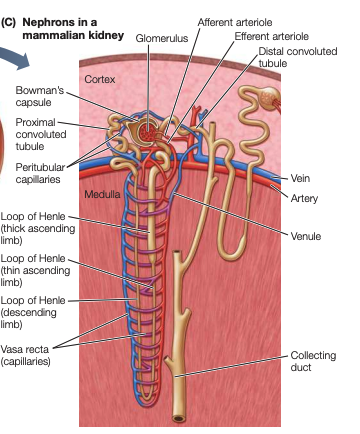
it becomes thin, straight, and descends directly down toward the tip of a renal pyramid. in the medulla the tubule turns and ascends back to the cortex, forming a loop of henle.

what does the ascending limb of the loop of henle become
it becomes the distal convoluted tubule when it reaches the cortex
distal because it is farther from the glomerulus
where does the distal convoluted tubules of many nephrons join to?
many nephrons join a common collecting duct in the cortex.
where does the collecting duct go
the collecting duct descend back down through the renal pyramid, parallel to and past the tips of the loops of henle, and empty into the pelvis
organization of the blood vessels of the kidney
smaller arteries branch from the renal artery and radiate into the cortex, forming the afferent arterioles that carry blood to each glomerulus. each glomerulus is drained by an efferent arteriole
what is the vasa recta
a vascular network and the avenue by which water gets out of the renal medulla and back into the circulation
how much of the blood filtered by kidneys is peed out
the kidneys receive about 1,500 liters of blood per day. the glomeruli filters 12% of it - 180 liters. and because we pee out 2 liters per day, around 99% of fluid filtered is returned to the blood
where does reabsorption occur
the proximal convoluted tubule reabsorbs water and solutes from the glomerular filtrate
how does proximal convoluted tubule’s reabsorption work
solutes, glucose, and amino acids are actively transported out of the tubule fluid. Once in the interstitial fluid, the water + solutes are taken up by peritubular capillaries are returned to the venous blood.
osmosis’ role in PCT cell reabsorption
the active transport of solutes from the proximal tubule into the interstitial fluid causes water to follow osmotically
what is isosmotic reabsorption in the proximal convoluted tubule
the overall osmolarity of the fluid flowing through PCT doesn’t change. so the fluid that enters the loop of henle has same osmolarity as blood plasma, even if its composition is different.
how are mammals able to concentrate their urine
because of a countercurrent multiplier mechanism which is made possible by the loops of henle
anatomy and function of the descending limb in the loop of henle
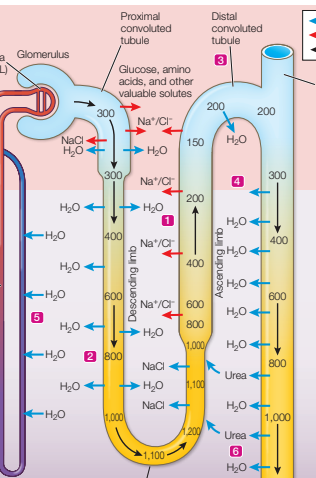
cells of the descending limb and initial cells of ascending limb are thin, with no microvilli and few mitochondrial. they are not specialized for transport
anatomy and function of the ascending limb of the loop of henle
partway up the ascending limb, the cells become specialized for active transport. these cells are thick and have many mitochondria

function of the thick ascending limb of the loop of henle
the thick ascending limb of the loop of henle transports Na/Cl from the tubule fluid to the interstitial fluid. water cannot leave the ascending limb, so Na/Cl accumulates in the interstitial fluid.

what happens because the thick ascending limb is not permeable to water
water is trapped inside the tubule while electrolytes like sodium and chlorine are actively pumped out into the surrounding kidney tissue.
This makes the tubule fluid more diluted and the medulla more salty.

what happens because the thin descending limb is highly permeable to water and not permeable to solutes
the local interstitial fluid will become more concentrated by sodium and chlorine. that concentration pulls water out thereby making the limb more concentrated as you descend
function of the thin ascending limb being permeable to solutes and not permeable to water
as the concentrated tubule flows up the thin ascending limb, it is more concentrated than the surrounding interstitial fluid, so NaCl diffuse out.

what is the results of the countercurrent multiplier mechanism
the tubule fluid entering the distal convoluted tubule is more dilute than blood plasma, while the solutes left behind in the renal medulla establish a concentration gradient within its interstitial fluid
how does the concentration established by the loop of henle in the medulla stay constant
the vasa recta preserves the concentration gradient by being both permeable to water and solutes.
The descending limb of vasa recta loses water and gains solutes. the ascending limb experiences the opposite
aquaporins in the nephron
regions of the nephron that are highly permeable to water have greater numbers of aquaporins. thus they are abundant in PCT cells/descending limbs of loops of henle, but not in ascending limbs of the loop of henle.
what happens in the first portion of the distal convoluted tubule
sodium and chlorine are transported out and water cannot follow making the tubule fluid more dilute
what happens in the later sections of the distal convoluted tubule
the tubule becomes permeable to water, and water is then osmotically drawn from the fluid into the interstitial fluid. as it joins with the collecting dust, the tubule fluid osmolarity matches that of the blood plasma
reabsorption phase of distal convoluted tubule
most reabsorption occurs in the proximal convoluted tubule but depending on if a person is depleted or in excess of a substance it can reabsorb or excrete
concentration gradient and the collecting duct
the concentration gradient in the renal medulla creates an osmotic potential which pulls the water out of the tubule. the further down the collecting duct, the more the solute concentration increases.

what is the main solute in the collecting duct
urea
what happens when urea leaks out of the collecting duct
some urea leaks out into the interstitial fluid, the urea will diffuse back with the loop of henle. the recycling of urea increases the concentration gradient and therefore its ability to concentrate the urine.
how are pH changes dealt with in the kidney
by adding a buffer, like bicarbonate ions it can control the pH of the blood. the kidneys remove proton ions from the blood and return bicarbonate ions to the blood
how do pH changes occur in the kidney
filtered bicarbonate ions combine with secrete H+ in the tubule fluid to form H2O and CO2. this resulting CO2 diffuses back into the tubule cells, where an enzyme converts it into new bicarbonate to be reabsorbed into the bloodstream
what happens for each H+ secreted into tubule fluid
a bicarbonate ion is released into the blood
what does a constant glomerular filtration rate depend on
an adequate blood supply to the kidneys at an adequate blood pressure
how does dilation keep the glomerular filtration rate constant
dilation decreases resistance in arterioles and helps maintain blood pressure in glomerulus
what keeps glomerular filtration rate constant if dilation isn’t enough
kidney release enzyme, renin which converts a protein which is then acted on another enzyme to form angiotensin
how does angiotensin work to regulate the glomerular filtration rate
it constricts the efferent renal arterioles, raising the resistance for blood leaving glomerulus
it constricts peripheral blood vessels to elevate blood pressure
release of a hormone aldosterone to stimulate sodium reabsorption makes water reabsorption more effective
it stimulates thirst in the brain
what is macula densa
modified cells of the tubule where the renal tubule becomes the distal convoluted tubule
what is juxtaglomerular cells
modified arteriole cells where the renal tubule becomes the distal convoluted tubule
what does macula densa cells do
they sense the concentration of NaCl in the fluid entering the distal convoluted tubule. if NaCl level drops too low, the macula densa cells signal the juxtaglomerular cells to release renin and trigger the RAAS response.
what is RAAS response
When kidneys detect low blood pressure, low sodium, or reduced blood flow, they release the enzyme renin, which triggers a cascade creating Angiotensin II, a powerful vasoconstrictor that elevates blood pressure and releases aldosterone for fluid retention
glomerular filtration rate and the flow speed through loop of henle
at high GFR, there is high flow rate through loop of henle so less NaCl is reabsorbed through the thick ascending limb
at low GFR, there is slow flow rate through loop of henle so more NaCl is reabsorbed through the thick ascending limb
what do juxtaglomerular cells do
they release renin and trigger the RAAS response
what is antidiuretic hormone (ADH)
a hormone that stimulates cells of the collecting duct to insert aquaporins into their cell membranes.
a higher level of ADH means
the greater the number of aquaporins
what are the various factors that stimulate or inhibit ADH release
osmoreceptors
baroreceptors
what do osmoreceptors do
ADH helps regulate blood osmolarity by controlling water reabsorption. the osmoreceptors also stimulate thirst. this results in diluted blood