neurosis and synaptic transmission
 Call Kai
 Learn
 Practice Test
 Spaced Repetition
 Match
 Flashcards
 Knowt Play
1/12

There's no tags or description
Looks like no tags are added yet.
13 Terms
The structure and function of neurons - types of neurons
There are how many neurons (n___ c___) in the h___ n___ s___, ___% of which are located where
By transmitting signals e____ and c____, these neurons provide the nervous system with whay
The structure and function of neurons - types of neurons
There are 100 billion neurons (nerve cells) in the human nervous system, 80% of which are located in the brain.
By transmitting signals electrically and chemically, these neurons provide the nervous system with its primary means of communication.
The structure and function of neurons - types of neurons
There are three types of neurons:
s___ neurons - These carry messages from the p____ n___ s___ to the C___. They have l____ d_____ and s__ a__
r___ neurons - These connect the sensory neurons to the motor or other relay neurons. They have short dendrites and short axons.
m____ neurons - These connect the c____ n___ s___ to effectors such as m____ and g___. They have s___ d___ and l___ a___
The structure and function of neurons - types of neurons
There are three types of neurons:
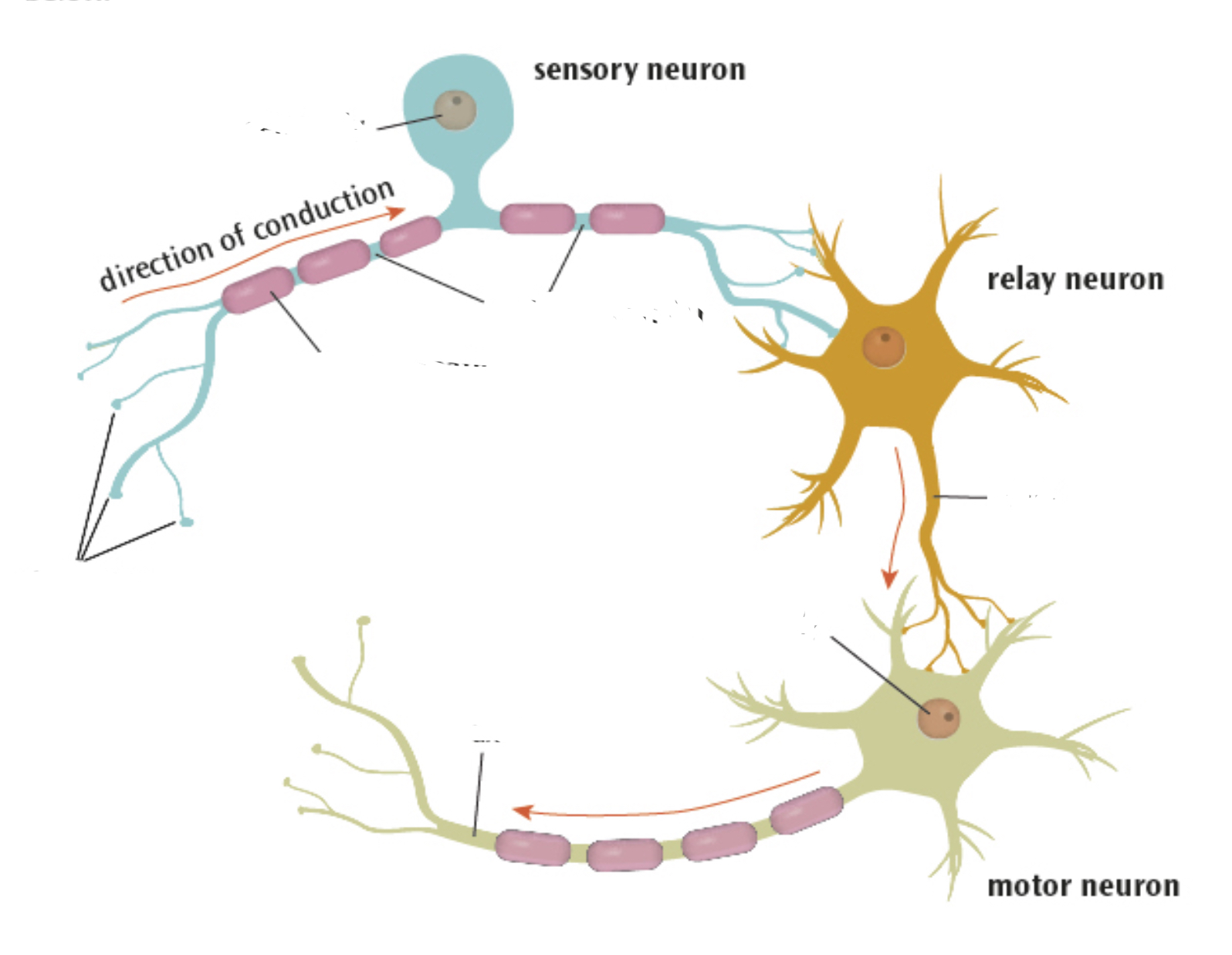
sensory neurons - These carry messages from the peripheral nervous system to the CNS. They have long dendrites and short axons.
relay neurons - These connect the sensory neurons to the motor or other relay neurons. They have short dendrites and short axons.
motor neurons - These connect the central nervous system to effectors such as muscles and glands. They have short dendrites and long axons.
The structure and function of neurons - types of neurons
label the diagram
The structure and function of neurons - the structure of a neuron
Neurons vary in size from what to up to what , but all what
The c___ b___ (or soma) includes a n___, which contains what of the cell.
B____ structures called d___ protrude from where
These carry what from neighbouring neurons towards the cell body.
The axon carries the impulses away from what down the length of the n___.
The axon is covered in what that protects the a___ and speeds up what
If the myelin sheath was c____ this would have the r___ effect and do what
Thus, the myelin sheath is s____ by gaps called what
These speed up the what by forcing it to 'j___' across the gaps along the axon.
Finally, at the end of the axon are t____ b____ that communicate with the next
neuron in the chain across a gap known as the s___
The structure and function of neurons - the structure of a neuron
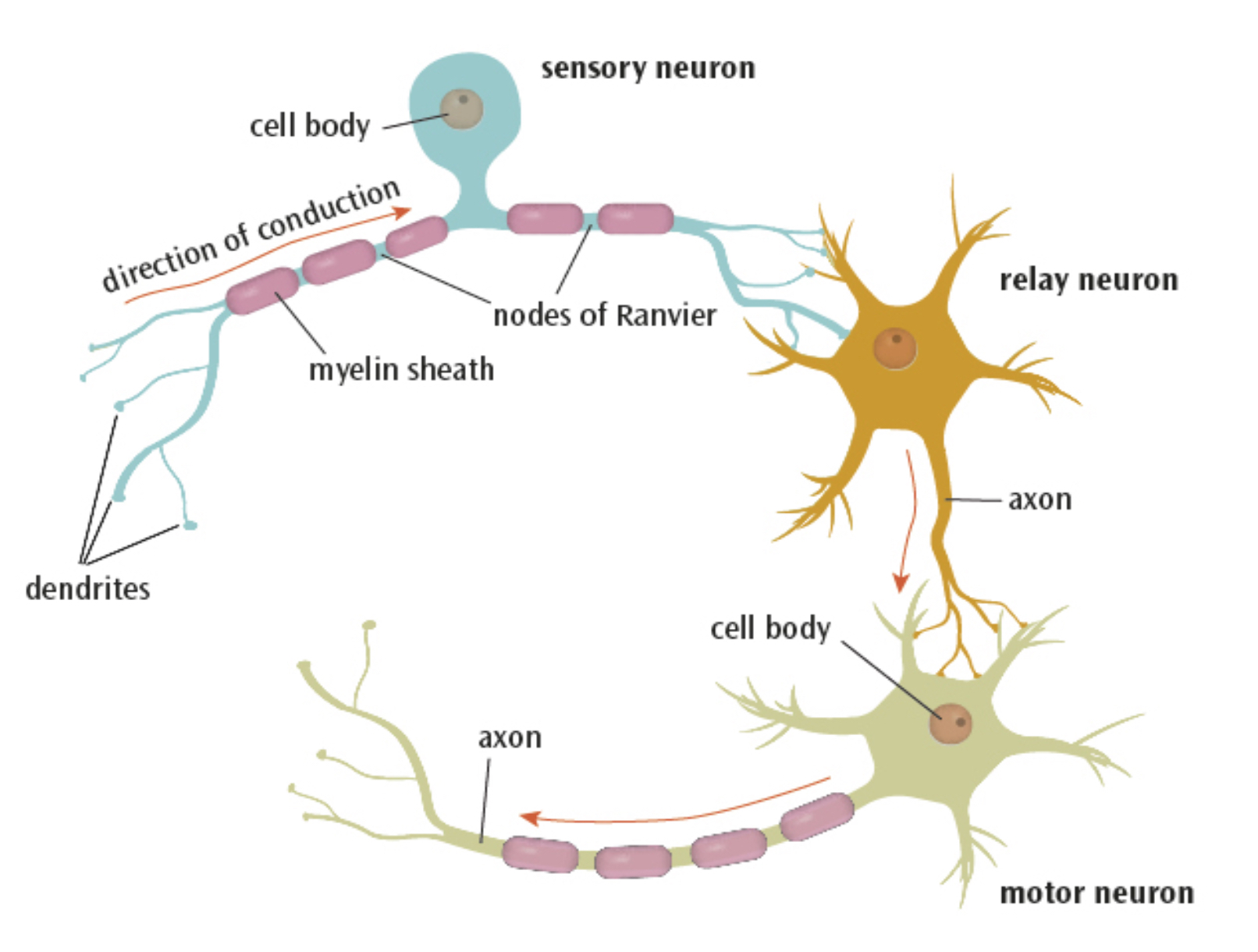
Neurons vary in size from less than a millimetre to up to a metre long, but all share the same basic structure.
The cell body (or soma) includes a nucleus, which contains the genetic material of the cell.
Branchlike structures called dendrites protrude from the cell body.
These carry nerve impulses from neighbouring neurons towards the cell body.
The axon carries the impulses away from the cell body down the length of the neuron.
The axon is covered in a fatty layer of myelin sheath that protects the axon and speeds up electrical transmission of the impulse.
If the myelin sheath was continuous this would have the reverse effect and slow down the electrical impulse.
Thus, the myelin sheath is segmented by gaps called nodes of Ranvier.
These speed up the transmission of the impulse by forcing it to 'jump' across the gaps along the axon.
Finally, at the end of the axon are terminal buttons that communicate with the next
neuron in the chain across a gap known as the synapse
The structure and function of neurons - location of neurons
The c___ b___ of motor neurons may be in the c___ n___ s___ (CNS) but they have what makes them form part of the p____ n___ s___ (PNS).
Sensory neurons are located outside of what?, in the PNS in clusters known as what?
r____ neurons make up how much % of all neurons and most are found within what 2 places?
The structure and function of neurons - location of neurons
The cell bodies of motor neurons may be in the central nervous system (CNS) but they have long axons which form part of the peripheral nervous system (PNS).
Sensory neurons are located outside of the CNS, in the PNS in clusters known as ganglia.
Relay neurons make up 97% of all neurons and most are found within the brain and the visual system.
The structure and function of neurons - Electrical transmission - the firing of a neuron
how is an electrical impulse that travels down the axon towards the end of the neuron created? (talk ab negative/postive charges and stimuluses)
The structure and function of neurons - Electrical transmission - the firing of a neuron
When a neuron is in a resting state the inside of the cell is negatively charged compared to the outside.
When a neuron is activated by a stimulus, the inside of the cell becomes positively charged for a split second causing an action potential to occur.
This creates an electrical impulse that travels down the axon towards the end of the neuron.
synaptic transmission
what is synaptic transmission
synaptic transmission
The process by which neighbouring neurons communicate with each other by sending chemical messages across the gap (the synapse) that separates them
synaptic transmission- chemical transmission
Neurons communicate with each other within groups known as n___ n____
Each neuron is s____ from the next by a very tiny g___ called the s____.
Signals within neurons are transmitted e___- However, signals between neurons are transmitted c___ across the s____.
When the electrical impulse reaches the end of the neuron (the p____ terminal) it triggers the release of what?
synaptic transmission- chemical transmission
Neurons communicate with each other within groups known as neural networks.
Each neuron is separated from the next by an very tiny gap called the synapse.
Signals within neurons are transmitted electrically- However, signals between neurons are transmitted chemically across the synapse.
When the electrical impulse reaches the end of the neuron (the presynaptic terminal) it triggers the release of neurotransmitter from tiny sacs called synaptic vesicles.
synaptic transmission- neurotransmitters
what are Neurotransmitters ?
Once a neurotransmitter crosses the gap, what happens?
Here, the chemical message is converted back into a what and the process of transmission begins again in this other n___.
the direction of travel can only be one-way. - why is this?
synaptic transmission- neurotransmitters
Neurotransmitters are chemicals that diffuse across the synapse to the next neuron in the chain.
Once a neurotransmitter crosses the gap, it is taken up by a postsynaptic receptor site on the dendrites of the next neuron
Here, the chemical message is converted back into an electrical impulse and the process of transmission begins again in this other neuron.
the direction of travel can only be one-way. This is because neurotransmitters are released from the presynaptic neuron terminal and received by the postsynaptic neuron (at the receptor sites).
synaptic transmission- neurotransmitters
Several dozen types of neurotransmitter have been identified in the b___ (as well as in the s___ c___ and some g___).
Each neurotransmitter has its own specific m____ structure that fits perfectly where? similar to a l___ and a k___
Neurotransmitters also have s____ functions. For instance, a____ (ACh) is found at each point where a m____ neuron meets a m___, and upon its release, what happens?
synaptic transmission- neurotransmitters
Several dozen types of neurotransmitter have been identified in the brain (as well as in the spinal cord and some glands).
Each neurotransmitter has its own specific molecular structure that fits perfectly into a postsynaptic receptor site, similar to a lock and a key.
Neurotransmitters also have specialist functions. For instance, acetylcholine (ACh) is found at each point where a motor neuron meets a muscle, and upon its release, it will cause muscles to contract.
synaptic transmission- neurotransmitters
Increased understanding of the mode of action of neurotransmitters in the brain has led to what?
synaptic transmission- neurotransmitters- Psychoactive drugs
Increased understanding of the mode of action of neurotransmitters in the brain has led to the development of psychoactive drugs to treat mental disorders.
For instance, depression has been linked to low levels of serotonin, which is thought to play an important role in stabilising mood.
drugs known as SSRIs (selective serotonin reuptake inhibitors) such as , slow down the reuptake of serotonin after it has crossed the synapse, ensuring it stays active for longer in the synapse.
synaptic transmission- Excitation and inhibition
Neurotransmitters have either an excitatory or inhibitory effect on the neighbouring neuron:
explain the inhibitory effect
explain the excitatory effect
synaptic transmission- Excitation and inhibition
Neurotransmitters have either an excitatory or inhibitory effect on the neighbouring neuron:
For instance, the neurotransmitter serotonin causes inhibition in the receiving neuron, resulting in the neuron becoming more negatively charged and less likely to fire.
In contrast, adrenaline (an element of the stress response which is both a hormone and a neurotransmitter) causes excitation of the postsynaptic neuron by increasing its positive charge and making it more likely to fire.
synaptic transmission- Summation
what does the process of summation decide ?
The excitatory and inhibitory influences are summed: if the net effect on the postsynaptic neuron is inhibitory then what is the effect of this?
if the net effect is excitatory it is more likely to fire- what is the effect of this?
Therefore, the action potential of the postsynaptic neuron is only triggered if the sum of what reaches the threshold.
synaptic transmission- Summation
Whether a postsynaptic neuron fires is decided by the process of summation.
The excitatory and inhibitory influences are summed: if the net effect on the postsynaptic neuron is inhibitory then the postsynaptic neuron is less likely to fire.
if the net effect is excitatory it is more likely to fire, i.e. the inside of the postsynaptic neuron momentarily becomes positively charged. Once the electrical impulse is created it travels down the neuron.
Therefore, the action potential of the postsynaptic neuron is only triggered if the sum of the excitatory and inhibitory signals at any one time reaches the threshold.