Chapter 8: The Cardiovascular and Respiratory Systems
 Call Kai
 Learn
 Practice Test
 Spaced Repetition
 Match
 Flashcards
 Knowt Play
1/60

There's no tags or description
Looks like no tags are added yet.
61 Terms
What is the function of the cardiovascular system?
In order to maintain homeostasis (everything balanced) blood must flow delivering oxygen and removing by products.
The cardiovascular system is composed of the heart, blood vessels and the blood.
What is the heart composed of?
Cardiac muscle or myocardium
Where is the heart located?
The heart is located in the center of the chest with 2/3 of it located to the left of the body’s midline.
What divides the heart from left to right?
Septum
What does the left ventricle pump? (Ox or deo)
The left ventricle pumps oxygenated blood to the body (systemic circulation).
What does the right ventricle pump? (Ox or deo)
The right ventricle pumps de-oxygenated blood to the lungs (pulmonary circulation).

Label the following valves:
Tricuspid valve (Right AV valve)
Pulmonary semilunar valve (Right semilunar valve)
Mitral valve (Left AV valve)
Aortic semilunar valve.

Label the following parts of the heart
Right atrium
Right ventricle
Left atrium
Left ventricle
Aorta
The heart contracts rhythmically as a _________thanks to the electrical impulse generated by the bundle of nerve fibers called the ____________. The impulse is then passed down via the _________ to the ___________, _________, and the ___________. The rate of contraction is regulated by the autonomic nervous system.
The heart contracts rhythmically as a syncytium thanks to the electrical impulse generated by the bundle of nerve fibers called the sinoatrial (SA) node. The impulse is then passed down via the internodal pathways to the atrioventricular (AV) node, AV bundle of HIS, and the Purkinje fibres. The rate of contraction is regulated by the autonomic nervous system.
What does the ECG provide?
The ECG provides a visual representation of the electrical activity of the heart.
What does the P wave represent?
The P wave represents atrial contraction (depolarization)
What does the QRS wave represent?
The QRS wave represents ventrical contraction (depolarization)
What does the T wave represent?
The T wave represents ventricle relaxation (repolarization)
The heart itself is a working muscle and requires constant supply of O2 and nutrients through the ___________ composed of _________ and _______
The heart itself is a working muscle and requires constant supply of O2 and nutrients through the coronary circulation composed of coronary arteries and veins.
When blood supply to part of the heart is cut off, that region of the heart muscle will be damaged.
This is called a ___________.
Myocardial infarction.
The ______ is a sequence of contractions (______ ) and relaxations (_________).
Cardiac cycle, Systole and Diastole
What are the two commonly called heart sounds?
Lubb and dubb.
What does the 1st sound (lubb represent)?
The 1st sound (lubb) occurs when the atrioventricular valves close.
What does the 2nd sound (dubb) represent?
The 2nd sound occurs when the aortic and pulmonary valves close at the end of ventricular systole.
What are the two blood measurements?
Systolic (during contraction) and Diastolic (when ventricles relax and fill with blood).
Blood pressure is measured with a blood pressure cuff.
What is the peripheral circulatory system composed of?
The peripheral circulatory system is composed of vessels that carry blood away from the heart (aorta, arteries, arterioles) and vessels that carry blood towards the heart (venules, veins and vana cava) The tiny vessels connecting arteries and veins is the capillary bed.
What do arteries do? What is the exception?
Arteries carry oxygenated blood away from the heart. The pulmonary artery carries deoxygenated blood.
What do veins do? What is the exception?
Veins carry blood back to the heart. The pulmonary vein carries the only oxygenated blood.
How does blood return to the heart?
Blood is returned to the heart by valves in veins which allow blood to only flow in one direction. Blood is pushed through veins by skeletal muscle pump, thoracic pump, and the nervous system.
What does blood do:
Transport - oxygen, carbon dioxide, waste products, nutrients, hormones, and enzymes
Regulation - temperature, pH and hydration
Protection - against harmful microorganisms.
What are the 4 things in the blood?
Plasma, Red blood cells (erythrocytes), White blood cells (leukocytes), and Platelets
What is plasma?
It is 55%, it is the liquid part of blood, functions as a solvent, composed mainly of water.
What are the red blood cells?
-Erythrocytes
-Contains hemoglobin
-Transports O2 and CO2
What are the white blood cells?
-Leukocytes
-Fight infections
What are the platelets?
-Thrombocytes
-Responsible for blood clotting
What is EPO?
EPO (erythtopoietin) regulates the production of red blood cells increasing it in response to low oxygen levels (at altitude) or training.
What is the Stroke Volume? (SV)
The stroke volume is the amount of blood pumped out of the heart with each heartbeat.
What is EDV? (End-Diastolic Volume)
The amount of blood in the ventricles right before they contract.
What is the Frank-Starling Law?
The more blood that fills the heart, the harder it contracts, pumping more blood out.
What is EF (Ejection Fraction)?
The percentage of blood pumped out of the ventricles with each heartbeat.
What is the heart rate of an adult at rest?
During rest the heart rate of an adult ranges from 40 to 75bpm.
What is the maximum effort heart rate can increase to?
200 bpm.
What percentage of your maximal heart rate is low intensity work considered?
60%
What percentage of your maximal heart rate is high intensity work considered?
85%
What is stroke volume?
Stroke volume (SV) is the amount of blood pumped by each ventricle with each heartbeat, averaging 70ml per beat in the adult at rest.
Just something to know:
Cardiac Output = Heart Rate x Stroke Volume
CO = HR x SV
What is the cardiovascular drift?
During prolonged exercise cardiac output is maintained while stroke volume decreases and heart rate increases.
What is the respiratory system responsible for?
Supply of O2
Removal of CO2
pH regulation
What are the two zones of the respiratory system?
The conductive zone (mouth, nose, pharynx, larynx, trachea, bronchi, bronchioles) is involved in ventilation.
The respiratory zone (respiratory bronchioles, alveolar ducts, alveolar sacs) is involved in gas exchange.
What happens in inspiration?
-Diaphragm flattens and external intercostal muscles contract
-Thoracic cavity is enlarged
-Abdominal muscles relax
-Air pressure drops below atmosphere pressure so the air can rush into lungs
What happens in expiration?
-External intercostal muscles and diaphragm relax
-Abs contract
-Increases air pressure is greater than atmospheric pressure so air rushes out of lungs.
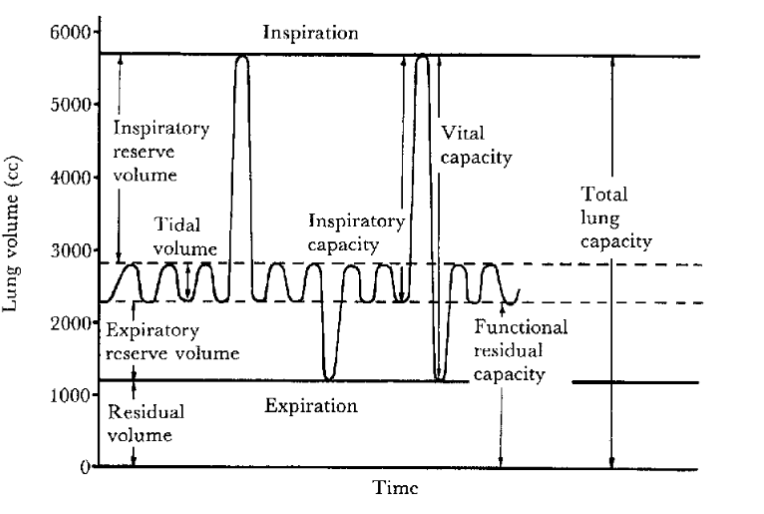
Tidal volume
The amount of air you breathe in and out during a normal breath
Inspiratory Reserve Volume
The extra air you can breathe in after taking a normal breath
Expiratory Reserve Volume
The extra air you can force out after a normal breath
Residual Volume
The air that stays in your lungs even after you breathe out as much as possible.
Total lung capacity
The total amount of air your lungs can hold.
Vital capacity
The maximum amount of air you can breathe out after taking the deepest breathe possible
Inspiratory Capacity
The maximum amount of air you can breathe in after taking a normal breath out/
Explain gas exchange between the alveolus and the capillary
Gas exchange happens by diffusion, where gases move from a higher concentration to a lower concentration. In the capillaries oxygen moves from the alveoli to the blood because it has a lower concentration in the blood. Carbon dioxide moves from the blood to the alveoli where its concentration is lower and then breathed out.
How is majority of oxygen transported?
Binding to hemoglobin.
What is external respiration?
External respiration is gas exchange between the alveoli and the blood
What is internal respiration?
Gas exchange between the blood and body cells.
What test is the maximum aerobic power test?
VO2 max
Oxygen deficit
At the onset of exercise the body must first depend on anaerobic metabolism before the O2 delivery is matched to O2 demand
What is EPOC (Excess Post-exercise Oxygen Consumption).
This is after exercise, your body continues to use more oxygen than normal to recover,