UNIT 7. HEMOGLOBIN
 Call Kai
 Learn
 Practice Test
 Spaced Repetition
 Match
 Flashcards
 Knowt Play
1/112

There's no tags or description
Looks like no tags are added yet.
113 Terms
Hemoglobin (Hgb)
_ is the most common yet complex organic molecule in vertebrates.
Hgb
the most studied protein
RBCs
Hgb is carried by __ in order for it to be protected.
1. For its protection from denaturation, particularly in the plasma.
2. To prevent its loss through excretion via the kidneys.
ENUMERATE
2 reasons why Hemoglobin is located inside the RBCs
approx. 34 g/dL
Hgb concentration in RBC
95%
Cytoplasmic content of RBCs is approx. _ Hgb
64,000 Daltons (64 kDa)
MW of hemoglobin
1%
This molecular weight of Hgb represents a little more than __ of the total body weight.
Transports oxygen from lungs to tissues
Transports carbon dioxide from tissues to the lungs
Transports of nitric oxide
Contributes to acid-base balance
ENUMERATE
4 Functions of Hgb
Nitric oxide
a vasodilator and a substance transported by Hgb
stronger base
There is a particular form of Hgb that is considered as a __, meaning it can bind and neutralize hydrogen ions.
globular
The Hgb molecule is considered as a _ protein.
4 polypeptide chains
(2 diff. pairs of polypeptide chains)
How many polypeptide chains are there in 1 Hgb molecule?
4 heme groups
How many heme groups are there in 1 Hgb molecule?
Iron (Fe²⁺)
Protoporphyrin IX
Polypeptide chains
2,3 Bisphosphoglyceric Acid (BPG)
ENUMERATE
Composition of a heme group
2,3 BPG
considered as a temporary resident and a sometime resident at the center of the Hgb molecule.
Lungs (High oxygen tension) = Absent
Tissues (Low oxygen tension) = Present
2,3 BPG Affinity to Hgb
Lungs (High oxygen tension) = __
Tissues (Low oxygen tension) = __
Heme/ Ferroprotoporphyrin IX
Consists of Protoporphyrin IX (ring of carbon, hydrogen and nitrogen atoms) + Ferrous Iron (Fe2+)
O2
In each heme group, Ferrous iron reversibly combines with 1 _ molecule
1.34 ml
1 mol of O2 is equivalent to __ of Oxygen.
Methemoglobin
Fe2+ → oxidized to Fe3+ → can’t bind O2 → ___ (non-functional; no oxygen-carrying capacity)
metheme
Once that the iron is oxidized the hemoglobin is already termed as methemoglobin; the heme portion is called __.
Globin Chains
Considered as the protein portion of the Hgb because it is made up of amino acids which are building blocks of protein molecules
F
Globin portion of Hgb consists of 2 identical pairs of unlike polypeptide chains
T or F
Globin portion of Hgb consists of 2 identical pairs of like polypeptide chains
amino acid sequence
Variation in ___ gives rise to different types of globin chains → Variation in the combination of two globin chains gives rise to different types of hemoglobin
8 helices;
7 non-helical segments
A globin chain is divided into ___ (linear & rigid) and separated by ___ (flexible).
2 α (alpha) chains
2 β (beta) chains
Pairing:
Chain 1: α + β
Chain 2: α + β
2 types of globulin chains in Hgb
Alpha (α)
Zeta (ζ)
ENUMERATE
Globulin chains composed of 141 amino acids
Beta (β)
Epsilon (ε)
Gamma (γ)
Delta (δ)
ENUMERATE
Globulin chains composed of 146 amino acids
16
Alpha, Zeta are found in Chromosome _
11
Beta, Epsilon, Gamma, Delta are in Chromosome _
Primary Structure
WHAT HEMOGLOBIN STRUCTURE?
amino acid sequence of the polypeptide chains
Refers to the building blocks of the proteins
Secondary Structure
WHAT HEMOGLOBIN STRUCTURE?
chain arrangements in helices and nonhelices
Tertiary Structure:
WHAT HEMOGLOBIN STRUCTURE?
arrangement of the helices into pretzel-like configuration
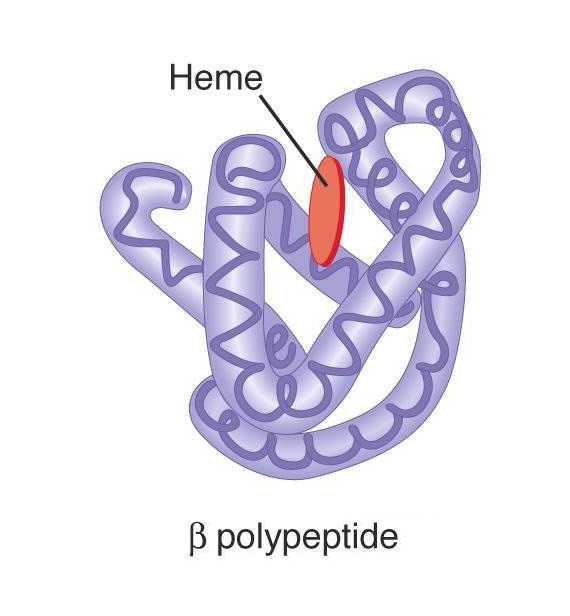
E & F
heme → suspended between __ helices

Quaternary Structure/Tetramer
WHAT HEMOGLOBIN STRUCTURE?
complete hemoglobin molecule
spherical/globular
4 heme groups + 4 globin chains

Pretzel-like configuration
This configuration is purposely for the globin chains to loop together (polypeptide chains) in order to form a cleft pocket.
cleft pocket
Pocket for the heme
Between E & F helices
Inside the cleft pocket = amino acids are HYDROPHOBIC
Inside the cleft pocket = amino acids are HYDROPHILIC
Cleft Pocket Water Affinity:
Inside the cleft pocket = amino acids are __
Inside the cleft pocket = amino acids are __
makes the Hgb water soluble
maintains Iron in its reduce form (Fe²⁺)
The cleft pocket being hydrophobic inside and hydrophilic outside is primarily because?
4
4
Hgb = _ heme + _ globin chains
4
1
1 Heme = _ pyrrole rings + _ Fe²⁺
4
4
1 Hgb = __ iron molecules
1 Hgb = __ moles of O2
Hb A1 > Hb A2 > Hb F
predominant adult hemoglobin
glycated hemoglobin (4-6%)
glycated hemoglobin
Glycation
non enzymatic binding of various sugars to the globin chain over the life span of the RBC
HbA1c
__ is a parameter used in the long term monitoring of DM patients.
Hemoglobin biosynthesis
__ is the production of hgb, initiated by heme & globin synthesis.
basophilic normoblast
polychromatophilic erythrocyte
Production of Hgb begins/commences particularly in the ___ stage & ends in the ___
mitochondria & cytoplasm
Hemoglobin biosynthesis occurs in the ____ & ___ of bone marrow erythroid precursors cells.
pronormoblast
Heme & globin synthesis starts in __.
65%
orthochromic normoblast
Approximately __ of Hgb is synthesized before the nucleus is excluded (_).
early polychromatophilic erythrocyte
The remaining 35% of Hgb is synthesized in the __.
polychromatophilic erythrocyte
The full hemoglobinization happens at the __.
mitochondria
cytoplasm/cytosol
Location of Heme synthesis
Nucleus
Ribosomes
Cytoplasm
Location of Globin synthesis
Heterodimer
Pairing of dissimilar polypeptide chains results to a __.
Tetramer (quaternary structure)
2 dissimilar heterodimers will now form the __.

Explain the process, location, substrates, products, and enzymes involved in HEME SYNTHESIS

Explain the process, location, substrates, products, and enzymes involved in GLOBIN SYNTHESIS
Mitochondrion
__ is the beginning and the end of heme synthesis.

Explain how iron enters the erythroid precursor cells.
acidification
Once transferrin is inside the endosome, it will then proceed to __, wherein there will be the pumping in of H+ ions.
decreases
Acidification inside the endosome ___ the affinity of the protein to the ferric iron, thus leading to the release of the ferric iron.
reduction
Once ferric iron is released it goes outside the endosome → enters the mitochondrion wherein subsequent __ occurs.
Free Erythrocyte Protoporphyrin
Upon the completion of heme synthesis, there is a small amount of excess protoporphyrin in the mitochondrion termed as __
F
Iron is not incorporated to FEPs
T or F
Iron is incorporated to FEPs in pathologic conditions.
Zinc Protoporphyrin (ZPP)
FEP can be complexed with zinc, forming the __
different anemias
Porphyria
Iron Deficiency Anemia (IDA)
FEP & ZPP are used as diagnostic parameters in the diagnosis of that conditions?
Inversely proportional
↓/absence of iron ↑ FEP/ZPP
Relationship between Iron levels and FEP/ZPP levels
Ferrochelatase
enzyme responsible for inserting Fe²⁺ into protoporphyrin IX in the last step of Heme production
Ferrochelatase deficiency
Diagnosis:
↓/absent Ferrochelatase
↑ ZPP/FEP
cannot efficiently form heme
Ferritin
found normally in the cytoplasm of the developing RBCs
represent storage form of iron that was not used in heme synthesis
T
T or F
Ferritin is also one of the parameters that is used to diagnose certain anemias.
mitochondria
globin chains
Once Heme is being produced → leaves the ___ and combines with ___ in the cytoplasm
mRNA
GLOBIN SYNTHESIS
Nucleus: transcription of globin genes → __
Preliminary messenger RNA (Pre-MRNA)
editing
ribosome
GLOBIN SYNTHESIS
Nucleus: DNA is transcribed to produce a ___
Then it will undergo ___ to create a final mRNA and proceeds to ___
globin/polypeptide chain
GLOBIN SYNTHESIS
Ribosomes: translation of mRNA → __
transfer-RNA (tRNA)
GLOBIN SYNTHESIS
Translation process, (4th process) __ collects amino acids in the cytoplasm, carrying it to the ribosomes to create proteins (Globin chain or Polypeptide chain)
heterodimer
Each globin binds to each heme molecule
non-α chain + α chain = __
Gower I
Gower II
Portland
ENUMERATE
Hgb present in the 1st 3 months of embryonic development
Hb F
Hb A1
Hb A2
ENUMERATE
Hgb present in Newborns & Adults
Hb F
Most predominant Hgb in the 2nd - 3rd trimesters of fetal life & at birth
Hb A1
Most predominant Hgb in the 6th months of age and through adulthood
At Birth:
Hb F = 60-90%
Hb A = 10-40%
At Birth:
Hb F = __%
Hb A = __%
Healthy Adult:
Hb A1 = 95%
Hb A2 = 3.5%
Hb F = 1-2%
Healthy Adult:
Hb A1 = __%
Hb A2 = __%
Hb F = __%
Gower 1
NORMAL HUMAN HEMOGLOBINS
2 zeta, 2 epsilon
Embryonic
Gower 2
NORMAL HUMAN HEMOGLOBINS
2 alpha, 2 epsilon
Embryonic
Portland
NORMAL HUMAN HEMOGLOBINS
2 zeta, 2 gamma
Embryonic
Hb F
NORMAL HUMAN HEMOGLOBINS
2 alpha, 2 gamma
Newborn & Adult
Hb A1
NORMAL HUMAN HEMOGLOBINS
2 alpha, 2 beta
Newborn & Adult
Hb A2
NORMAL HUMAN HEMOGLOBINS
2 alpha, 2 delta
Newborn & Adult
Hb F
most predominant HgB in the midfetal life upto birth.
Alpha Globin Gene
The gene coding for the Alpha chai
Beta Globin Gene
The gene for Beta Globin
Condensation of glycine & succinyl CoA to form ALA by ALA synthase
Key heme synthesis regulator
ALA synthase
the enzyme that catalyzes the initiation step in the Heme synthesis
key regulator of heme synthesis
↑ Heme produced in the body
↓ ALA synthase gene production
↓ Heme production
thru negative feedback mechanism
Relationship between Heme produced, ALA synthase production, Heme production in HEME SYNTHESIS
ALA dehydratase
porphobilinogen deaminase
Heme can also inhibit other enzymes such as ___ & ___ to control the production of heme.
transcription
Globin production is mainly controlled at the __ level.