parasites
 Call Kai
 Learn
Learn Practice Test
 Spaced Repetition
 Match
Match Flashcards
 Knowt Play
1/27

There's no tags or description
Looks like no tags are added yet.
Name | Mastery | Learn | Test | Matching | Spaced | Call with Kai | Chat |
|---|
No analytics yet
Send a link to your students to track their progress
28 Terms

Trypanosoma equiperdum; the causal agent of dourine in horses; resembles T. brucie but is transmitted venereally during coitus; was once prevelant in the US but is now eradicated

Trichomonas vaginalis; the urogenital trichomonad of humans; has 4 flagella and a short undulating membrane; usually diagnosed in a direct smear

Entamoeba histolytica cyst; pathogenic amoeba found in human colon; cyst is large and quadranucleate; if chromatoid bodies are present they are rounded (blunt) at the end;

Acanthamoeba spp; free-living, facultative parasitic amoebas; cause granulomatous amebic meningoencephalitis (GAE) anda amebic keratitis

paramecium; specifically in fission; water constantly flows thru them via osmosis; has two contractile vacuoles

paramecium; specifically in conjugation (i.e. sexual process where cells join together to exchange genetic material); must constantly expel water to prevent the cell from bursting

Amoeba proteus; specifically is eating when ‘arms’ of amoeba are in a ‘C’ shape
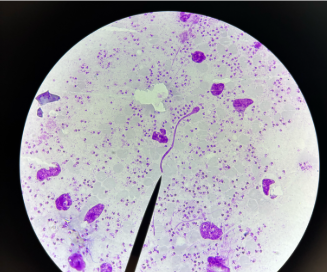
Leishmania donovani in a hamster spleen;

Balantidium coli troph

Gregarina cuneata

Trypanosoma rhodesiense

Leishmania major promastigotes

Leishmania major amastigotes

Giardia lamblia trophozoite

Entamoeba coli cyst

Entamoeba histolytica trophozoite

P. malariae trophozoite

Plasmodium; sporozoites from the salivary glands of an infected mosquito (the infective stage for humans)

Plasmodium oocysts; numerous oocysts attached to stomach wall; sporozoites are formed here via sporogony
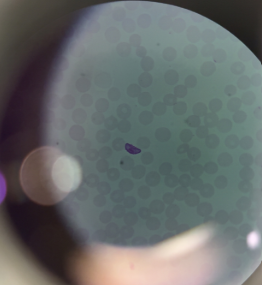
male microgametocyte of P. falciparum

hemozoin in the brain taken from a patient who died of a Plasmodium falciparum infection; note the dark deposits of hemozoin; similar deposits may be found in the kidneys and the phagocytes of the liver

Anopheles mosquito - the definitive host and vector of human malaria; only females suck blood; she has segmented antennae with a few bristles whereas males have feather antennae; note the ‘dappled’ wings

P. malariae schizont

Gregarina spp. in syzgy

Monocystis lumbrici; gametocyte with oocysts

Eirmera stidae with oocysts
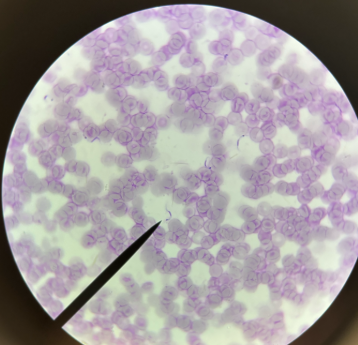
Trypanosoma cruzi; causes Chagas disease