Cell Cycle
 Call Kai
 Learn
 Practice Test
 Spaced Repetition
 Match
 Flashcards
 Knowt Play
1/38

There's no tags or description
Looks like no tags are added yet.
39 Terms
What is involved in cell clock?
growth factor receptors
monitors of genome integrity
TGF-B receptors
Integrins
Monitors of cell metabolism
What is cell proliferation?
cell growth AND subsequent cell division
3 checkpoints
G1/S- Stops cells from entering S-phase: allows cells time to repair damage before DNA replication occurs
S checkpoint- Slows replication: Allows repair, processing of damage
G2/M: Verify that DNA is completely replicated, undamaged
where is restriction point
after G1 before S
what happens in R point
cell must decide if it will stay in G1, retreat, or advance
what happens if you remove growth factors from cells while in G1
Cells would not advance through the cycle
Core components of cell cycle clock
Cyclins and CDKS
what are cyclins
regulatory subunits that assist CDKs
what type of kinase are CDKs
Serine/threonine kinases
Cdc2 is the same as
CDK1
When does Cyclin B expression peak?
Spikes during M phase
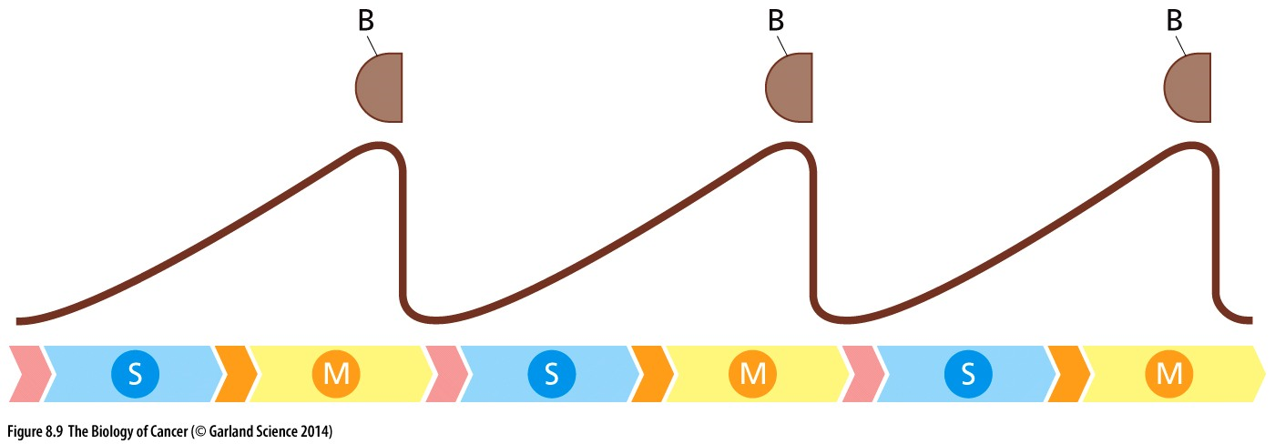
Cell cycle Cyclin Expression
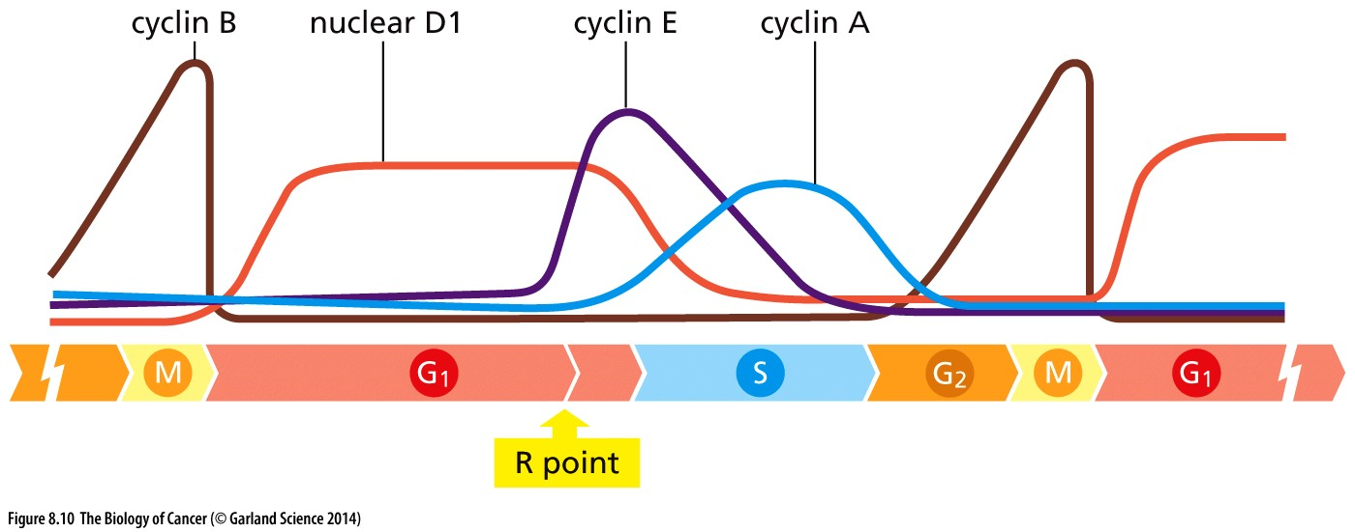
Cyclin D
Only cyclin members whose expression is largely controlled by extracellular signals
Removal of growth factors from cells results in rapid loss of D1 levels
Cyclin-CDK complexes regulate each other
Cyclin A-CDK2 inactivates transcription factor that induces cyclin E
Once cyclin B-CDK1 is activated by cyclin A-CDK2 this shuts down cyclin A synthesis
CDK inhibitors
7 proteins
INK4 proteins target CDK4/6 only
CIP/KIP proteins inhibit all other cyclin CDK complexes
TGFB control of cell cycle
Suppresses proliferation by inducing P15 (inhibitor of CDK4/6)

Weakly induces the other inhibitors
PI3K-ATK regulation of cell cycle
Blocks expression of p21 and p27

phosphorylation and CDK
Wee1 phosphorylation reduces kinases activity
Cdc25 family of phosphatases removes inhibitory phosphate from CDK to activate CDK-cyclin
what does RB do
guardian of restriction point gate
inhibits E2F transcription factor
Rb in G1
becomes mono or hypophosphorylated
binds to E2F and recruits a histone deacetylase
Rb in R point
becomes extensively phosphorylated and can no longer restrict proliferation
HPV and cancer
HPV protein E7 degrades RB so proliferation is increased
ubiquitin does what
serves as degradation signal
positive feedback loop
cdk 2 phosphorylates CDK inhibitors then skip 2 degrades them
Myc oncogene
when high it induces proliferation, when myc is low it’s replaced by MKB which lowers proliferation
how does myc increase proliferation
stimulates cyclin D expression
also induces expression of E2F
inhibits p21 and p27
TGFB regulation of cell cycle
induces expression of P15 which suppresses CDK
smad 2/3 proteins phosphorylated and bind to sequences that induce p53
MAP proteins interact with E2F and RB
how are cyclin CDK complexes regulated
expression of cyclins
CDKi
post-translational modifications
what do the kinases do
phosphorylate Rb or other proteins prior to S phase to enable DNA replication
Phosphorylate of histones in anticipation for S and M phases which places the chromatin in configuration that permit the phases to proceed normally
Phosphorylate proteins in nuclear membrane causes their dissociation and dissolution of nuclear membrane in M phase
G1/S checkpoint
Stops cells from entering S-phase
Allows cells time to repair damage before DNA replication occurs
S checkpoint
Stops replication
Allows repair, processing of damage
G2/M checkpoint
Verify that DNA is completely replicated, undamaged
p53 controlled by
MDM2 inhibits p53- Degraded rly fast after it’s made
ATM and ATR activate by directly binding to p53 or inhibiting MDM2
ARF activates
E2F activates
control of p53 by ATM and ATR
ATM and ATR can phosphorylate p53 or activate the checkpoint kinase 1 and 2 which phosphorylate p53
control of p53 levels by E2F
E2F targets ARF which suppresses MDM2 so p53 is increased
p53 and RB circuits
both need to be disrupted for tumor development
what do p21 and p27 do
cyclin inhibitors
why do both p53 and RB circuits need to be disrupted?
Because increased E2F increases ARF which increases p53
CDKN2A function
Makes either p16 or ARF