Ch. 2: Radiation Physics
 Call Kai
 Learn
Learn Practice Test
 Spaced Repetition
 Match
Match Flashcards
 Knowt Play
1/84

There's no tags or description
Looks like no tags are added yet.
Name | Mastery | Learn | Test | Matching | Spaced | Call with Kai | Chat |
|---|
No analytics yet
Send a link to your students to track their progress
85 Terms
D) K-shell
Which electrons have the greatest binding energy?
A) N-shell
B) M-shell
C) L-shell
D) K-shell
B) negative
What type of electrical charge does the electron carry?
A) positive
B) negative
C) no charge
D) positive or negative
C) molecule
Which term describes two or more atoms that are joined by chemical bonds?
A) ion
B) ion pair
C) molecule
D) proton
B) atom that loses an electron
What statement describes ionization?
A) atom without a nucleus
B) atom that loses an electron
C) atom with equal numbers of protons and electrons
D) none of the above
B) radioactivity
Which term describes the process by which unstable atoms undergo spontaneous disintegration in an effort to attain a more balanced nuclear state?
A) radiation
B) radioactivity
C) ionization
D) ionizing radiation
D) nucleons
Which is not a type of particulate radiation?
A) alpha particles
B) beta particles
C) protons
D) nucleons
A) electrons
Which is not a type of electromagnetic radiation?
A) electrons
B) radar waves
C) microwaves
D) x-rays
B) Wavelength is the distance between waves
What statement is incorrect?
A) Velocity is the speed of a wave
B) Wavelength is the distance between waves
C) Frequency is the number of wavelengths that pass a given point in a certain amount of time
D) Frequency and wavelength are inversely related
A) X-rays travel at the speed of sound
What statement is incorrect?
A) X-rays travel at the speed of sound
B) X-rays have no charge
C) X-rays cannot be focused to a point
D) X-rays cause ionization
B) X-rays have more energy than does visible light
What statement is correct?
A) X-rays are a form of electromagnetic radiation; visible light is not
B) X-rays have more energy than does visible light
C) X-rays have a longer wavelength that does visible light
D) X-rays travel more slowly that does visible light
Electronic focusing cup
Label 11

Cathode (-)
Label 12

Filament and electron cloud
Label 13

Focal spot on tungsten target
Label 14

Anode (+)
Label 15

Vaccum
Label 16

Useful x-ray beam
Label 17

Glass envelope
Label 18

Copper stem
Label 19

Tube window
Label 20
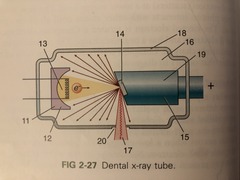
Aluminum disks
Label 21

Lead collimator
Label 22

Position-indicating device
Label 23

Tubehead seal
Label 24

X-ray tube
Label 25

Insulating oil
Label 26

Unleaded glass window of x-ray tube
Label 27

Metal housing of x-ray tubehead
Label 28

B) low-voltage circuit
Which regulates the flow of electrical current to the filament of the x-ray tube?
A) high-voltage circuit
B) low-voltage circuit
C) high-voltage transformer
D) low-voltage transformer
A) step-up transformer
Which is used to increase the voltage in the high-voltage circuit?
A) step-up transformer
B) step-down transformer
C) autotransformer
D) step-up circuit
C) X-rays travel from the filament to the target
Which does not occur when the high-voltage circuit is activated?
A) The unit produces an audible and visible signal
B) Electrons produced at the cathode are accelerated across the tube to the anode
C) X-rays travel from the filament to the target
D) Heat is produced
B) positive anode
Which is the location where x-ray are produced?
A) positive cathode
B) positive anode
C) negative cathode
D) negative anode
C) negative cathode
Which is the location where thermionic emission occurs?
A) positive cathode
B) positive anode
C) negative cathode
D) negative anode
A) general radiation
Which accounts for 70% of all the x-ray energy produced at the anode?
A) general radiation
B) characteristic radiation
C) Compton scatter
D) coherent scatter
B) characteristic radiation
Which occurs only at 70 kV or higher and accounts for a very small part of the x-rays produced in the dental x-ray machine?
A) general radiation
B) characteristic radiation
C) Compton scatter
D) coherent scatter
A) radiation that exits the tubehead
Which describes primary radiation?
A) radiation that exits the tubehead
B) radiation that is created when x-rays come in contact with matter
C) radiation that has been deflected from its path by the interaction with matter
D)none of the above
C) radiation that has been deflected from its path by the interaction with matter
Which describes scatter radiation?
A) radiation that exits the tubehead
B) radiation that is created when x-rays come in contact with matter
C) radiation that has been deflected from its path by the interaction with matter
D)none of the above
A) Compton
Which type of scatter occurs most often with dental x-rays?
A) Compton
B) coherent
C) photoelectric
D) none of the above
Absorption
Identify the x-radiation interaction with matter

Compton scatter
Identify the x-radiation interaction with matter

Coherent scatter
Identify the x-radiation interaction with matter

No interaction
Identify the x-radiation interaction with matter

B) no scatter; ionization
The interaction of x-radiation with matter illustrated in Figure 2-29 demonstrates:
A) no scatter; no ionization
B) no scatter; ionization
C) scatter; no ionization
D) scatter; ionization

D) scatter; ionization
The interaction of x-radiation with matter illustrated in Figure 2-30 demonstrates:
A) no scatter; no ionization
B) no scatter; ionization
C) scatter; no ionization
D) scatter; ionization

C) scatter; no ionization
The interaction of x-radiation with matter illustrated in Figure 2-31 demonstrates:
A) no scatter; no ionization
B) no scatter; ionization
C) scatter; no ionization
D) scatter; ionization

A) no scatter; no ionization
*NO INTERACTION = RADIOGRAPHY*
The interaction of x-radiation with matter illustrated in Figure 2-32 demonstrates:
A) no scatter; no ionization
B) no scatter; ionization
C) scatter; no ionization
D) scatter; ionization

D
Which has the shortest wavelength?

A
Which has the longest wavelength?

A
Which has the lowest frequency?

D
*Frequency and wavelength are inversely related; if the frequency of the wave is high, the wavelength will be short, and if the frequency is low, the wavelength will be long*
Which has the highest frequency?
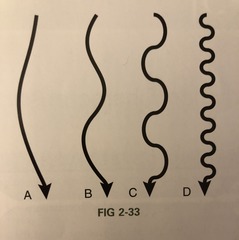
wavelength
the distance between the crest of one wave and the crest of the next
Radioactivty
the process by which certain unstable atoms or elements undergo spontaneous disintegration, or decay, in an effort to attain a more balanced nuclear state
Frequency
The number of wavelengths that pass a given point in a certain amount of time
Secondary Radiation
This type of radiation is created when the primary beam interacts with matter
Velocity
this term refers to the speed of the wave
Nucleus
the dense core of the atom; composed of protons and neutrons
Ionizing
radiation capable of producing ions by removing or adding an electron to an atom
electromagnetic radiation
examples include cosmic rays, gamma rays, x-rays, ultraviolet rays, visible light, infrared light radar waves, microwaves, and radio waves
Primary Radiation
this type of radiation refers to the penetrating x-ray beam that is produced at the target of the anode and that exits the tubehead
Electrons
tiny, negatively charged particles that have very little mass
Particulate Radiation
type of radiation composed of tiny particles of matter that possess mass and travel in straight lines at high speeds
Scatter Radiation
this type of radiation is the result of an x-ray that has been deflected from its path
orbits or shells
a well-defined path
Control Panel
Identify A
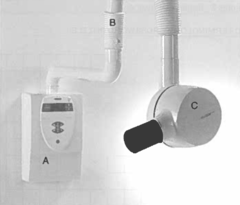
Extension Arm
Identify B

Tubehead
Identify C

Tubehead
Identify 1

Position-indicating device
Identify 2

When the filament circuit is activated, the filament heats up, and thermionic emission occurs
Describe the production of x-rays in the x-ray tube illustrated in Fig. 2-5
A

When the exposure button is activated, the electrons are accelerated from the cathode to the anode
Describe the production of x-rays in the x-ray tube illustrated in Fig. 2-5
B
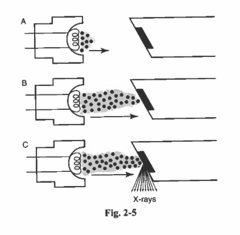
The electrons strike the tungsten target, and their kinetic energy is converted to x-rays and heat
Describe the production of x-rays in the x-ray tube illustrated in Fig. 2-5
C

Electrons travel from cathode to anode
CAT: ew cats = negative
NAP: yay! = positive
Describe how *"cat ---> nap"* can help you to remember the flow of the electrons in the x-ray tube.
invisible
*appearance*
X-rays are *visible / invisible*
no weight
*mass*
X-rays have *weight / no weight*
no charge
*charge*
X-rays have *no charge / + charge / - charge*
speed of light
*speed*
X-rays travel at the *speed of sound / speed of light*
short
hight
*wavelength*
X-rays have *long / short* wavelengths with a *high / low* frequency
can
*path of travel*
X-rays travel in straight lines and *can / cannot* be deflected
cannot
*focusing capability*
X-rays *can / cannot* be focused to a point
can
*penetrating power*
X-rays *can / cannot* penetrate liquids, solids, and gases
are
*absorption*
X-rays *are / are not* absorbed by matter
cause
*ionization*
X-rays *cause / do not cause* ionization
can
*fluorescence*
X-rays *can / cannot* cause certain substances to fluoresce; emit light
can
*effect on film*
X-rays *can / cannot* produce an image on photographic film
cause
*effect on tissues*
X-rays *cause / do not cause* biologic changes in living cells