Lec2: How culture evolve
 Call Kai
 Learn
 Practice Test
 Spaced Repetition
 Match
 Flashcards
 Knowt Play
1/14

There's no tags or description
Looks like no tags are added yet.
15 Terms
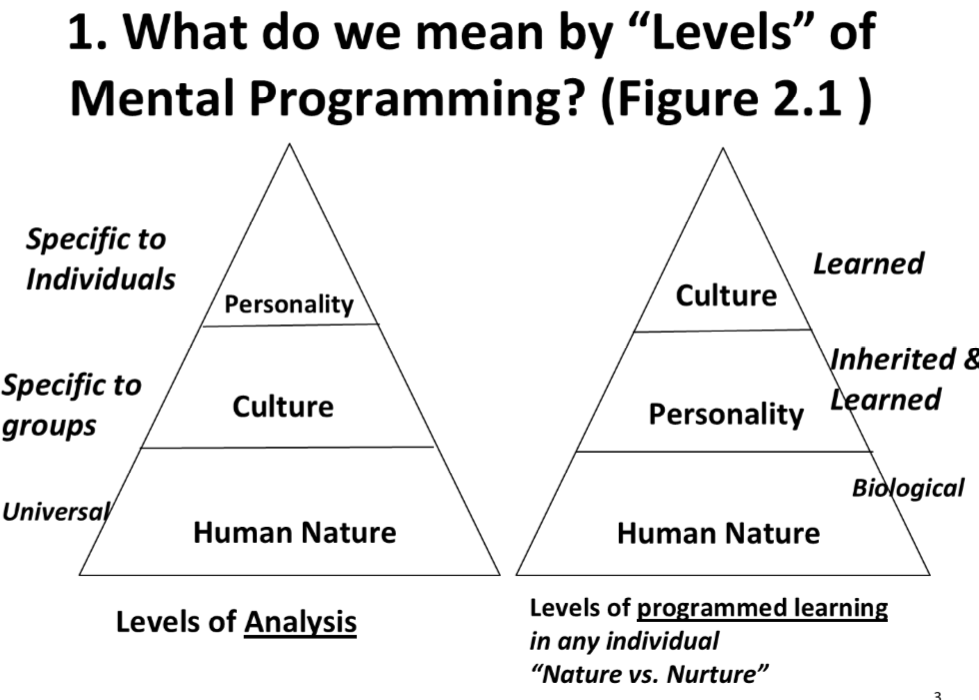
What are the levels of mental programming?
How you think
how you behave in a situation
Different levels of thinking/Why people behave differently:
people can be grouped by their values/culture (UO grads vs. UofT grads)
personality/characteristic (you vs. your sibling)
human nature/ biology (you vs. chicken)
Culture is most relevant level → learning values from past generations & people around you
What is 2. culture?
Learned from ancestors, family, friends → shared phenomenon within social groups
to be a culture, must be shared by others → a set of attributes & norms
more than national → people from same religion have own culture
What creates culture?
Differences between 3 create culture:
Artifacts → what can physically see/is obvious → shaped by values & unconscious underlying assumptions
Expoused values → explicitly stated beliefs
Underlying assumptions → implicit/hidden beliefs

Why do cultures differ?
ETIC → how one dresses in hot vs. cold climate, near sea vs. mountains → language (use of non-verbal)
EMIC → interpretation of behaviours → people behave different in different contexts
same behaviour means something else in different contexts & cultures (ex. shaking hands)
Tech transfers culture:
social media transfers slang, jargon, clothing, etc.
Political:
peaceful nation vs. defensive nation (military defense from neighbours, more cautious, less open)
Why are there still cultural differences despite globalization: religion/institutions?
Why do differences persist?
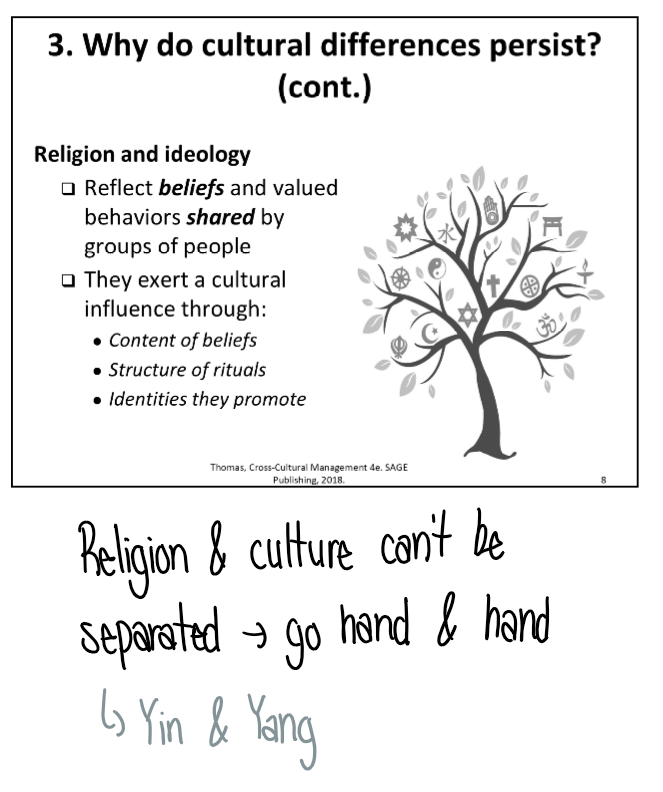
Religion → retain rules & traditions, less impacted by globalization
→ generational transfer maintained by social institutions → family, education, etc.
Why do cultural differences persist: language?
Persian language → very poetic & emotional tone
shows how they culturally view the world
how different languages describe the same thing shows cultural differences (ex. Indigenous languages have 4 words for types of snow)

How do cultures change??
Cant be changed easily → adjust to diff cultures & profiles
can have a combo of cultures
Separation, assimilation, exclusion, multi-culturism, co-existence
How do cultures change: Separation?
want to maintain home culture → ex. forced refugee (exclude self)
How do cultures change: Assimilation?
Want to adopt host culture 100% → lost home culture
What is Acculturation?
Change from one of the 5 types:
Separation, assimilation, exclusion, multi-culturism, co-existence
What is bi-culturation?
Adapt to 1 of the types more than the other: separation, assimilation, exclusion, multi-culturism, co-existence
ex. home more than host culture
exclusion more than assimilation
How do cultures change: exclusion?
Not adopting host or home culture → no culture (deemed as “bad)
How do cultures change: multi-culturism?
Embracing both home & host culture → deemed as “good” or the healthiest
How do cultures change: co-existence?
Toleration → not choosing host or home culture → not good/bad
Which is more important: organization or country culture?
Country → because grow up with it, unconscious thinking, natural to you, autopilot
When org culture differs from country culture → impacts your behaviour
Conflicted disagreements → solution: fit org culture to country culture
