MMI188b: Allergy and Parasites
 Call Kai
 Learn
 Practice Test
 Spaced Repetition
 Match
 Flashcards
 Knowt Play
1/58

There's no tags or description
Looks like no tags are added yet.
59 Terms
what is hypersensitivity (allergy)?
Adaptive immune response to harmless molecules
Type I hypersensitivity reactions are caused by:
the interaction of soluble allergens with specific IgE that causes the degranulation of mast cells
Type II hypersensitivity reactions are mediated by:
IgG antibodies made against new epitopes of cell-surface proteins caused by chemical modification.
Type III hypersensitivity reactions are caused by:
IgG antibodies which form immune complexes that are deposited in tissues and induce complement fixation and phagocyte attack
Type IV hypersensitivity reactions are caused by:
CD4 or CD8 T cells responding to the epitopes of foreign proteins or to peptides derived from chemically modified human proteins.
which hypersensitivity types are antibody mediated, and which are cell-mediated?
types 1, 2 and 3 are antibody mediated and type 4 is cell-mediated
what are other names for type 1 hypersensitivity? (2)
immediate hypersensitivity, or anaphylactic hypersensitivity
type 1:
- First contact with antigen causes _______ (Induction of ___ antibody formation)
-Subsequent contacts cause an allergic response (________ of IgE by antigen)
-Re-exposure to the same antigen results in:
Antigen binding to IgE on the surface of ______ cells causes the release of inflammatory mediatorsØ Antigen binding to antigen-specific IgE that is firmly attached to _____ on mast cells, basophils, and activated eosinophilsØ Cross-linking of the cell-bound IgEØ Release of inflammatory mediators within minutes (immediate reaction)Ø Release of ______
sensitization; IgE; Crosslinking; mast; FcεR1; Histamine
true/false: IgE does not activate the complement system
true
slide
10
what is the hygiene hypothesis?
Childhood exposure to germs and certain infections helps the immune system develop
true/false: In a population that has eradicated the parasites, there is an increased tendency for the generation of inflammatory IgE-mediated immune responses directed against environmental antigens that are structurally similar to parasite antigens.
true
type 2 immunity is run by which antibody?
IgG4; which has anti-inflammatory properties
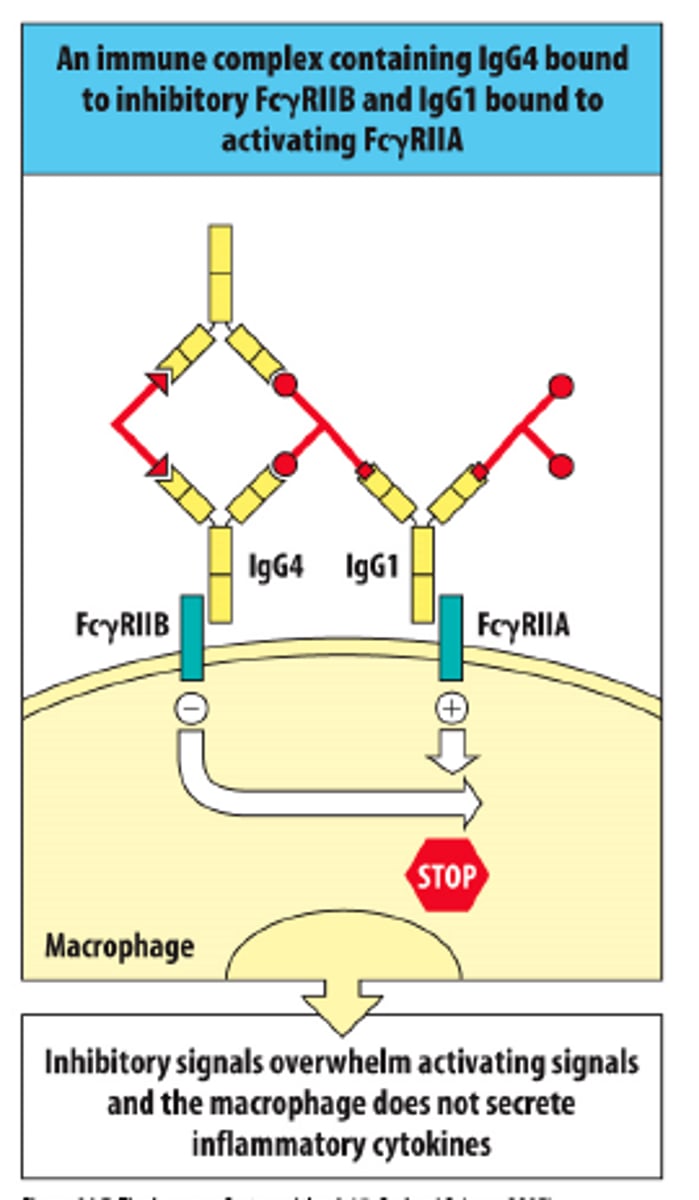
How does IgG4 facilitate type 2 immunity?
It forms mixed molecules in which the two Fabs have different antigenic specificity. This property facilitates the formation of immune complexes that interact with macrophages and suppress their inflammatory responses.
Shown here is an immune complex in which the _____ of IgG4 engages with the inhibitory receptor FcγRIIB on the _______, while the Fc of _____ engages with the activating receptor FcγRIIA.Ø The inhibitory signal is _______ (weaker/stronger)
Fc; macrophage; IgG1; stronger
The ____ and the two ______ chains of FcεRI transduce signals to themast cell.
beta; gamma
what are the two kinds of mast cells?
mucosal mast cells and connective tissue mast cells
mucosal mast cells produce ________ and connective tissue mast cells produce ________.
tryptase; chymotryptase
how are mast cells activated?
Crosslinking of FcεR1 on the surface of mast cells by antigen and IgE
how are mast cells able to display a diversity of IgE antibodies with different antigenic specificities?
Mast cells passively acquire IgE from the circulation, which is bound irreversibly by FcεRI. Each mast cell displays around 500,000 FcεRI molecules on its surface.
what is the difference between membrane bound FcεRI and FcεRII?
FcεRI is composed of a single IgE-binding polypeptide (the α chain), FcεRII is a trimer of a polypeptide that contains both an extracellular IgE-binding domain and an intracellular signal-transduction domain.
how many IgE molecules can the FcεRII trimer bind?
three
FcεRI is expressed by __________________(3)
FcεRII is expressed by ________ (1)
mast cells, eosinophils, and basophils; B cells
Omalizumab is a monoclonal antibody used in clinical practice to:
reduce the symptoms of IgE-mediated allergic diseases such as asthma.
how does omalizumab work?
Covers up the site on IgE that binds to FcεRI
what are the five product types released by mast cells? what other cell type can also secrete most of these?
enzymes, toxic mediators, cytokines, chemokines, and lipid mediators; activated eosinophils
which mast cells products are pre-made?
enzymes, toxic mediators (histamine), and TNF-alpha
true/false: mediators of type 1 hypersensitivity are long-lasting
false
name the toxic mediators
histamine, prostaglandins and thromboxanes, leukotrienes
true/false: do histamine and prostaglandins cause dilation of blood vessels, increased vascular permeability, and smooth-muscle contraction?
true
what is the function of thromboxanes?
platelet aggregation
how are leukotrienes different from the other toxic mediators?
they are not pre-formed and are only made during an allergic reaction, they are also not influenced by antihistamines
Mast cells synthesize prostaglandins and leukotrienes from ___________ by different enzyme pathways.
arachidonic acid
The anti-inflammatory effect of aspirin (acetyl salicylate) is achieved by irreversible inhibition of ____________ blocking __________ synthesis.
prostaglandin synthase; prostaglandin
do eosinophils increase or decrease the severity of the inflammatory response? how?
decrease, by releasing histaminase that degrades histamine and arylsulfatase that degrades leukotrienes
what is the genetic predisposition to immediate hypersensitivity or allergy?
atopy
ay fever, asthma, eczema, and urticaria are all examples of:
atopic disorders
all atopic disorders are associated with elevated ______ antibody levels which is caused by:
IgE; Mutations in the genes encoding the alpha chain of the IL-4 receptor: Enhance the effectiveness of IL-4 Result in increased IgE synthesis by B cells
T FH2 cells are:
follicular helper T cells that promote the production of type 2 immunity.
what is the molecular type of inhaled allergens that induce T-cell responses?
proteins that induce t cell responses
why do inhaled allergens need to have peptides presented by MHC class 2?
its needed for T cell activation
sensitization to an inhaled allergen causes induction of what response?
Tfh2 response
Genetic variations associated with susceptibility to asthma:
MHC class 2, IL-4 or IL-4 receptor alpha chain
what is the Peak Expiratory Flow Rate?
breathing capacity used to measure response to an allergen
what is systemic anaphylaxis?
sudden respiratory and circulatory disruption from antigen in the blood that can be fatal
how can penicillin cause allergic reaction?
it modifies proteins on erythrocytes to create foreign epitopes
how does an epipen save lives during anaphylaxis?
increasing the blood pressure
Atopic dermatitis has the most genes associated with what gene type?
innate immunity
what is urticaria?
hives
what is the difference between acute and chronic desensitization?
acute is administration of small incremental doses to produced antigen-IgE complexes, and chronic is long-term weekly administration of the antigen to induce IgG4 (blocking antibodies)
what are three drugs that can counteract the action of inflammatory mediators?
1. Block mediators from binding to target tissue (Antihistamines)
2. Stabilize granules and cell membranes (Corticosteroids (prednisone) suppress lymphocyte function)
3. Block mediator release by inhibiting calcium influx (Cromolyn sodium (inhalers))
true/false: penicillin can cause the first three types of hypersensitivity
false, it can cause all four
what is serum sickness?
type III hypersensitivty. After transfusions, drugs in fluid act as haptans.
what is arthus reaction?
type III hypersensitivity reaction specifically characterized by local vasculitis due to the deposition of antigen/antibody complexes in dermal blood vessels.
1. DRESS, Drug reaction with eosinophilia and systemic symptoms
2. SJS-TEN, Stevens-Johnson syndrome - toxic epidermal necrolysis
3. AGEP, Acute generalized exanthematous pustulosis Type IV Hypersensitivity
are all examples of:
type 4 hypersensitivity
Type 1 hypersensitivity
immune rxn:
mechanism of effects:
clinical findings:
timing:
drugs implicated:
IgE-mediated allergy; mast cells; urticaria, angioedema, respiratory distress, hypotension, vomiting and diarrhea; up to 6 hours; penicillin and cephalosporins
Type 2 hypersensitivity
immune rxn:
mechanism of effects:
clinical findings:
timing:
drugs implicated:
cytoxic; antibodies to rbc's; hemolytic cytopenias; hours to days; penicillin and aspirin
Type 3 hypersensitivity
immune rxn:
mechanism of effects:
clinical findings:
timing:
drugs implicated:
immune complex; complement system; serum sickness, glomerulonephritis and vasculitis; 1-3 weeks; trimethoprim and penicillin
Type 4 hypersensitivity
immune rxn:
mechanism of effects:
clinical findings:
timing:
drugs implicated:
delayed hypersensitivity; macrophages and T cells; contact dermatitis; within 1 week; anti-seizure meds and penicillin and trimethoprim