Grammar & Syntax
 Call Kai
 Learn
 Practice Test
 Spaced Repetition
 Match
 Flashcards
 Knowt Play
1/32

There's no tags or description
Looks like no tags are added yet.
33 Terms
Syntax Definition
Teilgebiet der Linguistik, das sich mit der Struktur von Sätzen und der Kombination von Wörtern zu größeren Einheiten beschäftigt.
Zentrale Frage: Wie werden Wörter zu Phrasen und Sätzen organisiert?
Wordclasses: Lexical word classes
Nouns
Verbs
Adjectives
Adverbs
Wordclasses: Autosemantic vs. synsemantic
Autosemantische Wörter
→ tragen eigenständige lexikalische Bedeutung
→ benötigen keinen zusätzlichen Kontext
Beispiele: Nomen, Vollverben, Adjektive, Adverbien
Synsemantische Wörter
→ haben v. a. grammatische Funktion
→ Bedeutung nur im Kontext
Beispiele: Artikel, Präpositionen, Pronomen, Hilfsverben
Lexical word classes: Nouns
proper nouns: Sarah, Mike → names
abstract nouns: opinion → cant see or feel them
concrete nouns: son, boy → see them
Lexical word classes: Verbs
a) Full verbs → tragen Hauptbedeutung (z. B. smile, pop, lose)
Hilfsverben (Auxiliaries) → grammatische Funktionen (Tempus, Fragebildung etc.) Beispiele: be, have, do (primary verbs)
1.2 Modalverben → Modalität (Möglichkeit, Notwendigkeit) Beispiele: will, can
b) Transitive verbs → Verben, die ein direktes Objekt benötigen, um eine vollständige Bedeutung zu haben.
→ Subjekt + transitives Verb + Objekt → lost (to lose sth.), popped (to pop); She read a book.
Intransitive verbs → Verben, die kein Objekt benötigen → smiled (to smile); He sleeps.
copula verbs → Verben, die das Subjekt mit einer Subjekt-Ergänzung (subject complement) verbinden. → drücken Zustand/Identität aus, keine Handlung → was, am, be; She is happy
c) Finite verb forms → nach Person, Numerus und Tempus flektiert, stehen als Hauptverb im Satz und können allein ein Prädikat bilden: was am, have, do, smiled, popped
Non-finite verb forms → nicht flektiert, können nicht alleine stehen: Infinitiv, Gerund (going), Partizip(gone, going); to come across, lost, be
Lexical word classes: Adjectives
1.
attributiv (vor Nomen)
prädikativ (nach Kopulaverb)
2.
Gradable adjectives: steigerbar → können mit very, quite, extremely usw. verwendet werden. big, happy, cold
Ungradable adjectives: keine Abstufung (absolute Bedeutung) → nicht mit very, ect. verwendbar. perfect, dead, unique
Lexical word classes: Adverbs
Modifizieren Verben, Adjektive oder ganze Sätze.
Adverb modifying a verb
→ describes how an action is done
She sings beautifully.
(beautifully modifies the verb sings)
Adverb modifying an adjective
→ changes intensity of adjective
The movie is very interesting.
(very modifies the adjective interesting)
Adverb modifying another adverb
→ changes intensity of another adverb
He runs very quickly.
(very modifies the adverb quickly)
Adverb modifying a whole sentence (sentence adverb)
→ comments on the entire statement
Unfortunately, we missed the bus.
(unfortunately modifies the whole sentence)
Grammatical word classes: Articles
definite articles: the
indefinite articles: an, a
Grammatical word classes: Pronouns
Personal pronouns: I, you, he/she/it, we, they
Possessive pronouns vs. possessive adjectives: Mine, yours, hers/his/its, ours, theirs vs. My, your, her/his/its, our, their
Object pronouns: Replaces the object in a sentence (She gave me the book.)
Demonstrative pronouns vs. demonstrative adjective: this, that, these, those; adjectives stand before the noun, pronouns replace them (This car is fast, this is fast.)
Grammatical word classes: Auxiliaries
Hilfsverben (Auxiliaries) → grammatische Funktionen (Tempus, Fragebildung etc.) Beispiele: be, have, do (primary verbs)
Grammatical word classes: Prepositions
Funktionswörter, die Beziehungen zwischen Satzteilen ausdrücken und Präpositionalphrasen einleiten.
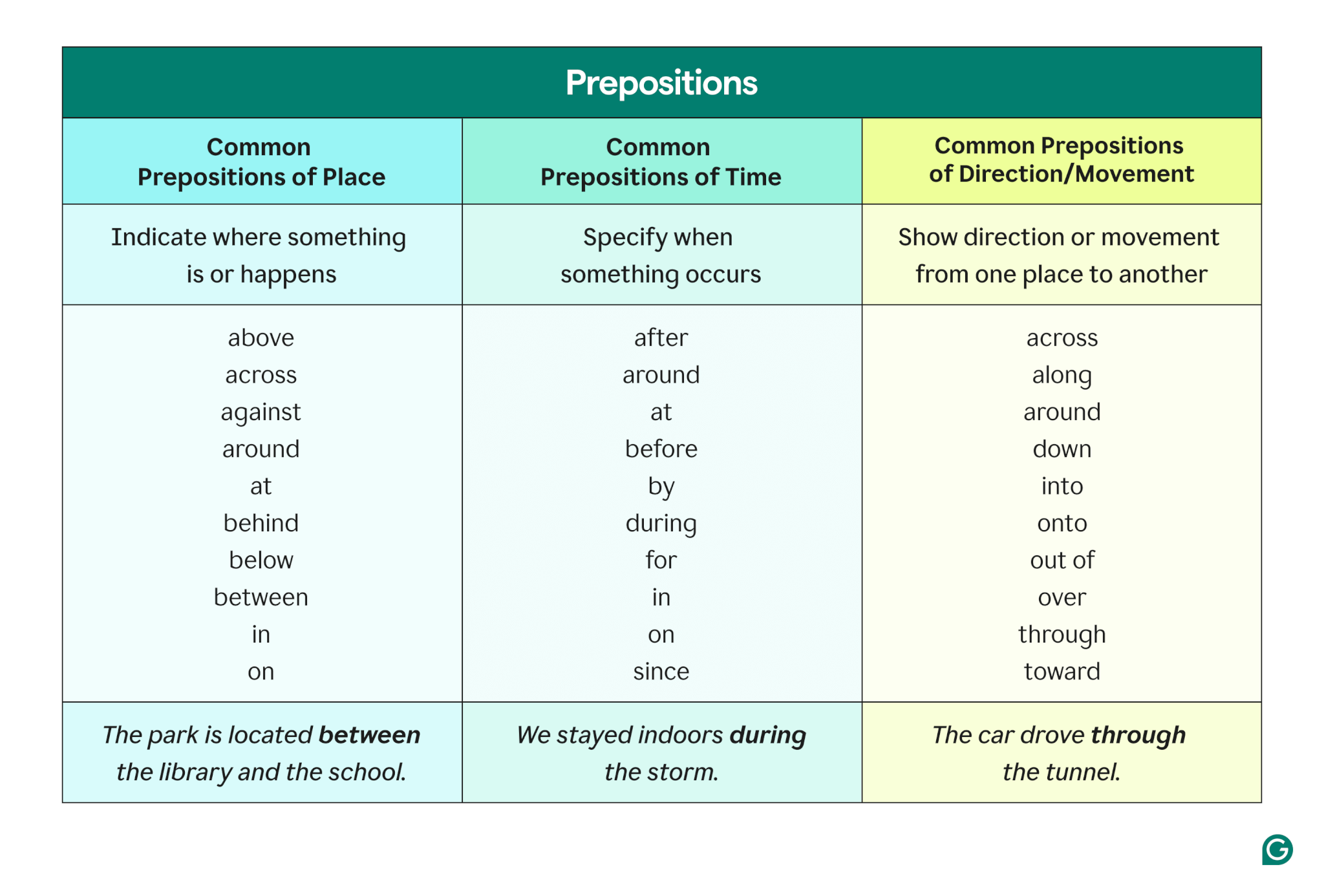
Grammatical word classes: Conjunctions
Conjunctions are words that join words, phrases, or clauses together in a sentence. There are two main types of conjunctions:
Coordinating Conjunctions: These connect words or groups of words that are similar (e.g., "and," "but," "or").
Subordinating Conjunctions: These connect a dependent clause to an independent clause (e.g., "because," "although," "since”).
Phrases
NP: Noun phrases - The cat…
VP: Verb phrases - moved, felt ill, disappeared quickly…
PP: Preposition phrases: into bed, in the taxi…
AP: Adverb phrases: quite slowly…
AdjP: Adjective phrases: very happy…
Structural ambiguity: Form vs. Function
Form: Welche Kategorie hat ein Ausdruck? (Wortart / Phrasentyp, z.B. NP, VP, PP).
Funktion: Welche Rolle spielt er im Satz? (z.B. Subjekt, Objekt, Prädikat, Adverbial).
Beispiele:
the cat → Form: NP, Funktion: Subjekt.
into bed → Form: PP, Funktion: Adverbial (Ort/Richtung).
got into bed → Form: VP, Funktion: Prädikat.
Clauses
A clause is a group of words containing at least a subject and a finite verb.
It forms a unit of sentence structure and expresses a proposition.
Example:
She studies linguistics. → subject + finite verb = clause
Main clause: can stand alone as a sentence.
Subordinate clause: cannot stand alone and is syntactically dependent on a main clause.
Main clause (independent clause)
A main clause is a clause that can stand alone as a complete sentence.
It expresses a complete thought and does not depend on another clause.
Features:
contains subject + finite verb
grammatically independent
can form a full sentence
Examples:
She is tired.
They went home.
I like syntax.
A sentence can contain more than one main clause:
She was tired, but she finished her work.
Subordinate clause (dependent clause)
A subordinate clause cannot stand alone as a full sentence and depends on a main clause.
It functions as part of the main clause.
Features:
has subject + finite verb
grammatically dependent
introduced by subordinators (e.g. because, although, that, if, who)
Examples:
because she was tired
that he likes linguistics
when they arrived
Used with main clause:
She went home because she was tired.
I think that he is right.
Sentences
Definition: Grammatische Einheit bestehend aus mindestens Subjekt und Prädikat.
Satztypen
Deklarativsatz (Aussage)
Interrogativsatz (Frage)
Imperativsatz (Befehl)
Exklamativsatz (Ausruf)
Agreement
Agreement (also called concord) is the grammatical relationship where one element in a sentence must match another in features such as number, person, gender, or tense.
Most important in English: subject–verb agreement.
Agreement shows the grammatical relationship between elements in a clause and helps identify:
subject
finite verb
clause structure
Grammatical relations/functions: Subject
The subject is the clause element that typically refers to the doer or topic of the clause and agrees with the finite verb.
Form, Subjekte sind meist:
Noun phrases (NP) → The student reads.
Pronouns → She reads.
manchmal clauses → What he said is interesting.
Position
Declarative sentences:
→ normalerweise vor dem finite verb
The student reads syntax.
Questions:
→ nach dem auxiliary (subject–aux inversion)
Does the student read syntax?
Is she happy?
Optional oder obligatorisch?
Declarative clauses:
→ subject ist obligatorisch im Englischen
❌ Is raining
✔ It is raining (dummy subject “it”)
Questions:
→ subject ebenfalls obligatorisch
Is she coming?
Agreement
Subject bestimmt die Form des finite verb (number & person).
She runs
They run
Grammatical relations/functions: Objects
Direct Object (DO)
Element directly affected by the action of a transitive verb.
Form: meist NP
She reads a book.
Frageprobe: What? / Whom?
→ What does she read? → a book
Indirect Object (IO)
Entity that receives something or benefits from the action.
Position:
IO vor DO
She gave him a book.
mit Präposition to/for
She gave a book to him.
IO = Empfänger
DO = Sache
Grammatical relations/functions: Subject Complement
Follows a copula verb (be, seem, become).
Describes or identifies subject.
She is happy.
He became a teacher.
Kann sein:
adjective phrase
noun phrase
Grammatical relations/functions: Object Complement
Gibt zusätzliche Information über das Objekt.
They elected him president.
She painted the door red.
Beschreibt Objekt, nicht Subjekt
Grammatical relations/functions: Predicate
The predicate is everything in the clause except the subject.
Contains the verb and all complements/objects.
Beispiel:
The student reads a book in the library
Subject = the student
Predicate = rest des Satzes
Grammatical relations/functions: Adverbials
Optional elements that give extra information about circumstances (time, place, manner etc.).
Nicht obligatorisch für grammatische Vollständigkeit.
Adverbial of place
→ Wo?
She studies in the library.
Adverbial of time
→ Wann?
She studies every day.
Adverbial of manner
→ Wie?
She studies carefully.
Instrumental adverbial
→ Womit?
He cut the bread with a knife.
Voice
Voice beschreibt das Verhältnis zwischen Verb, Handelndem (agent) und Betroffenem (patient) in einem Satz.
Es zeigt, wer die Handlung ausführt und wer betroffen ist.
Haupttypen:
Active: subject = agent
Passive: subject = patient
Agent: führt Handlung aus
Patient: betroffen
Monotransitive: 1 Objekt
Ditransitive: 2 Objekte
Mediopassive: aktiv form, passiv meaning
Voice: Active voice
In der active voice ist das Subjekt der Handelnde (agent) und führt die Handlung aus.
Struktur:
Subject (agent) + verb + object (patient)
Beispiele:
The student writes the essay.
She opened the door.
→ Subjekt = Handelnder
→ Objekt = betroffen
Voice: Passive voice
In der passive voice wird der patient zum Subjekt des Satzes.
Der Handelnde (agent) ist unwichtig, unbekannt oder optional.
Struktur:
Patient → wird Subjekt
be + past participle (+ by-agent optional)
Beispiele:
The essay was written (by the student).
The door was opened.
Merkmale:
Fokus auf Handlung/Ergebnis
agent kann weggelassen werden
Bildung: form of be + past participle
Voice: Agent and patient
Agent: Die Entität, die eine Handlung aktiv ausführt.
Beispiel:
The chef cooked the meal.
→ agent = the chef
Patient: Die Entität, die von der Handlung betroffen ist oder sie empfängt.
Beispiel:
The chef cooked the meal.
→ patient = the meal
Voice: Monotransitive Verbs
Ein monotransitives Verb nimmt genau ein direktes Objekt.
Struktur:
Subject + verb + direct object
Beispiele:
She reads a book.
He opened the door.
→ ein Objekt = direct object
Voice: Ditransitive Verbs
Ein ditransitives Verb nimmt zwei Objekte:
direct object
indirect object
Struktur:
Subject + verb + indirect object + direct object
Beispiele:
She gave him a book.
They sent her a letter.
Alternative:
She gave a book to him.
Voice: Passive mit ditransitiven Verben
Bei ditransitiven Verben können zwei verschiedene Passive entstehen:
Aktiv:
She gave him a book.
Passiv 1 (IO wird Subjekt):
He was given a book.
Passiv 2 (DO wird Subjekt):
A book was given to him.
Voice: Mediopassive (Middle voice)
Form sieht aktiv aus, Bedeutung ist passiv.
Subjekt ist Patient, aber kein sichtbarer Agent.
Beispiele:
This book sells well.
The door opens easily.
Niemand wird genannt, der die Handlung ausführt.
→ Fokus auf Eigenschaft des Objekts
Definition (exam):
The mediopassive is a construction that has active form but passive meaning, where the subject is affected by the action without an expressed agent.