General Pharmacology: Drug-Receptor Interactions and Pharmacokinetics
 Call Kai
 Learn
 Practice Test
 Spaced Repetition
 Match
 Flashcards
 Knowt Play
1/44

Earn XP
Description and Tags
Vocabulary practice flashcards covering fundamental pharmacological concepts, including drug-receptor theory, dose-response kinetics, antagonism, receptor nomenclature, and mathematical formulations.
45 Terms
Pharmacology
The study of drugs and drug actions in living tissues, either in vivo or in vitro, encompassing research and drug development.
Pharmacokinetics
The sub-division of pharmacology that examines how the body handles a drug through absorption, distribution, metabolism, and excretion (ADME), as well as time and response.
Pharmacodynamics
The sub-division of pharmacology dealing with the biological and physiological effects of drugs on the body and the relationship between drug dose and response.
Pharmacotherapeutics
The clinical sub-division of pharmacology focusing on the study of drugs used for the prevention, mitigation, and cure of diseases.
Pharmacogenetics
The study of how an individual's genetic make-up determines their response to specific drugs, seeking the hereditary basis for differences in responsiveness.
Pharmacotoxicity
The sub-division of pharmacology concerned with the study of the harmful and toxic effects of drugs on biological systems.
Toxicity
The specific dose or concentration of a drug that produces deleterious effects in humans.
Pharmacoepidemiology
The study of drug effects and therapeutic outcomes evaluated at the population level, analyzing response variability between individuals and populations.
Pharmacoeconomics
The field that evaluates and quantifies in economic terms the costs and benefits of drugs used therapeutically.
Drug
A chemical substance that, upon administration, alters or moderates physiological processes in humans or animals by either stimulation or inhibition.
Receptors
Macromolecular sites, primarily composed of protein or lipid-protein structures on cell membranes, that serve as target and recognition sites for chemical agents.
Side-Chain Theory (Receptors)
Paul Ehrlich's concept visualizing receptors as unsatisfied chemical side chains on cells that combine with nutrients or bacterial toxins.
Receptive Substance
The term introduced by J.N. Langley to distinguish the specific cellular physiological target of drugs like nicotine and curare from the contractile substance of muscle.
Salvarsan (606)
An organoarsenic compound synthesized by Paul Ehrlich for the targeted treatment of syphilis.
A.V. Hill's Equation
A quantitative mathematical formulation describing drug action on frog rectus abdominis muscle as a bimolecular reaction: Y=k1+knN−M, where Y is response height, N is nicotine concentration, M is a threshold, and k and k1 are constants.
Rang's Receptor Postulate
H.P. Rang's foundational concept stating that the receptor concept is to pharmacology as homeostasis is to physiology or metabolism is to biochemistry.
Affinity
The intrinsic ability of a drug or ligand to bind to and form a complex with a specific receptor.
Intrinsic Action
The capability of a drug to bind to a receptor and initiate a downstream pharmacological response.
Efficacy
The property of a drug that describes its capacity to exert a maximum pharmacological effect at low concentrations.
Selective Toxicity
The foundational principle of chemotherapy whereby a chemical agent selectively eradicates parasites or pathogens without injuring the host.
Rate Theory
A pharmacological theory stating that drug action depends on the rate of collision between drug molecules and receptors and their subsequent rate of dissociation.
Bioavailability
The fraction or total amount of an administered drug that enters the systemic circulation unchanged to produce its biological effect.
Half-Life (t1/2)
The duration of time required for the initial plasma concentration of a drug to decrease by half (50%).
Clearance (CL)
The volume of plasma completely cleared of a drug per unit time, expressed as CL=CRate of Elimination, where C is plasma concentration.
LD50
The lethal dose of a drug required to cause death in 50% of the tested animal population.
EC50
The molar concentration of a drug required to induce 50% of the maximum achievable response.
ED50
The therapeutic dose of a drug required to produce the specified biological effect in 50% of subjects.
TD50
The dose of a drug required to produce toxic manifestations in 50% of the subjects receiving it.
Maximum Effect (Emax)
The upper limit of drug response on a dose-response curve where all functional receptors are occupied, such that further increases in dose yield no higher effect.
Synergistic Interaction
A drug combination where the combined biological effect is greater than the algebraic sum of their individual effects, conceptually represented as 1+1=3.
Additive Interaction
A drug interaction in which the combined effect equals the sum of the individual effects produced by each agent administered alone, represented as 1+1=2.
Potentiatory Interaction
A drug-drug interaction in which the co-administration of an otherwise nontoxic agent triggers or amplifies severe toxicity, represented as 1+1=6.
Inhibitory Interaction
A phenomenon where one drug interferes with the activity of another, yielding an outcome lower than expected, represented as 1+1=21.
Agonist
A molecule that binds to a receptor via chemical linkages (e.g., ionic, covalent, hydrogen, hydrophobic, van der Waals) and activates it to trigger a biological response, displaying both affinity and efficacy.
Full Agonist
An agonist capable of eliciting the maximum possible biological tissue response upon binding and activating receptors.
Partial Agonist
A ligand that cannot achieve the maximum response (Emax) even when all available receptors are occupied, due to lower intrinsic efficacy.
Inverse Agonist
An agent that binds to the same receptor as an agonist but exerts the opposite biological effect, suppressing basal receptor activity.
Antagonist
A drug that displays affinity for a receptor but lacks efficacy, preventing agonist binding and receptor activation without initiating a cellular response.
Competitive Antagonist
A pharmacological antagonist sharing structural similarity with an agonist that reversibly competes for the exact same primary receptor binding site.
Competitive Antagonism (Criteria)
Characterized by a parallel rightward shift of the agonist dose-response curve without altering Emax, indicating a surmountable loss of potency.
Non-Competitive Antagonist
An antagonist that binds to an allosteric site distinct from the agonist binding site, usually possessing a different chemical structure than the agonist.
Non-Competitive Antagonism (Criteria)
Characterized by a downward flattening of the dose-response curve and depression of Emax, reflecting an insurmountable reduction in efficacy.
Ion Channels
Pore-forming transmembrane proteins that selectively permit the flux of ions across the cell membrane to regulate cell excitability.
Voltage-Gated Channels (VOCC)
Membrane ion channels that open or close in response to alterations in transmembrane potential, exhibiting high selectivity for ions like Na+, K+, Ca2+, and Cl−.
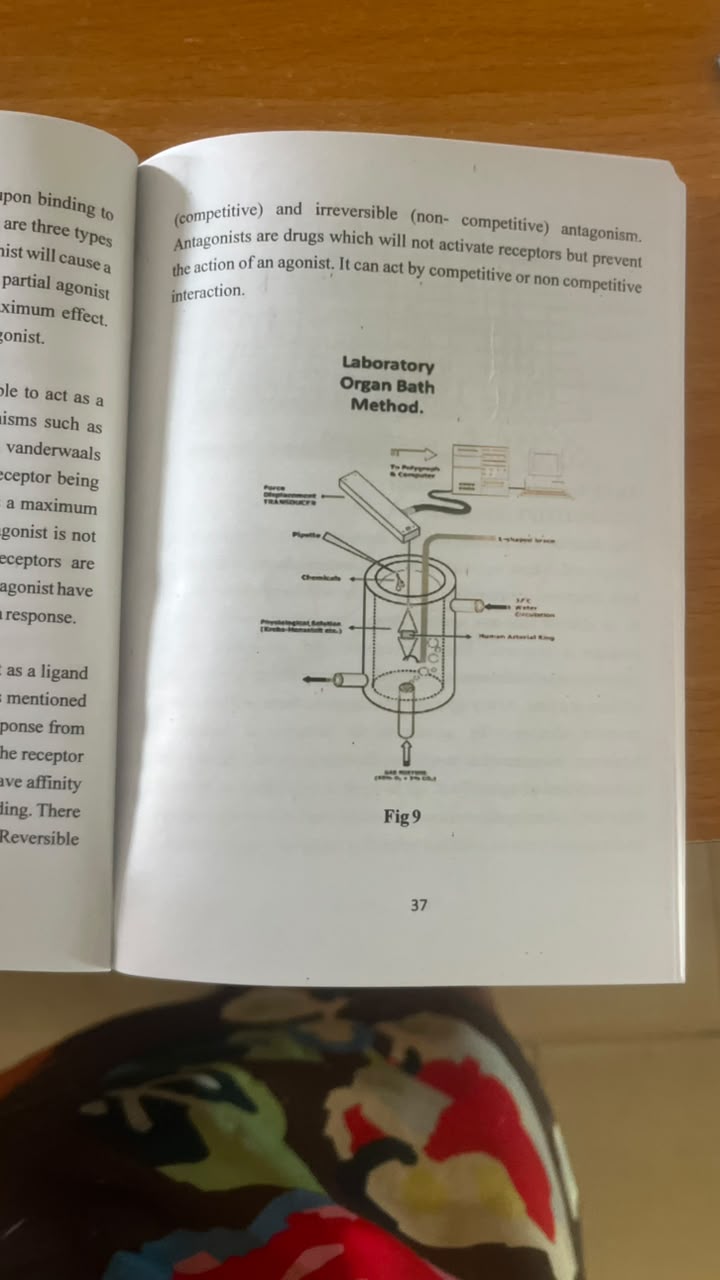
Laboratory Organ Bath Method
An in vitro experimental setup designed to measure pharmacological responses of isolated tissues mounted in physiological buffer (e.g., Krebs-Henseleit solution) under aerated gas conditions (95%O2, 5%CO2).