Pathology of The Adrenal Gland
 Call Kai
 Learn
 Practice Test
 Spaced Repetition
 Match
 Flashcards
 Knowt Play
1/62

There's no tags or description
Looks like no tags are added yet.
63 Terms

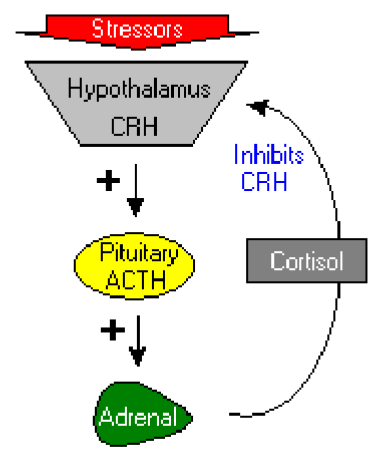
Describe the Hypothalamo-pituitary-adrenal axis


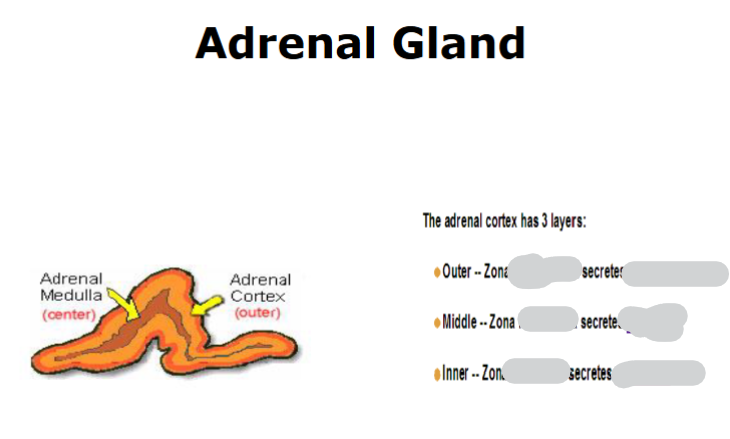
3 causes of Adrenocortical Hyperfunction (Hyperadrenalism)
▪ Cushing’s syndrome
▪ Hyperaldosteronism
▪ Adrenogenital (Virilising) syndromes
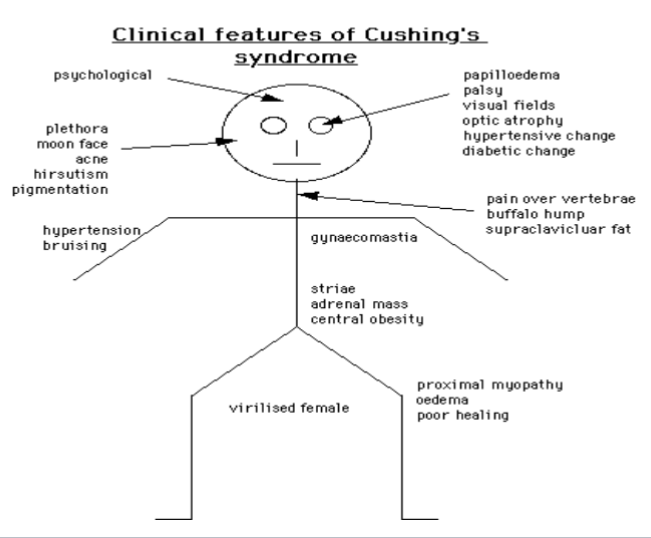
Clinical features of Cushing’s Syndrome
Most common cause of Cushing’s Syndrome
Iatrogenic
What is Cushing’s disease
Excessive ACTH production due to a benign pituitary adenoma
2 other causes of ACTH dependent Cushing’s
ectopic ACTH secretion (paraneoplastic)
ectopic CRH secretion
3 causes of ACTH-independent Cushing’s
adrenal adenoma
adrenal carcinoma
primary cortical hyperplasia

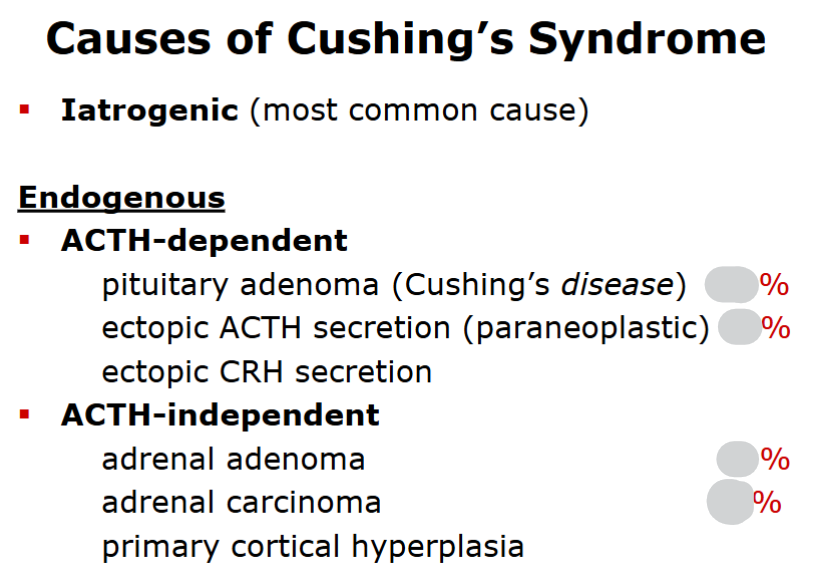
Prevalence of each type of endogenous Cushing’s Syndrome

Cushing’s Disease incidence rate per year
2/106/yr
Cushing’s Disease gender & age risk factors
Commoner in females: (4:1, F:M)
Age: 20-40 years
Main cause of Cushing’s Disease
Small pituitary adenoma
Other cause of Cushing’s Disease
Corticotroph cell hyperplasia in the anterior pituitary
3 causes of Adrenal Cushing’s Syndrome
▪ Adrenal adenoma
▪ Adrenal carcinoma
▪ Cortical hyperplasia
Effect of Adrenal Cushing’s Syndrome on adrenals function
Adrenal Cushing’s Syndrome → The adrenals function autonomously
Adrenal Cushing’s Syndrome main 2 causes
Adenomas and carcinomas are equally common in adults
Adrenal Cushing’s Syndrome main cause in children
In children, carcinomas predominate
Age & Gender risk factors for Adrenal Cushing’s Syndrome
More common in women
Age: 30-50
How common is Autonomous hyperplasia in Adrenal Cushing’s Syndrome
Autonomous hyperplasia is uncommon
What is wrong in Primary Hyperaldosteronism
Autonomous overproduction of aldosterone
How is the RAAs affected by Primary Hyperaldosteronism
Suppression of the renin-angiotensin system
How does Primary Hyperaldosteronism affect electrolytes & what is the effect of this
Excessive Na+ retention & K+ excretion → hypertension
What’s wrong in Secondary Hyperaldosteronism
↑ Activation of RAAS → ↑ Renin → ↑ Aldosterone release
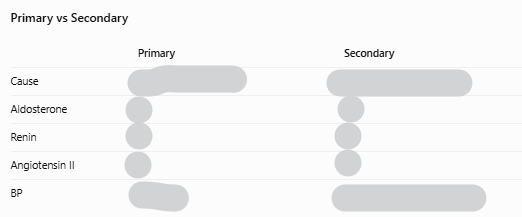

3 causes of Primary Hyperaldosteronism
▪ Primary idiopathic hyperaldosteronism 60%
▪ Adrenal adenoma (Conn syndrome) 35%
▪ Aldosterone-producing carcinoma (rare)
5 causes of Secondary Hyperaldosteronism
▪ Activation of renin-angiotensin system
▪ Heart failure
▪ ↓ renal perfusion
▪ Hypoalbuminaemia
▪ Cirrhosis
True/False Primary Hyperaldosteronism can → severe HTN
True - it can → Moderate to severe HTN
Sx of Hypokalaemia associated with Hyperaldosteronism
Usually asymptomatic
May present with cramps, myopathy, polyuria & nocturia (diabetes insipidus)
Name 2 Adrenogenital Syndromes
Adrenocortical neoplasms
Congenital adrenal hyperplasia
Are Adrenocortical neoplasms more likely to be a carcinoma / adenoma
more likely to be a carcinoma
What causes Congenital adrenal hyperplasia
An inborn enzyme deficiency, which causes a partial block in the synthesis of adrenocortical steroids and an increase in the production of androgens
21-hydroxylase deficiency accounts for approximately 90% of cases


What is the effect of increased testosterone associated with Adrenogenital Syndromes
It can cause Precocious (early) puberty
Primary adrenocortical insufficiency can be acute/chronic - give an example of both
Acute (adrenal crisis)
Chronic (Addison’s disease)
What’s wrong in secondary adrenocortical insufficiency
↓ stimulation of adrenals due to ↓ ACTH
6 Causes of Primary Adrenal Insufficiency
Autoimmune conditions
Infections
Adrenal hemorrhage
Infiltrations
Neoplasms
Drugs
Name 2 Autoimmune conditions that can → Primary Adrenal Insufficiency
adrenalitis (60-70%)
polyglandular autoimmune syndromes
Name 4 Infections that can → Primary Adrenal Insufficiency
Tuberculosis
Histoplasmosis
CMV infection
HIV-associated infection
Name 3 causes of Adrenal hemorrhage that can → Primary Adrenal Insufficiency
Waterhouse-Friderichsen syndrome
Coagulopathy
Traumatic birth
What is Waterhouse-Friderichsen Syndrome
Rapid development of adrenal insufficiency associated with massive bilateral adrenal haemorrhage
Pathogenesis of Waterhouse-Friderichsen Syndrome & complication
Neisseria meningitidis septicaemia → DIC with widespread purpura → Waterhouse-Friderichsen Syndrome → Profound hypotension
Name 3 infiltrations that can → Primary Adrenal Insufficiency
amyloidosis, sarcoidosis, haemochromatosis
Name 3 neoplasms that can → Primary Adrenal Insufficiency
primary and secondary carcinomas (esp. lung and breast), lymphomas
Name 4 drugs that can → Primary Adrenal Insufficiency
ketoconazole, fluconazole, phenytoin, rifampicin
Addison’s Disease sx & signs (including biochemical abnormalities)
▪ Nausea, vomiting, abdominal pain
▪ Weight loss
▪ Muscle weakness, myalgia
▪ Fatigue
▪ Postural hypotension
▪ Darkening of the skin in both exposed and non-exposed parts of the body
▪ Hyponatraemia, hyperkalaemia, hypoglycaemia, hypercalcaemia
3 causes of Secondary Adrenal Insufficiency
▪ Hypothalamic disease
▪ Hypopituitarism
▪ Rapid withdrawal of exogenous corticosteroids or failure to increase steroid dose in periods of stress
4 causes of hypopituitarism
tumour, infiltration, surgery, radiation
Is hyperpigmentation seen more in primary/secondary Adrenal Insufficiency - why?
Seen more in primary
The hyperpigmentation of primary Addison’s disease is lacking in secondary insufficiency because pro-opiomelanocortin levels (derived from ACTH) are low
What are Phaeochromocytomas
Adrenomedullary catecholamine-secreting tumours
Sx of Phaeochromocytomas
Cause 0.1-0.6% of cases of hypertension
What % of Phaeochromocytomas are malignant
10%
What % of Phaeochromocytomas are extra-adrenal
10%
Where would extra-adrenal Phaeochromocytomas be
paraganglionomas in Organ of Zuckerkandl (@ aortic bifurcation) or carotid body
What % of Phaeochromocytomas are not associated with hypertension
10%
What % of sporadic cases of Phaeochromocytomas are bilateral
10%

What % of Phaeochromocytomas are familial
25%
Name 2 Syndromes Associated with Phaeochromocytomas
MEN type IIA
MEN type IIB
Von Hippel-Lindau
Von Recklinghausen
Sturge-Weber (→ port wine stains)

Name 2 conditions other than Phaeochromocytomas that are associated with MEN type IIA
Medullary thyroid CA
Hyperparathyroidism
Name 3 conditions other than Phaeochromocytomas that are associated with MEN type IIB
Medullary thyroid CA
Mucosal neuromas
Marfanoid features
How are Phaeochromocytomas diagnosed
Tumour turns black when treated with potassium dichromate fixative
Why do pheochromocytomas turn black when treated with potassium dichromate fixative
Oxidation of stored catecholamines
Name the 4 classic features of pheochromocytomas & give some others as well
Classic 4:
▪ Sweating
▪ Headaches
▪ Tremor
▪ Palpitations
Others
▪ Sustained or episodic ↑BP
▪ Pallor or flushing
▪ Anxiety
▪ Paraesthesiae
▪ Seizures
▪ Chest pain
▪ Dyspnoea
▪ Abdominal pain
▪ Nausea