MAE 4243 Oral Exam Prep
 Call Kai
 Learn
Learn Practice Test
 Spaced Repetition
 Match
Match Flashcards
 Knowt Play
1/154

There's no tags or description
Looks like no tags are added yet.
Name | Mastery | Learn | Test | Matching | Spaced | Call with Kai | Chat |
|---|
No analytics yet
Send a link to your students to track their progress
155 Terms
Ramjet Advantages
High specific thrust at design Mach
Highly efficient at Mach 3-5
No Moving Parts
Ramjet Disadvantages
Has specific operating range
Scramjet Advantages
High specific thrust at hyper sonic, mach 5+
Efficient at hypersonic, more than ramjet
No moving parts
Scramjet Disadvantages
Has specific operating range
Turbojet Advantages
Highest specific thrust
High thrust for given airflow
Large operation envelope
Turbojet Disadvantages
Highest TSFC
Lowest propulsive efficiency
Turbofan Advantages (Low Bi-pass Ratio)
High Specific Thrust
Descent propulsive efficiency
Turbofan Advantages (High Bi-pass Ratio)
Low TSFC
High Propulsive efficiency
Turbofan Disadvantages (Low Bi-pass Ratio)
High TSFC
Turbofan Disadvantages (High Bi-pass Ratio)
Low specific thrust
Needs greater Airflow
Turboprop advantages
Highest propulsive efficiency
Lowest TSFC
Turboprop disadvantages
Lowest specific thrust
Only viable at low subsonic
Complex gearboxes, mechanical losses
Turboshaft Advantages
Highest propulsive efficiency
Lowest TSFC
Turboshaft disadvantages
Lowest specific thrust
Only viable at low subsonic
Complex gearboxes, mechanical losses
What is the purpose of the inlet/diffuser?
to capture incoming air, slow/condition it, and deliver a more uniform usable flow to the compressor.
What is the purpose of the fan?
To add energy to a large mass of air and increase its pressure. In a turbofan, much of this air becomes bypass flow that produces thrust.
What is the purpose of the compressor?
To add shaft work to the flow, increasing pressure and temperature before combustion.
What is the purpose of the combustor?
To add fuel energy to the flow, causing a large increase in temperature and enthalpy.
What is the purpose of the turbine?
To extract energy from the hot gas and provide shaft power to the compressor, fan, or other components.
What is the purpose of the afterburner?
To add additional fuel downstream of the turbine and increase exhaust temperature and thrust.
What is the purpose of a mixer?
To combine the bypass and core flow streams before the exhaust nozzle.
What is the purpose of the exhaust nozzle?
To convert pressure/enthalpy energy into kinetic energy and accelerate the exhaust flow to produce thrust.
Phase 1-2
Inlet
Phase 2-3
Fan/Compressor
Phase 3-4
Combustor/Afterburner
Phase 6-7
Combustor/Afterburner
Phase 4-5
Turbine
Phase 5-6
Mixer
Phase 7-8-9
Exhaust Nozzle
Inlet (diffuser) conservation
As kinetic energy decreases, enthalpy increases.
Fan/compressor conservation
Work goes in; enthalpy, temperature, and pressure increase.
Combustor/afterburner conservation
Heat goes in; enthalpy and temperature increase.
Turbine conservation
Work comes out; enthalpy, temperature, and pressure decrease.
Nozzle conservation
Enthalpy decreases and kinetic energy increases.

Name the highlighted section
Inlet

Name the highlighted section
Fan/Compressor
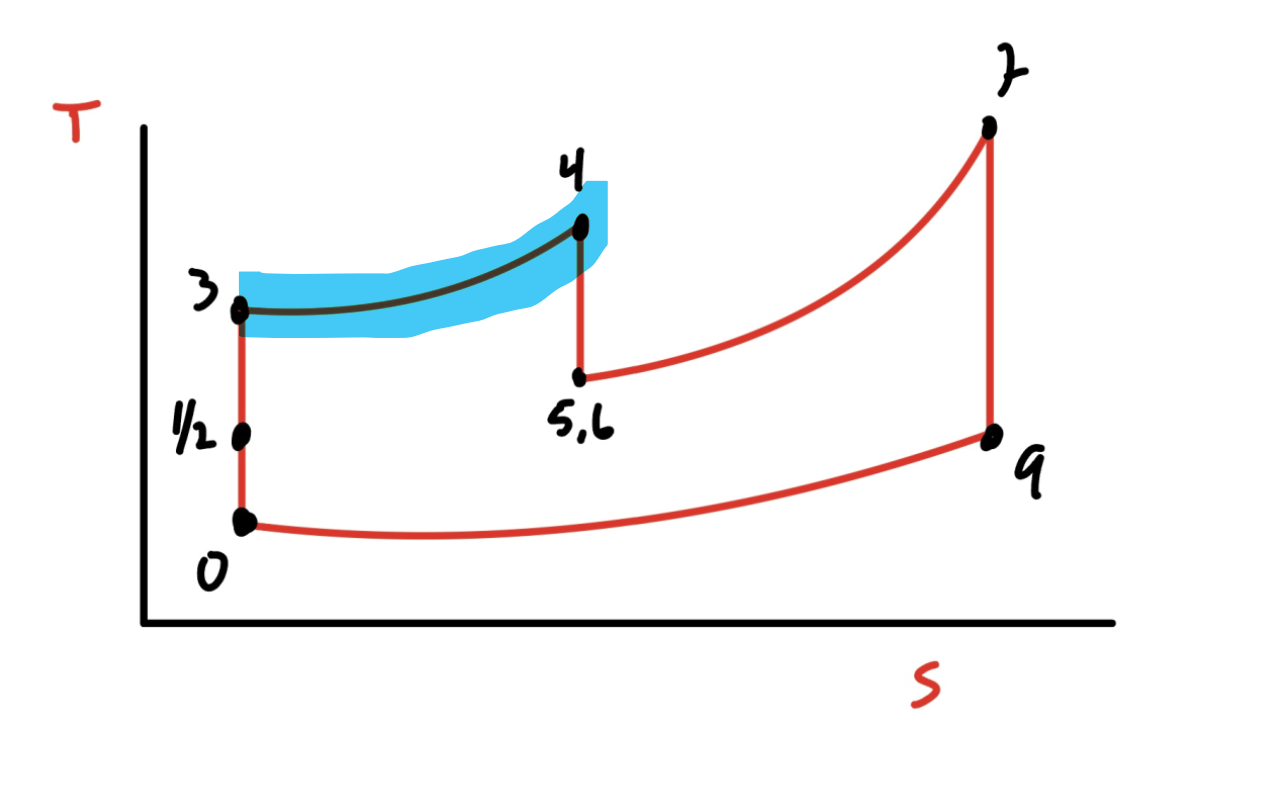
Name the highlighted section
Combustor
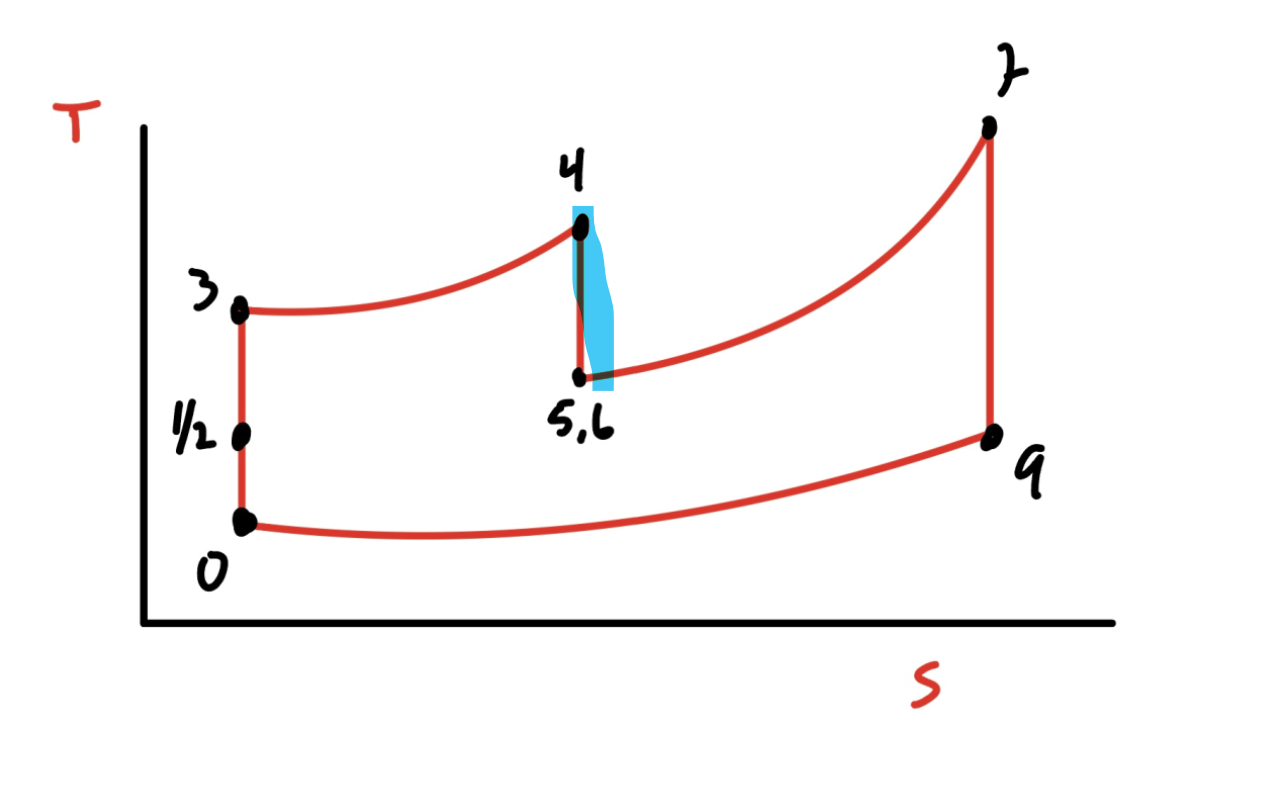
Name the highlighted section
Turbine

Name the highlighted section
After Burner

Name the highlighted section
Exhaust Nozzle
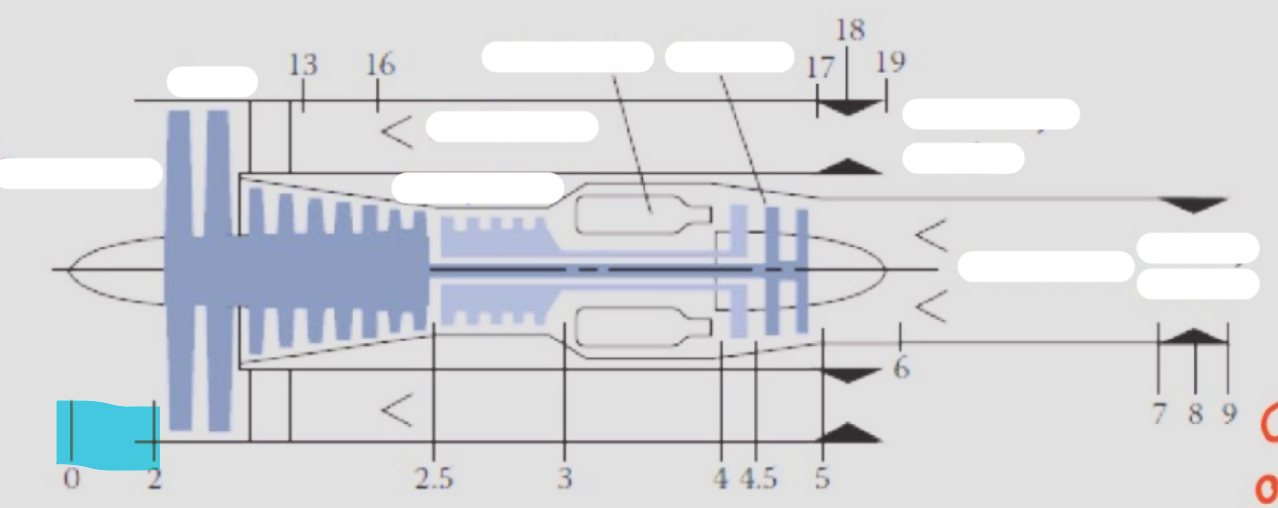
Name the highlighted section
Inlet

Name the highlighted section
Fan/Compressor

Name the highlighted section
Combustor/Afterburner
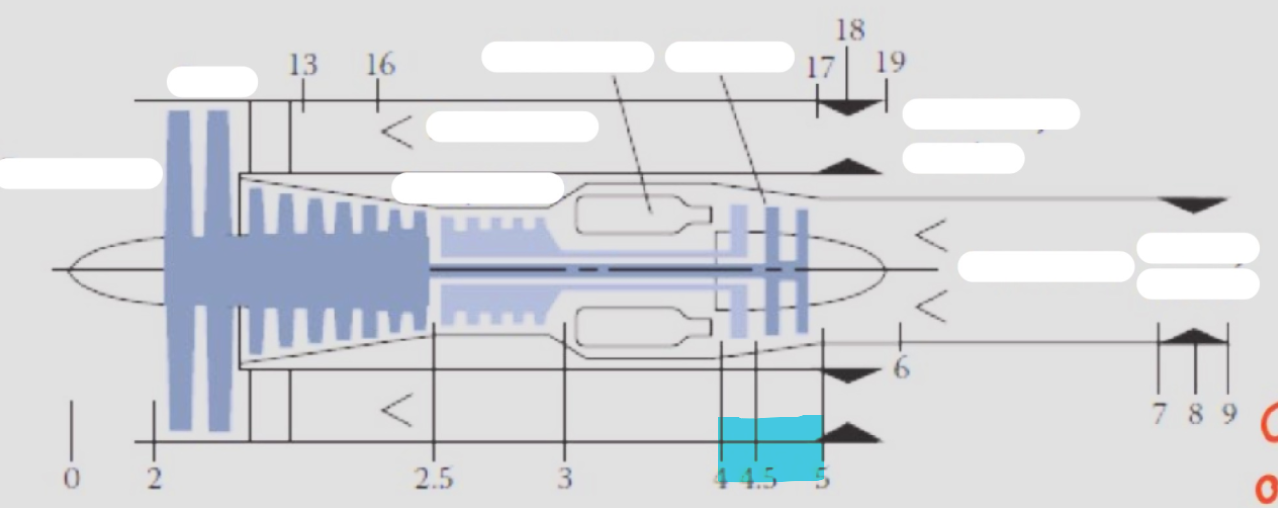
Name the highlighted section
Turbine
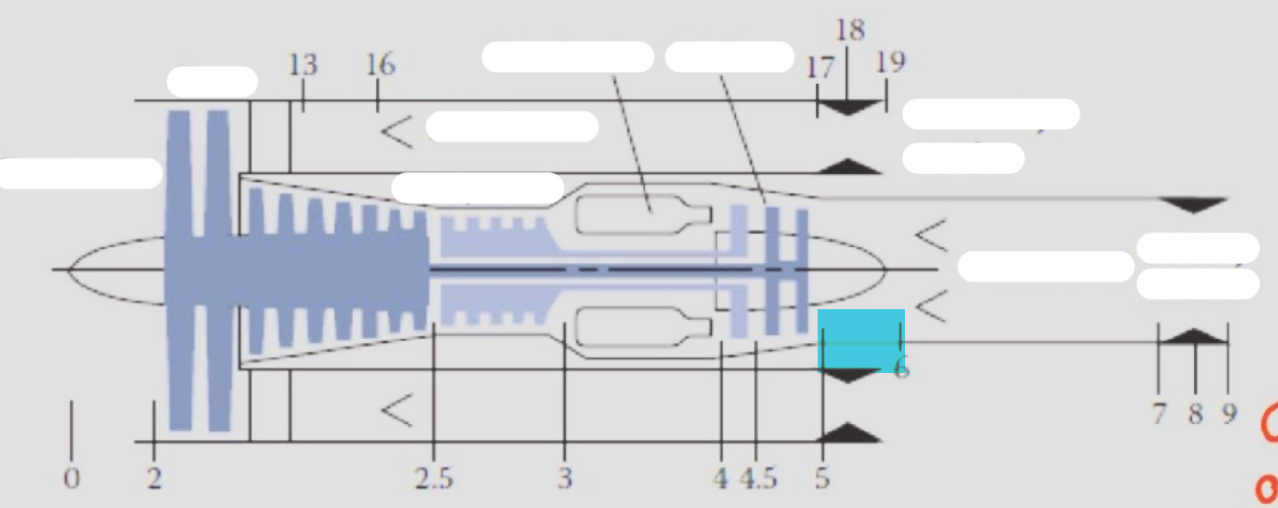
Name the highlighted section
Mixer

Name the highlighted section
Exhaust Nozzle
Rocket Advantage
Can operate without outside air because it carries both fuel and oxidizer; can operate at very high altitude and in space.
Rocket Disadvantage
Must carry its own oxidizer, which increases propellant mass and consumption.
What is thrust?
Force produced by the engine due to the change in momentum of the flow plus any pressure thrust.
What is specific thrust?
Thrust produced per unit air mass flow.
What is TSFC?
Fuel consumed per unit thrust.
What is specific impulse?
Thrust produced relative to propellant weight flow.
What do propulsion efficiencies measure?
How effectively the engine converts energy into useful thrust or propulsive power.
How are TSFC and engine efficiency related?
They are inverse trends. High TSFC means lower engine efficiency; low TSFC means higher engine efficiency.
General specific thrust trend by engine type (highest and lowest)
Turbojet has the highest specific thrust. As bypass ratio increases, specific thrust decreases. Turboprop/turboshaft have the lowest specific thrust.
General TSFC trend by engine type (highest and lowest)
Turbojet has high TSFC. Higher bypass ratio improves fuel efficiency and lowers TSFC. Turboprop/turboshaft have very low TSFC.
What happens when bypass ratio increases?
Fuel efficiency and propulsive efficiency improve, but specific thrust decreases.
What is an overexpanded nozzle?
Exit pressure is less than atmospheric pressure. Your review associates this with low altitude.
What is perfect expansion?
Exit pressure equals atmospheric pressure. This occurs at the design altitude.
What is an underexpanded nozzle?
Exit pressure is greater than atmospheric pressure. Your review associates this with high altitude.
Why does nozzle performance change with altitude?
Atmospheric pressure changes with altitude, changing how well the nozzle exit pressure
What happens through the compressor on a T-s diagram?
Temperature increases.
What happens through the combustor on a T-s diagram?
Temperature increases significantly as energy is added.
What happens through the turbine on a T-s diagram?
Temperature decreases as energy is extracted.
What is the purpose of a T-s diagram for a jet engine?
To visualize property trends through each engine component.
What happens in subsonic flow through decreasing area
Velocity increases.
What is choked flow at the throat?
Mach number equals 1.
What happens through a compressor?
Pressure and temperature increase.
What happens through a turbine?
Pressure and temperature decrease.
What happens across a shock?
Mach number decreases and total pressure decreases.
Why do we use simplifying assumptions?
They allow us to analyze complicated real engine equations more easily.
What is the disadvantage of simplifying assumptions?
The model becomes less representative of the real engine and results become less accurate.
How do you determine whether a propulsion answer is sensible?
Check expected engine trends, conservation laws, realistic magnitudes, signs, and efficiencies.
Compressor sanity check (what to look for)
Pressure, temperature, and enthalpy should increase.
Combustor sanity check (what to look for)
Temperature and enthalpy should increase.
Turbine sanity check (what to look for)
Pressure, temperature, and enthalpy should decrease.
Efficiency sanity check (what to look for)
Efficiency should be between 0 and 1.
Conservation sanity check (what to look for)
Mass and energy must satisfy conservation laws.

Name the highlighted line on the graph
Turbojet

Name the highlighted line on the graph
Low BPR Turbofan

Name the highlighted line on the graph
High BPR Turbofan

Name the highlighted line on the graph
Turboprop
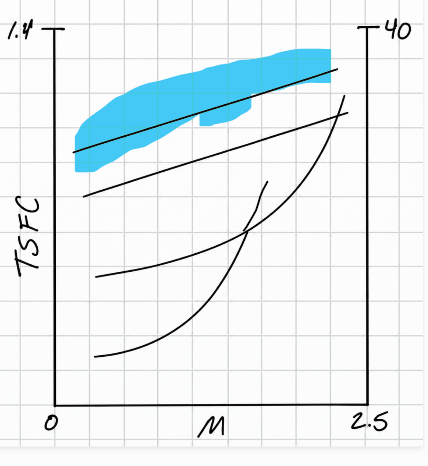
Name the highlighted line on the graph
Turbojet

Name the highlighted line on the graph
Low BPR Turbofan

Name the highlighted line on the graph
High BPR Turbofan

Name the highlighted line on the graph
Turboprop
What is the air-breathing engine thrust equation?
F=m˙eVe−m˙0V0+(Pe−P0)Ae
What is the thrust equation for a perfectly expanded nozzle?
F=m˙eVe−m˙0V0
What is the equation for specific thrust?
ST=m˙0F
What is the equation for TSFC?
TSFC=Fm˙f
What is the equation for specific impulse?
Isp=m˙pg0F
What is the general steady-flow First Law equation?
q−w=(hout−hin)+2Vout2−Vin2+g(zout−zin)
What is the simple compressor work equation?
wc=hout−hin=cp(Tout−Tin)
What is the simple turbine work equation?
wt=hin−hout=cp(Tin−Tout)
What is the combustor fuel energy equation?
Q˙in=m˙fhPR
What is the basic ideal turbojet power balance?
W˙t=W˙c
What is the basic ideal turbofan power balance?
W˙t=W˙c+W˙f
What is the compressor pressure ratio equation?
πc=Pt2Pt3
What is the fan pressure ratio equation?
πf=Pt2Pt13
What is the bypass ratio equation?
α=m˙corem˙bypass