Neural Function - 1
 Call Kai
 Learn
 Practice Test
 Spaced Repetition
 Match
 Flashcards
 Knowt Play
1/99

There's no tags or description
Looks like no tags are added yet.
100 Terms
What are the structural divisions of the Nervous System?
Central Nervous System: Brain, Brainstem, Cerebellum, Spinal Cord
Peripheral Nervous System: Cranial Nerves, Spinal Nerves, ganglia

What is the function of the Cerebral cortex?
Receives sensory information from skin, muscles, glands, and organs
Sends messages to move skeletal muscles
Performs : thinking, learning, and remembering
What is the function of the basal nuclei?
Coordinates slow, steady movements
blocks out unnecessary movement
What is the function of the Hypothalamus?
Controls homeostatic functions (body temperature, respiration, HR)
control hormone secretions of the pituitary.
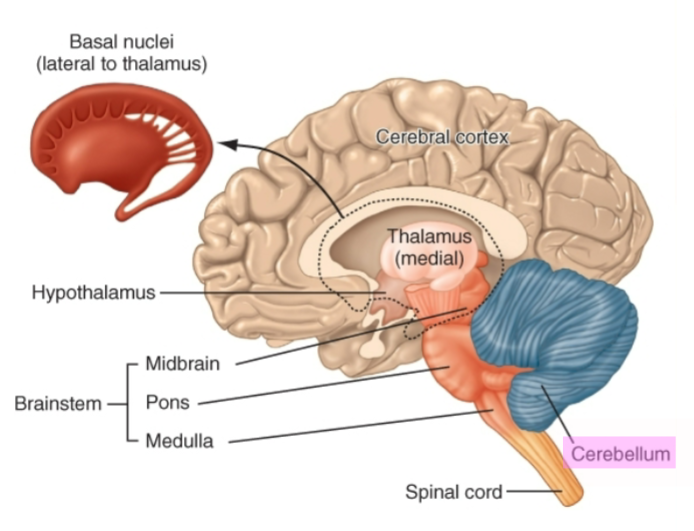
What is the function of the Cerebellum?
controls subconscious movements of skeletal muscles
BALANCE
muscle tone
posture
What is the function of the Brainstem?
—> Manages: HR, breathing
houses cranial nerves
controls head/eyes } reflexes

What is Spina Bifida?
back part does not seal: open vertebral canal => meninges and spinal cord HERNIATES
most common neural tube birth defect in US
What are the maternal risk factors of Spina Bifida?
family history
folate deficiency
certain medications (e.g., antiseizure agents)
diabetes mellitus
What are the complications of Spina Bifida?
physical and neurologic impairments
hydrocephalus
meningitis
learning problems
What are the types of Spina Bifiida? (arranged from least to worst)
Spina Bifida occulta
Meningocele
myelomeningocele

What is Spina Bifida occulta?
Mildest form
Results in a small gap in one or more vertebrae
usually nothing protrudes
NO NEURO DEFECTS
subtle skin findings: dimple, birthmark, or tuft of hair over the site

What is Meningocele?
the meninges protrude through the vertebral opening
The meninges and CSF form a sac on the surface of the back
The spinal cord develops normally
Usually NO NEURO DEFECTS
How does the spinal cord usually develop in meningocele?
Normally

What is Myelomeningocele
Most severe form
The meninges, spinal cord, spinal nerves, and CSF protrude through the large opening and form a sac on the infant’s back
Tissues and nerves are exposed in most cases, making the infant vulnerable to life-threatening infections
What are the complications of myelomeningocele?
paralysis
bowel and bladder problems
seizures
What is Hydrocephalus?
"water on the brain"
CSF accumulation in the skull.
Pressure thins the cortex, causing severe brain damage.
What happens to the ventricles in hydrocephalus? and what happens after?
They dilate —> the brain and blood vessels become compressed
What are the causes of hydrocephalus?
CSF flow disruption: obstructive hydrocephalus
CSF is not properly absorbed by the bloodstream
What are the risk factors of hydrocephalus?
prematurity
pregnancy complications
nervous system tumors
CNS infections
severe head injuries
What are the manifestations of Hydrocephalus in older children and adults?
headache followed by vomiting
nausea
blurred vision or diplopia
sluggish pupil response to light
uncoordinated movements
extreme fatigue
development delay
memory loss
confusion
irritability
personality changes
What are the manifestations of Hydrocephalus in infants?
large head
bulging fontanelle
seizures
development delay
What is Cerebral Palsy?
A group of nonprogressive disorders that appear in infancy or early childhood
permanently affects motor movement and muscle coordination
What are the manifestations of Cerebral Palsy?
persistence of early reflexes
development delays
ataxia
spasticity (stiff, tight muscles)
flaccidity
hyperreflexia
unusual positioning of limbs when resting or when held up
excessive drooling
difficulty swallowing
impaired sucking
difficulty with fine motor skills
What are the complications of Cerebral Palsy?
contractures
seizures
learning or cognitive difficulties
speech delays
balance and coordination issues
What urinary problem may occur in cerebral palsy?
urinary incontinence
What gastrointestinal problem may occur in cerebral palsy?
constipation
What are the contributing factors for cerebral palsy?
prematurity
maternal infections during pregnancy
head injury
What is Encephalitis?
Inflammation of the brain and spinal cord
Infection triggers the inflammatory response
What occurs during the inflammatory response in encephalitis?
vasodilation
increased capillary permeability
leukocyte infiltration
What can severe encephalitis cause to nerve cells?
degeneration
What are the causes of encephalitis?
virus (e.g., poliovirus, adenovirus, HSV, cytomegalovirus (CMV), West Nile virus, measles, and mumps)
• bacterial infections (e.g., Lyme disease, tuberculosis, and syphilis
What are complications of encephalitis?
cerebral edema
cerebral hemorrhage
brain damage
What are the manifestations of encephalitis?
Similar to meningitis but with a more gradual onset
• History of flu like symptoms
How does Encephalitis commonly begin compared with meningitis?
More gradually
True or False:
Most cases of encephalitis are mild and self-limiting.
True
What is Meningitis?
Inflammation of the meninges and subarachnoid space, usually resulting from an infection leading to swelling of the meninges.
Can be self-limiting (viral) or life-threatening (acute bacterial)
What does swelling in meningitis increase?
Intracranial pressure
What are the manifestations of Meningitis?
fever
chills
mental status changes
decreased consciousness
nausea
vomiting
photophobia (sensitivity to light - not wanting to be in ligth)
severe headache
stiff neck
agitation
bulging fontanelle
What are the causes of Meningitis?
bacteria (e.g., group B Streptococcus)
viruses (e.g.,enterovirus, West Nile virus, influenza,
human immunodeficiency virus [HIV])
tumors
allergens
What are the complications of Meningitis?
seizures
hearing loss
cerebral edema
permanent neuro damage and paralysis
What types of viruses cause Zika disease?
a flavivirus
How is Zika Virus transmitted?
mosquitos
sexual transmission
mother to fetus
blood transfusion
what are the manifestations of Zika Virus?
usually none
flulike symptoms if present
What are the complications of Zika virus?
With maternal- fetal transmission: ocular lesions, miscarriage, and microcephaly
What are the ways to prevent Zika Virus?
wearing protective covering
minimizing outdoor exposure
using insect repellant with DEET
using condoms
What commonly causes a traumatic brain injury?
blow or jolt to the head
What is a closed head injury?
nonpenetrating head injury
What can a TBI injury damage? and what can it cause
Nerve fibers
can cause hemorrhaging
What are manifestations of TBI?
can be sudden or severe
symptoms can improve or suddenly worsen
The outward appearance of the head does not indicate of a brain injury
What is a closed TBI?
nonpenetrating head injury
What is a concussion?
momentary interruption of brain function
can/cannot lead to loss of of consciousness
Amnesia, confusion, sleep disturbances, and
headaches may occur for weeks
What are the symptoms that follow a cerebral contusion? (which can last for weeks)
amnesia
confusion
headache
sleep disturbances
What usually causes a concussion?
Mild blow to the head
What is a cerebral contusion?
bruising of the brain
What causes a cerebral contusion?
blunt impact w skull
What is a coup injury?
Opposite rebound area
What is a countercoup injury?
opposite rebound area
Name all the types of skull fractures
linear
depressed
basilar
compound
comminuted
What complications risk increases w an open TBI?
infection
What are the ‘rules’ of TBI manifestations? (like what TBI is and how the symptoms generally behave)
changes in or unequal pupil size
fluid draining from the nose, mouth, ears
loss of consciousness
seizures
not being able to recall event details
What scale assesses consciousness after head trauma?
Glasgow Coma scale
What does the Glasgow Coma Scale assess?
eye opening
verbal response
motor response
response to stimuli
What is the normal ICP?
60-200
What relationship exists within the skull?
Pressure-volume relationship
What vascular response may occur when ICP increases?
vasoconstriction: if blood vessels dilate —> constrict blood —> constrict if ICP increases
What three contents are involved in the Monro-Kellie hypothesis?
CSF, blood, brain tissue
What is Cushing’s reflex?
increase sympathetic stimulation when the mean arterial pressure drops below the ICP
What can Cushing’s reflex cause?
vasoconstriction
increased cardiac contractility
increased cardiac output
What is Cushing’s Triad?
increased blood pressure
bradycardia
Cheyne-Stokes respirations
What is a herniation a complication of?
increased intracranial pressure
What structures can herniation compress?
neural tissue and cranial nerves
What parts of the brain are affected by herniations?
brainstem and cerebellum
What can compression of the reticular activations system cause?
coma or death
What is an intracranial hematoma?
collection of blood in the tissue that develops from ruptured blood vessels
What can bleeding from a hematoma increase?
intracranial pressure
blood may also coagulate and form a solid mass
What are the types of intracranial hematoma?
epidural
subdural
subarachnoid
intracranial
What is an epidural hematoma?
bleeding between the dura and skull, usually caused by an arterial tear
What are the manifestations of a typical epidural hematoma?
alertness between losses of consciousness, then loss of consciousness
Where does a subdural hematoma develop?
between dura and arachnoid, caused by venous tear
progresses rapidly and has a high mortality rate
When do acute subdural manifestations generally appear?
within 24 hours
When do chronic subdural manifestations generally appear?
manifestations develop several weeks after the injury due to a leak
Who is more likely to develop a chronic subdural hematoma and why?
elderly adults because of brain atrophy
Where does an intracerebral hematoma occur?
brain tissue
What are the causes of an intracerebral hematoma?
contusion or shearing injuries but can also result from hypertension
cerebral vascular accidents (strokes)
aneurysms
vascular abnormalities
Where does subarachnoid hemorrhage occur?
bleeding between arachnoid and pia
What is the primary presentation of subarachnoid hemorrhage?
sudden severe headache that worsens near the back of the head
What can directly injure the spinal cord?
—> pulling or compression from:
direct injury to the spinal cord / indirect damage to surrounding bones, tissues, or blood vessels
What are the causes of spinal cord injuries?
motor vehicle accidents
falls
sports injuries
violence
weakening vertebral structures (rheumatoid arthritis / osteoporosis)
What is a spinal shock?
temporary neurologic suppression due to spinal cord compression, but function will return
What is autonomic hyperreflexia?
Massive sympathetic response that can cause:
headaches, hypertension, tachycardia, seizures, stroke, and death
Which injuries are most associated with autonomic hyperreflexia?
injuries above T6
What is a neurogenic shock
an abnormal vasomotor response
What causes neurogenic shock
disrupted sympathetic impulses
what happens after spinal cord injury?
loss of neurologic functioning
Which extremities are affected by cervical or thoracic injuries?
upper and lower extremities
What are the problems associated with cervical/thoracic injuries?
breathing difficulties
loss of normal bowel and bladder control
paresthesia
sensory changes
spasticity
pain
weakness
paralysis
blood pressure instability
temperature fluctuations
diaphoresis (too much sweating, which is a compensating response)
True or False:
Lumbar/sacral injuries affect the lower extremities in varying degrees
True
Do lumbar/sacral injuries include breathing difficulties?
No
What are the complications of spinal cord injuries?
respiratory injuries
effects of immobility
changes in bowel and bladder function
sexual dysfunction
chronic pain
death
Name the effects of immobility
constipation
pulmonary infections
urinary infections
thrombus
impaired skin integrity
contractures