Unit 2 - Motivational Theories
 Call Kai
 Learn
 Practice Test
 Spaced Repetition
 Match
 Flashcards
 Knowt Play
1/24

There's no tags or description
Looks like no tags are added yet.
25 Terms
Motive
Psychological state that arouses an individual to act towards a desired goal or outcome
3 types of goals
Performance (end result without comparison)
Process (quality of performance)
Outcome (end result in comparison to others)
Types of cycles
Macrocycle > Mesocycle > Microcycle > Individual sessions
Achievement Goal Theory
Success or failure depend on an athlete’s perception of goal attainment
Task vs. ego orientation
Draw out the achievement goal theory 2×2

Add in the arrows and descriptions

What two things are necessary for achievement behavior in achievement goal theory?
Achievement goals + Perceived ability

Draw out achievement goal theory flow chart

____ have more adaptive motivational patterns. For example, ____
Task goals; positive attitudes, increased effort
We should focus extra attention on ___ and ___ goals because they ____.
We should focus extra attention on task-oriented and approach goals because they foster task motivational climates.
Self-Determination Theory
People become self-determined when their three basic needs are met: Relatedness, autonomy, and competence
Humanistic theory

Relatedness
Will to interact with, be connected to, and experience caring for others
Competence
The need to feel effective in activities; seek to control the outcome and experience mastery
Autonomy
Desire to be causal agents and act in harmony with one’s self → feeling of psychological liberty; does NOT mean to be independent of others
The taxonomy of motivation falls under what theory?
Self-determination theory
Draw out taxonomy of motivation

OPTIMAL Theory
Optimizing Performance Through Intrinsic Motivation and Attention for Learning
Focuses on two key psychological variables that influence motor skill learning
Enhanced expectancies
High expectations for future performance
Prepares the learner for successful movement at lower levels
Creates a good practice environment
Self-efficacy is key!

Autonomy
An individual’s need to play a role in determining their behavior
Ties into intrinsic motivation → We put more effort into things we aren’t forced to do.
Perceived autonomy increases enhanced expectancies.
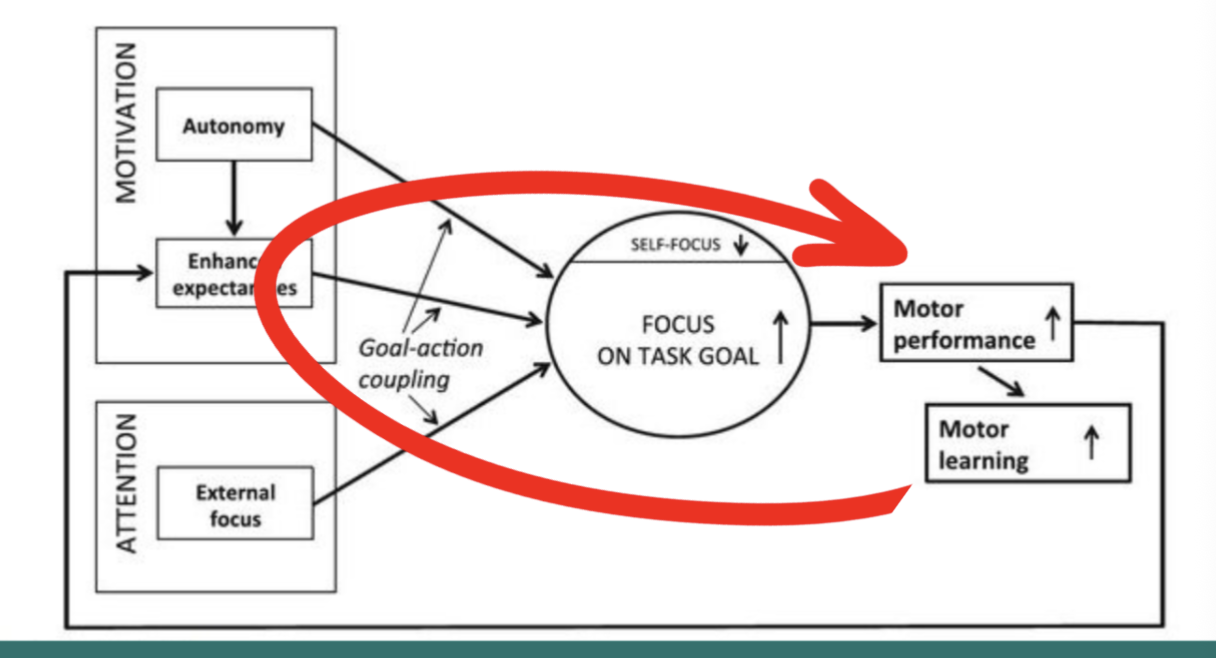
Draw OPTIMAL Theory
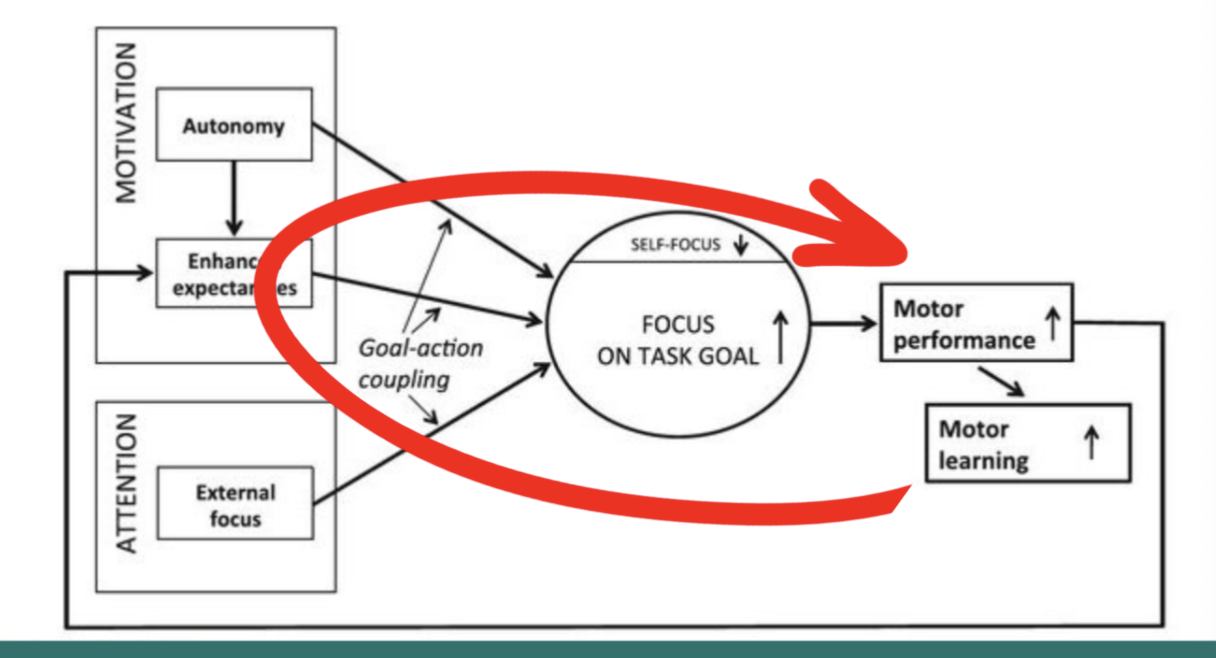

Why does this diagram have the red arrow?
When a performer experiences success, it reinforces their belief in themselves (enhanced expectancies), contributing to further focus, which contributes to increased motor performance. Performance and motivation continuously enhance one another.
Self-efficacy in motor learning
One’s belief that they can perform a specific action within a specific environment → self-efficacy =/= self-confidence (overall belief in self)
Reciprocal determinism
The assumption that actions are the result of an interaction among an individual’s thoughts, the context of the environment, and the consequences of actions
Factors that are integrated to form self-efficacy perception (draw it out)
Self-Efficacy Perception = Vicarious experience + Verbal persuasion + Previous experience + Physiological state

Integration of self-efficacy factors
Through information- and executive-processing, factors come together to create self-efficacy perception.
