CogPro Midterm 2 Chapters 6-9
 Call Kai
 Learn
 Practice Test
 Spaced Repetition
 Match
 Flashcards
 Knowt Play
1/138

There's no tags or description
Looks like no tags are added yet.
139 Terms
Acquisition
The process of placing new information into long-term memory
Storage
The state in which a memory, once acquired, remains until it is retrieved
Retrieval
The process of locating information in memory and activating that information for use
Modal Model of Memory
was proposed in 1968 by Richard Atkinson and Richard Shiffrin. It describes human memory as a system with three structural memory stores and a set of control processes that govern how information moves between them

Sensory Memory
A form of memory that holds on to just-seen or just-heard input in a “raw” sensory form.
Short-Term Memory
An older term for what is now called working memory.
the place where you hold information while you’re working on it
Working Memory
The storage system in which information is held while that information is being worked on. All indications are that working memory is a system, not a single entity, and that information is held here via active processes, not via some sort of passive storage. Formerly called short-term memory
Long-Term Memory (LTM)
The storage system in which we hold all of our knowledge and all of our memories. Long-term memory contains memories that are not currently activated
Place
contemporary theorists don’t think of working memory as a “______” at all. Instead, working memory is simply the name we give to a status.
Free-Recall Procedure
a memory test and cognitive research paradigm where a person studies a list of items (such as words, numbers, or pictures) and then retrieves them from memory in any order they choose, without any external prompts or cues
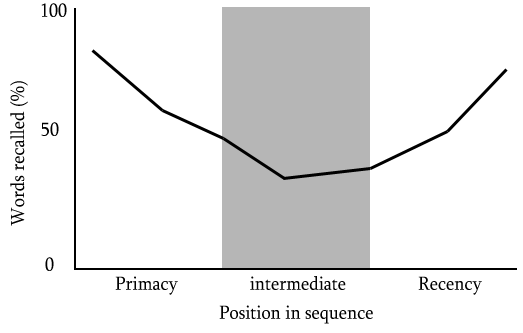
Primacy Effect
Better recall of items presented at the beginning of a list or sequence
Initial items get more attention and mental rehearsal, allowing them to transfer from working memory into long-term memory
Recency Effect
Better recall of items presented at the end of a list or sequence.
Final items remain active in short-term working memory at the time of recall
Serial-Position Effect
a psychological tendency where people best remember the first and last items in a series, while forgetting items in the middle. This creates a U-shaped recall curve.
Memory Rehearsal
the mental or verbal repetition of incoming information to keep it active and process it for retention
Two types: maintenance vs elaborative
Digit-Span Task
For many years, the holding capacity of working memory was measured with a _________
Digit-Span Task
A task often used for measuring working memory’s storage capacity. Research participants are read a series of digits (e.g., “8 3 4”) and must immediately repeat them back. If they do this successfully, they are given a slightly longer list (e.g., “9 2 4 0”), and so forth. The length of the longest list a person can remember in this fashion is that person’s digit span. Also see operation span.
7 plus-or-minus 2
A range often offered as an estimate of the number of items or units able to be contained in working memory.
Chunks
The hypothetical storage units in working memory; it is estimated that working memory can hold 7 plus-or-minus 2 chunks. However, an unspecified quantity of information can be contained within each chunk, because the content of each chunk depends on how the memorizer has organized the materials to be remembered.
Operation Span
A measure of working memory’s capacity
also the modern replacement for the (less useful) measure obtained from the digit-span task.
Working Memory Capacity
is a cognitive system that temporarily holds and manipulates information needed for complex tasks like reasoning, learning, and problem-solving
Articulatory Rehearsal Loop
a component of Baddeley's model of working memory responsible for temporarily holding and refreshing verbal and auditory information
Subvocalization
The silent internal pronunciation of words when reading or thinking, which involves tiny, often undetectable movements of the speech organs like the tongue, lips, and larynx.
Phonological Buffer
a component responsible for the temporary storage and assembly of sound-based (phonological) information during speech, reading, writing, and language tasks
Concurrent Articulation Task
a participant is required to repeatedly speak or mime a simple, irrelevant speech sequence (such as saying "tah-tah-tah" or counting "1, 2, 3" aloud) while simultaneously performing another primary task
It ties up the vocal tract, motor control muscles, and phonological loop mechanisms required for spoken language.
It prevents the person from silently sounding out or internally rehearsing verbal information (subvocalization).
Researchers use it to test whether a specific task (such as reading comprehension, visual memory, or problem-solving) relies on internal speech and the phonological buffer.
Episodic Buffer
a component of Baddeley's Model of Working Memory that acts as a temporary storage system to integrate visual, spatial, and verbal information with a sense of time and sequence
Maintenance Rehearsal
A rote, mechanical process in which items are continually cycled through working memory, merely by being repeated over and over
Relational/Elaborative Rehearsal
A form of mental processing in which one thinks about the relations, or connections, among ideas. The connections created (or strengthened) in this way will later guide memory search
vastly superior to maintenance rehearsal for establishing information in memory.
Intentional Learning
The acquisition of memories in a setting in which people know that their memory for the information will be tested later
Incidental Learning
Learning that takes place in the absence of any intention to learn and, correspondingly, in the absence of any expectation of a subsequent memory test
Level of Processing
An assessment of how “deeply” newly learned materials are engaged; shallow processing involves thinking only about the material’s superficial traits, whereas deep processing involves thinking about what the material means.
Memory Connections
Apparently, elaborate processing leads to better recall. Why? The answer hinges on ____________
Retrieval Paths
A connection (or series of connections) that can lead to a sought-after memory in long-term storage.
Mnemonic Strategies
Techniques designed to improve memory accuracy and to make learning easier; in general, mnemonic strategies seek to help memory by imposing an organization on the materials to be learned.
Peg-Word Systems
A type of mnemonic strategy using words or locations as “pegs” on which to “hang” the materials to be remembered.
e.g.
One is a bun.
Two is a shoe.
Three is a tree.
Four is a door.
Five is a hive.
Six are sticks.
Seven is heaven.
Eight is a gate.
Nine is a line.
Ten is a hen.
Context-Dependent Learning
A pattern of data in which materials learned in one setting are more likely to be remembered when the person returns to that setting but are less well remembered in other settings.
Context Reinstatement
A procedure in which a person is led to the same mental and emotional state they were in during a previous event; context reinstatement can often promote more accurate and more complete recollection of that event.
Encoding Specificity
The tendency, when memorizing, to place in memory both the materials to be learned and some amount of their context. As a result, these materials are likely to be recognized as familiar, later on, only if the materials appear again in a similar context.
Associations or Associative Links
Functional connections that are hypothesized to link nodes within a mental network or detectors within a detector network; these associations are often hypothesized as the “carriers” of activation from one node or detector to the next.
Node
An individual unit within an associative network.
Summation
The addition of two or more separate inputs so that the effect of the combined inputs is greater than the effect of any one input by itself.
Spreading Activation
process through which activation travels from one node to another, via associative links.
Lexical-Decision Task
a psycholinguistic experiment where participants view or hear a string of letters and quickly decide whether it is a real word or a nonsense word (nonword)
Semantic Priming
A process in which activation of an in memory causes activation to spread to other ideas related to the first in meaning
Recognition
The task of memory retrieval in which the items to be remembered are presented and the person must decide whether or not the item was encountered in some earlier circumstance. For example, someone might be asked, “Have you ever seen this person before?” or “Is this the poster you saw in the office yesterday?” Often contrasted with recall.
Recognition, recall
Two modes of retrieval
Attribution
the act of giving credit, assigning responsibility, or identifying the cause or origin of something
Source Memory
the ability to remember the origin, context, or conditions under which you acquired a piece of information or experienced an event
Word-Stem Completion
A task in which research participants are given the beginning of a word (e.g., “COM . . .”) and must provide a word that starts with the letters provided.
Explicit Memory
A memory revealed by direct memory testing
the conscious, intentional recollection of facts, events, and personal experiences
Direct Memory Testing
A form of memory testing in which people are asked explicitly to remember some previous event. Recall and standard recognition testing are both forms of direct memory testing. Often contrasted with indirect memory testing.
Indirect Memory Testing
A form of memory testing in which research participants are not told that their memories are being tested. Instead, they’re tested in such a way that previous experiences can influence current behavior. Examples of indirect tests include word-stem completion, the lexical-decision task, and tachistoscopic recognition. Often contrasted with direct memory testing.
Implicit Memory
A memory revealed by indirect memory testing
a type of long-term memory that you acquire and use unconsciously. It lets you perform tasks and react to things automatically without needing to actively or deliberately think about them
Illusion of Truth
An effect of implicit memory in which claims that are familiar end up seeming more plausible thanks to a prior exposure to the claim
Processing Fluency
The speed or ease of processing involved in recognizing or thinking about a stimulus or idea; usually understood as a reflection of the speed or ease with which activation moves through a processing pathway.
Retrograde Amnesia
An inability to remember experiences that occurred before the event that triggered the memory disruption. Often contrasted with anterograde amnesia.
Korsakoff’s syndrome
A clinical syndrome characterized primarily by dense anterograde amnesia. Korsakoff’s syndrome is caused by damage to specific brain regions, and it is often precipitated by a form of malnutrition that is common among long-term alcoholics.
Intrusion Error
A memory error in which a person recalls elements that were not part of the original episode.
DRM Paradigm
A commonly used experimental design, named after its originators (Deese, Roediger, and McDermott), for eliciting and studying memory errors. In this procedure, a person sees or hears a list of words that are related to a single theme; however, the word that names the theme is not itself included. Nonetheless, people are very likely to remember later that the theme word was presented.
Schema
Knowledge describing what is typical or frequent in a particular situation.
Retention Interval
The amount of time that passes between the initial learning of some material and the subsequent memory retrieval of that material
Decay Theory of Forgetting
The hypothesis that with the passage of time, memories may fade or erode.
Interference Theory
The hypothesis that materials are lost from memory because of interference from other materials that are also in memory. Interference caused by materials learned prior to the learning episode is called “proactive interference;” interference caused by materials learned after the learning episode is called “retroactive interference.”
Retrieval Failure
A mechanism that probably contributes to a great deal of forgetting. Retrieval failure occurs when a memory is, in fact, in long-term storage but the person is unable to locate that memory when trying to retrieve it.
TOT Phenomenon
a temporary mental state where you cannot quite recall a familiar word, even though you feel certain that you know it and that retrieval is right around the corner
Testing Effect
actively pulling information out of memory strengthens long-term retention much more effectively than passively rereading or restudying notes
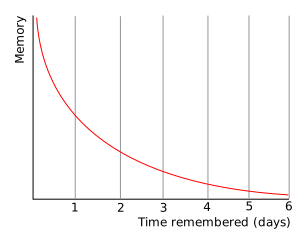
Forgetting Curve
a psychological model introduced by German psychologist Hermann Ebbinghaus in 1885 that describes the exponential, non-linear decline of human memory over time when there is no attempt to retain it
Autobiographical Memory
The aspect of memory that records the episodes and events in a person’s life.
Memory Consolidation
The biological process through which new memories are “cemented in place,” acquiring some degree of permanence through the creation of new (or altered) neural connections. Consolidation involves changes in the brain that include the adjustment of synaptic connections and also the creation of new connections, and it unfolds over the hours after the target event. Factors that disrupt a person’s biological state (including extreme fatigue, extreme stress, malnutrition, or a high level of intoxication) can prevent consolidation from occurring; in this situation, no enduring memory is created.
Flashbulb Memories
Memories of extraordinary clarity, typically for highly emotional events, that are retained over many years. Despite their remarkable vividness, flashbulb memories sometimes are inaccurate.
The Cognitive Interview
a specialized interview method designed to help eyewitnesses, victims, or survey respondents accurately retrieve and report memories or mental processes
Long-Term Memory
Vast, perhaps limitless?
Slower rate of forgetting
Must be searched… not instantly accessible; most information lies dormant
Semantic Memory
A type of explicit memory
generalized knowledge (facts, categories)
Consciously know it, but don’t recall learning it
Rehearsal
Increases the likelihood or remembering material
The type is important (not just more = better)
Memory is not a monolithic structure: level of active engagement matters
Incidental Learning
Spontaneous / unstructured
Learning in the absence of intention
Core to AI / machine learning
e.g. language, context specific, task specific, cultural specific (watching films), music (pick up new vocabulary)
Clustering
Strong tendency to recall items in an organized manner (e.g. categories: abstract vs concrete, inanimate vs animate, colours, simple vs complex, etc)
Robustness
The ___________ of a memory system is its ability to retain, store, and retrieve information reliably despite errors, noise, unexpected inputs, or environmental disturbances
Physical
_________ context is the strongest for aiding in memory/learning
Physiology-Mood
_________ context is the weakest in aiding in memory/learning
Memory Myths
Memory is just a simple linear model (just age/time)
Memory is a veridical (factual) recording of events: you remember it like a photograph
Time is the only factor that influences memory quality
The 7 Sins of Memory - D. Schachter
Transience - lose access over time
Absent-Mindedness - superficial processing
Blocking - temporary access failure
Misattribution - attributing something to an incorrect source
Suggestibility - implanted memories
Bias - current beliefs distort past info
Persistence - unwanted recall
Anterograde Amnesia
disruption for things learned after the event
Dissociative (Psychogenic) Amnesia
Fugue State
No obvious organic cause; loss of memory as the result of emotional trauma / crisis (e.g. Breaking Bad)
Motivated forgetting ? → Suppression?
After a violent crime or traumatic event
Limited science for this type of event
Organic Amnesia
memory loss caused by head injury, stroke, variety of diseases
damage to brain regions: Medial temporal lobe (Patient HM), medial thalamus (attention control), basal forebrain (false memories)
Effects of Amnesia
Tends to be preserved:
Working memory
Sematic memory
Procedural + Implicit memory
Tends to be disrupted:
episodic + autobiographical memory
mostly anterograde
Korsakoff’s Syndrome
Long-term alcohol abuse, thiamine deficiency
Typically unaware of profound memory deficits
Often accompanied by emotional changes (e.g. apathy or mild euphoria
Scripts
A pattern of temporal information
Eyewitness Memory
Memory is generally very accurate for events/actions
access the emotional space = greater recall
recall for information is higher for actions than for people details/features
Tips to Improve Interview Techniques/Interrogation
Double blind line up
Instructions to the witness
confidence statements
simultaneous vs. sequential presentations
Recording of procedures
The Cognitive Interview, Hypnosis, Emotional Engagement
3 techniques to improve recall…
The Cognitive Interview
Reconstruct environmental context
Reconstruct personal and emotional context
Reconstruct all details (even insignificant ones)
Use of open-ended questions - no right or wrong answer
Hypnosis
Modest evidence: may increase the amount of information people recall.
Restriction: More recalled information does not necessarily mean more accurate information.
Suggestibility: People may incorporate suggestions into their memories, creating false or distorted memories.
Confidence: Hypnosis may increase confidence in memories, even when those memories are inaccurate.
can improve the quantity of recall without improving the accuracy of recall.
Emotional Engagement
Emotion plays a role in directing the attention spotlight to specific details
Risk for suggestibility
Long-Term Remembering
Beyond trauma/injury, adult memories are generally most stable into mid-life (enhanced via family/social network)
While there is evidence of infantile/childhood amnesia, we have developmental evidence that infants do have impressive memory systems
Rovee-Collier’s “Kicking Studies”
Studied memory in infants as young as 2–3 months old.
Attached a ribbon from the infant's ankle to a mobile above their crib.
Infants learned that kicking their legs caused the mobile to move (cause-and-effect association).
Researchers tested memory by reintroducing the mobile and observing whether infants kicked more.
Infants retained the memory for several days, demonstrating early long-term memory.
Reminders and familiar cues helped infants retrieve memories they seemed to have forgotten.
Retention in 2 month olds for 2 days, retention in 3 month olds for 7 days
Significance: Demonstrated that infants can form and retain memories, suggesting childhood amnesia is not simply due to an inability to create memories.
Meltzoff's Deferred Imitation Paradigm
Studied memory in infants around 14–18 months old.
Infants watched an adult demonstrate how to perform a novel action with an unfamiliar object.
Researchers prevented infants from immediately copying the action.
After a delay (hours or days), infants were given the same object to see if they remembered the action.
Infants successfully reproduced actions they had previously observed, even after a delay.
Demonstrated that infants can form and retain memories of events without immediately practising them.
Significance: Provides evidence of early long-term memory and shows that infants can remember and later retrieve information through imitation.
Possible Reasons for Childhood Memory Loss
Failure to fully encode at outset
Repression linked to emotional trauma
Differences between adult and childhood schemata (and access)
Language
Concept
An internal, mental representation of the properties of objects or events
Category
A mental “pigeonhole” into which objects or events with common properties are placed
Concept Identification
Task requires deciding if an item is a member of a given category or not
Family Resemblance Theory
From philosopher Wittgenstein
Suggests there are features that are common with a family to “build’ knowledge of the category
Not every members of the family holds each feature