RNA Structure, Synthesis and Genetic Code (GOCHIN)
 Call Kai
 Learn
Learn Practice Test
 Spaced Repetition
 Match
Match Flashcards
 Knowt Play
1/172

There's no tags or description
Looks like no tags are added yet.
Name | Mastery | Learn | Test | Matching | Spaced | Call with Kai | Chat |
|---|
No analytics yet
Send a link to your students to track their progress
173 Terms
What is the structure of RNA?
nucleic acid monomer (ppt)
polymer of ribonucleotides (pdf)
True or False
RNA is a polymer of ribonucleotides connected by phosphate groups through the 3’ and 5’ hydroxyl groups in the same linkage as DNA
a) true
b) false
a)
How many strand or strands does RNA typically exist in?
a) single strand of RNA
b) double stranded RNA
a)
What is a difference in the structure of sugar in RNA vs DNA?
a) DNA has a 2’-OH on its 2nd carbon
b) RNA has a 2’-OH on its 2nd carbon
b)
True or False
RNA uses Uracil instead of Thymine
a) true
b) false
a)
True or False
RNA has unusual bases and unique modifications after synthesis (pseudouridine, dihydrouridine, methyladenosine) which confer specific structure or function.
a) true
b) false
a)
Which is more stable DNA or RNA?
a) DNA
b) RNA
a)
True or False
RNA is not nearly as stable as DNA and is prone to degradation by RNAses
a) true
b) false
a)
What is anticodon pairing?
Some non-Watson Crick base pairing at the base of stem-loop structures and in the codon
Which of the following is/are true about RNA structure:
a) RNA is a single strand, with hairpins and loops. RNA’s are much smaller in length than DNA.
b) RNA has a much wider variety of structures than DNA. RNA structures are far less dense than proteins
•c) RNA can be catalytic (e.g. tetrahymena introns, some rRNA introns)
d) All eukaryotic RNA is produced as a primary transcript which is modified to produce the mature product. Splicing occurs in almost all RNAs, and specific cleavage, base editing and / or end modifications occur depending on the type of RNA
e) all of the above
e)
What are ribozymes?
RNA’s with catalytic function
What are the different categories of RNA?
a) coding RNA
b) Transcriptional RNA
c) Non-coding RNA
d) Small RNAs
e) all of the above
e)
What type of RNA belongs to the category of Coding RNA
a) mRNA
b) rRNA
c) tRNA
d) ncRNA, snoRNA, snRNA, siRNA, miRNA, stRNA
a)
What type of RNA belongs to the category of Transcriptional RNA (Choose 2)
a) mRNA
b) rRNA
c) tRNA
d) ncRNA, snoRNA, snRNA, siRNA, miRNA, stRNA
b, c
What type of RNA belongs to the category of Non-coding RNAs/Small RNAs
a) mRNA
b) rRNA
c) tRNA
d) ncRNA, snoRNA, snRNA, siRNA, miRNA, stRNA
d)
Which types of RNA are involved in protein production?
a) rRNA
b) tRNA
c) mRNA
d) miRNA
e) siRNA
f) A, B. C
g) A, C, D
f)
What type of RNA comprises 80% of the RNA in the cell?
a) tRNA
b) mRNA
c) rRNA
d) miRNA
c)
What are the different type(s) of RNA polymerases in Prokaryotes?
a) RNA pol I
b) RNA pol
c) RNA pol II
d) RNA pol III
b)
What are the different types of RNA polymerases in Eukaryotes?
a) RNA pol I
b) RNA pol
c) RNA pol II
d) RNA pol III
e) Mitochondrial
f) A, C, D, E
g) All of the above
f)
What is the product of RNA polymerase I
a) rRNA (28S, 18S, 5.8S)
b) mRNA (hnRNA), snRNA
c) tRNA, 5S rRNA
d) mitochondrial RNA
a)
What is the product of RNA polymerase II?
a) rRNA (28S, 18S, 5.8S)
b) mRNA (hnRNA), snRNA
c) tRNA, 5S rRNA
d) mitochondrial RNA
b)
What is the product of RNA polymerase III?
a) rRNA (28S, 18S, 5.8S)
b) mRNA (hnRNA), snRNA
c) tRNA, 5S rRNA
d) mitochondrial RNA
c)
What is the product of Mitochondrial RNA polymerase?
a) rRNA (28S, 18S, 5.8S)
b) mRNA (hnRNA), snRNA
c) tRNA, 5S rRNA
d) mitochondrial RNA
d)
What is the product of RNA polymerase in Prokaryotes?
a) rRNA (28S, 18S, 5.8S)
b) mRNA (hnRNA), snRNA
c) tRNA, 5S rRNA
d) mitochondrial RNA
e) all RNA’s except primers for DNA synthesis
e)
True or False
In prokaryotes, the alpha, beta, and omega subunits form the core of a core enzyme. The enzyme is inactive until the sigma factor recognizes the promotor and binds to it, thus making it a holoenzyme and active.
a) true
b) false
a)
True or False
Non-coding RNA’s are not important in development
a) True
b) False
b)
True or False
Non-coding RNA’s are VERY important in development
a) True
b) False
a)
X-linked FMR1 gene, which contains a CGG trinucleotide repeat sequence in the 5’-UTR. Expansion to > 200 repeats results in Fragile X syndrome (FXS), which occurs in both males and females, although often with more serious clinical symptoms of mental retardation in males. It is thought that epigenetic modification by miRNA’s in the repeat region leads to hypermethylation and gene silencing. The FMRP protein is expressed at its highest levels early during fetal development, and is associated with miRNA modulation of mRNA is the brain.
Based on the example above does this show that Non-coding RNA’s are very important or not important in development?
a) Non-coding RNA’s very important in development
b) Non-coding RNA’s not important in development
a)
Which is best described based on the description below: This type of RNA can undergo:
modification (snoRNA)
processing (snoRNA)
Splicing
Group I introns self-splicing
Group II introns lariat pathway
a) pre-rRNA
b) pre-mRNA
c) pre-tRNA
a)
Which is best described based on the description below: This type of RNA can undergo:
modification (cap, polyA)
splicing (snRNA: U1-U6)
editing (gRNA)
Transport
a) pre-rRNA
b) pre-mRNA
c) pre-tRNA
b)
Which is best described based on the description below: This type of RNA can undergo:
modification (base, ribose)
processing (ribosome)
splicing (enzymatic)
editing
a) pre-rRNA
b) pre-mRNA
c) pre-tRNA
c)
Which RNA polymerase will synthesize:
pre-rRNA → modification (snoRNA)
Modification(snoRNA)→ processing (snoRNA)
Processing (snoRNA) → splicing (Group I and Group II introns)
Splicing (Group I and Group II introns)→ 18S, 5.8S, 28S rRNA
18S, 5.8S, 28S rRNA → Protein
Product= Protein
a) RNA polymerase I
b) RNA polymerase II
c) RNA polymerase III
a)
Which RNA polymerase will synthesize and undergo the following steps:
pre-mRNA also makes snRNA
Modification (cap,polyA)
Splicing (snRNA: U1-U6)
Editing (gRNA)
Transport
Gm7/ A200 mRNA
Product= Protein
a) RNA polymerase I
b) RNA polymerase II
c) RNA polymerase III
b)
Which RNA polymerase will synthesize and undergo the following steps:
pre-tRNA also makes PRnase
Modification (base, ribose)
Processing (ribosome)
Splicing (enzymatic)
Editing
tRNA
Product= Protein
a) RNA polymerase I
b) RNA polymerase II
c) RNA polymerase III
c)
Fill in the blanks below:
_______ is assembled from 4 subunits. Three are them (28S, 18S, 5.8S) are made by _______ in the nucleolus, and are obtained from post-transcriptional processing of 45S rRNA by snoRNA’s. Forth subunit (5S) made in nucleus by RNA polymerase III. The subunits are assembled with proteins into 40S and 60S ribonucleoprotein particles. The 28S subunit has catalytic activity (peptide bond formation).
a) Ribosomal RNA, RNA polymerase I
b) Transfer RNA, RNA polymerase III
c) Messenger RNA, RNA polymerase II
a)
Which RNA polymerase synthesizes the fourth subunit (5S) in the nucleus for rRNA?
a) RNA polymerase I
b) RNA polymerase II
c) RNA polymerase III
c)
Fill in the blank:
________ is made by _______ and is extensively modified after transcription, including base modifications, removal of internal bases by endonucleases and both 5’ and 3’ terminal modifications. RNAse P is a ribozyme that cleaves the 5’ end, and RNAse D adds CCA-3’-OH to the 3’ end where _____ will be primed with an amino acid.
a) Ribosomal RNA, RNA polymerase I, rRNA
b) Transfer RNA, RNA polymerase III, tRNA
c) Messenger RNA, RNA polymerase II, mRNA
b)
Fill in the blank:
_______ is synthesized by ________ as heterogeneous RNA (hnRNA) or_______. Basal (generic) transcription factors associate with the promoter region of the gene to be transcribed, to form a pre-initiation complex with RNA pol II and the DNA template strand. The promoter is ~30 bp upstream of the first transcribed base on the coding strand of the DNA. Additional gene-specific enhancers or suppressors may bind to sites 1000’s of base pairs away from the promoter region. Specific termination sequences on the template strand signal the end of _______ synthesis.
a) Ribosomal RNA, RNA polymerase I, rRNA, rRNA
b) Transfer RNA, RNA polymerase III, tRNA, tRNA
c) Messenger RNA, RNA polymerase II, mRNA, mRNA
c)
Which of the following is NOT TRUE about RNA transcription (synthesis and processing)
a) RNA is transcribed from the coding strand of the DNA duplex
b) RNA is initially formed as a copy of the coding strand
c) RNA is post-transcriptionally processed by base modification and cleavage
d) RNA polymerases have similar cofactor and directionality requirements to DNA polymerases, but do not require a primer
e) All of the statements are true
a)
Which of the following is TRUE about RNA transcription (synthesis and processing)
a) RNA is transcribed from the template strand of the DNA duplex
b) RNA is initially formed as a copy of the coding strand
c) RNA is post-transcriptionally processed by base modification and cleavage
d) RNA polymerases have similar cofactor and directionality requirements to DNA polymerases, but do not require a primer
e) All of the statements are true
e)
What type of RNA is best described below:
Transcription of the primary transcript of pre-mRNA
Processing to form mature messenger RNA
capping
tailing
splicing
a) Template RNA
b) Transcriptional RNA
c) Coding RNA
d) Messenger RNA
c)
True or false:
Transcription of pre-mRNA as heterogenous nuclear hnRNP
Eukaryotes require Basal or General transcription factors for RNA polymerase to recognize promoter
a) true
b) false
a)
Fill in the Blank:
Transcription of pre-mRNA as heterogenous nuclear hnRNP
Eukaryotes require ____ or ____ transcription factors for RNA polymerase to recognize promoter
a) basal, general
b) snoRNA, miRNA
c) vitamins, RNA polymerase III
a)
What type of basal transcription factor recognizes the TATA box in the Pre-Initiation Complex and binds to the promoter —> recruits other proteins to the site?
a) TFIIA
b) TFIID
c) TFIIB
d) TFIIH
b)
What type of basal transcription factor is recruited by TFIIB first and is required for activation of transcription.
a) TFIIA
b) TFIID
c) TFIIB
d) TFIIH
a)
What type of basal transcription factor recruits RNA polymerase II.
a) TFIIA
b) TFIID
c) TFIIB
d) TFIIH
c)
Which basal transcription factor possesses helicase and kinase enzyme properties and is also found in a type of DNA nucleotide excision repair?
a) TFIIA
b) TFIID
c) TFIIB
d) TFIIH
e) TFIIE
d)
What are the 6 transcriptional factors that form the Pre-Initiation Complex with RNA polymerase II
a) TFIIA
b) TFIID
c) TFIIB
d) TFIIH
e) TFIIE
f) TFIIF
g) all of the above
g)
Place the steps in transcription of pre-mRNA in order:
1) Formation of the PIC (RNA pol II + 6 TFs)
2) Synthesis of hnRNA/hnRNP* based on the sequence of the DNA template strand
3) Termination of synthesis at a transcription stop signal (AAUAAA and GU-rich elements)
4) Unwinding of the DNA double helix with a helicase enzyme
5) Co and post-transcriptional processing
a) 1, 3, 4, 2, 5
b) 1, 4, 2, 3, 5
c) 1, 2, 4, 3, 5
d) 1, 4, 2, 5, 3
b)
Where does the transcription of pre-mRNA occur?
a) in the nucleus
b) in the cytoplasm
a)
Why did I use the term hnRNP?
a) Because RNA pol II is bound
b) Because hnRNA is not naked and is actually coated protein
b)
Where is the promoter relative to a gene with the coding sequence written 5’ – 3’?
a) Upstream of the coding sequence
b) Downstream of the coding sequence
a)
What direction do RNA polymerases synthesize RNA?
a) 5’ —> 3’
b) 3’ —> 5’
a)
Which strand is also know as the (-, antisense) strand?
a) coding strand
b) template strand
b)
What strand is also known as the (+, sense) strand
a) coding strand
b) template strand
a)
What is the coding sequence in pre-mRNA?
a) exon
b) intron
a)
What is the non-coding sequence in pre-mRNA processing?
a) exon
b) intron
b)
What is the capping enzyme?
a) RNA polymerase II
b) RNA polymerase III
c) Guanyl Transferase
d) RNA polymerase I
c)
What is the function of guanyl transferase?
a) capping enzyme
b) adds Guanine triphosphate cap to 5’ end of mRNA
c) Guanine triphosphate cap helps stabilize the mRNA to prevent it from degradation
d) Guanine triphosphate cap also enables recognition of mRNA in ribosome
e) all of the above
e)
True or False
After 5’ end is capped with Guanine triphosphate, a consensus sequence (AAUUAAA) is added, which is recognized by specific AAUAAA endonuclease which will cleave it off. Poly A polymerase will then add a poly A tail to the 3’ end.
a) true
b) false
a)
What is the benefit of adding poly-A tail?
-mRNA stability and transport signal
-stop 3’ exonucleases
True or False
RNA splicing interacts dynamically with transcription, capping and polyadenylation. Most splicing reactions require protein complexes called spliceosomes (snRNP, “snurp”)
a) true
b) false
a)
True or False
snRNP’s U1 and U2 recognize the 5’ and 3’ splice sites respectively, and U4, U5, U6 contribute to formation of the spliceosome complex and alignment of the branch point adenosine and adjacent exons.
a) true
b) false
a)
What splice site does the snRNP U1 recognize?
a) 5’ splice site
b) 3’ splice site
a)
True or False
snRNP contains both RNA and protein in their complex
a) true
b) false
a)
What splice site does the snRNP U2 recognize?
a) 5’ splice site
b) 3’ splice site
b)
True or False
There are specific sequences at the 5’ and 3’ splice sites
a) true
b) false
a)
In the intron, what is the 5’-splice donor site?
a) - -AG I GURAGU- -
b) - -CTRAYY- -
c) -YYYYYYYYNCAG I G- -
*Note: R= purine; Y= pyrimidine; N= any nucleotide
a)
In the intron, what is the 3’-splice acceptor site?
a) - -AG I GURAGU- -
b) - -CTRAYY- -
c)-YYYYYYYYNCAG I G- -
*Note: R= purine; Y= pyrimidine; N= any nucleotide
c)
What is the splicing branch point in the intron?
a) --AG I GURAGU- -
b) - -CTRAYY- -
c) -YYYYYYYYNCAG I G- -
b)
True or False
snRNP’s guide the specificity of the splicing region. The base pairing is accomplished by the RNA part. snRNA’s job is to direct the spliceosome based on the specificity of base pairing.
a) true
b) false
a)
What would be the result of a splicing error?
It would lead to a non-functional or malfunctioning protein due to improper intron removal causing a disruption in the open reading frame
What makes the final mature mRNA (remove introns out from pre-mRNA)?
a) transferase
b) spliceosome
c) poly A polymerase
d) AAUAAA endonuclease
b)
True or False
U4, U5, U6 contribute to formation of the spliceosome complex and alignment of the branch point adenosine and adjacent exons.
a) true
b) false
a)
True or False
Alternative splicing, in which exons may be skipped or different/multiple polyadenylation sites recognized, is important in adding to the variety of protein products of an individual gene.
a) true
b) false
a)
Specific exonic or intronic elements and RNA binding proteins determine the selection / inhibition of exon –intron boundaries
a) true
b) false
a)
What would cause an spliceosome complex to skip over a Poly A site?
a) blockage of Poly A site
b) altered Poly A site
c) all of the above
c)
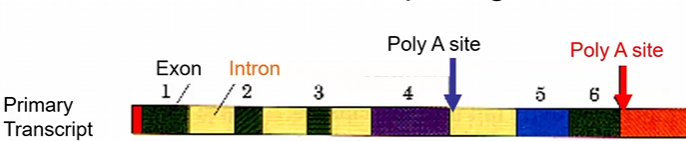
In the example of alternative splicing, if the first Poly A site is skipped by the spliceosome complex what will occur? (look at image)
a) Thyroid/Calcitonin = 1, 2, 3, 4
b) Neural Tissues/ CGRP= 1, 2, 3, 5, 6
b)
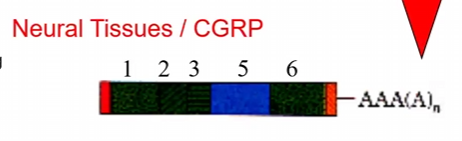
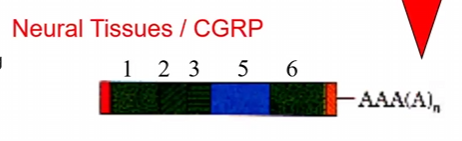
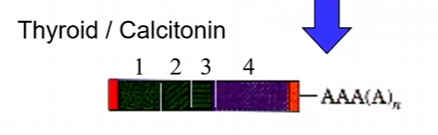
In the example of alternative splicing, if the first Poly A site is NOT skipped by the spliceosome complex what will occur? (look at image)
a) Thyroid/Calcitonin = 1, 2, 3, 4
b) Neural Tissues/ CGRP= 1, 2, 3, 5, 6
a)
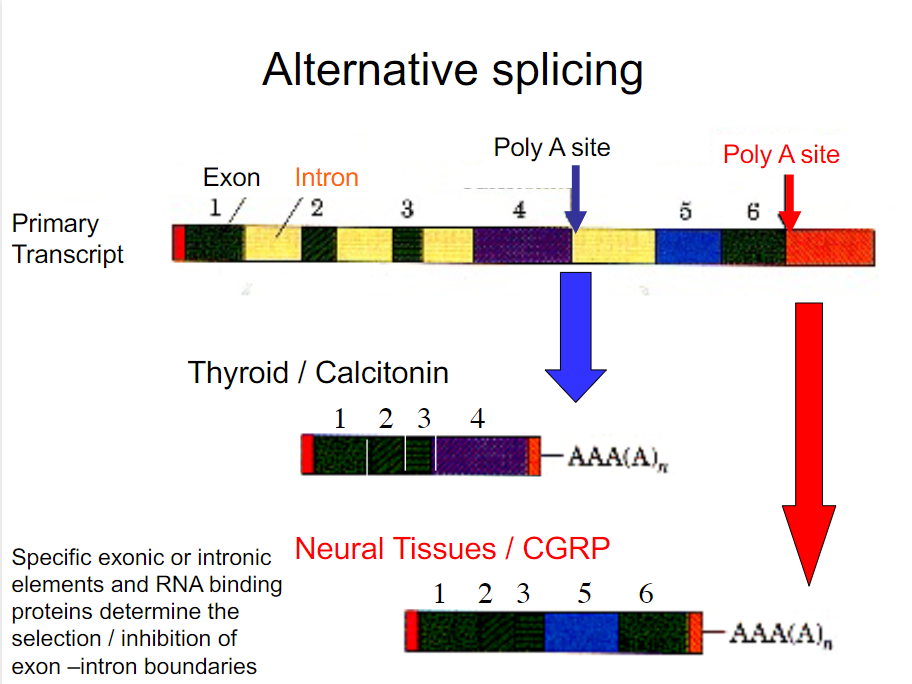
What do you notice happens when the second poly-A site is selected?
a) All exons up to the beginning of the second poly-A site are retained
b) The exon immediately following the first poly-A site is removed
c) The exon immediately preceding the first poly-A site is removed
c)
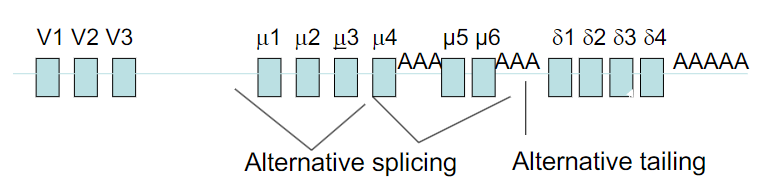
B-Cell Differentiation
Alternative splicing and cleavage at 3’-ends leads to selection of IgM or IgD immunoglobulin production
Initially: IgM, membrane-bound
After antigen selection: gradually switches to IgD on cell surface, IgM secreted
a) true
b) false
a)
Which of the following are secreted IgM?
a) μ1 μ2 μ3 μ4
b) μ1 μ2 μ3 μ5 μ6
a)
Which of the following are transmembrane bound IgM?
a) μ1 μ2 μ3 μ4
b) μ1 μ2 μ3 μ5 μ6
b)
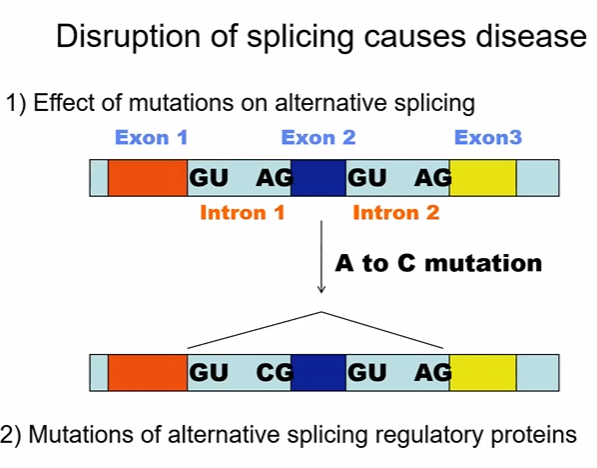
Disruption of splicing causes disease
effect of mutations on alternative splicing
mutations of alternative splicing regulatory proteins
a) true
b) false
a)
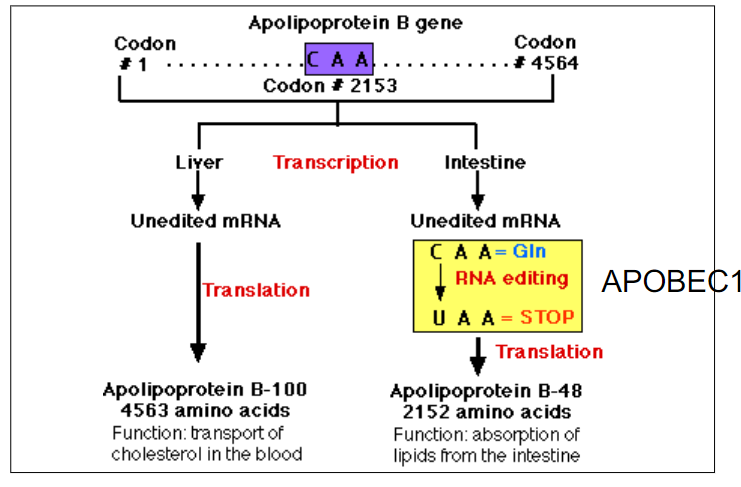
RNA Editing is another mechanism to increase the number of proteins available from a single gene.
a) true
b) false
a)
Accuracy in splicing is critical because of the defined boundaries between exons and introns. Disrupted splicing is estimated to occur in 15% of disease-causing point mutations.
a) true
b) false
a)
RNA pol II is the target of alpha-amanitin, a poison from the death cap mushroom that inactivates protein synthesis and causes complete liver failure within 48 hours of ingestion.
a) true
b) false
a)
True or False
Prokaryotic RNA polymerase is sensitive to rifampicin, an antibiotic that is used against M. tuberculosis.
a) true
b) false
a)
True or False
Transcription factors are proto-oncogenes, gain-of-function genes that activate cell-cycle and growth. If over-expressed or mutated, they may promote uncontrolled cell growth.
a) true
b) false
a)
Which of the following is true about Transcriptional RNA-rRNA?
a) rRNA genes are on the p-arms of acrocentric chromosomes
b) 80% of all RNA is rRNA
c) 200 rRNA copies per haploid genome in humans
d) Chromosomes 13, 14, 15, 21, 22
e) all of the above
e)
What does the 18S rRNA become?
a) large ribosomal subunit —> 60S ribonucleoprotein
b) small ribosomal subunit —> 40S ribonucleoprotien
b)
What does the 5.8S, 28S rRNA, and 5S rRNA become?
a) large ribosomal subunit —> 60S ribonucleoprotein
b) small ribosomal subunit —> 40S ribonucleoprotien
a)
What is the function of small nucleolar RNAs (snoRNA)
a) recognize specific sequences and direct the modification of ribosomal RNA’s
b) provides the template for telomere synthesis
c) results in: specific site methylation at 2’-OH
d) results in: Uridine—> Omega U
e) results in: splicing/removal of unmethylated areas
f) all of the above
f)
Which of the following is true about Transcriptional-Transfer RNA
a) small (< 100 nucleotides)
b) 32 tRNA’s, multiple copies
c) lots of modified bases
d) specific recognition sequences
e) synthesized by RNA Pol III
f) all of the above
f)
How is the processing of tRNA unique compared to mRNA?
a) It utilizes an RNA enzyme (ribozyme)
b) It adds bases to the transcript
c) It modifies bases throughout the transcript
d) all of the above
c)
What are the specific recognition sequences in tRNA?
a) T Omega C ARM
b) DHU ARM
c) Anticodon loop
d) CCA terminus on 3’ end
e) aminoacyl arm on 3’ end
f) all of the above
f)
What does RNAse D do in the processing of tRNA?
a) cleavage
b) splicing
c) base modification
d) -CCA added to 3’ end
d)
What does RNAse P (ribozyme) do?
a) cleavage
b) splicing
c) base modification
d) -CCA added to 3’ end
a)
What modifications can occur in the tRNA?
a) cleavage
b) splicing
c) base modification
d) all of the above
d)
What is the function of tRNA?
a) tRNA is an adapter molecule that recognizes and binds to the RNA codon and carries a corresponding amino acid for the growing protein chain.
b) Each aa-tRNA interacts with a specific binding partner AARS, to effect accurate translation. Therefore tRNA is the second adaptor and AARS is the first adaptor
c) all of the above
c)