Fatty Acid Synthesis 2
 Call Kai
 Learn
 Practice Test
 Spaced Repetition
 Match
 Flashcards
 Knowt Play
1/28

There's no tags or description
Looks like no tags are added yet.
29 Terms
FA Synthesis
Energetically favorable:
only a 1 ATP used during each FAS via CO2 release
13C-bicarbonate used
no 13C was incorporated into palmitate FA
14C-bicarbonate (HCO3-) used (ACC step)
no/undetectable amount of 14C was incorporated into palmitate FA
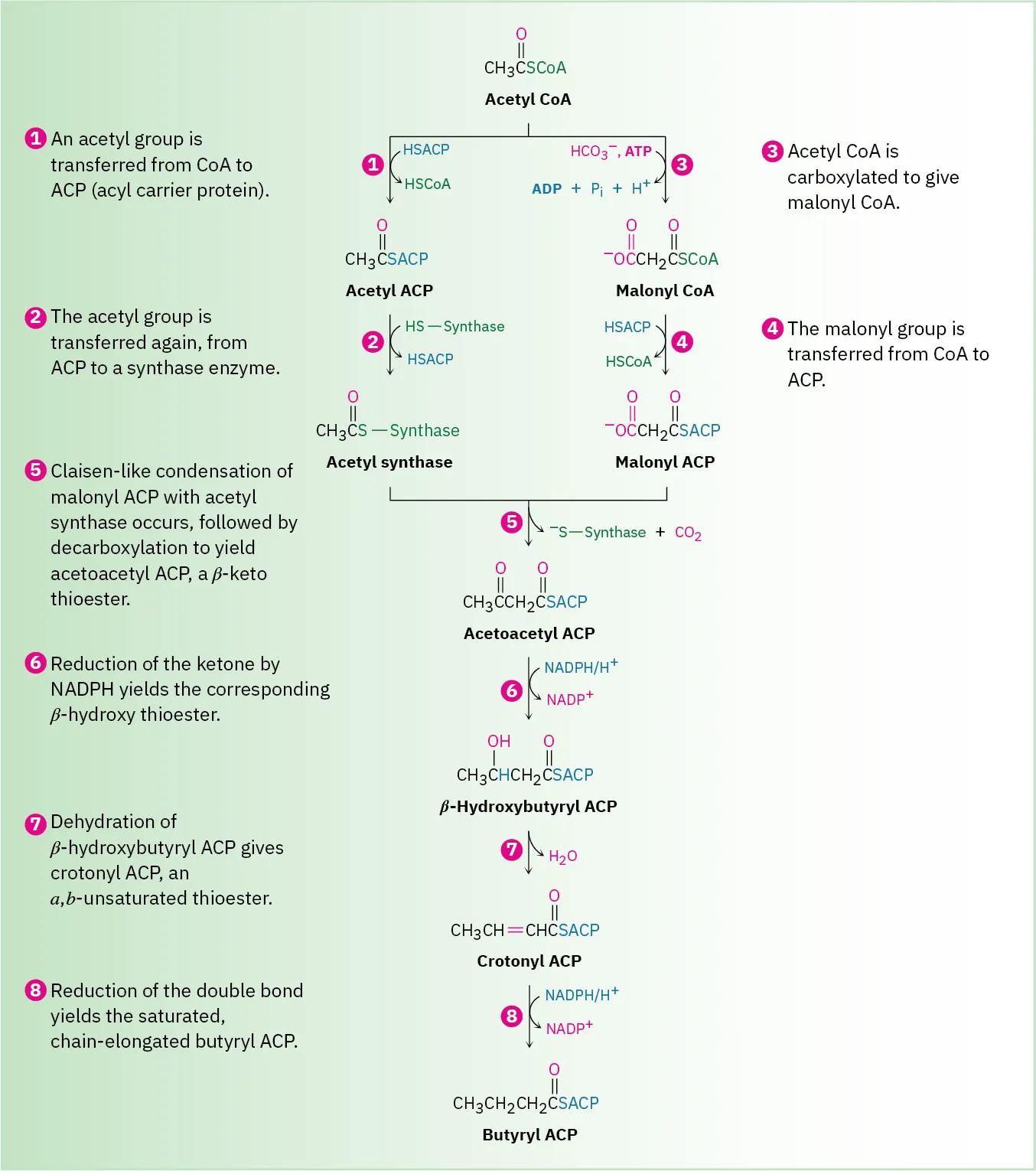
8 Acetyl CoA (2C) + 14 NADPH + 13H+ + 7 ATP→ Palmitate (16C) + 8 CoA-SH + 6 H2O + 14 NADP+ + 7 ADP + 7 Pi
FA Measure:
HPLC
Radioactivity Measure:
Liquid scintillation Counter
ACC Step
Biotin-enzyme + ATP + HCO3- <—> CO2-biotin-enzyme + ADP + Pi
CO2-biotin-enzyme + acetyl-CoA → Malonyl-CoA + biotin-enzyme
FAS Steps
Acetyl-CoA + Malonyl-CoA → Acetoacetyl ACP + ACP + CO2
ACC and FAS
Both ACC and FAS are regulated
FAS does not always release palmitate → It occasionally can instead release the 14-carbon saturated fatty acid myristate
In healthy adults:
FAS primarily expressed in hormone sensitive cells and cells with high lipid metabolism
Well-nourished individuals:
Preferentially use circulating free FAs from diet
FAs de novo synthesis → only minor contribution /rarely needed
CHO ingestion:
upregulates FAS
Glucagon
down regulates FAS
FAS activity is upregulated in tumors:
Tumor cells rely on FAs de novo synthesis
Accommodates more FA for membrane synthesis
Regulate tumor DNA damage repair and apoptosis and used for tumor signaling
Support rapid diving cell: more membrane phospholipids required for cell membranes
Energy production
Tumor control can be achieved via FAS control:
Inhibitors of Beta-ketoacyl ACP: condensation reaction
Inhibited phospholipid synthesis
Interestingly, these inhibitors showed weight loss – anti-tumor effect and anti-obesity effect
Lactating mammary glands:
Need high activity/expression of FAS:
Fatty acid synthase is required for mammary gland development and milk production during lactation
Synthesis of long-chain fatty acids from palmitate:
Fatty acids of up to 36 carbons in length can be synthesized in vivo, but they all originate from the same precursor – the C16 fatty acid palmitate:
Key to the process are elongases and desaturases
Occurs in the endoplasmic reticulum and mitochondria
Elongation and Desaturation
Synthesize a variety of saturated, monounsaturated (MUFA) & polyunsaturated FAs (PUFA)
Essential FAs
Linoleic acid (18:2n-6) & α-linolenic acid (18:3n-3):
must get from diet
Elongases
Now known as elongation of very long-chained fatty acids (aka, Elovl), add two carbons onto a fatty acyl-CoA
Desaturases
Introduce an enoyl group (or, carbon-carbon double bond) into a fatty acyl Co-A
Most of FA in the body:
Dietary origin
But Palmitic acid (C16:0) can be de novo synthesized from excess CHOs
Myristic acid (C14:0) & stearic acid (C18:0): much lesser extent
Lipogenic Tissues
liver
adipose
lactating mammary glands
The synthesis of the saturated 18-carbon fatty acid stearate from palmitate requires:
palmitoyl-CoA (aka, “activated” palmitate)
malonyl-CoA (endoplasmic reticulum) or acetyl-CoA (mitochondria)
NADH or NADPH, plus H+
5 individual enzymes (rather than one enzyme complex as with palmitate synthesis)
Coenzyme A as acyl carrier – rather than ACP
Rest of all in the ER is identical to palmitate synthesis; elongation, reduction, dehydration and reduction
Summary of Fatty Acyl-CoA Elongation
Condensation
C donor: Malonyl-CoA activated form with CO2.
Primer: Fatty acyl-CoA: Derived from Palmitate /palmitic acid or stearic acid/stearate
Occurs in the smooth ER
Final step:
involves either the action of thioesterase on the elongated fatty acyl-CoA (liberating the new fatty acid and CoA-SH), or the further elongation or desaturation of the elongated fatty acyl- CoA

De Novo Synthesis of FA s in Mitochondria
Major function of this is to production of Lipoic acid
Prosthetic group multienzyme complexes: PDH and Krebs cycle enzyme (α-ketoglutarate dehydrogenase) – critical for mitochondrial energy generation.
How malonyl CoA synthesize in Mit. → not clear
Both Malonyl-CoA and Acetyl-CoA membrane impermeable to the mitochondrial membrane
Suggesting that there are isoforms of ACC: ACC1 vs ACC2
ACC1 → cytoplasmic
ACC2 may be attached cytoplasmic side of mitochondrial outer membrane → evidence lacks
Key to the addition of two carbon units are the Elovl enzymes:
Eight isoforms exist:
Seven (Elovl1... Elovl7) are in present in mammals
The eighth (Elovl8) to date is only identified in aquatic species
Each isoform will act on specific classes of fatty acids
Whether with FAS, or individual enzymes to expand the length of a fatty acid beyond 16 carbons, the steps are identical:
Condensation
Reduction of ketone to alcohol
Dehydration to form enoyl group
Reduction (or hydrogenation) of enoyl group
Mammalian fatty acids derived from palmitate:
Starting with palmitate, we can make saturated, monounsaturated fatty acids (MUFA), & polyunsaturated fatty acids (PUFA):
The MUFAs include omega-7, omega-9, and omega-10 species
The PUFAs are only omega-9
Synthesis of unsaturated long-chained fatty acids:
The unsaturation of fatty acids requires the use of fatty acyl-CoA desaturases:
In mammals, there are three fatty acyl-CoA desaturases:
Δ5 desaturase
Δ6 desaturase
Δ9 desaturase or stearoyl-CoA desaturase (SCD)
5 isoforms exist: SCD1, SCD2... SCD5
With very few exceptions, the initial desaturation (or the introduction of a carbon-carbon double bond by reduction) of a saturated fatty acyl-CoA is introduced at the 9th carbon from the carboxylic acid (with the carbon at C=O being #1)
Oleoyl-CoA (Oleate) from stearoyl-CoA by SCD
Stearoyl-CoA desaturase → SCD – oleoyl-CoA is major pdc of SAD-1
Fe2+ to Fe3+ = lost one electron
So need two of cytochrome b5
FADH2 – release 2 H+ (protons) and 2 e during one FADH2 reduction
Essential long-chained fatty acids from plants:
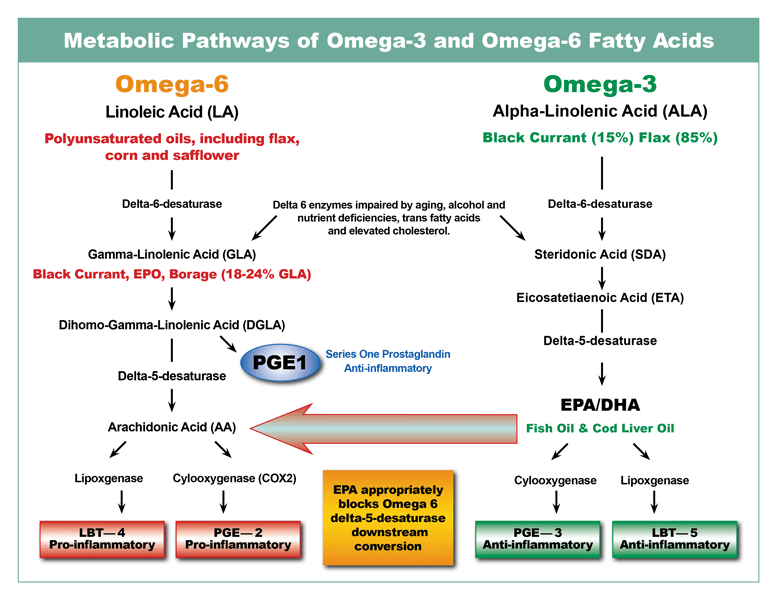
Plants have Δ12 and Δ15 desaturases, which generate the “omega-3” and “omega-6” fatty acids from oleate
Aquatic species and mammal intake these through diet, to anabolize them into other fatty acids (i.e., the omega-3 FAs DHA and EPA, and the omega-6 FA arachidonate)
Aside from providing energy via beta oxidation, other roles for fatty acids exist:
Incorporation into phospholipids to influence curvature of cell membranes and lipoproteins
Cell signaling (lipid rafts)
Transcriptional regulation (Beta carotene –retinoic acid in heart tissues is a transcriptional regulator (alter gene expression) of lipid metabolizing enzymes – alter cardiac lipid metabolism)
Others... hormones, steroids