INBDE Condensed Study Guide
 Call Kai
 Learn
 Practice Test
 Spaced Repetition
 Match
 Flashcards
 Knowt Play
1/109

There's no tags or description
Looks like no tags are added yet.
110 Terms
post. triangle innervation (5 & locations)
"Let's Go To (Elementary) School"
Erb's point: behind SCM
Lesser occipital - lat. scalp & neck
Great auricular - mandible & ear
Transverse cervical - ant. neck
Supraclavicular - upper chest
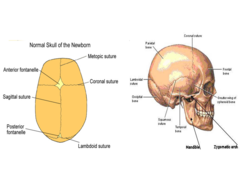
Cranial sutures (4 lines & 3 points)
Coronal - bow
Sagittal - arrow
Squamous - lat.
Lambdoid - post.
Bregma: sup.
Lambda: post.
Pterion: lat.
CN I (name, cranial vault, funct)
Olfactory - cribiform plate of ethmoid
S: smell
CN II (name, cranial vault, funct)
Optic - optic canal
S: vision
CN III (name, cranial vault, funct)
Oculomotor - SOF
M: *extraocular m.s & levator palpebrae sup.*
PS: sphincer pupillae & cilliary m.
CN IV (name, cranial vault, funct)
Trochlear - SOF
M: sup. oblique (extraocular excp)
CN V1 (name, cranial vault, funct)
Ophthalmic - SOF
S: skin above eyes & includes nose
CN V2 (name, cranial vault, nerves, funct)
Maxillary - f. rotundum
- infraorbital n. -> SAN
S: skin b/w eye & lips
CN V3 (name, cranial vault, nerves, funct)
Mandibular - f. ovale
- ant (M): deep temporal, pterygoids, masseteric, buccal
- post (S): lingual, auriculotemporal, IAN
S: ant 2/3rds tongue, lat. face (TMJ) & mand. skin
M: m. of mastic, mylohyoid, ant. digastric, tensor tympani, tensor veli palatini (palate excp)
CN VI (name, cranial vault, funct)
Abducens - SOF
M: lat. rectus (extraocular excp)
CN VII (name, cranial vault, nerves, funct)
Facial - int. acoustic meatus -> stylomastoid f.
"To Zanzibar by Motor Car"
M: facial expression m.
CN VII chorda tympani (name, cranial vault, funct)
Facial - tympanic cavity
- hitchhikes lingual n. (V3)
S: taste ant 2/3rds tongue
PS: sublingual & submand. salivary glands (submand. ganglions)
CN VII PS branches (nerves, funct)
- g. petrosal n.
PS: lacrimal gland (pterygopalatine gang.)
CN VIII (name, cranial vault, funct)
Auditory / Vestibulocochlear - int. acoustic meatus
S: balance & hearing
CN IX (name, cranial vault, nerves, funct)
Glossopharyngeal - jugular f.
- (PS): tympanic br. -> lesser petrosal n.
S: taste & sensation of post. 1/3rd tongue, oropharynx, carotid body
M: stylopharyngeus m. (pharynx excp)
PS: parotid gland (otic gang.)
CN X (name, cranial vault, nerves, funct)
Vagus - jugular f.
- auricular br. (tympanic memb)
- sup. & recurrent laryngeal n.
S: viscera of neck, thorax, abdomen, taste fr/ epiglottis & palate
M: larynx, pharynx, soft palate, palatoglossus (tongue excp) & levator veli palatini
PS: same as sensory
CN XI (name, cranial vault, funct)
(Spinal) Accessory - f. magnum -> jugular f.
M: SCM & trapezius m.
CN XII (name, cranial vault, funct)
Hypoglossal - hypoglossal canal
M: tongue m. (eg. genioglossus, styloglossus, hyoglossus)
Muscles of Mastication (4: actions)
mostly elevate & protract mand.
o Temporalis: elevation (ant) & retraction (post)
o Masseter: elevate & protraction
o Lat. pterygoid: protraction, depression, CL
- Sup head: gr. wing sphenoid
- Inf head: lat. of lat. pterygoid
o Med. pterygoid (copies masseter)
Suprahyoid muscles (5: innervations)
Geniohyoid - C1 (CN XII hitchhiker)
Mylohyoid - n. to mylohyoid (CN V3)
Ant. digastric - n. to mylohyoid (CN V3)
Post digastric - CN VII
Stylohyoid - CN VII
Tongue muscles (4: actions)
Hyoglossus: depress & retract
Styloglossus: elevate & retract
Genioglossus: depress & protract
Palatoglossus: elevate
Maxillary artery (3 parts, assoc. teeth)
1: mandibular - MMA & inf. alveolar a.
2: pterygoid (muscular) - deep temporal, pterygoid, masseteric, buccal
3: pterygopalatine
- post. sup. alveolar / PSA *(molars)*
- infraorbital: *ant & middle* sup. alveolar a. *(incisors & premolars)*
- desc. palatine: gr & lesser *(hard & soft palate)*
- pharyngeal, pterygoid canal, sphenopalatine (nasal)
Facial veins (5)
o Angular: *ophthalmic v.s (cavernous sinus)*
o Facial: deep facial (pterygoid plexus)
o Common facial v. = facial + ant. retromand.
- *post. retromand. + post. auricular* = EJV
o IJV
o Venous angle: IJV + subclavian = brachiocephalic v.

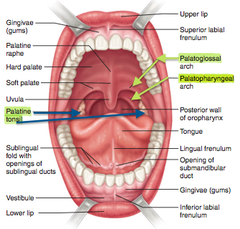
Palatal arches (2)
- Palatoglossal arch (ant)
- Palatine tonsils
- Palatopharyngeal arch
Embyronic Structures (6 arches)
(5, 7, 9, 10)
1. CN V - Meckel's cartilage, teeth, tensor veli palatini, etc.
2. CN VII
3. CN IX - stylopharyngeus m.
4. CN X - sup/ext. laryngeal (pharynx & palatoglossus m.)
5. N/A
6. CN X - recurrent laryngeal (larynx)
Visual pathways (3 parts & vision loss)
o Optic nerve - same side
Severing causes blindness in an eye
o Optic chiasma
Severing causes peripheral vision loss
o Optic tract - crosses
Severing causes blindness in the opp. visual field

Nerve fibers (6)
A-alpha - somatic & proprioception
A-beta - pressure & vibration
A-gamma - m. tone
A-delta - sharp / superf. pain
B - pregang. ANS
C - unmyelinated; temp, dull/achy pain, post-gang. ANS
Hypothalamus & Pituitary hormones (7)
- TRH -> TSH -> T3/T4 (inc absorb) & PTH (inc resorp)
- CRH -> ACTH -> cortisol (adrenal cortex)
- GnRH -> LH & FSH
- GHRH -> GH
- PRH -> prolactin
- ADH / vasopressin
- Oxytocin
Adrenal Gland (4: compartments & secretions)
Zona fasciculata - cortisol
Zona glomerulosa - aldosterone
Zona reticularis - androgens
Medulla - catecholamines
RAAS System (5 players, locations, enzymes)
inc blood pressure
- *Renin* (kidney): cleave Angiotensinogen -> Ang I
- *ACE* (lungs): Ang I -> Ang II
- *Ang II*: vasoconstrict, aldosterone, ADH, thirst
- *Aldosterone* (adrenal cortex): Na+ reabsorp. & K+ excretion
- *ADH*: water reabsorp.
Pancreas (3 cells/hormones)
Alpha: glucagon - inc blood GLC
Beta: insulin - dec blood GLC
Delta: somatostatin (inhib GH, insulin, glucagon)
Agranulocytes (2 categs)
Lymphocytes
- B cells: make Abs
- T-cells: act. macrophages
- NK cells
Monocytes
- Macrophages: granuloma form.
- DCs: APC to act. T-cells
Granulocytes (4)
- Neutrophils/PMNs: multi-lobed, phagocytosis & ROS, first resp. to acute inflamm.
- Eosinophils: red & bi-lobed, allergies & multi-cell *parasites*, MBP
- Basophils: blue & bi-lobed, *histamine* (vasodilat. & bronchoconstrict), heparin (anticoagulant)
- Mast cells: purple oval, IgE med. resp. (histamine), heparin
Innate Immune Resp. (3 categs)
neutrophils, macrophages, NK cells
o Complement Activation - plasma prots
- Recruit leukocytes & inflamm.
- Cell lysis
- Opsonization & phagocytosis
- Enhance B-cell resp.
- Anaphylatoxins
o Reticuloendothelial (RES) / mononuclear phagocyte system
- Monocytes (blood) & Macrophages (tissues)
- DCs
- Kupffer cells (liver)
o Pattern Recognition Receptors (PRRs)
- Toll-like (*TLRs*) - recognizes *PAMPs* (LPS, flagellin, viral DNA/RNA) & *DAMPs* (damaged host cells)
- Nod-like (NLRs) - sense stress & inc inflamm.
Adaptive Immune Resp: Humoral (5 immunoglobulins & 4 HS)
B-cells make Abs, present Ags' epitopes, become plasma cells; express Igs
o IgG - crosses placenta, complement, Type II HS (most common in perio)
o IgA - ext. secretions (saliva, tears, breast)
o IgM - pentamer, 1st to resp, agglutination, complement, Type II HS
o IgE - atopic allergies, histamine release, Type I HS
o IgD
HS types
I - immediate, IgE-med.
II - cytotoxic Ab-med. (autoimmune), direct
III - immune complex, indirect
IV - delayed, cell-med.
Adaptive Immune Resp: Cell-Mediated (3 kinds, 2 MHC paths)
T-cells release cytokines, express TCRs
o *CD4 helper*: act. B cells & recruit neutrophils, release ILs
- Th1: act DCs & macrophages
- Th2: humoral (B cells & Abs)
- Th17: recruit neutrophils & inflamm.
o *CD8 cytotoxic*: kill infected cells
o Treg: suppress immune resp.
MHC Pathways - polymorphic gene
- *MHC I*: *intracellular* Ags, recog. by (CD8+) *Cytotoxic* T-cells
- *MHC II*: *extracellular* Ags on APCs (DCs, macrophages, B cells), recog. by (CD4+) *Helper* T-cells
Other immune resp. players (cytokines, et al)
Cytokines
- Colony-stim. factors (CSF): hematopoietic prolif. in bone marrow
- Interferons: host-specific, anti-viral & immunomod.
- Interleukins (ILs): leukocyte communication
- Tumor necrosis factors (TNF): inflamm. & apoptosis in tumors
- Chemokines: recruit leukocytes
Other
- Leukotrienes: lipid, mediates HS & inflamm.
- Bradykinins: peptide, causes vasodilat.
- Haptens: not antigenic but can react with Abs
Immunity types (4)
- Natural Active: make own Abs from natural infection
- Natural Passive: Abs from another person eg. placental IgG & breast IgA
- Artificial Active: vaccination (body makes own Abs)
- Artificial Passive: Ab injection
Membrane Potential (RMP & 4 ions)
moves toward ion w/ greatest perm.
- RMP: *-70mV* (weighted moreso by K+)
- Na+ influx (depolarizes): *+60mV* (ENa)
- K+ efflux (repolarizes): *-90mV* (EK)
- Cl-: -70mV
- Ca2+: +120mV
Fluid Compartments: ECF vs ICF (ion conc)
have similar osmolarities
- ICF: K+, Mg2+, PO4, GLC
- ECF: Na+, Cl-, Ca2+, bicarb. (HCO3-)
inhib vs excitatory NTs
Inhibitory: GABA & glycine
Excitatory: glutamate, aspartate, ACh
Blood clot form. (3 steps)
- vasoconstriction
o Platelet plug formation (prim hemostasis): platelets adhere via vWF & recruit more
o Coagulation cascade (2ndary hemostasis): stabilize clot, fibrinogen -> *fibrin* via *thrombin*
- Intrinsic: exposed collagen
- Extrinsic: TF, faster
o *Plasmin* - fibrinolysis (cleaves fibrin) to breakdown clot
Vessels Characteristics (3)
arteries - hi-resistance, thick tunica media
capillaries - have only the tunica intima (innermost)
veins - hi-compliance, thin tunica media
Hb types & subunits (3)
HbA (adult): α2β2
HbA2: α2𝛿2
HbF (fetal): α2γ2
Blood types (4)
A/B - receives from itself or O blood, can donate to itself or AB
AB - receives all blood, can only donate to itself
O - receives only O neg, universal donor
Muscle fibers (2: purpose, energy, color)
Type 1 (slow twitch) - fatigue-resist, endurance
- Aerobic (oxidative) & darker color (myoglobin)
Type 2 (fast twitch) - fatigues easily, hi-intensity & short duration
- Anaerobic & lighter color
Haversion canal (3)
*Lamellae* - concentric rings that surround canal
*Lacunae* - spaces b/ lamellae that house osteocytes
*Canaliculi* - connects osteocytes & canal
Ossification types (2: def & ex)
Intramembranous (IM) - bone directly develops fr/ tissue
- Flat bones eg. skull (cranial vault)
Endochondral (EC) - hyaline cart. template becomes bone
- Long bones eg. femur & cranial base
DNA replication (Euks vs Proks)
Topoisomerase - relieves tension / supercoiling
Helicase - unwind & separate strands
Primase - synth RNA primer
DNAP - synth DNA (add to 3' end) & proofread
Ligase - join Okazaki fragments on lagging strand
Exonuclease - proofreading
Telomerase - extend chrom. ends
o Euks only
Single-Stranded Binding prots (SSBs) - keep strands separate
RNase H - removes primers
DNAP alpha - helps primase
DNAP delta - lagging strand
DNAP epsilon - leading strand
DNAP gamma - rep. mito DNA
o Proks only
Gyrase - topoisomerase that relieves tension
DNAP I - remove primers
Mutations (6)
Silent
Missense - one AA changed
Nonsense - STOP
Frameshift - insertion or deletion
*Transversion*: change to opp. category (eg. purine to pyramidine)
*Transition*: change in same category (eg. purine to purine)
Phospholipid bilayer (permeabilities)
hydrophilic (polar) faces outside, hydrophobic tails face in
- perm. to small, nonpolar molecs eg. O2, CO2
- mod. perm to small, polar molecs eg. H2O, ethanol
- imperm. to ions eg. Na+, K+, Cl-
Cell Junctions
*Gap junctions* - communication & connexins
Tight junctions (zona occludens) - seals cells
Adherens junctions (zona adherens) - mech. attachment & connect actin
*Desmosomes* - connects inermed. filaments & communication
Hemidesmosomes - anchor to BM
Metabolism (4 steps & net ATP)
o Glycolysis
- NADH in cyto is passed into mito via shuttles
o PYR DH
o TCA / Krebs / Citric Acid Cycle
o Oxidative phosphorylation
Net ATP: *36 ATP* per GLC
Other metab cycles (3)
o Cori Cycle - muscles produce lactate, shuttles to liver, converts to GLC, sent back to m.
o Urea Cycle - remove nitrogen as urea
- Arginase: arginine -> urea + ornithine
o Purine / Uric Acid breakdown
- Xanthine oxidase: Xanthine -> uric acid
- Uricase (animals only): uric acid -> allantoin
Note: hi-uric acid creates risk of gout in ppl
Enzyme kinetics (4)
- Ka (association constant): affinity of enzyme f/ substrate
- Km (Michaelis Constant): substrate concentration at half of max velocity
- Vmax (max velocity): when enzymes are fully saturated w/ substrate
- kcat (turnover #): when saturated, the conversion of substrate per unit time
Enzyme regulation (3 inhibitors & effects on Km/Vmax)
Competitive inhib: bind active site
- inc Km
- can be overcome by inc substrate conc.
Noncompetitive inhib: bind allosteric site (of enzyme or enzyme-substrate complex)
- dec Vmax
- can't be overcome by inc in substrate conc.
Uncompetitive inhib: bind enzyme-substrate complex
- dec both Km & Vmax
Vitamins (A, 8B, C, D, E, K)
A - night blindness
B1 Thiamine (Beriberi & W-K)
B2 Riboflavin: FAD & FMN
B3 Niacin: NAD/NADP+ (Pellagra)
B5 Pantothenic acid: Coenzyme A - FA metab.
B6 Pyridoxine - AA metab
B7 Biotin: carboxylases
B9 Folate / Folic acid: DNA/RNA (nitrogenous bases) - Megaloblastic anemia
B12 Cobalamin: methionine synth. -Megaloblastic anemia
C - scurvy
D - rickets & osteomalacia
E - anemia & weak m.s
K - bleeding/bruising
Gram neg vs positive (layers & characteristics)
Gram negative - stains pink
- Membrane, thin peptidoglycan, outer memb.
- LPS: endotoxin
Gram positive - stains purple
- Memb. & thick peptidoglycan
- Techoic acid
Bact. genetic transfer (3)
Conjugation - cell-to-cell via sex/F pilus
Transformation - fr/ environ.
Transduction - bacteriophage (viruses)
Agar plates (3: type & color)
- Alpha-hemolysis (streptococci): partial hemolysis, green
- Beta-hemolysis: complete hemolysis, clear zone
- Gamma-hemolysis: none
Diabetes types (2.2)
Diabetes insipidus - dec ADH, water loss
Diabetes mellitus
Type 1: autoimmune, younger pops
Type 2 (90%): insulin resist, older pops, obesity
Autoimmune disorders (5 metab & others)
Metab
- Addison's dis: prim. adrenal insuff, dec cortisol & aldosterone; hyperpigment, hypotension, hyperkalemia
- Cushing's dis: excessive cortisol
- Graves' dis: hyperthyroidism (weight loss, tremors, inc HR)
- Hashimoto's dis: hypothyroidism & cretinism
- Hyperparathyroidism - "stones, bones, groans (GI) and moans"
Other
- Myasthenia gravis: against ACh receptors at neuromusc. junct
- Rheumatic fever: mitral valve
- Mult. sclerosis: most common demyelinating disorder
- Systemic lupus erythematosus (SLE): butterfly rash
- Pemphigus Vulgaris: Nikolsky sign
Inherited / Genetic disorders (3: characteristics)
- Down's synd: trisomy 21, lymphoblastic leukemia
- Turner's synd (females): short
- Klinefelter's synd (males): tall, small testes, infertile
Bone disorders (6)
Osteitis deformans / Paget's dis. - mix of osteolysis & osteogenesis
Osteoarthritis - wear & tear
Osteoporosis - postmenopausal women due to dec. estrogen
Osteopetrosis - inc bone density, brittle, deaf & blind, anemia
Osteomalacia - Vit D def, soft bones in adults
Rickets - Vit D def, bowed legs in kids
Common bact. infections
- S. pyogenes / GAS: rheumatic fever & glomerulonephritis
- C. botulinum: toxins inhib. acetylcholine
- M. tuberculosis: lungs
- Chlamydia: STI
- N. gonorrhoeae: STI
- T. pallidum: syphilis (chancre, condyloma lata, gumma)
Common viral infections (herpesvirus & heptatitis)
- Rhinovirus: flu
- Measles: Koplik spots
- Mumps: parotid gland swelling
- Human Papilloma (HPV): condyloma acuminatum
- HIV: destroys Helper T (CD4+) cells
herpesvirus
- HSV-1: oral lesions & cold sores
- HSV-2: genital herpes
- Varicella-zoster (VZV): herpes zoster (shingles) & varicella (chickenpox)
- Epstein-Barr (EBV): infectious mononucleosis
- Cytomegalovirus (CMV)
Hepatitis
Hep A - fecal-oral
Hep B - blood, STD
Hep C - blood, cirrhosis, no vaccine
Hep D - dep. on Hep B
Hep E - fecal-oral, no vaccine
Dental Anatomy Trends (missing teeth & root #)
- Missing teeth: max 3rds, mand 3rds, max laterals, mand 2nd premolars
- Missing Primary teeth: max laterals
- Embrasures: L > B
- Root #s exceptions: max 1st premolar (2 roots) & sometimes mand canine (3 roots)
Tooth Calcification & Eruption Dates
Calcification dates
- Primary: 6mo in utero
- Permanent: at birth
Note: 20 primary teeth (A to T)
Eruption dates
o Primary dentition
Mand incisors: 6-7mo
Max incisors
1st molars: 1yr
Cuspids
2nd molars: 2yrs
o Permanent dentition begins: 6-7yrs
1st molars
Mand incisors
Max incisors
Mand cuspids
1st premolars: 10yrs
2nd premolars
Max cuspid
2nd & 3rd molars
o All temp teeth fall out: 12yrs
Max cent. (cingulum, twist, pulp horns)
Distally offset cingulum
DL twist
3 pulp horns
Max lat. (cingulum, fissure, roots)
Centered cingulum
Linguogingival fissure
curved root
Mand lat. (twist, cingulum)
DL twist
Distally offset cingulum
Mand canine (cingulum, roots)
Longest crown
Distally offset cingulum
Possible root bifurcation
Max 1st premolar (shape, grooves, roots)
Hexagon
prom. mesial developmental groove
bigger & longer cent. groove
Bifurcating roots (B & L)
Max 2nd premolar (shape, cusps, grooves)
More symmetrical
cusps same size but further apart
shorter central groove (closer pits)
Mand 1st premolar (shape, grooves, cusps)
Diamond
mesial HOC more cervical
"Snake eyes" & transverse ridge
bulkier lingual-distal
short & non-funct lingual cusp (possibly -1 pulp horn)
Mand 2nd premolar (lobes, occlusal shape)
5 lobes (3 cusps)
- Y-shaped occlusal
- central fossa & lingual groove
Possible for 2 cusps
- H or U occlusal
- central groove
Molars (root trunk & crown size)
Root trunk length: 3rd > 2nd > 1st
Crown size: 1st > 2nd > 3rd
Max molars (oblique ridge, roots, cusps)
Oblique ridge: ML & DB
3 roots: DB, MB, P
cusps: ML > MB > DB > DL
Max 1st molars (shape, lobes, canals)
Square
ML Cusp of carabelli - 5 lobes
4 canals (MB has 2)
Max 2nd molar (shape & cusps)
Heart: 3 cusps (absent DL)
Rhomboid: 4 cusps
Mand molars (roots, canals, cusps)
2 roots: M & D
3 canals (M has 2)
cusps: ML > DL > MB > DB > D
Mand 1st & 2nd molar (shape & roots)
1st
pentagon: 5 cusps
mesial root may bifurcate
2nd
trapezoid
Inter-arch relationship (2 cusp types)
Centric/holding/supporting/working cusp: 1/3 BL width of tooth, broad & rounded
Non-centric/guiding/shearing/balancing cusp: 1/6th of tooth, tall & pointed
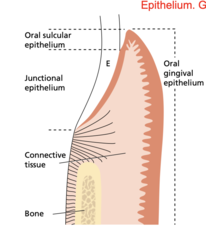
Gingiva epith. (5: location & kerat)
- Junctional epith (epith. attachment): at CEJ, non-kerat
- Sulcular epith: non-kerat. & thin
- Free gingiva / oral epith: kerat.
- Attached: kerat. or perakeratinized, rete pegs
- Alveolar mucosa: non-keratinized
Enamel form. (3 stages & players)
o Pre-secretory: polarize
o Secretory / amelogenesis: prot. accum.
Bud, cap, bell (bulk)
- Ameloblast secretion (instead of matrix vesicles)
- Enam. matrix prots: *amelogenin* (90%), enamelin, ameloblastin, amelotin, ODAM, tuftelin
- Tomes' processes
o Maturation: mineralization, late bell
- MMP-20 & KLK-4 proteinases
Dentin composition (2.4)
Intertubular: Type I collagen
o Non-collagenous prots (NCPs)
SIBLING prots: DSPP (DSP & DPP), DMP-1, BSP
Osteocalcin (OC)
alkaline phosphatase
proteoglycans: decorin
Pulp layers (3.3: cell types)
Peripheral pulp - tall columnar
- Odontoblastic layer: forms dentin
- Cell-free zone of Weil: vascular
- Cell-rich zone
Furcation - short columnar or cuboidal
near root apex - squamous
oral bacteria composition in biofilm (8)
- Birth: S. Lactobacillus (caries)
- Eruption: *S. mutans* (caries) & Actinomyces
- Salivary pellicle: gram. pos. cocci & facultative anaerobes
- Orange Complex (ANUG): *F. nucleatum & P. intermedia* (ANUG - *treponema spirochetes*)
- Red complex: *P. gingivalis, T. forsythia, T. denticola*
- Aggressive perio: *A. actinomycetemcomitans*
- Perio in endodontically-treated pts: E. faecalis
Gingivitis stages (4: name & immune cells)
I) Initial - neutrophils
II) Early - T-cells
III) Established - plasma cells
IV) Advanced - becomes perio
Grafts (5)
Autogenous - self, gold standard
Allogenic - from another person
Isograft - from an identical twin
Xenograft / heterograft - from another animal
Alloplastic - synthetic
Endodontics (6 procedures)
- Indirect Pulp Tx (IPT): for deep caries adjacent to pulp
- Indirect Pulp Capping: pulp not exposed
- Direct Pulp Capping: pulp exposed, use cements w/ calcium silicate
- Pulpotomy: use if pulp is vital & not necrotic
for carious invasion & inflamm, but contraindic. if goes beyond coronal pulp
- RCT / Pulpectomy: use for necrotic tooth or PA lesion
- Regenerative (revascularization): if necrotic pulp tissue & immature apices
Restorative / Filling materials (4)
Amalgam
Composite - esthetic & polish
Glass ionomer - fluoride, chemical bond
Resin-mod. glass ionomer (RMGI) - fluoride
Impression materials (2 categs: 3 & 2)
o Elastomeric
PVS "Addition silicone" - chain-growth polym, accurate & stable
Polyethers - step-wise polym, stiff
Polysulfides- step-wise polym
Condensation silicones - step-wise polym, shrinks
o Non-elastomeric
Alginate "irreversible" - cheap, silica filler
Agar "reversible" - accurate but req. bath
Terminology
Imbibition - absorbs water & expands
Syneresis - expels water & shrinks
Gypsum types (expansion & strength)
Type I - hi-expansion
Type IV - low-expansion, hi-strength
cements (3 types)
- ZOE / IRM - low strength, for temps
- Zinc phosphate cement - no fluoride release, shrinks slightly
- Glass ionomer - best choice
temp crown materials (2)
PMMA - temps, hi-shrinkage
Bis-acryl - temps, brittle
crowns materials (4)
Porcelain - esthetics
Lithium disilicate (E. max) - esthetics
Zirconia - strongest, 5Y to 3Y
Gold - best longevity
Infection control (3 types)
o Sanitization / Cleaning - dec. conc. of pathogens
o Antiseptics - on living tissues
- Antimicrobial hand soaps: chlorhexidine gluconate & triclosan
- Intermed. marker bact: M. tuberculosis
o Disinfectants - on inanimate objects, elim. most bact but not spores
Autoclaving temp & time (3)
Ultimate test: endospore form.
- Steam: 250°F (121°C) for 15 minutes (15 PSI)
- Dry heat: 320°F (160°C) for 2 hours
- Ethylene oxide sterilization: several hrs
X-ray contrast (2 scales, kVp, density)
Short-scale - hi-contrast (fewer shades)
Long-scale - low-contrast (more shades) by inc kVp
- hi-kVp also inc density (darkness)