Phase of Cardiac Cycle: Systole
 Call Kai
 Learn
 Practice Test
 Spaced Repetition
 Match
 Flashcards
 Knowt Play
1/33

There's no tags or description
Looks like no tags are added yet.
34 Terms
categories of heart disease
congenital or acquired
systolic dysfunction
diastolic dysfunction
pressure overload
volume overload
L atrium
receiving chamber
L ventricle
pumping chamber
mitral valve
separates L atrium and ventricle
aortic valve
separates the ventricle and artery
how to increase pressure in a chamber
add volume
constrict/contract chamber
mitral valve is open when
LA pressure > LV pressure
mitral valve is closed when
LV pressure > LA pressure
aortic valve is open when
LV pressure > Ao pressure
aortic valve is closed when
Ao pressure> LV pressure
isovolumic phase
all valves are closed
very short period of time
Systole
#6: diastole atrial contraction
#1: systole isovolumic contraction
#2:systole ejection
diastole - atrial contraction
in the final phase of diastole, the atrium contracts and empties the last 20% of blood into the ventricle
systole isovolumic contraction
following ventricular depolarization (QRS complex on ECG), the ventricles begin to contract
contraction rapidly increases ventricular pressure, when ventricular pressure > atrial pressure the mitral valve closes
aortic valve remains closed until the pressures in the ventricle exceed the aorta
called isovolumic contraction because the ventricles are contracting and the ventricular pressure increases by all the valves remain closed and the blood volume remains unchanged

systole ejection
when ventricular pressures exceed the aortic pressures, the aortic valve opens and blood is ejected into the artery
Ao valve remains open as long as ventricular pressure > aortic pressure
initially both ventricular and aortic pressure continue to increase (~80 mmHg → 120 mmHg) as the ventricle continues to contract and pump more blood into the aorta
2nd half: following ventricular repolarization (T wave on ECG), the pressures in the ventricle and aorta start to gradually reduce until the ventricular pressures fall below the aortic pressures and the aortic valve closes
as ventricles are contracting the atria are filling with blood

S1 heart sounds
“lub”
occurs at the time of MV closure and marks the start of systole
murmurs that happen between “lub” and “dub” → systolic murmur
S2 heart sounds
'“dub”
occur at the time of AoV closure and marks the end of systole
murmurs that happen after “dub” → diastolic murmur
systolic dysfunction diseases
characterized by reduced pumping function and progressive heart dilation and can have varied underlying causes
primary disease of the heart muscle
dilated cardiomyopathy (DCM)
arrhythmogenic right ventricular cardiomyopathy (ARVC)
secondary to other diseases
inflammation/infection
toxins/drugs
diet associated cardiomyopathies
tachycardia induced cardiomyopathy
hypothyroidism
BP equation and components
BP = CO x VR
CO = SR x HR
SR → preload, after load, contractility
cardiac output
liters/min
volume of blood pumped out of the heart
stroke volume
liters/beat
volume of blood pumped out of the heart with each contraction
3 determinants → preload, after load, contractility (inotropy)
heart rate
beats/min
preload
ventricular wall tension at the end of diastole
stretch on the ventricular fibers at the end of diastole that is best estimated clinically by the end diastolic volume or pressure
increased end diastolic volume = increased preload
after load
ventricular wall tension during contraction
the amount of force that must be generated to eject blood
clinically the systolic BP is used as an estimate
increased arterial BP = increased after load
contractility (inotropy)
strength of contraction that is modulated by frug or autonomic tone influences
increased contractility = increased strength of contraction
dilated cardiomyopathy (DCM)
disease of L heart muscle characterized by reduced systolic function and progressive dilation
reduced systolic and diastolic BP
Myocyte atrophy, degeneration and death that appears attenuated (thin) wavy fibers and fibrosis
echocardiographic measurements of systolic function
ejection fraction percentage (EF%)
fractional shortening percentage (FS%)
ejection fraction percentage (EF%)
represents the % change in left ventricular volume before and after contraction of the ventricle normal
normal > 50%
systolic dysfunction < 50%

fractional shortening percentage (FS%)
represents the % change in the width of the left ventricular chamber between systole and diastole
normal > 30%
systolic dysfunction <30%

Why is BP low in patients with DCM?
DCM → dec contractility → dec SV → dec CO → dec systolic BP
hypokinetic (weak) femoral pulses
Why might a patient with DCM have tachycardia?
low BP detected by baroreceptors → inc SNS/dec PNS outputs → compensatory inc HR
pathophysiology of dilated cardiomyopathy (DCM)
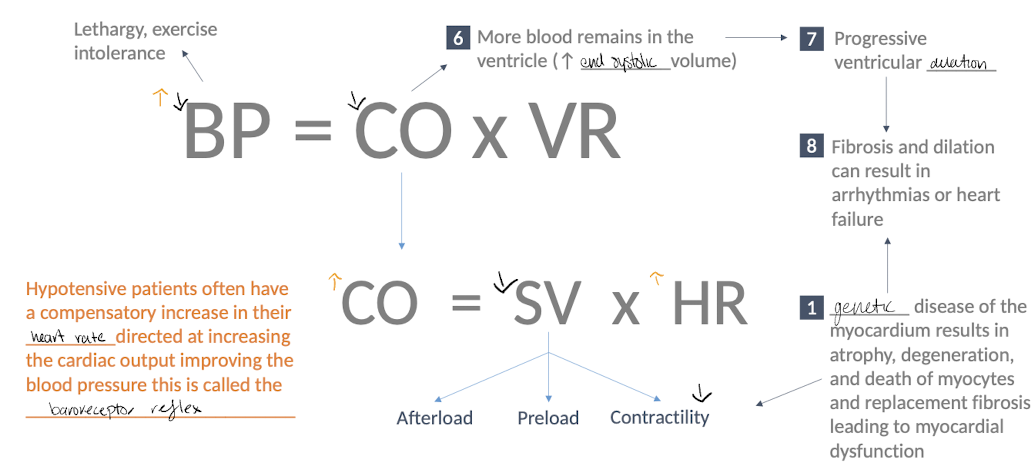
treatment for DCM
vasoconstrictor to stabilize
positive inotropic medications → pimobendan (vetmedin)
A heart murmur is heard between S1 and S2 heart sounds. During what phase of the cardiac cycle is this murmur occurring? diastole or systole
systole