Lab: Central lines, IVPB and TPN
 Call Kai
 Learn
 Practice Test
 Spaced Repetition
 Match
 Flashcards
 Knowt Play
1/23

There's no tags or description
Looks like no tags are added yet.
24 Terms
isotonic
osmolality
what kind of solution ?
osmolality is the same as blood (310 mEq/L)
electrolyte solutions are isotonic (must be diluted with water of they will cause enter RBCs too quickly and cause then to rupture)
no fluid shift
used for low blood volume
hypotonic
electrolyte content is less than 250 mEq/L
lower osmolality than blood
causes cells to swell
uses for cellular dehydration (DKA, hyperosmolar hyperglycemia)
hypertonic solution
electrolyte content is greater than 375 mEq/L
causes cells to shrivel
used for cerebral edema
Fluid Overload
overloading with fluid
s/s moist crackles on auscultation of the lungs, cough, restlessness, distended neck veins, edema, weight gain, dyspnea, and rapid, shallow respirations.
tx: decreasing the IV rate, monitoring vital signs frequently, assessing breath sounds, and placing the patient in a high Fowler position.
Air Embolism
s/s
tx? immediately ? position ? assess? administer ?
air in veins
s/s: palpitations, dyspnea, continued coughing, jugular venous distention, wheezing, and cyanosis; hypotension; weak, rapid pulse; altered mental status; and chest, shoulder, and low back pain.
tx: immediately clamping the cannula and replacing a leaking or open infusion system, placing the patient on the left side in the Trendelenburg position, assessing vital signs and breath sounds, and administering oxygen
Phlebitis
inflammation of a vein
chemical (from a vessicant), mechanical (catheter issues) or bacterial (infection)
s/s: reddened, warm area around the insertion site or along the path of the vein, pain or tenderness at the site or along the vein, and swelling.
Infiltration
unintentional administration of a nonvesicant solution or medication into surrounding tissue.
s/s: edema around the insertion site, discomfort and coolness in the area of infiltration, and a significant decrease in the flow rate
tx: the infusion should be stopped, the IV catheter removed, and a sterile dressing applied to the site after careful inspection to determine the extent of infiltration.
warm compress & elevate arm
cold compress of hypertonic solution
Extravasation
administration of vesicant or irritant solution or medication into the surrounding tissue
s/s: pain, burning, and redness at the site. Blistering, inflammation, and necrosis of tissues can occur.
thrombophletis
presence of a clot plus inflammation in the vein.
s/s: localized pain, redness, warmth, and swelling around the insertion site or along the path of the vein, immobility of the extremity because of discomfort and swelling, sluggish flow rate, fever, malaise, and leukocytosis
hematoma
s/s
tx
results when blood leaks into tissues surrounding the IV insertion site.
ecchymosis, immediate swelling at the site, and leakage of blood at the insertion site.
tx: removing the needle or cannula and applying light pressure with a sterile, dry dressing;
applying ice for 24 hours to the site to avoid extension of the hematoma;
elevating the extremity to maximize venous return, if tolerated
where do peripheral Ivs go
infants ?
use ?
hands, feet, forearms, AC
infants up to 9 months may use scalp veins bc its easier to see
use shortest length and smallest gauge possible
Central Venous Cases Device
sites?
used f0r
rapidly diluted to?
newborns ?
what kinds
subclavian, jugular vein, femoral vein
used for high osmolatiy solutions (TPN, chemical, vesicants) inserted at a high flow into a large vessel
rapidly diluted into isotonic solutions by the blood vessel
newborns - umbilical cord vein for IV
types: tunneled, non-tunneld/ PICC/ implanted
Non -tunnled Central Catheter
lumens ?
must be ?
how long can it be used
do not use until ?
single, double or triple lumens (labeled medial distal and proximal)
must be clamped and secured with needle-less adapter or caps so pt does not bleed out
for short term use / emergency use
do not use until placement is secured by xray
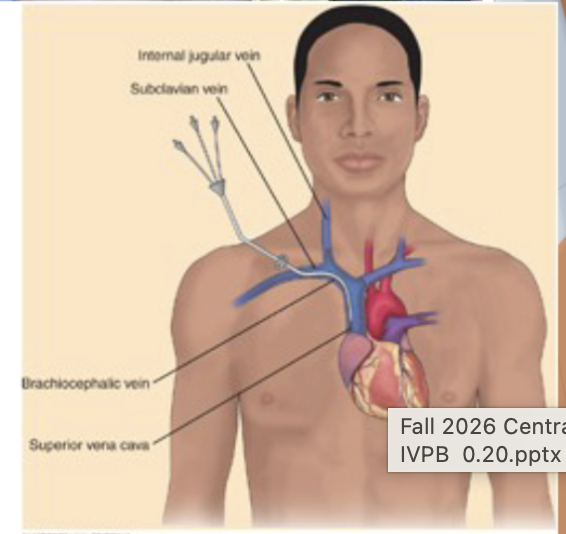
insertion of central catheters
inserted at bedside in ICU, ER
consent needed
nurses role: monitor ECG, BP, maintain sterility, pt comfort, document
tunneled catheter
placement ?
purpose of cuff?
used for how long
lumens ?
some have?
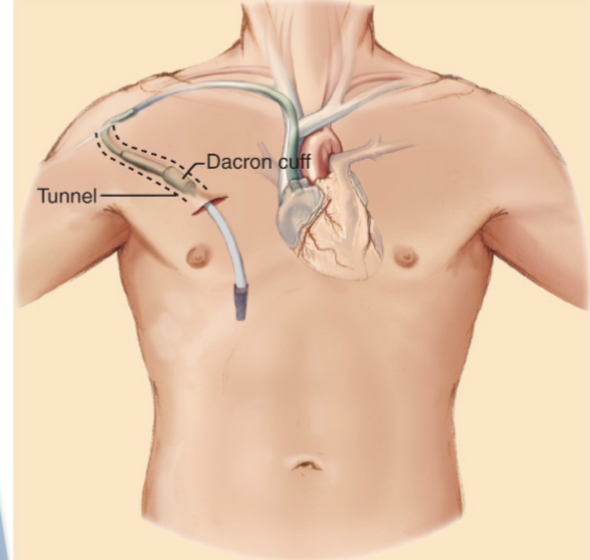
Inserted into the subclavian vein and advanced until its tip lies n the SVC just above the right atrium.
The proximal end is then tunneled from the entry site through the subcutaneous tissue of the chest wall and brought out through an exit site on the chest & sutured
Dacron cuff anchors the catheter in place and serves as a
barrier to infectionlong term use (years)
inserted surgically at bedside
single double or triple lumen
Some have valves that prevent backflow of blood and air
Peripherally Inserted Central Catheter (PICC)
how long can it be used
inserted where ?
N/I?
placement ?
can be used for days to months
can be inserted at bedside
NO BP, IV or blood taken from same extremity with a PICC
placement: basilic or cephalaic vein and cath is threaded to SVC
infants: Inserted via saphenous vein with tip in the IVC above the diaphragm

implanted port
what is it
what kind of needle
pros and cons
self sealing septum that allows needles to go through without damage or leakage
90 degree needle for entry (huber needle)
for long term iv therapy
placed surgically underneath the skin
more pt freedom and less r/o infection
more expensive

how can we minimize infection when managing central lines
hand hygiene (both nurse and pt)
turn pt head to opposite side when doing dressing changes
sterile technique
PPE (gloves, mask, gown)
chlorohexidine used b/c it dries faster and it reduces the likelihood that the catheter will be inserted before the bacteria have died off
remove if not needed or if infected (necessity must be reassessed daily)
antibiotic patches
caps on ports and when accessing scrub for 15 seconds
TPN
what is it
who needs it
what has already been considered
Method of providing nutrient to the body via Intravenous route
Patients who are unable to ingest adequate oral food or fluid within
7 days-severe burns, malnutrition, AIDS, sepsis cancer, bowel surgeries, acute pancreatitis, psychiatric syndromes (anorexia nervosa)
Have already considered enteral nutrition (tube feeds) b/c of better
maintenance of gut mucosal integrity and fewer complications
administering TPN
how much over how long
compare ?
what must be assessed ? how often
what size filter ?
how long Is TPN good for ?
tubing ?
some solutions ? filter?
must have ?
1-3 L of solution is administered over 24 hours
Compare label with physician‘s order – prepared in pharmacy under hood for sterility
pt specific - needs are reassessed every day based on blood work and modified daily
TPN/ PPN needs 0.22-micron-in-line filter
after 24 hours bag and tubing need to be discarded
cannot reuse same tubing - high sugar = r/o bacteria
Some solutions come mixed with TPN/PPN and fats emulsions in one bag with a special filter - Called TNA (3-in-1) – Total Nutrient
Admixture – use 1.2-micron filtermust have dedicated port for TPN, not be used for other medications administration
Intravenous fat emulsions
infused through ?
over how many hours and how many times a week?
filter ?
white bag - not pt specific
Intravenous fat emulsions may be infused through Y-connector close to the insertion site and below the TPN/PPN filter,
slowly over 6-12 hours and approx. 2-3 times a week.
Comes with own 1.2-micron-in-line filter (lipids are bigger molecules)
nursing implications for TPN
what are the 2 ways we can administer
what is always needed to administer
in case of emergency what can we give
how can hypoglycemia happen ? to avoid ?
verification of ?
what needs to be changed/ assessed daily ?
what needs to be checked regularly ?
10% or more dextrose solution administered via central line only
large Gauged peripheral line may be used for Peripheral Parenteral Nutrition (PPN) of lower osmolality and for shorter use
infusion pump used always, and check q2-3 hrs to verify rate
If TPN runs out and pharmacy has not prepared hand D10W (emergency - we don’t want hypoglycemia!)
never stop abruptly always taper (again hypoglycemia)
needs 2 nurses verification (same as blood)
tubing changed daily to avoid bacterial growth
monitor weight and labs daily to reassess formula of TPN
glucose checked regularly!
what are we assessing on our pts who are on TPN
weight
electrolytes
caloric intake & hydration
muscle wasting
poor tissue healing
Vomiting and diarrhea
complications of central catheter
pneumothorax - may accidentally puncture plueral membrane
monitor O2 sat and respiratory function
air embolism
clots - if you face any resistance STOP! can dislodge clot and push into patient
displaced catheter
infection / sepsis
fluid volume overload