Bio 155 Lecture
 Call Kai
 Learn
Learn Practice Test
 Spaced Repetition
 Match
Match Flashcards
 Knowt Play
1/25

There's no tags or description
Looks like no tags are added yet.
Name | Mastery | Learn | Test | Matching | Spaced | Call with Kai | Chat |
|---|
No analytics yet
Send a link to your students to track their progress
26 Terms
What is Homeostasis?
The ability to maintain a stable environment. Is preserved when our physiological mechanisms use energy to keep body conditions steady in spite of disruptions
What 3 components does homeostasis regulation of a biological variable require?
1.) sensor : Detects changes or deviations in a physiological variable from its normal range
2.) Integrator: which is the control center. It compares value to the set point and determines appropriate response.
3.) effector: organ or tissue that receives commands from control center and works to restore homeostasis.
What is Allostasis? What are the 2 types and what do they particularly do that’s different from homeostasis.
Refers to the body’s ability to adapt our set points or our behaviour to meet different conditions.
Physiological Allostasis: our internal integrators can shift their set points during specific states ( ex. Bp increases when scared)
Behavioural Allostasis: when we voluntarily perform behaviours that alter a regulated variable away from its current set point. (Ex. Wrapping up before you go outside)
Both forms are feed-forward and anticipate a future physiological need.
What’s a feedback loop? What are the 2 types?
Feedback loop: occur when change detected by a sensor triggers an effector response that changes the environment.
Negative feedback loop: returns the controlled variable toward its set point. (Ex. Eating roses blood glucose level and insulin is released to take up glucose so levels decrease in blood. When at set point insulin release stops.)
Positive feedback loop: enhance or amplify changes. Each cycle moves the regulated variable further from its initial set point.
Structure determines ____. Exact features of a structure may reflect ___ between ____.
Function.
tradeoffs. Multiple competing functions.
Cell Cycle describes what? What happens if the cell cycle is disrupted?
The balance in a typical cell between cell division and ‘simply’ performing normal physiological functions.
If cell cycle regulation is disrupted, abnormal cell division can occur leading to tumours, which can lead to cancer.
True or false: a cell that divides at an abnormally fast rate will become a cancer.
False- it will become a tumour.
Benign tumour vs. malignant tumour.
Benign tumour - stays within its original tissue boundaries. Malignant cancer spreads beyond them.
Compare the concentrations of ions in the extracellular fluid (ECF) and the Intracellular fluid (ICF)
ICF: little Na. Lots of K+, little Cl. Lots of large anions. very little Ca- almost none.
ECF: lots of Na. little of K+. lots of Cl. no large anions and a lil bit of Ca. (but more than ICF)
Passive vs. active transport + the different types of each.
What is vesicular transport?
Passive Transport: allows substances to move according to their concentration or electrochemical gradients.
Free diffusion.
Facilitated diffusion
Active Transport: uses stored energy to move ions against a concentration gradient.
primary active transport - ‘pump’ protein directly uses ATP
secondary active transport - uses a gradient of one molecule (created using ATP) to move another molecule.
Vesicular Transport: a specialized form of active transport (needs ATP) that can move large molecules or many molecules at a time using endosomes.
Exocytosis - transporting things out
Endocytosis- transporting things in- needs more ATP.
Is the inside or outside of the cell more electronegative?
inside of cell.
What are the 4 types of tissues?
Epithelial Tissue, Connective Tissue, Muscle Tissue, Nervous Tissue.
Explain what Muscle Tissue is.
Muscle Tissue is able to contract and produce mechanical force.
Explain what Nervous Tissue is.
Specialized to send and receive information in the form of electrochemical signals.
Explain what epithelial tissue is.
What 2 main types does this include?
Tissue that covers surfaces in your body- external surfaces, internal cavities and passageways and secreting structures.
includes Epithelia and Glands
Explain what connective tissue is.
Typically fills or stiffens spaces in you body.
What are some basic features all epithelial cells share. What are the types of surfaces in epithelial cells?
they share polarization. Meaning they are structurally and functionally different on either side.
Apical surface ( in contact with lumen) . Basolateral surface ( in contact with interstitial fluid) . There is also the basement membrane.

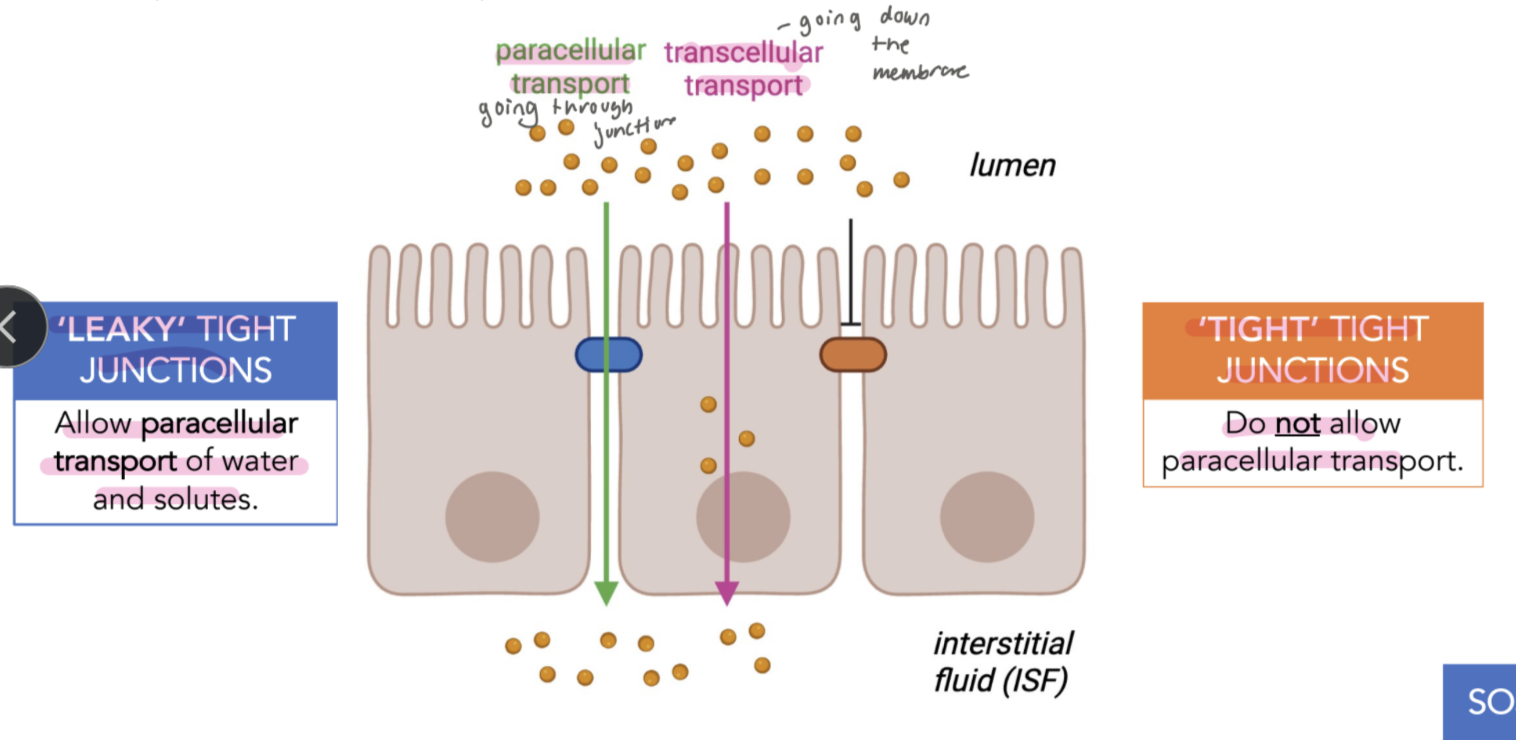
What defines how water and solutes can move between lumen and ISF? What are the different types of these?
Tight junctions define how water and solutes can move between the lumen and ISF.
‘Leaky’ tight junctions- allows paracellular transport of water and solutes.
‘Tight ‘ Tight junctions - do not allow for paracellular transport.
(paracellular transport- goes through junction. )
(transcellular - goes through the membrane)
What are the different types of epithelial tissue structures?
What is ‘pseudo- stratified’ ?
What determines the name of the tissue structures?
There is squamous. Cuboidal. Columnar.
There is also simple epithelia- one layer between basal membrane and lumen . And Stratified epithelia - multiple layers.
There is also ‘Pseudo-stratified’ which is an exception. Is is ‘pseudo’ because every epithelial cell touches the basement membrane.
The layer closest to the lumen determines shape name of epithelial cells.

What is the histological definition of connective tissue? What are the different types?
It is defined by the presence of extracellular protein fibres and cells suspended within a ground substance (matrix), but can fulfill many functions.
Connective Tissue proper. Fluid connective tissues.(blood, lymph) Supporting connective (cartilage, bone) tissues.
What types of connective tissue are there?
Can be divided into:
Loose - with low density of extracellular fibres and with more diversity of cell types.
Dense - with high density of extracellular fibres and with less diversity of cell types.
What are the different cell types found within loose connective tissue- + give examples
There are fixed cells - which remain permanently in the tissue.
Fibroblasts- baby cells remain that secrete the proteins of extracellular matrix
Fibrocytes- mature cells that maintain the proteins of the extracellular matrix
Wandering cells - can move into or through tissue depending on physiological demands.
Mesenchymal cells- stem cells that divide to replace damaged cells
Several different types of protein with different biophysical properties can be present as extracellular fibres in connective tissue proper
Elastin fibres- not always present but they are elastic and stretch + recoil.
Collagen fibres- in most connective tissues. High tensile strength ( strong but not stretchy - resists mechanical force)
Tissue membrane vs. Fasciae.
Tissue membrane: a layer of epithelial tissue + underlying layers of connective tissue.
Fasciae: layers of pure connective tissue that surround organs and provide physical support.
how do epithelial and connective tissues employ strategies for healing repair after damage?
Epithelium: Rapid proliferation (makes lots of new cells) A clot forms out of blood tissue for ex.
Connective : (mostly) increased rates of secretion of more fibres. A scar forms when a dense web of collagen fibres is secreted at the injury site.