Week 4 (Skeletal, Axillary, Perpendicular) Terms
 Call Kai
 Learn
 Practice Test
 Spaced Repetition
 Match
 Flashcards
 Knowt Play
1/26

There's no tags or description
Looks like no tags are added yet.
27 Terms
Tuberosity
Large rounded bump, may be rough; muscle attachment

Crest
Narrow, prominent ridge; muscle attachment
Trochanter
Very large blunt bump; only on the femur (there are 2; greater and lower)

Line
Narrow ridge, less prominent than a crest
Tubercle
Small rounded bump
Epicondyle
Raised area on or above a condyle

Spine
Sharp, slender, pointed projection
Ramus
Armlike bar of bone

Process
Any bony projection
Head
Rounded end on a narrow neck; forms a joint

Facet
Smooth, flat joint surface
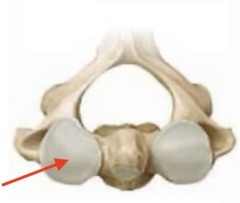
Condyle
Rounded joint projection

Groove
Furrow; vessels and nerves pass through
Fissure
Narrow slit; vessels and nerves pass through

Foramen
Round or oval hole through a bone

Notch
Dent in the edge of a bone
Meatus
Canal-like passage
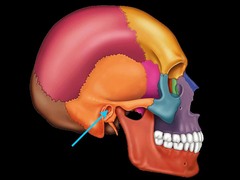
Fossa
Shallow, bowl-like depression

Sinus
Air-filled cavity inside a bone

What component is left when a bone is soaked in acid (HCl) and why?
Flexible rubbery collagen is left, because acid dissolves the inorganic mineral salts.
What component is left when a bone is baked/heated, and why?
Brittle minerals are left, because heat burns away the organic collagen fibers.
What are the primary spinal curves and why do they form?
Primary Spinal Curves: Thoracic and sacral curves; they are present at birth due to the fetal’s natural C-shape.
What are the secondary spinal curves and why do they form?
Secondary spinal curves: Cervical and lumbar curves; they develop after birth as the child begins to lift its head and learn to walk.

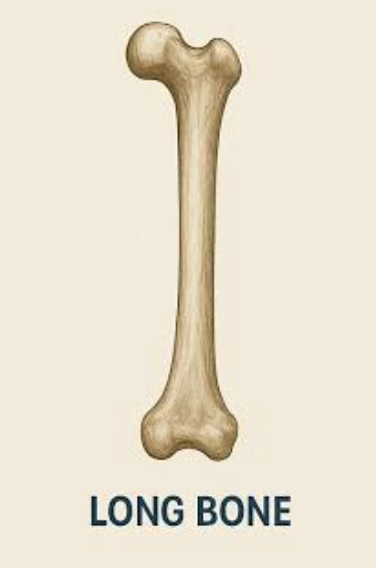
What defines a long bone?
Being longer than it is wide, consisting of a shaft with two ends (e.g., femur, humerus)
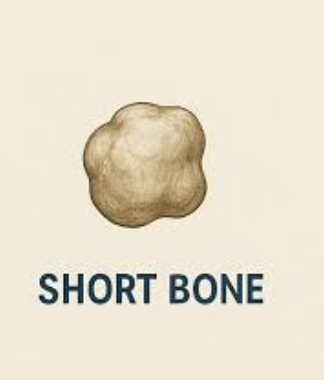
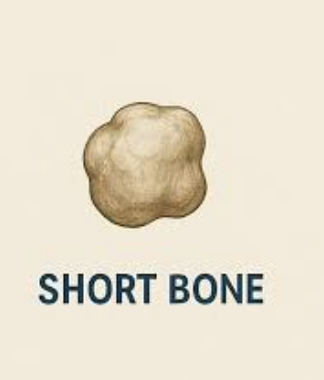
What defines a short bone?
Being roughly cube-shaped (e.g., carpals in wrist, tarsals in ankle).
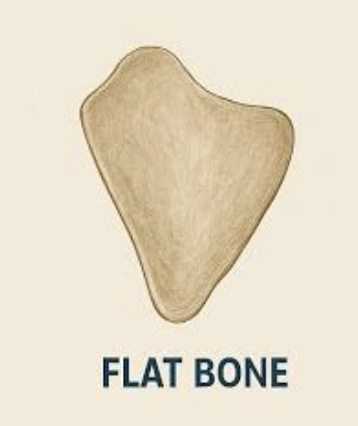
What defines a flat bone?
Being thin, flattened, and usually curved for protection or muscle attachment (e.g., sternum, ribs, cranial bones).

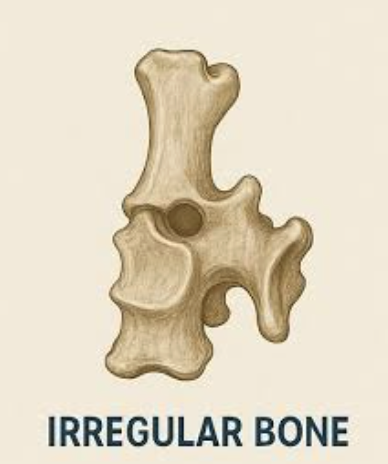
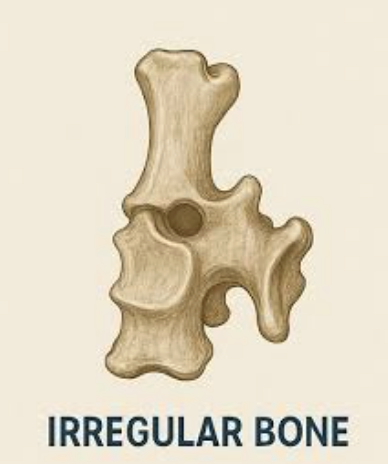
What defines an irregular bone?
Having a complex shape that does not fit into any other category (e.g., vertebrae, hip bones)