Unit 7 - The Nervous System
 Call Kai
 Learn
 Practice Test
 Spaced Repetition
 Match
 Flashcards
 Knowt Play
1/136

There's no tags or description
Looks like no tags are added yet.
137 Terms
What is membrane potential?
charge difference across membrane
What is membrane potential the result of? Which ions are attracted and which are not permeable?
in part from presence of large anions being trapped inside the cell. cations like K+ attracted inside by anions and Na+ not permeable and actively transported out
What is the RMP and what does it depend on? What is it most affected by and why?
resting membrane potential is -70 mV. depends on concentrations + permeability of ions inside and out of cell. affected mostly by K+ bec it’s most permeable
1 V = ? mV. Why is RMP -70 mV?
1000 mV. Use -70 mV because of constant moving of Na+ and K+ and Na+/K+ pump

What do electrodes attached to a voltmeter record? What does -70 mV refer to?
Electrodes record charge difference, the -70 mV means the inside of the cell is more negative than the outside by -70 mV
What is potential and what is equilibrium potential?
potential - charge distribution across a capacitor, equilibrium potential = voltage across cell membrane if only 1 ion could diffuse
Equilibrium potential (Ek) for K+ and Na+
K+ = -90 mV and Na+ = +66 mV

Explain how Ek is achieved and what does this mean
K+ (cations) attracted inside by trapped anions but also driven out by its concentration gradient. electrical and diffusion forces are equal and opposite

What is the concentration for these ions (which is greater outside vs inside)? Na+, K+, Ca2+, Cl-
Na+, Ca2+, Cl- = greater concen. outside and K+ = greater inside
Eflux vs influx and what are diffusion channels specific to?
Outward movement of ions across the cell membrane vs. inward movement of ions into the cell. Specific to the ion they let in
What are Na+/K+ pumps described as? How much mV does it add to the RMP and why is this charge negative / positive?
described as electrogenic because 3 Na+ pumped out for every 2 K+ taken in. Adds -3mV to RMP and it’s negative because more positive (3 Na+) leaving and gradually decreases
Cells have channels that are ____ open
always

Why is the membrane more permeable to K+ and what does this mean?
Bec of leakage channels and this means contributes more to RMP of -70 mV
Fixed anions aren’t able to do what and why?
Fixed anions can’t cross membrane bec most are proteins meaning too big to diffuse, charged molecule, no transporters
What are the divisions of the nervous system? What do they consist of?
CNS = integration, brain + spinal cord. PNS = cranial + spinal nerves
What kinds of cell types are in the nervous system (NS)?
Neurons and glial cells (neuroglia)
What are neurons and glial cells?
neurons are functional units of nervous system + glial cells are supporting cells that maintain homeostasis (5x more common than neurons)
4 ways neurons gather and transmit information
gather info through receptors
responding to stimuli
producing and sending electrochemical impulses
releasing chemical messages

How are neurons named?
Named based off # nerve fibers coming out of cell body

What are the anatomical classifications of neurons?
multipolar = many nerve fibers
bipolar = 2 fibers from cell body
pseudo = unipolar bec neither fake axon/dendrite
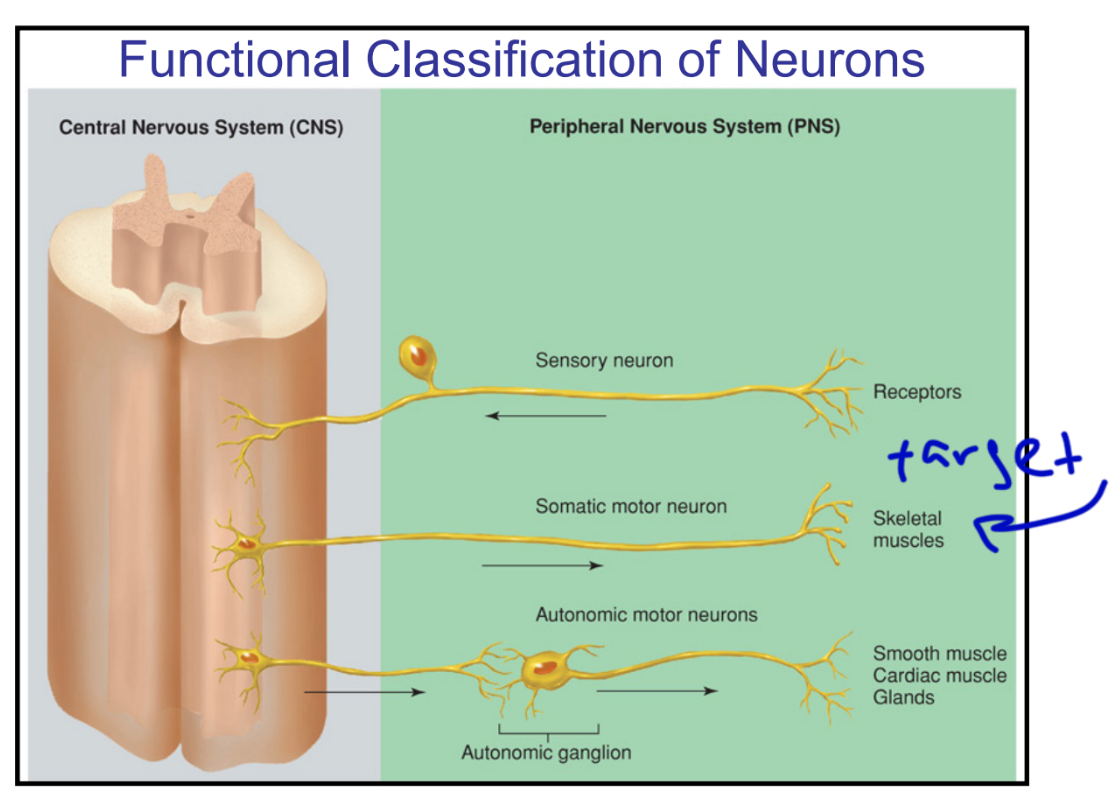
Functional classification of neurons
sensory = towards CNS
somatic motor = away from CNS → target
autonomic motor = anything other than skeletal muscle, divides into sympathetic and parasympathetic
Function of myelin
increase speed at which AP travels along axon + AP conduction activity increases if axon is myelinated
Difference between Schwann and oligodendrocyte
Schwann -
only myelinating in PNS (PNS also has satellite cells)
entire cell wraps around axon
can only make 1 myelin sheath
oligodendrocyte -
myelin around axons in CNS
sends out processes / fibers that form myelin sheath
can make 1+ myelin sheath
At rest, all cells have a _____ internal charge and ______ distribution of ions
negative, unequal
What does a negative internal charge and unequal distribution of ions?
large cations being trapped inside the cell
Na+/K+ pump and limited permeability keep Na+ high outside cell
K+ is very permeable and is high inside cell - attracted by negative charges inside
Explain excitability. Why do neurons and muscles do this?
excitable - neuron’s ability to produce AP and excitable cells can produce an AP quickly by rapid changes in ion permeability. to generate and conduct impulses
How are Membrane potential (MP) changes measured?
Placing 1 electrode inside cell and 1 outside
Explain depolarization and hyperpolarization and provide an example
depolarization - MP becomes more pos.
hyperpolarization - MP becomes more neg. than RMP
Cl- ion → hyperpolarizes bec Cl- concen is greater outside and flows to low inside cell
What is repolarization and when does it occur?
MP returns to RMP and only happens if depolarization / hyperpolarization has occurred
What are membrane ion channels?
MP changes occur by ion flow through membrane channels
Some channels are normally open and some closed. What’s the difference between leakage and VG channels?
leakage - always open, VG channels - opened by depolarization + have molecular gates that can be opened
Which VG channels are closed in resting cells at -70 mV? Which one has 2 gates?
Na+ (2 gates), K+, and Ca+

What is the state of the activation and inactivation channels at -70mV (RMP)? What about -60 mV?
at -70 mV = Activation channel - closed and inactivation channel - open
at -60 mV = pos. enters activation gates and both are opened, sudden Na+ influx

What happens at +30 mV to the activation and inactivation gates? Why?
inactivation gate closes + activation gate opened no more Na+ → bounces because needs to reset and this depends on timing about 2ms. after this time period, activation gate closes and inactivation gate opens
Where does the AP begin and where does it go?
begins at axon hillock transmit to axon terminal where neuron communicates w/ post-synaptic cell via NT
What is AP and how is it formed?
wave of MP change that sweeps along the axon from soma to synapse and wave formed by rapid depolarization of membrane by Na+ influx; followed by rapid repolarization by K+ efflux

What’s the initial stimulus/depolarizing event in the graph the result of? What’s the max amplitude for Na+
Na+ channel opening and max amplitude = +30 mV
How long does the VG K+ channel stay open for and why? How is this restored to RMP?
stays open until equilibrium is reached at -90 mV (min MP) because there’s no inactiv gate for it. Na+/K+ pump restores gradient
Describe depolarization as it relates to AP and the feedback loop involved
at threshold, VG Na+ channels open and it’s driven inward by electrochemical gradient opening more channels and this is positive feedback
Describe repolarization as it relates to AP
VG Na+ channels close; VG K+ channels open and electrochemical gradient drives K+ outward and repolarizes axon back to RMP
How do depolarization and repolarization occur? Do they require active transport?
diffusion, no
Why don’t we always see the Na+/K+ pump working?
Because of the rapid influx of Na+ and efflux of K+ when VG Na+ / K+ channel opens and overpowers the pump

Do all APs have the same amp and why?
yes because follow all-or-none
What does the AP have to be depolarized to in the body and give an example on how this works in the body?
to -60 mV in the body, stimuli depends on what’s touching the body like a fly, if it depolarizes touch receptors to -60 mV than you will feel something
What happens when an MP reaches threshold and bec of pos fdbck what happens
AP irreversibly fired and more and more Na+ channels opened. then shortly after opening, Na+ channels close and become inactivated until repolarization
How does the brain know the stimulus strength if the amplitude is the same?
Based on the frequency of AP / time (sec) = Hertz, 1 Hz = 1 AP/sec

Increased stimulus intensity causes ____ APs to be fired and does no AP mean no depolarization occured?
more APs, not true just means it wasn’t depolarized to -60 mV
refractory period
time in which no AP can be generated at the segment of the axon

Absolute vs relative refractory period
absolute = membrane cannot produce another AP bec Na+ VG channels are inactivated
relative = VG K+ channels open making it harder to depolarize to threshold
axon conduction
AP traveling along axon from hillock to terminal
What’s the AP threshold for opening a VG Na+ channel?
-60 mV AP

Explain what happens in this diagram and once an AP is started it is _____
self-propagating
Any VG Na+ channel in segment 2 is open
Na+ goes back toward segment 1
depolarizes #2 resulting in AP
no AP in segment 1 bec refractory period
segment 2 is refractory → goes to #3 depolarizes
Explain conduction in an unmyelinated axon
After axon hillock reaches threshold and fires AP, Na+ influx depolarizes adjacent regions to threshold → generating new AP → process repeats along axon → AP amp is always the same → conduction is slow

Why can’t dendrites and cell bodies produce AP?
because no VG Na+ / K+ channels only axons can generate and conduct AP
What are 2 factors affecting the speed of AP?
diameter (size), small = slow AP velocity, large = fast AP
if there are bare axons, no myelin = Nodes of Ranvier
Why are AP not generated in axons w myelin?
bec they don’t have Na+/K+ VG channels
AP begins at ____ and travels in ___ direction
axon hillock, 1

What happens when ions can’t flow across a myelinated membrane and no AP generated?
Saltatory conduction occurs
Because voltage-gated Na⁺ channels are only at unmyelinated Nodes of Ranvier, AP not produced at every axon segment
Instead, Na⁺ influx at one node creates a passive electrical current that flows rapidly under the myelin sheath
This skips myelinated areas to depolarize the next node, allowing the signal to travel significantly faster to the axon terminal
Why do humans have a small diameter?
bec not enough space in the body so have myelin sheath
What’s a synapse?
connection between a neuron (presynaptic) and another cell (postsynaptic)
What are the types of synapses and which is the most common and rare?
chemical (most common) and electrical synapses (rare in NS)
How does synaptic transmission at chemical synapses occur?
via NT, AP reaches axon terminal and reaches dead end → can’t jump over synaptic cleft so NT is needed
What happens in an electrical synapse?
physical connection via gap junctions between presynaptic neuron and post synaptic cell
What are graded potentials (GP)?
are produced when a ligand (stimulus) opens a ligand-regulated / chemical channel and causes a voltage which dissipate with distance from stimulus
What are synaptic potentials/post synaptic potential (PSP)?
occur at a synapse between a neuron and another cell
What are generator potentials?
occur when a sensory receptor is stimulated
What causes voltage change / MP?
ions going in and out of the cell
Why are gap junctions produced? How does this relate to AP?
each of 2 cells have transmembrane proteins with channels / pore allowing anything in 1 cell to go through the next cell and share material. AP goes thru 1 cell via gap jxn to another one w/o using NT
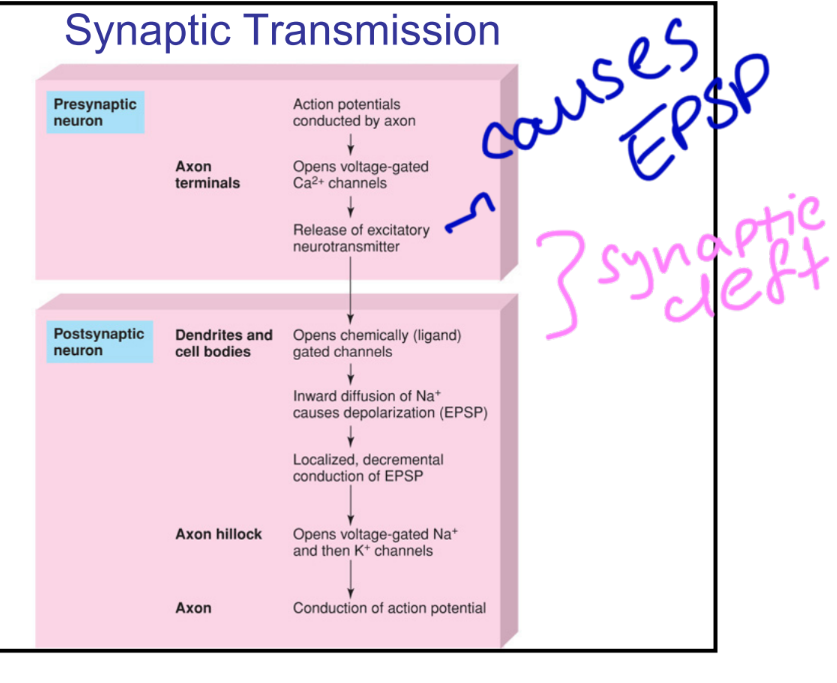
synaptic transmission
process by which a neuron communicates with a cell across a synapse
Steps of synaptic transmission - leading up to NT release
AP reach axon terminal at -60 mV
Ca2+ enters axon terminal via VG channels opened by Na+ that is trapped and as AP travels down axon, axon terminal is depolarized
Ca2+ bind to sensor protein in cytoplasm
Ca2+ protein complex + flood of Ca2+ mobilizes synaptic vesicles to move
vesicles fuse w/ axon terminal and via exocytosis NT (can be ACh) diffuses and binds to receptors on postsynaptic cell
Steps of synaptic transmission - leading up to post synaptic potential (PSP)
NT diffuses across cleft
binds to receptor proteins on postsynaptic membrane
causes opening ligand/chemically-regulated ion channels
PSP produced as ions diffuse across membrane via ligand-regulated ion channel
What do depolarizing and hyperpolarizing channels cause? Why is depolarizing like that?
depolarizing - EPSPs (excitatory postynaptic potentials) because of the probability of AP threshold being reached + exciting the cell
hyperpolarizing - IPSPs (inhibitory postsynaptic potentials)
EPSP and IPSP depends on what? What happens if the ion channel closes before reaching -60 mV?
depends on how much ions flow through. MP goes back to rest
To elicit an AP, axon hillock has to be what?
reached

Summation happens between ____ and _____? What has to be achieved for a new AP to be generated?
between EPSPs and IPSPs. MP in postsynaptic cell has to reach threshold
Where does the signal in the AP arrive?
brain - sensory receptor → brain or effector / target organ - brain → motor output
Does a nerve have a synapse and what does this mean for curare?
no it doesn’t so curare can’t inhibit anything but it can inhibit the synapse
AP vs GP/EPSP: stimulus for opening of ionic gates
AP: depolarization to -60 mV, GP: ACh or other excitatory NT
AP vs GP/EPSP: initial effect of stimulus
AP: VG Na+ channels open and, GP: common channels for Na+ and K+ open
AP vs GP/EPSP: cause of repolarization
AP: VG opening of K+ gates, GP: loss of intracellular pos charges w/ time and distance (moving of Na+ further away from entry point that caused it to come in)
AP vs GP/EPSP: conduction distance
AP: regenerated over length of the axon, GP: 1-2 mm; a localized potential (move further away from ion = smaller potential)
AP vs GP/EPSP: pos fdbck (self-propagating) between depolarization and opening of Na+ gates
AP: yes, GP: no
AP vs GP/EPSP: max depolarization
AP: +30 mV means VG Na+ channels inactivation gate closes + no more Na+ allowed, GP: -70 to 0
AP vs GP/EPSP: summation
AP: no summation - all-or-none event, GP: summation of EPSPs producing graded depolarizations
AP vs GP/EPSP: refractory period
AP: yes, GP: no
AP vs GP/EPSP: effect of drugs
AP: ACh effects inhibited by tetrodotoxin NOT by curare, GP: ACh effects inhibited by curare, not by tetrodotoxin
Why does GP have no threshold?
bec direct proportional responses
What is the most widely used NT and where is it used?
ACh in the brain and ANS at all neuromuscular junctions
What are the 2 subtypes of ACh?
nicotinic - allow Na+ in and depol, excitatory
muscarinic - K+ channel and hyper, inhibitory
Which is involved in muscle contractions and what does the binding of ACh to nicotinic receptors do?
nicotonic involved in muscle contractions and APs, binding of ACh opens Na+ channel + EPSP
What forms nicotinic ACh channel and what does it contain?
formed by 5 polypeptide subunits and contains 2 subunits w/ ACh binding sites
Nicotinic is a ligand-gated channel and how is it opened? What does this produce?
opens when 2 AChs bind to receptor channel allowing influx of Na+ and efflux of K+ out of postsynaptic cell and produces EPSPs
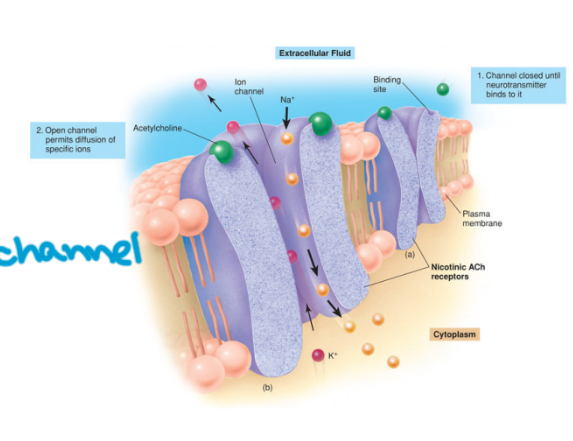
Why does the inward flow of Na+ dominate in a nicotinic ACh channel?
the influx is fast and the channel is more permeable to it so it acts like an Na+ channel but still allows K+ in just slower
Are the muscarinic receptor and channel separate?
Yes
NT in G-protein coupled channels: is the NT receptor part of the ion channel? What is it and what does it activate?
No, it’s a 1 subunit membrane polypeptide and it activates ion channel indirectly through G-proteins
For muscarinic ACh channel, what does the binding of 1 ACh mean?
activation of G-protein cascade which affects gated K+ channels. opens some causing hyperpolarization and closes some causing depolarization

What does acetylcholinesterase do? Where is it located?
inactivates ACh (NT), terminating its action and no longer stimulating the receptor. located in cleft

What are neurons that use acetylcholine as a NT referred to and often found?
cholinergic neurons, often found @ neuromuscular junction
What are large synapses on skeletal muscle called?
end plates or neuromuscular junctions (NMJ)
What do end plates / NMJ produce, open, and cause?
produce large EPSPs called end-plate potentials, open VG channels beneath end plate, cause muscle contraction