Bio CA1
 Call Kai
 Learn
Learn Practice Test
 Spaced Repetition
 Match
Match Flashcards
 Knowt Play
1/45

There's no tags or description
Looks like no tags are added yet.
Name | Mastery | Learn | Test | Matching | Spaced | Call with Kai | Chat |
|---|
No analytics yet
Send a link to your students to track their progress
46 Terms
What plants need to grow healthy
Sunlight, water, oxygen
Carbon dioxide
Mineral ions
What plants respond to
Their environmental conditions and change in their surroundings
What the response is called
Stimulus
Three types of stilmuli that plants respond to
Phototropism ,sun
Hydrotropism, water
Gravitropism , gravity
What is a tropism
Any response to a stimulus
Movement towards stimulus
Positive tropism
movement away from stimulus
Negative tropism
Unidirectional/ unilateral
Light from one direction
Uniform
Light that shines evenly from all directions
What hormones control
Growth , flowering,fruit ripening
Auxins
Plant growth hormones which control the growth of shoots and roots
How auxin works?
Auxin is produced in the tip of growing shoots and roots
Auxin diffuses down to the region where cell division occurs
Auxin stimulates the cells in the region to elongate ( more auxin equals faster elongation)
If light shines equally all around the tip , auxin will be spread evenly throughout the cells leading the shoot to elongate at the same rate and straight up
If light shines from one side the auxin will diffuse to the darker side making the cells on the shaded side elongate and grow faster than from cells in the other side
The higher concentration of auxins of the darker side
More growth by causing more cell elongation
Which causes shoot to bend and grow faster towards the light
Why is important for plants to respond at light
It must receive the maximum amount of sunlight for photosynthesis. Therefore more glucose is made which is used to release more energy for respiration, this energy is used for greater growth
Reproduce pollination
When tips are removed
No auxin is made so there is no growth
When tips are covered
Auxin diffuses to all the parts of the stem , causing the cells to elongate equally and upwards
tips are illuminated (gain light ) from one side only
Auxin diffuses and accumulates in the shaded side causing the shaded side to grow more . Seeding bend towards light
Negative geotropism happens in
Shots ,lower side grows faster shoot grows upwards
Positive geotropism
Roots, lower side grow slower , root grows down towards gravity
Why is important for a plant to respond to gravity
absorbs water and mineral ions
Ensures that roots grows deep enough to anchor the plant
Ensures plants grow tall enough to reach light => photosynthesis
Maximising chances for pollination
Clinostat
Machines that rotates ( cancels gravity ) so seeding grow horizontally
Why is auxin not considered a hormone
It’s transported in phoelm not plasma
is produced on tips not from organs
Auxin has different effect on roots and shoot
Stem
Positive phototropism, grows towards light , get maximum light for photosynthesis
Negative geotropism ,grows away from gravity , more chances to find light
Root
Negative phototropism, grows away from light , less chance of drying out (collects water )
Positive geotropism, grows towards gravity , more chances to find minerals
Diffusion
The net movement of particles from a region to high concentration to a region of low concentration (passive transport ,does not require energy )
Diffusion is affected by
Temperature
Concentration gradient
Surface area
Distance
Size of particles
Higher the temperature
More kinetic energy
Faster molecule movement
More collisions
Rate of diffusion is higher
Greater the difference in concentration
Faster movement will occur
More random collisions
Bigger the cell or structure is
Smaller the surface area to volume ratio ,which slows the rate of diffusion
Larger the surface area to volume ratio
Faster rate of diffusion
Smaller distance
Faster transport
Larger particles..
Cannot pass through without assistance
Calculating rate
Change/ time
Osmosis
The net movement of water molecules from an area of high water potential to an area of low water potential through a semi permeable membrane
Concentrated solution
Larger mass of solute dissolved in a given volume => lower water potential
Dilute solution
Smaller mass of solute dissolved in a given volume of solvent => higher water potential
How to answer osmosis question
State where high and low water potential are
State the direction of movement of WATER MOLECULES
Say OSMOSIS
say the movement happens across a SELECTIVELY PERMEABLE MEMBRANE
State what happens to the cell INCREASE IN VOLUME/ BURST
Isotonic solution
Equal water concentration, no net movement flaccid
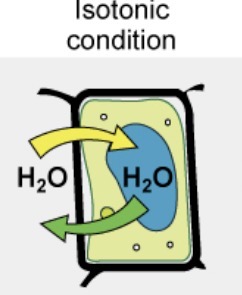
Hypertonic solution
Higher concentration of ions (concentrated) plasmolyzed

Hypotonic
Has lower concentration ( dilute) turgid

Active transport
Movement of particles across the cell membrane by carrier proteins from low to high concentration, using energy from respiration
Concentration gradient (high to low ) is the opposite to
Active transport (low to high concentration)
% change =
Final - starting mass / starting x 100
Surface area
6(l x w)
Volume
L x w x h
Surface area to volume ratio
sa / v