TEAS acid and bases pt.1 / chemistry
 Call Kai
 Learn
 Practice Test
 Spaced Repetition
 Match
 Flashcards
 Knowt Play
1/53

There's no tags or description
Looks like no tags are added yet.
54 Terms

1. What is an acid?
An acid is a substance that releases or provides hydrogen ions (H⁺) when dissolved in water.
Let's break that down.
H = Hydrogen
+ = Positive charge
H⁺ = A hydrogen ion (basically a hydrogen atom that lost its electron).
Think of an acid as something that puts H⁺ into water.
Here's the important part:
When an acid enters water, the H⁺ joins with a water molecule (H₂O) to make something called hydronium (H₃O⁺).
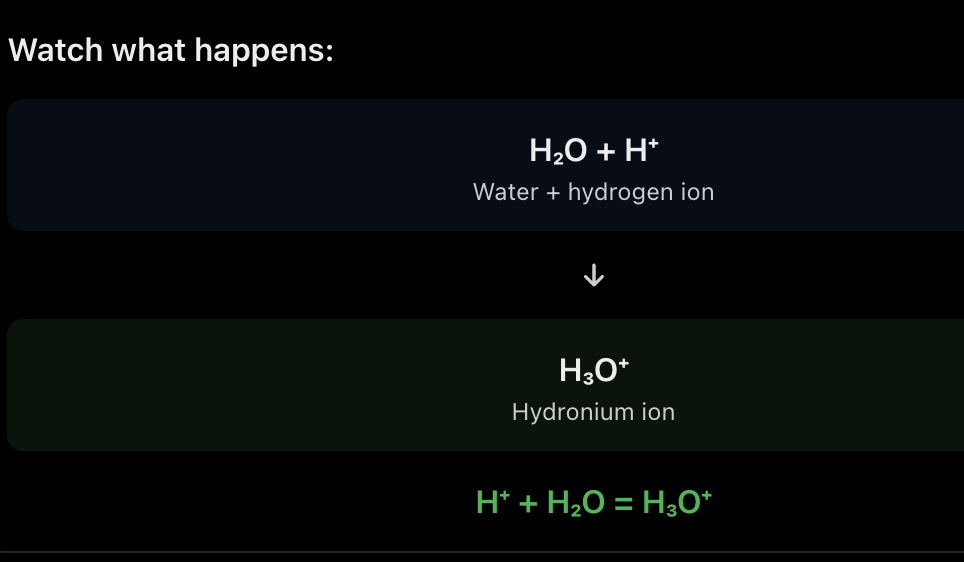
Memory trick: Acid adds H⁺ to water!
You don't need to overcomplicate this. Just remember that acids produce H⁺, which forms H₃O⁺ in water.
2. How do you recognize an acid?
Acids have three important characteristics:
Property | What it means |
|---|---|
Sour taste | Acids are often sour, like lemons. |
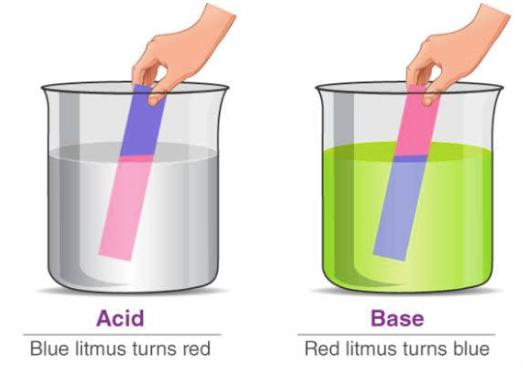
Turn litmus red | They change blue litmus paper to red. |
Corrosive | Strong acids can damage materials. |
Let's break down the hard words:
Litmus: Special paper used to test whether something is an acid or base.
Corrosive: Something that can eat away at or damage materials.
Memory trick:
❤ ACID = RED
Think: Acid turns blue litmus paper RED.
Important: Never taste or touch unknown chemicals to test them. The sour taste is just a characteristic, not a way to test chemicals.

3. Common acids you NEED to recognize
1. Citric Acid
Found in lemons and oranges.
Remember: CITRIC = CITRUS.
Formula: C₆H₈O₇
2. Lactic Acid
Found in yogurt and buttermilk.
Remember: LACTIC = DAIRY.
Formula: C₃H₆O₃
Acetic Acid
Found in vinegar.
Remember: ACETIC = VINEGAR.
Formula: CH₃COOH or C₂H₄O₂
4. Hydrochloric Acid
Found in your stomach.
Helps break down food during digestion.
Remember: HYDROCHLORIC = STOMACH.
Formula: HCl
. Phosphoric Acid
Found in some soft drinks and detergents.
Remember: PHOSPHORIC = SODA.
Formula: H₃PO₄
6. Nitric Acid
Used in making fertilizers.
Remember: NITRIC = FERTILIZER.
Formula: HNO₃
4. Your super-easy memory sheet
Here's how I want you to remember all six:
Acid | Think of... |
|---|---|
Citric | 🍋 Citrus fruits |
Lactic | 🥛 Yogurt |
Acetic | 🥗 Vinegar |
Hydrochloric | 🫃 Stomach |
Phosphoric | 🥤 Soda |
Nitric | 🌱 Fertilizer |
Quick memory sentence:
"Lemons, yogurt, vinegar, stomach, soda, fertilizer."
Those are your six connections!

5. What is MOST important for the TEAS?
Acids produce H⁺ ions in water.
H⁺ combines with H₂O to form H₃O⁺ (hydronium).
Acids turn blue litmus paper RED.
Acids generally have a sour characteristic.
Strong acids can be corrosive.
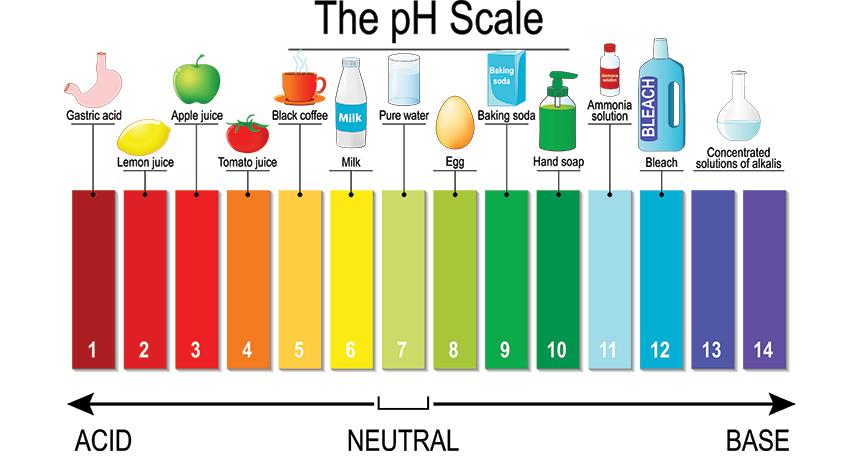
One extra thing to know: Acids have a pH below 7. We'll connect that to bases as we continue.
1. What ion do acids produce when dissolved in water?
Acids provide H⁺ ions. These combine with water to form H₃O⁺.
2. What happens when an acid touches blue litmus paper?
It turns red
Acids turn BLUE litmus paper RED.

3. Which acid is found in vinegar?
. Acetic acid
Acetic acid is the acid in vinegar.
4. Which acid is found in the stomach?
Hydrochloric acid (HCl) is found in stomach acid.
5. What is H₃O⁺ called?
Hydronium
forms when H⁺ combines with H₂O.

1. What is a base?
Acids = H⁺
Bases = OH⁻
is a substance that produces hydroxide ions (OH⁻) when dissolved in water.
Let's break that down:
OH = Oxygen + Hydrogen.
⁻ = Negative charge.
OH⁻ = Hydroxide ion.
Remember how acids produce H⁺?
Bases are different because they produce OH⁻ in water.

2. What does a base do?
Property | Super-easy meaning |
|---|---|
Slippery | Can feel slippery in solution, like soapy water. |
Corrosive | Strong bases can damage materials. |
Turn litmus blue | Turn RED litmus paper BLUE. |
Bitter | Have a bitter taste. |
Let's explain two words:
Solution: A substance dissolved in a liquid.
Corrosive: Something that can eat away at or damage materials.
Memory trick:
ACID = BLUE turns RED ❤
BASE = RED turns BLUE 💙
Remember: You change the opposite-colored litmus paper!
Never taste or touch chemicals to identify them. These are characteristics, not testing methods.


3. Common bases you need to recognize
1. Sodium Hydroxide (NaOH)
Used in soap and oven cleaners.
Memory trick: SODIUM = SOAP.
2. Potassium Hydroxide (KOH)
Used in soap and textiles.
Memory trick: POTASSIUM = SOAP.
3. Ammonia (NH₃)
Used in cleaning products and fertilizers.
Memory trick: AMMONIA = CLEANING.
Important: Ammonia reacts with water to produce OH⁻. It doesn't have OH in its formula!
. Magnesium Hydroxide (Mg(OH)₂)
Used in antacids and laxatives.
Memory trick: MAGNESIUM = STOMACH.
Helps relieve excess stomach acid.
Two hard words:
Antacid: A medicine that helps neutralize stomach acid.
Laxative: Something that helps you have a bowel movement.
What does Mg(OH)₂ mean?
The little ₂ outside the parentheses means there are TWO OH groups.
So: Mg(OH)₂= Mg + 2 (OH)
That means it contains:
1 magnesium (Mg)
2 oxygen atoms
2 hydrogen atoms
Memory trick: A little number outside parentheses multiplies EVERYTHING inside.

4. What does acidic, basic, and neutral mean?
Your paragraph says that water solutions contain two types of ions:
H⁺ = Hydrogen ions
OH⁻ = Hydroxide ions
The amount of each determines whether something is acidic, basic, or neutral.
Let's pretend we're counting them!
ACIDIC solution
More H⁺ than OH⁻
H⁺
H⁺
H⁺
H⁺
H⁺
OH⁻
More hydrogen ions = ACID.
BASIC solution
More OH⁻ than H⁺
H⁺
OH⁻
OH⁻
OH⁻
OH⁻
OH⁻
More hydroxide ions = BASE.
NEUTRAL solution
Equal amounts of H⁺ and OH⁻
H⁺
H⁺
H⁺
OH⁻
OH⁻
OH⁻
Equal amounts = NEUTRAL.
The easiest memory trick EVER:
Acid wins the H⁺ count.
Base wins the OH⁻ count.
Neutral = TIE!

5. What does aqueous solution mean?
"Anything that is dissolved in water is an aqueous solution."
Aqueous (pronounced AY-kwee-us) simply means something is dissolved in water.
For example:
Imagine putting salt into a glass of water.
Salt = the substance being dissolved.
Water = the liquid doing the dissolving.
Salt water = an aqueous solution.
Remember: AQUEOUS = WATER!
Another word you'll see is:
Solvent: The liquid that dissolves something.
Solute: The substance that gets dissolved.
Water is the main solvent discussed in your paragraph.
6. What happens when water interacts with itself?
Your paragraph says that even PURE water can naturally produce a tiny amount of hydrogen and hydroxide ions.
Wait... WHAT?
Yes! Even pure water has a tiny amount of ions in it.
Here's what happens:
Two water molecules interact.
One water molecule gives away an H⁺ (hydrogen ion).
The other water molecule receives that H⁺.
This creates TWO things:
H₃O⁺ = Hydronium
OH⁻ = Hydroxide
Look at the equation:

Water makes a pair!
H₃O⁺ = Hydronium
OH⁻ = Hydroxide
Pure water has equal amounts of these ions, so it is neutral.

7. What are electrolytes?
is a substance that produces ions when dissolved in water.
Remember:
Ions are particles with an electrical charge.
Positive ions have a + charge.
Negative ions have a − charge.
Here's why that matters:
Ions can carry electricity!
When acids and bases dissolve in water, they produce ions. Those ions allow the solution to conduct electricity.
Let's break down two more words:
Conduct: To allow something (like electricity) to pass through.
Electrolyte: A substance that forms ions in solution and allows electrical current to flow.
Memory trick: ELECTROLYTES = ELECTRICITY!
Think of it this way:
Acid or base dissolves in water.
Ions are present in the water.
Ions carry electrical charge.
The solution can conduct electricity.
Important: Not every substance dissolved in water is an electrolyte. Sugar dissolves in water, for example, but does not break into ion

8. Put everything together: Your TEAS cheat sheet
Topic | What to remember |
|---|---|
Acid | Produces H⁺ |
Base | Produces OH⁻ |
Hydronium | H₃O⁺ |
Hydroxide | OH⁻ |
Acidic | More H⁺ than OH⁻ |
Basic | More OH⁻ than H⁺ |
Neutral | Equal H⁺ and OH⁻ |
Aqueous | Dissolved in water |
Solvent | Does the dissolving |
Solute | Gets dissolved |
Electrolyte | Produces ions in solution |
Conduct | Allows electricity to pass |
pH scale — remember this too!
Catchy memory trick:
ACID goes DOWN (below 7).
BASE goes UP (above 7).
NEUTRAL stays in the MIDDLE (7).
1. Which ion is associated with bases?
OH-
Bases produce hydroxide (OH⁻) ions in water.

2. What happens to RED litmus paper when exposed to a base?
blue
Bases turn red litmus paper blue.
3. Which substance is commonly used in antacids?
Magnesium hydroxide is used in antacids.’
4. A solution has more OH⁻ ions than H⁺ ions. What is it?
base
5. What does aqueous mean?
dissolves in water
7. What forms when two water molecules exchange an H⁺?
Hydronium and hydroxide
The products are H₃O⁺ and OH⁻.
8. Why can acids and bases conduct electricity in water?
Because they contain ions

1. Are ions the same thing as electrolytes?
Not exactly! They are related, but they are NOT the same thing.
Think of it like this:
Ions = the little charged particles.
Electrolyte = a substance that produces ions when dissolved in water.
For example, let's use salt water.
When you put salt (NaCl) into water:
Salt dissolves.
It separates into two ions:
Na⁺ = positive sodium ion.
Cl⁻ = negative chloride ion.
Those ions move around in the water.
So, salt is the electrolyte, and Na⁺ and Cl⁻ are the ions!
That's the difference.

2. How do ions carry electricity?
Remember:
Positive ions have a positive charge (+).
Negative ions have a negative charge (−).
Electricity involves the movement of electrical charges.
When salt dissolves in water, its ions are FREE to move around.
Imagine connecting electrodes to salt water with a battery.
Here's what happens:
The battery creates an electrical push.
Positive ions move toward the negative electrode.
Negative ions move toward the positive electrode.
Their movement helps carry electrical current through the water.
THAT'S HOW THE WATER CAN CONDUCT ELECTRICITY!
Think of ions like little delivery trucks carrying electrical charges through the water.
Memory trick:
IONS = CHARGED PARTICLES
MOVING IONS = ELECTRICITY CAN FLOW
One important detail: In metals, electrons usually carry the electrical current. In solutions, moving ions carry the current.
3. Why doesn't sugar water conduct electricity the same way?
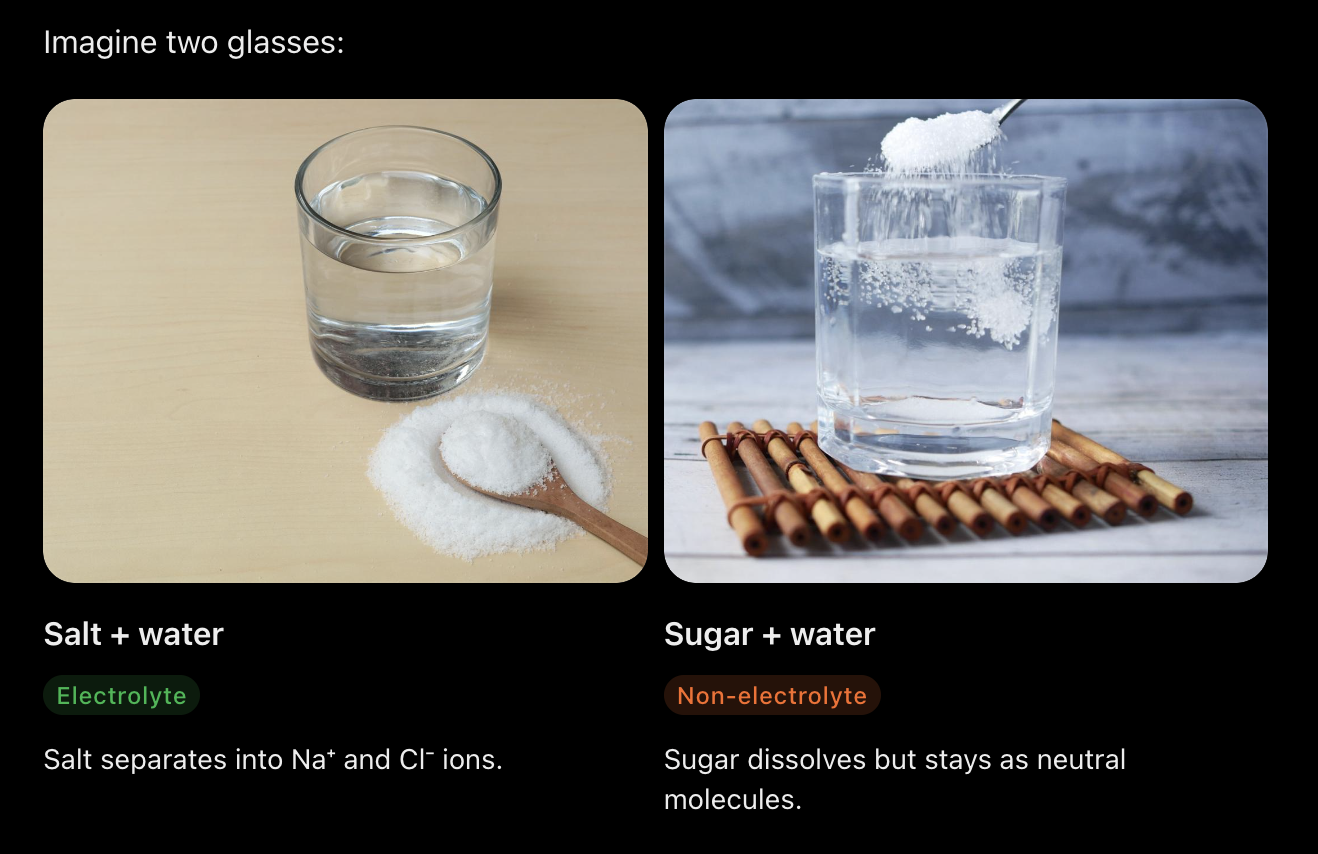
Imagine two glasses:
Salt water:
Salt dissolves.
Salt separates into charged ions.
The ions move around.
It can conduct electricity.
Sugar water:
Sugar dissolves.
Sugar does NOT separate into ions.
It stays as neutral sugar molecules.
It does not conduct electricity well.
THE BIG MEMORY TRICK:
Dissolving does NOT automatically mean making ions!
Salt dissolves AND separates into ions.
Sugar dissolves BUT does not separate into ions.
That's why salt is an electrolyte and sugar isn't.
Do two water molecules ALWAYS have to interact to form ions?
2H₂O→H₃O⁺ + OH⁻
Let's translate it.
2H₂O = two water molecules.
H₃O⁺ = hydronium.
OH⁻ = hydroxide.
One water molecule gives an H⁺ to another water molecule.
Imagine two water molecules interacting:
Water molecule #1
H₂O
Gives away H⁺
H⁺ transfers to the other water molecule
Water molecule #2
H₂O
Receives H⁺
OH⁻ H₃O⁺
Hydroxide Hydronium
Pure water contains HUGE numbers of water molecules.
This process happens naturally between water molecules throughout the water. Only a tiny fraction of them form ions at any given moment.
It does NOT mean you need to have ONLY two water molecules in a glass!
You can have a whole glass, a bottle, or a swimming pool of water. The same process happens.
5. Why is pure water neutral?
Remember what neutral means?
Equal amounts of H₃O⁺ and OH⁻.
When water naturally forms these ions, it produces them in equal amounts.
Hydronium = positive.
Hydroxide = negative.
Neither one is greater than the other.
That's why pure water is neutral (pH 7 at 25°C).
🧠 Final memory sheet
Word | Easy meaning |
|---|---|
Ion | Particle with an electrical charge |
Electrolyte | Substance that produces ions in water |
Conduct | Allow electricity to flow |
Salt water | Has moving ions; conducts electricity |
Sugar water | Sugar stays neutral; poor conductor |
H₃O⁺ | Hydronium |
OH⁻ | Hydroxide |
Neutral water | Equal amounts of H₃O⁺ and OH⁻ |
Electrolytes produce ions, and moving ions allow electricity to flow through water. 💗
When salt dissolves in water, what happens?
It separates into ions
Salt separates into Na⁺ and Cl⁻ ions.
What is an electrolyte?
A substance that produces ions in water
Electrolytes produce ions when dissolved in water.
Why can salt water conduct electricity?
Because it contains moving ions
Does sugar separate into ions when dissolved in water?
No, it stays as neutral molecules
Sugar dissolves but does not break into ions.
Do you need exactly two water molecules in your entire glass to form hydronium and hydroxide?
No, this happens naturally among many water molecules
The equation shows two molecules participating in one interaction, not the total amount of water needed.
Which of the following is an acid?
H3P04
is a common acid that is capable of donating one of its hydrogen atoms to form a hydronium ion.
Arrhenius theory.
H⁺
ACID
Hydrogen ion donor
OH⁻
BASE
Hydroxide producer (in water)
Remember: H⁺ is hydrogen. OH⁻ is hydroxide.
1. First theory: Arrhenius acids and bases
The first theory is called the Arrhenius theory.
Don't worry about remembering the scientist's name right now. Just remember what this theory says:
Arrhenius acid: Produces H⁺ ions when dissolved in water.
Arrhenius base: Produces OH⁻ ions when dissolved in water.
That's it!
Think of Arrhenius as the WATER theory because it explains what acids and bases do when they dissolve in water.
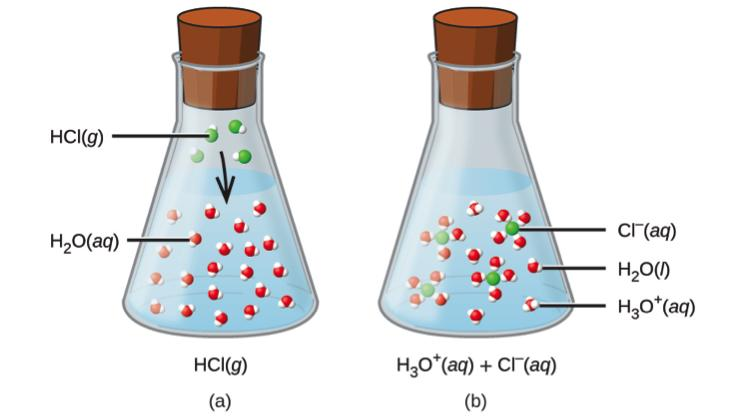
Let's look at your first picture: HCl
Your picture shows this:
Let's translate EVERYTHING.
Symbol | Meaning |
|---|---|
HCl | Hydrochloric acid |
(g) | Gas |
→ | Turns into / separates into |
H⁺ | Hydrogen ion |
Cl⁻ | Chloride ion |
(aq) | Dissolved in water |
What is happening?
Imagine HCl going into water.
HCl separates into two ions.
One is H⁺.
The other is Cl⁻.
Because HCl produces H⁺ in water, it is an Arrhenius acid.
Memory trick:
HCl produces H⁺.
H⁺ = ACID.
Therefore, HCl is an acid!
One little detail: Your equation uses H⁺ as a shortcut. In actual water, that H⁺ attaches to H₂O to form H₃O⁺ (hydronium). We'll come back to that!
One little detail: Your equation uses H⁺ as a shortcut. In actual water, that H⁺ attaches to H₂O to form H₃O⁺ (hydronium). We'll come back to that!


Now let's look at your second picture: NaOH
Let's translate:
Symbol | Meaning |
|---|---|
NaOH | Sodium hydroxide |
(s) | Solid |
→ | Separates into |
Na⁺ | Sodium ion |
OH⁻ | Hydroxide ion |
(aq) | Dissolved in water |
What's happening?
Sodium hydroxide (NaOH) dissolves in water.
It separates into Na⁺ and OH⁻.
It produces OH⁻.
Because it produces OH⁻ in water, it is an Arrhenius base.
Memory trick:
NaOH produces OH⁻.
OH⁻ = BASE.
Therefore, NaOH is a base!
Memory trick:
NaOH produces OH⁻.
OH⁻ = BASE.
Therefore, NaOH is a base!
Wait! What do (g), (s), and (aq) mean?
These are just little labels that tell you what state the substance is in.
(g) = Gas
(s) = Solid
(l) = Liquid
(aq) = Aqueous, meaning dissolved in water.
Don't confuse (aq) with a new chemical. It just tells you the substance is in a water solution.
2. Why do we need another theory?
Limitation means something a theory cannot fully explain.
Arrhenius works well for many common acids and bases, BUT it has a problem.
It focuses on:
Acids producing H⁺.
Bases producing OH⁻.
But what about substances that act like acids or bases WITHOUT having H⁺ or OH⁻ in their original formula?
That's why scientists developed another way to classify acids and bases.
It's called the Brønsted-Lowry theory.
3. Second theory: Brønsted-Lowry acids and bases
This theory is actually easier if you remember ONE thing:
A hydrogen ion (H⁺) is also called a PROTON.
So if you see the word proton in chemistry, think:
proton H+
Now, the Brønsted-Lowry theory says:
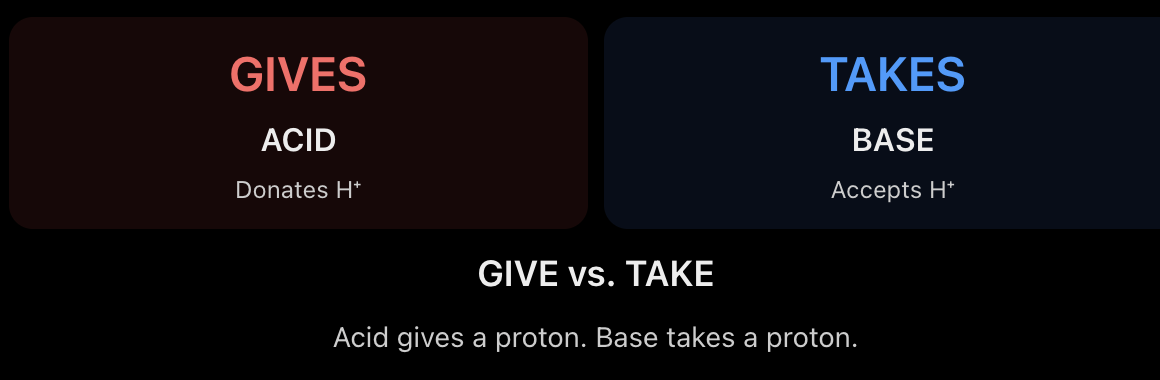
Acid = DONATES H⁺ (gives it away).
Base = ACCEPTS H⁺ (takes it).
That's the entire idea!
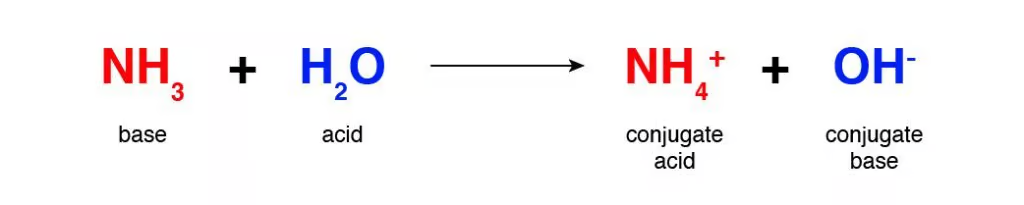
Let's look at your third picture: Ammonia + Water
Your picture shows:
The equation is:

First, let's identify everyone:
NH₃ = Ammonia
H₂O = Water
NH₄⁺ = Ammonium
OH⁻ = Hydroxide
What is actually happening?
Imagine ammonia and water meeting.
Ammonia (NH₃) wants to ACCEPT an H⁺.
Water (H₂O) gives an H⁺ to ammonia.
Let's watch:

Now we get to TWO new terms.

What is a conjugate acid?
A conjugate acid is what a base becomes AFTER it ACCEPTS an H⁺.
Look at ammonia:

NH₃ was the base.
It ACCEPTED H⁺.
It became NH₄⁺.
Therefore, NH₄⁺ is the conjugate acid.
What is a conjugate base?
A conjugate base is what an acid becomes AFTER it DONATES an H⁺.
Look at water:

H₂O was the acid.
It DONATED H⁺.
It became OH⁻.
Therefore, OH⁻ is the conjugate base.
THE MEMORY TRICK YOU NEED:
Base TAKES H⁺ → becomes conjugate ACID.
Acid GIVES H⁺ → becomes conjugate BASE.
For your ammonia example:
Substance | Its job |
|---|---|
NH₃ | Base |
H₂O | Acid |
NH₄⁺ | Conjugate acid |
OH⁻ | Conjugate base |
Answer to your textbook question
The conjugate base is OH⁻.
How do I recognize a conjugate pair?
Look for two substances that differ by ONE H⁺.
NH₃ and NH₄⁺ differ by one H⁺.
H₂O and OH⁻ differ by one H⁺.
That's how you recognize conjugate acid-base pairs.
4. Why does the book say H⁺ doesn't float around freely in water?
Remember learning about hydronium?
This connects directly to that!
Your textbook says free H⁺ ions don't just float around by themselves in water.
Instead, H⁺ attaches to H₂O.

Let's translate:
H⁺ = Hydrogen ion.
H₂O = Water.
H₃O⁺ = Hydronium.
Hydronium is just water that has accepted an extra H⁺!
So why do you sometimes see H⁺ and sometimes H₃O⁺?
Because chemistry books often use H⁺ as a shortcut when talking about acids.
For the TEAS, remember:
H⁺ = shorthand for the hydrogen ion being transferred.
H₃O⁺ = what forms when that H⁺ attaches to water.
They are related, but they are not exactly the same formula.
5. Third theory: Lewis acids and bases
Okay, last theory! This one sounds complicated, but let's make it easy.
The Lewis theory focuses on electrons, not H⁺.
Remember electrons?
They are negatively charged particles found around atoms.
The Lewis theory says:
Lewis acid = ACCEPTS a pair of electrons.
Lewis base = DONATES a pair of electrons.
ACCEPTS DONATES
Lewis acid Lewis base
Takes electron pair Gives electron pair
Memory trick:
Lewis acid = takes electrons.
Lewis base = gives electrons.
Let's make sure you see the difference between the three theories:
Theory | Acid | Base |
|---|---|---|
Arrhenius | Produces H⁺ in water | Produces OH⁻ in water |
Brønsted-Lowry | Gives H⁺ | Takes H⁺ |
Lewis | Takes electron pair | Gives electron pair |
Notice the pattern:
Arrhenius = What ions form in water?
Brønsted-Lowry = Who gives or takes H⁺?
Lewis = Who gives or takes electrons?
You do NOT need to mix these up!

6. What does amphoteric mean?
Your textbook ends with one more word: amphoteric.
Amphoteric means a substance can act as BOTH an acid AND a base.
Yes! The same substance can do both!
Your textbook uses pure water as the example.
Remember our Brønsted-Lowry theory?
Acid = gives H⁺.
Base = takes H⁺.
Water can do either depending on what it reacts with.
For example:
When water gives away H⁺, it acts as an acid.
When water accepts H⁺, it acts as a base.
Memory trick: AMPHOTERIC = BOTH!
Think: Water can play BOTH teams!
Acid & Base Classification
1. Arrhenius theory
Acid = produces H⁺ in water.
Base = produces OH⁻ in water.
2. Brønsted-Lowry theory
Acid = DONATES H⁺.
Base = ACCEPTS H⁺.
Proton = H⁺.
Conjugate acid = base AFTER accepting H⁺.
Conjugate base = acid AFTER donating H⁺.
3. Lewis theory
Acid = ACCEPTS electron pair.
Base = DONATES electron pair.
4. Amphoteric
Can act as BOTH an acid and a base.
Example: Water.
5. Hydronium
H⁺ attaches to H₂O.
Forms H₃O⁺.
H⁺ is often used as shorthand in equations.
8. TEAS memory tricks
If you see... | Immediately think... |
|---|---|
Arrhenius | Water and ions |
Brønsted-Lowry | Give or take H⁺ |
Lewis | Give or take electrons |
Proton | H⁺ |
Conjugate acid | Base gained H⁺ |
Conjugate base | Acid lost H⁺ |
Amphoteric | Can be BOTH |
1. Which theory says acids produce H⁺ and bases produce OH⁻ in water?
Arrhenius
Arrhenius focuses on the ions produced in water.
2. According to Brønsted-Lowry, what does an acid do?
Donates H⁺
An acid DONATES (gives away) a proton.
3. According to Brønsted-Lowry, what does a base do?
Accepts H⁺
A base ACCEPTS (takes) a proton.
4. In NH₃ + H₂O → NH₄⁺ + OH⁻, what is NH₃?
Base
NH₃ accepts H⁺ from water, so it is the base.
5. In that same reaction, what is OH⁻?
Conjugate base
Water donated H⁺ and became OH⁻, its conjugate base.
6. What does a Lewis acid accept?
An electron pair
Lewis acids accept a pair of electrons.
7. What does amphoteric mean?
Can act as both an acid and a base
Amphoteric substances can act as both.
8. What is another name for H⁺?
Proton
A hydrogen ion (H⁺) is also called a proton.
CH₃COOH + H₂ O ⇌ H₃O⁺ +CH₃COO⁻
You only need to focus on the water for now:
H20→ H30+
2. What happened?
Remember:
H₂O = Water
H⁺ = Hydrogen ion (proton)
H₃O⁺ = Hydronium
The water ACCEPTS an extra H⁺ from the acid.
Look:
H₂O
Water
+ H⁺
Water accepts an extra hydrogen ion
H₃O⁺
Hydronium
See what happened?
Water started with 2 hydrogen atoms.
It accepted 1 more hydrogen.
Now it has 3!
That's why it's called H₃O⁺!
3. Why is H₃O⁺ the conjugate acid?
Remember our rule:
A BASE accepts H⁺ and becomes a CONJUGATE ACID.
In this equation:
H₂O = Base (accepts H⁺).
H₃O⁺ = Conjugate acid (after accepting H⁺).
TEAS answer
H₃O⁺ is the conjugate acid.
4. The easiest memory trick
Water TAKES H⁺ → becomes H₃O⁺.
Water now has one extra hydrogen.
Base takes → conjugate ACID.
Don't forget: H₂O + H⁺ = H₃O⁺.
1. First, what is an acid and a base?
Remember these two rules:
H⁺
ACID
Increases H⁺ (hydrogen ions).
Think: ACID = H⁺
OH⁻
BASE
Increases OH⁻ (hydroxide ions).
Think: BASE = OH⁻
Easy memory trick:
Acid = H⁺
Base = OH⁻
2. What is a neutralization reaction?
an acid and a base react together to make water and salt.
Think about it like this:
Acid brings H⁺.
Base brings OH⁻.
H⁺ and OH⁻ join together to make WATER!
Look:
H⁺
From the acid
+
OH⁻
From the base
H₂O
WATER!
So what happened?
The acid's H⁺ joined the base's OH⁻ and formed water.
That's neutralization!
. But wait... what is SALT?
You might be thinking: Why does salt appear in the reaction?
A neutralization reaction usually produces TWO things:
Water
Salt
Salt = an ionic compound made from the remaining positive and negative ions.
Don't let the word salt confuse you!
It doesn't necessarily mean the table salt you put on food.
For example, KBr is potassium bromide. It is a salt.

Chemical formula | What it means |
|---|---|
HBr | Hydrobromic acid |
KOH | Potassium hydroxide (base) |
KBr | Potassium bromide (salt) |
H₂O | Water |
What's happening?
Step 1: The acid and base meet.
HBr
+
KOH
Step 2: They react.
H⁺ from the acid joins OH⁻ from the base to make water.
Step 3: The remaining ions form salt.
K⁺ and Br⁻ join to form KBr.
KBr + H₂O
Salt + Water!
That's it! One acid + one base = salt + water.

First, what are these?
Formula | Meaning |
|---|---|
HCl | Hydrochloric acid |
Mg(OH)₂ | Magnesium hydroxide (base) |
MgCl₂ | Magnesium chloride (salt) |
H₂O | Water |
Why are there numbers in front?
The number in front is called a coefficient.
A coefficient tells you how many molecules you have.
For example:
2HCl = 2 molecules of hydrochloric acid.
2H₂O = 2 molecules of water.
The little ₂ in H₂O is different! It means there are 2 hydrogen atoms inside ONE water molecule.
Remember:
BIG number in front = number of molecules.
LITTLE number below = number of atoms.
Why do we need 2 HCl and 2 H₂O?
Because magnesium hydroxide has TWO OH groups:
MgOH2
Each OH needs one H to make water.
So:
2 OH groups need 2 H.
2 H₂O molecules form.
That's why we need 2 HCl!
The reaction in simple words:
2 hydrochloric acid molecules + 1 magnesium hydroxide molecule
1 magnesium chloride molecule + 2 water molecules
6. What does the last warning mean?
Be Careful
Not all neutralization reactions proceed in the manner where all reactants are in the aqueous phase. In some chemical reactions, one reactant may be a solid. The neutralization reaction can still proceed to completion.
Your lesson says:
"Not all neutralization reactions have all reactants in the aqueous phase."
Let's translate!
Aqueous = dissolved in water.
Usually, you see substances dissolved in water during acid-base reactions.
But sometimes one of the substances starts as a solid.
That does NOT mean the reaction cannot happen!
The important idea: A neutralization reaction can still happen even if one reactant is a solid.
For the TEAS, just remember:
Aqueous means dissolved in water. A solid reactant doesn't automatically prevent neutralization.
ACID-BASE REACTIONS
. Acid
- Increases H⁺.
2. Base
- Increases OH⁻.
3. Neutralization
- Acid + Base → Salt + Water.
4. Water formation
- H⁺ + OH⁻ → H₂O.
5. Salt
- An ionic compound formed from the remaining ions.
6. Aqueous
- Dissolved in water.
7. Coefficient
- Big number in front = number of molecules.
8. Subscript
- Little number below = number of atoms.
ACID + BASE = SALT + WATER
This is the BIGGEST thing to remember!
ACID gives H⁺. BASE gives OH⁻. They make WATER. The leftover ions make SALT.
1. What ion does an acid increase?
H+
An acid increases H⁺ (hydrogen ions).
2. What ion does a base increase?
OH-
A base increases OH⁻ (hydroxide ions).
3. What are the two main products of neutralization?
Acid + base → salt + water.
5. In 2HCl, what does the 2 mean?
Two HCl molecules
The coefficient 2 means two molecules of HCl.
4. What does aqueous mean?
dissolved in water.
6. What happens when H⁺ and OH⁻ join?
They form water
H⁺ + OH⁻ → H₂O.

1. First, what does STRONG vs. WEAK mean?
Imagine you put an acid into water.
Some acids break apart COMPLETELY.
Other acids only break apart A LITTLE.
That's the difference!
STRONG ACID= Completely breaks apart
Almost all acid molecules break apart into ions.
Produces lots of ions.
Called complete ionization.
WEAK ACID=Partially breaks apart
Only some acid molecules break apart.
Some stay together.
Produces fewer ions.
Called partial ionization.
MEMORY TRICK:
STRONG = SPLITS COMPLETELY.
WEAK = ONLY SOME SPLIT.


2. Now let's understand YOUR picture!
First, understand the little balls:
Picture | Meaning |
|---|---|
Red ball with gray attached | Acid molecule |
Small gray ball with + | Proton (H⁺) |
Red ball with − | Negative ion |
Now let's look at each beaker.
LEFT SIDE: STRONG ACID
Look at all those red balls and little gray balls!
The acid breaks apart completely.
The red negative ions separate from the positive H⁺ ions.
Almost no acid molecules remain together.
RIGHT SIDE: WEAK ACID
Look carefully!
Some acid molecules break apart.
Some stay together.
That means the acid only partially ionizes.
The easiest way to remember the picture:
LEFT = mostly separated balls = STRONG.
RIGHT = some balls still connected = WEAK.
3. What does IONIZATION mean?
This is a big science word, but the meaning is simple.
Ionization = when a substance breaks apart and forms ions.
Remember:
An ion is an atom or group of atoms with an electrical charge.
Positive ion = +
Negative ion = −
For example:
A strong acid breaks apart into positive and negative ions.
That's ionization!
Memory trick: Ionization = making ions.

4. What does ELECTROLYTE mean?
An electrolyte is a substance that produces ions in water and allows the solution to conduct electricity.
Let's make it simple:
More ions = stronger electrolyte.
Fewer ions = weaker electrolyte.
Type | What happens? |
|---|---|
Strong electrolyte | Produces lots of ions |
Weak electrolyte | Produces fewer ions |
So remember:
Strong acids = strong electrolytes.
Weak acids = weak electrolytes.
Memory trick: Strong = MORE ions = MORE ability to conduct electricity.
Example A: Strong acid

Don't panic about the formula!
Formula | Meaning |
|---|---|
HNO₃ | Nitric acid |
H⁺ | Positive hydrogen ion (proton) |
NO₃⁻ | Negative nitrate ion |
What's happening?
Nitric acid goes into water.
It breaks apart completely.
It produces H⁺ and NO₃⁻ ions.
Remember
This is a STRONG acid because it completely ionizes.
What does the arrow → mean?
It means the reaction goes forward to form the products.
Example B: Weak base

Formula | Meaning |
|---|---|
NH₃ | Ammonia (base) |
H₂O | Water |
NH₄⁺ | Ammonium ion |
OH⁻ | Hydroxide ion |
What's happening?
Ammonia (NH₃) mixes with water.
Ammonia ACCEPTS an H⁺ from water.
Ammonia becomes NH₄⁺.
Water becomes OH⁻.
Remember: A base accepts H⁺!
Why is this a weak base?
Because only some ammonia molecules react with water. The reaction is incomplete.
What does this weird arrow mean?
→
←
It means the reaction can go BOTH directions.
Think of it like a two-way street!
Some substances form products, and some products can react to form the original substances again.
Memory trick:
→ = one-way arrow.
⇌ = two-way/reversible arrow.
6. What does STRONG BASE vs. WEAK BASE mean?
Strong base | Weak base |
|---|---|
Reacts extensively with water | Reacts only partially with water |
Produces lots of OH⁻ ions | Produces fewer OH⁻ ions |
Strong electrolyte | Weak electrolyte |
Examples to recognize:
Strong base: NaOH (sodium hydroxide).
Weak base: NH₃ (ammonia).
Easy memory trick:
Strong = lots of ions.
Weak = fewer ions.
Now let's learn pH!
Your heading mentions pH, so let's make sure you understand this important part too.
pH tells us how acidic or basic a solution is.
Think of pH as a NUMBER that tells you whether something is an acid or a base.
Memorize these 3 rules:
pH BELOW 7 = ACID.
pH EQUALS 7 = NEUTRAL.
pH ABOVE 7 = BASE.
Examples:
pH | What is it? |
|---|---|
2 | Acid |
5 | Acid |
7 | Neutral |
9 | Base |
13 | Base |
The BIG memory trick:
LOW = ACID.
7 = NEUTRAL.
HIGH = BASE.
And one more important thing:
Lower pH = more acidic.
Higher pH = more basic.
For example, pH 2 is more acidic than pH 5.
8. VERY IMPORTANT: Strength is NOT the same as concentration!
This is something that can confuse students.
They are TWO different things.
Strength = How much an acid or base ionizes.
Concentration = How much acid or base is dissolved in a certain amount of solution.
Think about it:
Strong acid = breaks apart completely.
Concentrated acid = lots of acid in a certain amount of liquid.
Weak acid = only partially breaks apart.
Dilute acid = little acid in a certain amount of liquid.
A strong acid can be dilute!
A weak acid can be concentrated!

Your ultimate TEAS cheat sheet
ACID & BASE STRENGTH + pH
STRONG ACID
Completely ionizes.
Produces lots of ions.
Strong electrolyte.
Example: HNO₃.
WEAK ACID
Partially ionizes.
Some molecules stay together.
Produces fewer ions.
Weak electrolyte.
STRONG BASE
Reacts extensively with water.
Produces lots of OH⁻.
Example: NaOH.
WEAK BASE
Reacts partially with water.
Produces fewer OH⁻.
Example: NH₃.
IMPORTANT WORDS
Word | Easy meaning |
|---|---|
Ion | Charged particle |
Ionization | Making ions |
Electrolyte | Solution that conducts electricity using ions |
Deprotonate | Remove an H⁺ |
Reversible | Can go both directions |
Aqueous | Dissolved in water |
pH | Measures acidity/basicity |
Concentration | Amount dissolved in a solution |
pH RULES
Below 7 = Acid.
7 = Neutral.
Above 7 = Base.
Lower number = more acidic.
Higher number = more basic.
STRONG = COMPLETELY breaks apart.
WEAK = PARTIALLY breaks apart.
pH LOW = ACID.
pH HIGH = BASE.
1. What happens when a STRONG acid is placed in water?
It completely ionizes
Strong acids completely ionize in water.
2. What happens when a WEAK acid is placed in water?
Only some molecules break apart
Weak acids partially ionize. Some molecules stay together.
3. What does ionization mean?
making ions
Ionization means forming ions.
4. Which is a strong electrolyte?
A strong acid
Strong acids completely ionize and are strong electrolytes.
5. What does the double arrow ⇌ mean?
The reaction can go both directions
The double arrow means reversible reaction.
6. Ammonia (NH₃) accepts H⁺ from water. What kind of substance is ammonia?
A base
Bases accept H⁺. Ammonia is a weak base.
1. Remember this ONE rule
Acid = DONATES (gives away) H⁺
Base = ACCEPTS (takes) H⁺
Think of H⁺ as a little ball being passed around.
ACID
GIVES AWAY H⁺
BASE
RECEIVES H⁺
Important: H⁺ is not something that only acids can have. Bases can ACCEPT it!
3. The easiest memory trick EVER
What does it do with H⁺? | What is it? |
|---|---|
Gives H⁺ away | ACID |
Takes H⁺ | BASE |
Remember:
ACID = GIVER 🎁
BASE = RECEIVER 📥
If a substance ACCEPTS an H⁺ from another substance, is it: a base
7. A solution has a pH of 3. What is it?
acid
Anything below 7 is acidic.
8. A solution has a pH of 11. What is it?
base
Anything above 7 is basic.
9. Which statement is TRUE?
Strength and concentration are different
Strength measures ionization; concentration measures how much substance is in a solution.
10. Which acid produces more ions through ionization: strong or weak?
Strong acids
completely ionize, while weak acids only partially ionize.
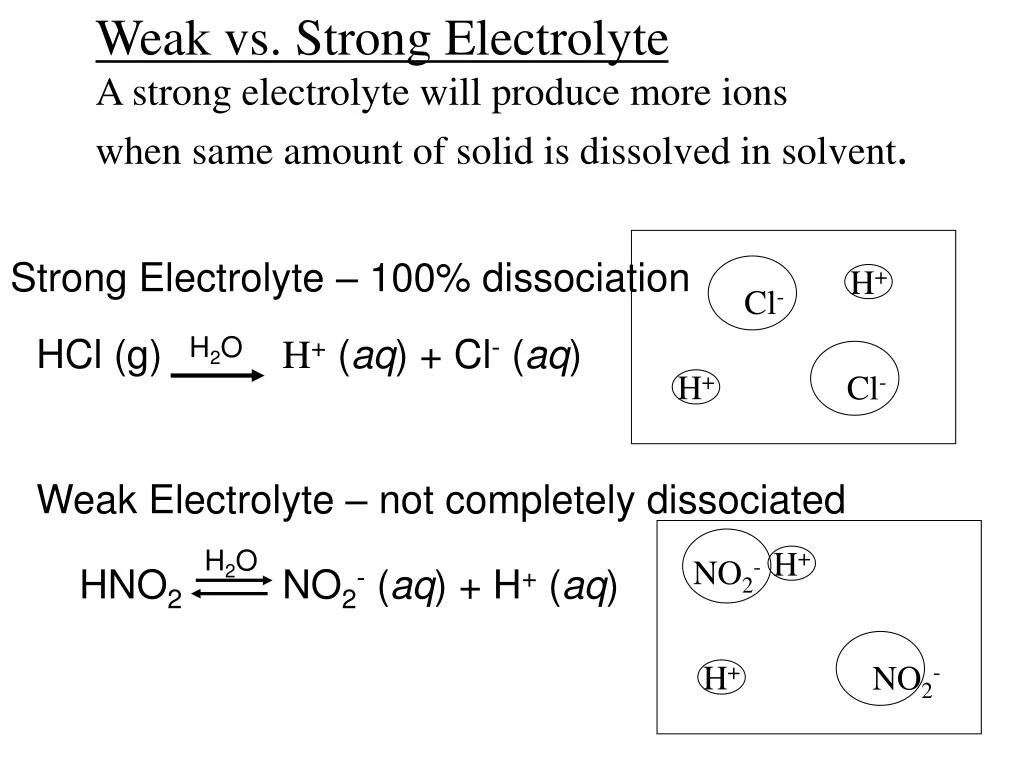
1. First, remember: What does STRONG vs. WEAK mean?
Imagine putting an acid or base into water.
STRONG
Completely dissociates = breaks apart completely.
Almost all the particles separate into ions.
Think: EVERYONE separates!
WEAK
Partially dissociates/reacts = only some break apart.
Some particles separate, but others stay together.
Think: ONLY SOME separate!
MEMORY TRICK:
STRONG = ALL (or essentially all) break apart.
WEAK = ONLY SOME break apart.
That's it! Keep this in your head throughout the entire lesson.
2. What does DISSOCIATE mean?
Dissociate = separate or break apart into ions.
Remember, ions are particles with electrical charges.
For example:
Positive ion = +
Negative ion = −
When something dissociates, its positive and negative ions separate in water.
Memory trick:
DISSOCIATE = DISCONNECT!
