HNSC 1210 Ch.7 (pt. 2): Vitamins (Water-soluble)
 Call Kai
 Learn
 Practice Test
 Spaced Repetition
 Match
 Flashcards
 Knowt Play
1/62

There's no tags or description
Looks like no tags are added yet.
63 Terms
What vitamins are water-soluble?
Vitamin C
8 Vitamin B-complex
Water soluble vitamins characteristics (4)
Dissolve in water
Easily absorbed and excreted
Not stored extensively in tissues
Seldom toxic levels
How are water-soluble vitamins absorbed?
Directly through the cells of the intestines (enterocytes), emptied into the bloodstream and pass through the liver
Liver function during hepatic processing
Liver serves as a critical processing, activation, and distribution hub for essential water-soluble nutrients before they reach the systemic circulation
How are water-soluble stored?
They are generally not stored long-term, but the liver maintains small temporary storage reserves during the first pass for brief dietary gaps
Reabsorption of water-soluble vitamins
Nutrients are completely filtered out of the blood by the kidney in the initial steps of urine production and later rescued in the kidney’s plumbing system to prevent loss in urine
What does it mean if excess amounts are excreted?
It’s rare to reach toxic levels in the body (hypervitaminosis)
The history in discovering importance of Vitamin C
Scurvy being the leading cause of death at sea as voyagers lacked fresh food and survived on salted meats and dry biscuits
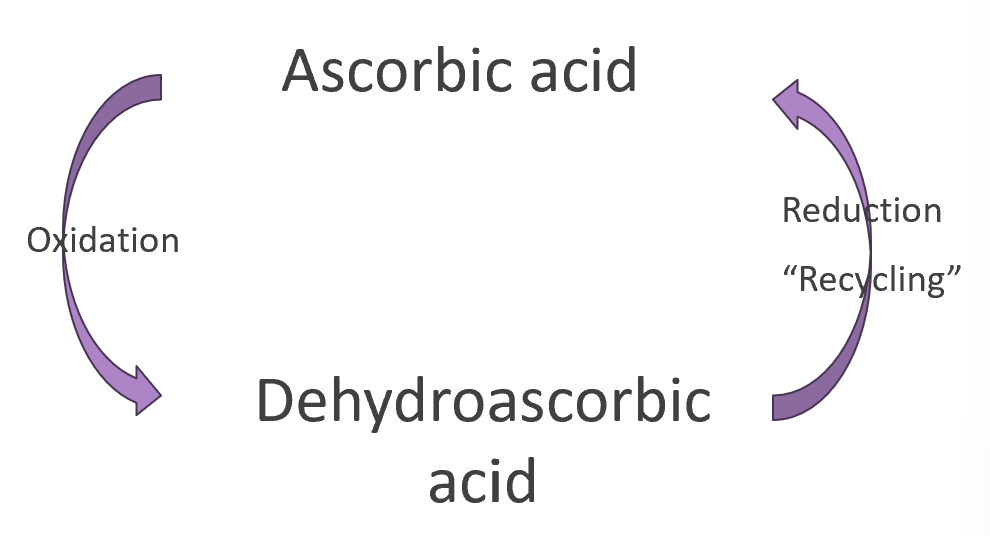
Vitamin C primary structural states (2)
Ascorbic acid / Dehydroascorbic acid
Why are ascorbic acid and dehydroascorbic acid efficient dietary antioxidants?
Form a highly efficient chemical partnership by shifting back and forth by trading a pair of electrons (oxidation)
Vitamin C food sources (4)
Peppers - yellow, red bell, green bell
Tropical fruits - guava, kiwi, papaya
Citrus fruits - orange, orange juice, grapefruit juice
Cruciferous vegetables - mustard spinach, kale, broccoli brussels sprouts
Vitamin C functions (4)
Antioxidant
Enhances intestinal iron absorption
Assembly and function of collagen
Immunity
Antioxidant function of vitamin C
Neutralizes reactive oxygen species and free radicals, protecting cellular structures like DNA, proteins, and lipids form destructive oxidative stress

Ascorbate radical
Vitamin C oxidized into a temporary intermediary molecule upon losing an electron - stable and unreactive (does not cause harm)
How can an ascorbate radical become a dehydroascorbic acid?
It can later donate a second electron if need, converting fully
How does Vitamin C protect cell membranes if not fat-soluble?
Vitamin C runs a continuous biochemical recycling operation with lipid-soluble Vitamin E (alpha-tocopherol)
Recycling operation between Vitamin C and Vitamin E (4 steps)
Vitamin E loses an electron when protecting the lipid layer during attacks
Vitamin E turns into a spent, oxidized tocopheroxyl radical
Spent Vitamin E floats near the water-rich cellular fluid where Vitamin C makes contact
Vitamin C transfers an electron across borders and regenerates Vitamin E back into its active state
Most potent enhancer of plant based iron absorption in the human diet
Vitamin C
How is Vitamin C the most potent enhancer for iron absorption?
By donating an electron to iron, a small amount of vitamin C can multiple iron absorption by up to three-fold
Vitamin C is an absolute biological requirement for the proper assembly and function of?
Collagen
Immunity role of Vitamin C
Active immune cells accumulate and utilize ascorbic acid rapidly when fighting pathogens - crucial during active infections
Can daily Vitamin C prevent you from catching a cold?
NO (for general public)
Can daily Vitamin C shorten cold duration/severity?
YES (modest 8-14% reduction in adults)
Does Vitamin C intake prevent heart disease and cancer?
NO - can reduce their risks though
Scurvy
Life-threatening clinical syndrome caused by a severe dietary deficiency of Vitamin C
Scurvy symptoms (8)
Loss of appetite
Growth cessation
Weakness
Frequent infections
Bleeding gums
Loose teeth
Tiny red spots on skin
Swelling in wrists and ankles
Vitamin C toxicity symptoms (rare) (5)
Gastrointestinal problems (diarrhea)
Altered insulin response to carbohydrates
Interfere with anticoagulation medications
Hemochromatosis (excess iron)
Kidney stones
8 B Vitamins
Thiamin (B1)
Riboflavin (B2)
Niacin (B3)
Pantothenic acid (B5)
Pyridoxine (B6)
Biotin (B7)
Folate (B9)
Cobalamin (B12)
Important function of B vitamins
Act as coenzymes to unlock enzymes catalytic power and enable essential chemical reactions

B Vitamins and coenzyme names

B Vitamins are also involved in what body process?
Energy metabolism - brain,, nerves, muscles, bones

Mandatory structural key for coenzymes B vitamin
B1 - Thiamin
How is Thiamin (B1) the mandatory structural key for coenzymes?
Pully energy out of carbohydrates into amino acids, making it a foundational driver of glucose metabolism and central nervous system function
What foods are Thiamin-heavy? (4)
Legumes - peas
Whole grains
Pork
Seeds
Active coenzyme form of Thiamin
Thiamine Pyrophosphate (TPP)
What happens to the body if no TPP? What organ will fail first?
Entry of carbohydrates into the energy metabolism stalls and therefore the capability to derive energy is reduced - brain is the first to suffer as it relies almost exclusively on glucose
Thiamin deficiency symptoms in nerves (4)
loss of sensation in hands and feet
depression
advancing paralysis
Edema
Beriberi
A severe, life-threatening disease caused by a deficiency of thiamin: wet and dry beriberi
Dry Beriberi comes with what type of symptoms?
Without edema; neurological symptoms
Wet Beriberi
Edema (fluid accumulation); muscle and cardiovascular symptoms

Thiamin deficiency symptoms in muscles (2)
muscle weakness
abnormal heart function
Thiamin deficiency symptoms in alcoholism (3)
impaired absorption
elevated excretion
Wernicke-Korsakoff syndrome
Wernicke-Korsakoff syndrome
A serious brain disorder caused by thiamine (vitamin B1) deficiency, often linked to chronic alcohol use, leading to memory loss, confusion, and coordination problems
Riboflavin (Vitamin B2) functions (3)
forms essential coenzymes needed for energy production
cellular function
fat, drug, and steroid metabolism
support vision and skin health
Why should foods containing riboflavin be stored in opaque containers?
Riboflavin degrades when exposed to light
Riboflavin food sources (8)
whole grains
veggies
milk and dairy products
eggs
lean meats
organ meats
legumes
fortified breads or cereals
Essentials coenzymes that riboflavin forms (2)
Flavin mononucleotide (FMN) - critical electron carrier
Flavin adenine dinucleotide (FAD) - primary electron carrier in cellular metabolism

How does riboflavin protect against cataracts?
Riboflavin is a crucial component of the enzymes that protect the lenses of your eyes form the free radicals caused by sunlight and metabolic processes
How does riboflavin support skin health?
Riboflavin maintains collagen levels, accelerates wound healing, and reduces skin inflammation by acting as an essential cofactor for cellular energy production and tissue repair
Ariboflavinosis
Severe vitamin B2 (riboflavin) deficiency which primarily disrupts how your cells generate energy
How do developed countries prevent ariboflavinosis that developing countries can’t really do?
Routinely fortifies breakfast cereals, breads, and grains with B vitamins
Ariboflavinosis symptoms (4)
energy deficiencies in cells
tissue breakdown in the mouth (painful, splitting cracks on the corners of lips; swollen, magenta-coloured tongue)
tissue breakdown in the skin (greasy, red, scaly rashes around the nose, ears and eyebrows)
tissue breakdown in the eyes (bloodshot, intense burning/itchy, light sensitivity)
Is there a UL for riboflavin?
No
Niacin (Vitamin B3) functions
Functions through two critical coenzymes
converting food into cellular energy
“shuttle” in oxido-reduction reactions
Cellular metabolism
Convert carbohydrates, fats, and proteins into usable energy
Coenzymes that niacin functions through (2)
Nicotinamide adenine dinucleotide (NAD)
Nicotinamide adenine dinucleotide phosphate (NADP)

Niacin food sources
Enriched (added back to the natural level) and whole grains; cereals and baked products
Leafy green vegetables, mushrooms
Meat, fish, eggs, legumes
Milk and milk products
Niacin secondary food source (synthesized from the body)
Tryptophan - an essential amino acid found in protein-rich foods
How much of dietary tryptophan to make 1mg of niacin?
60mg tryptophan → 1mg niacin
if protein intake drops, niacin backup system in the body fails
Niacin deficiency name and symptoms (4 D’s)
Pallegra
dermatitis
diarrhea
dementia
death
What does high-dose niacin do to the body? (2)
lowers blood cholesterol
problem: liver toxicity
Niacin toxicity symptoms (5)
flushing skin, rashes
tingling in extremities
nausea
diarrhea
liver disease/damage