1.12, 1.13: Monosaccharides, disaccharides & polysaccharides
 Call Kai
 Learn
 Practice Test
 Spaced Repetition
 Match
 Flashcards
 Knowt Play
1/58

There's no tags or description
Looks like no tags are added yet.
59 Terms
spec point
What type of substances are carbohydrates?
organic
What does it mean that carbohydrates are organic substances?
contains carbon and at least one hydrogen
What are the molecules in carbohydrates?
Carbon, hydrogen, oxygen
What are the three main groups of carbohydrates?
monosaccharides
disaccharides
polysaccharides
What are monosaccharides?
the monomers of carbohydrate
they are simple carbohydrates
they are sugars
Monosaccharides can join together to make…
carbohydrate polymers
What are the names of the different types of monosaccharides formed from molecules with varying numbers of carbon atoms?
triose (3C)
pentose (5C)
hexose (6C)
What type of sugar is glucose?
a hexose sugar
What type of structure do the six carbons that make up glucose form?
a ring structure
carbons 1-5 form a ring, while carbon 6 sticks out above the ring
What are the two forms of glucose?
alpha (α)
beta (β)
Difference between alpha and beta glucose
alpha glucose has the H above carbon 1 and the OH group below
alpha has the H above
beta glucose has the H below carbon 1 and the OH group above
beta has the H below

What is the main function of monosaccharides?
to store energy within their bonds
When the bonds are broken during ___________, ______ is released
respiration
energy
How is the structure of glucose related to its function as the main energy store for animals and plants?
it is soluble so can be transported easily
it has many covalent bonds which store energy
Monosaccharides can combine through ____________ reactions to form larger carbohydrates
condensation
Some monosaccharides are used to form long, structural ______, which can be used as ________ _______ in some cell types
fibres
cellular support
To make monosaccharides more suitable for storage, they are bonded together to form…
disaccharides and polysaccharides
How are disaccharides and polysaccharides formed?
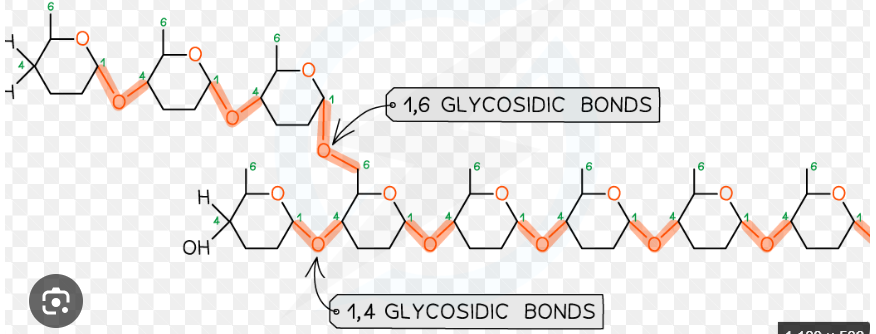
two hydroxyl groups (OH) on different monosaccharides interact to form a strong covalent bond called a glycosidic bond
What are the names of the two types of glycosidic bonds?
1,4 glycosidic bonds
1,6 glycosidic bonds
Difference between 1,4 and 1,6 glycosidic bonds
1,4: The OH groups are located on carbon 1 of one monosaccharide and carbon 4 of the other
1,6: The OH groups are located on carbon 1 of one monosaccharide and carbon 6 of the other
What type of reaction are glycosidic bonds formed by, and what does this mean?
condensation reaction
- every glycosidic bonds results in one water molecule being released

How is the disaccharide maltose formed?
two alpha glucose molecules joined by a 1,4 glycosidic bond
How is the disaccharide sucrose formed?
glucose + fructose joined by a 1,4 glycosidic bond
How is the disaccharide lactose produced?
glucose + galactose joined by a 1,4 glycosidic bond
How is a glycosidic bond broken?
when water is added in a hydrolysis reaction
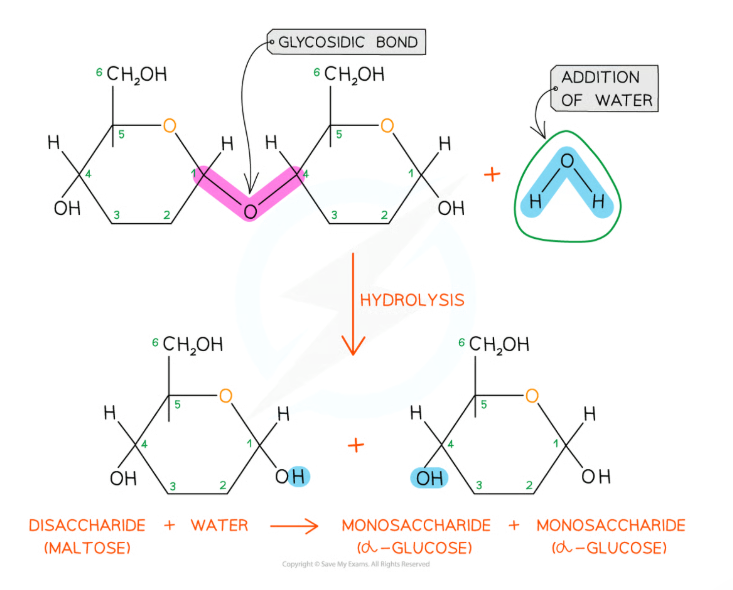
Examples of hydrolytic reactions
digestion of food in the alimentary tract
breakdown of stored carbohydrates in muscle and liver cells
Function of disaccharides
to provide the body with a source of quick-release energy
- disaccharides are made up of two sugar molecules so they’re easily broken down by enzymes in the digestive system into their respective monosaccharides and then absorbed into the bloodstream
Solubility of disaccharides in water (and explanation)
easily soluble
- there is a large number of hydroxyl groups which form hydrogen bonds with the water molecules when dissolved in aqueous solutions
Sweetness of disaccharides and monosaccharides
both have a sweet taste
- e.g. sucrose = table sugar
Examples of polysaccharides
starch
glycogen
cellulose
Define polysaccharides
carbohydrate polymers which are made of repeated chains of many monosaccharides joined by glycosidic bonds in a condensation reaction
Categories of polysaccharides
branched or unbranched
straight or coiled
Branched vs unbranched polysaccharides
being branched increases the rate at which a polysaccharide can be broken down
What are straight polysaccharides more suitable for?
constructing cellular structures e.g. cellulose
What are coiled polysaccharides more suitable for?
being coiled makes a molecule more compact and suitable for storage
e.g. amylose in starch
Examples of storage polysaccharides
starch
glycogen
Example of structural polysaccharide
cellulose
Why are starch and glycogen useful as storage polysaccharides?
they are compact so large quantities can be stored
they are insoluble so will have no osmotic effect, (unlike glucose which would increase the solute concentration of a cell and cause water to move in by osmosis)
Starch is the storage polysaccharide of…
plants
How is starch stored inside plant cells?
as granules
Plants make _______ during photosynthesis and the molecules of _______ are joined to make the polysaccharide starch
glucose
How many different polysaccharides is starch constructed from?
two
What are the two polysaccharides for starch?
amylose
amylopectin
Shape/structure of amylose
unbranched
helix-shaped chain forming a spiral shape
1,4 glycosidic bonds between α-glucose molecules

Benefits of the structure of amylose
the helix shape enables it to be more compact and thus more can be stored
Structure/shape of amylopectin
branched molecule
1,4 glycosidic bonds and 1,6 glycosidic bonds between α-glucose molecules

Benefits of structure/shape of amylopectin
branches result in many terminal glucose molecules that can be easily hydrolysed for use during cellular respiration or added to for storage
Glycogen is the storage polysaccharide of…
animals and fungi
Structure/shape of glycogen
highly branched (even more than amylopectin)
not coiled
contains both 1,4 and 1,6 glycosidic bonds
glycogen is compact

Benefits of shape/structure of glycogen
branching provides more terminal glucose molecules
- these can either be added to or removed by hydrolysis
- this allows the quick storage or release of glucose to suit the demands of the cell
→ this is essential in animal cells as animals are very metabolically activeglycogen being compact means that much can be stored in a small space
- liver and muscle cells have a concentration of glycogen, present as visible granules
→ this enables a high cellular respiration rate
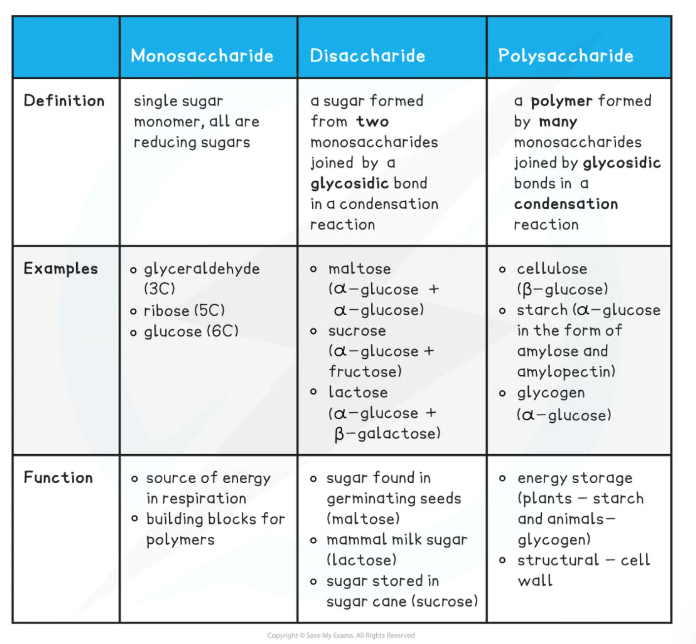
Summary of storage polysaccharides table

Summary of types of carbohydrates table
Where is cellulose found?
plant cell walls
What monomers and bonds is cellulose made from?
beta glucose + inverted beta glucose joined by a 1,4 glycosidic bond

Bundles of 60-70 straight, unbranched cellulose molecules can lie ________ to form cellulose ____________
parallel
microfibrils
Microfibrils are held together by…
hydrogen bonds between the hydroxyl (-OH) groups in neighbouring chains to produce a strong structure
Microfibrils are stuck together by…
a polysaccharide ‘glue’ made from short branched polysaccharides called hemicelluloses and pectins
Function of cellulose
main structural component of cell walls due to its strength which is the result of the many hydrogen bonds
the high tensile strength of cellulose allows it to be stretched without breaking, making it possible for cell walls to withstand turgor pressure