AQA A level Chem 1.08 Thermodynamics
 Call Kai
 Learn
Learn Practice Test
 Spaced Repetition
 Match
Match Flashcards
 Knowt Play
1/6

Earn XP
Description and Tags
Name | Mastery | Learn | Test | Matching | Spaced | Call with Kai | Chat |
|---|
No analytics yet
Send a link to your students to track their progress
7 Terms
Magnesium chloride dissolves in water. Give an equation, including state symbols, to represent the process that occurs when the enthalpy of solution of magnesium chloride is measured. (1)
MgCl2 → Mg2+ (aq) + 2Cl- (aq)
The enthalpy of hydration of Ca2+(g) is –1650 kJ mol–1 Suggest why this value is less exothermic than that of Mg2+(g) (2)
Ca2+ (ion) bigger/lower charge to size than Mg2+ (1)
weaker attraction to (Oδ- in) water (1)

This question is about thermodynamics. Consider the reaction shown.
2 Al2O3(s) + 3 C(s) → 4 Al(s) + 3 CO2(g)
The table below shows some thermodynamic data.
Explain why the standard entropy value for carbon dioxide is greater than that for carbon (1)
CO2 is more disordered (than solid) (1)
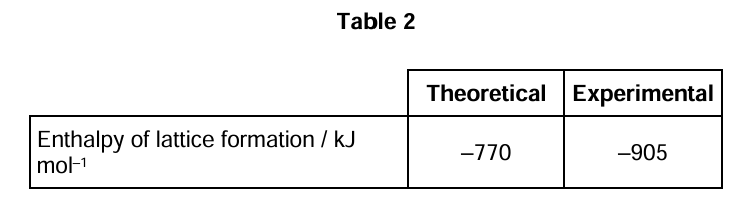
Table 2 shows the theoretical lattice enthalpy, based on a perfect ionic model, and an experimental value for the enthalpy of lattice formation of silver chloride.
State why there is a difference between the theoretical and experimental values (1)
Has covalent character or partial covalent bonding (as well as ionic bonding) (1)

Calculate a value for the enthalpy of lattice formation for magnesium oxide. (3)
∆fH = ∆aH (Mg) + ½ ∆BDH (O2) + ∆1st IEH (Mg) + ∆2nd IEH (Mg) + ∆1st EAH (O) + ∆2nd EAH(O) + ∆LEH (MgO) (1)
- 602 = 150 + (½ × 496) + 736 +1450 – 142 + 844 + ∆LEH (MgO) (1)
∆LEH (MgO) = -3888 / -3890 (kJ mol–1)
A calculation of the enthalpy of lattice formation of silver iodide based on a perfect ionic model gives a smaller numerical value than the value calculated in part (b)
Explain this difference. (2)
AgI contains covalent character (1)
Forces/bonds (holding the lattice together) are stronger (1)
Anhydrous magnesium chloride, MgCl2, can absorb water to form the hydrated salt MgCl2.4H2O
MgCl2(s) + 4H2O(l) ⟶ MgCl2.4H2O(s)
Suggest one reason why the enthalpy change for this reaction cannot be determined directly by calorimetry. (1)
not possible to prevent some dissolving