Chapter 2 - Basic Neurochemistry
 Call Kai
 Learn
 Practice Test
 Spaced Repetition
 Match
 Flashcards
 Knowt Play
1/44

Earn XP
Description and Tags
make sure to know the anatomical planes. find a blank diagram and fill it out.
45 Terms
Central Nervous System (CNS)
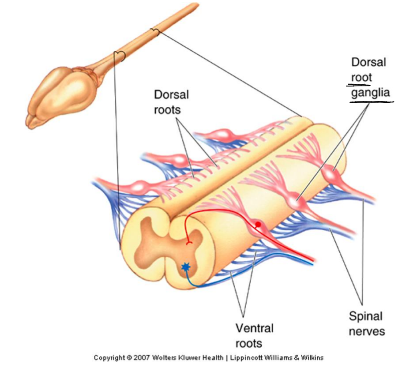
brain and spinal cord
Peripheral Nervous System (PNS)
spinal and cranial nerves present outside the CNS
Parts of the spinal cord
skin, joints, muscles, spinal nerves (dorsal root and ventral root)
two parts of the autonomic nervous system
sympathetic and parasympathetic
functions of neurons
process information, command body responses, sense environmental changes and communicate these changes to other neurons
neuronal membrane
barrier that encloses cytoplasm
3 parts of the neuron
cell body (soma), dendrite, axon
cell body
metabolic center of neuron (contains the same organelles as in all cells)
dendrite
receives signals from axons on other neurons
axon
transmits information from soma to different target sites
rough ER
major site for protein synthesis (ribosomes)
smooth ER and Golgi apparatus
sites for preparing/sorting proteins for delivery, regulating substances
mitochondria
site of cellular respiration
components of axon (3)
axon hillock (beginning), axon proper (middle), axon terminal (end)
synapse
site of signal transmission
anterograde transport
soma to terminal (typical)
retrograde transport
terminal to soma (rare)
Nissl substance
substance of RNA granules
postsynaptic
receies signals from axon terminal
cytoplasmic region
determines the shape of a neuron
3 filamentous elements of a neuron
microfilaments, microtubules, neurofilaments
microfilaments (what it’s made of, what it makes up)
made of actin, makes up majority of growth cone
microtubules (function, what it’s made of)
train tracks to help deliver things to body, made of MAP proteins (Tau protein), containws + end and - end
pick’s disease
frontal lobe shrinks, pick bodies on frontal lobe, diminished spacial skills and behavioral issues
Tau hyperphosphorylation
adding a phosphate group leads Tau protein to weaken and the microtubule to disintegrate
Tau tangles
clumped Tau protein, indicator of Alzheimers
4 general types of neurons
multipolar, bipolar, pseudounipolar, unipolar
multipolar neurons
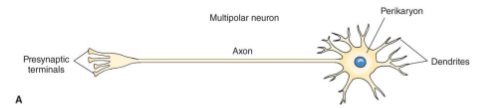
most common, multiple dendrites and one long axon
bipolar neurons
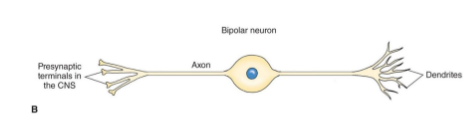
dendrites on one end, axon on the other, cell body in middle
pseudounipolar neuron
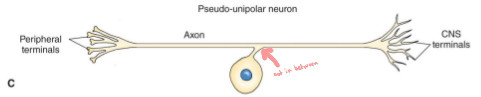
one cell body, 2 branches (peripheral projects to periphery, branch 2 projects to CNS)
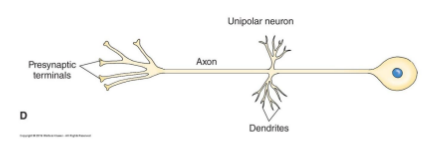
unipolar neuron
single neurite, dendrites on one end and axon on same site
stellate cells
star-shaped
pyramidal cells
triangle/pyramid shaped
Classification of neurons: 3 types based on connection with the CNS
primary sensory neurons, motor neurons, interneurons
Classification of neurons: 2 types based on axonal length
Golgi type I, Golgi Type II
3rd way to classify neurons
based on neurotransmitter type (ex Cholinergic = acetylcholine at synapses)
glia
control environment in CNS; insulates, supports, and nourishes neurons
types of glial cells
astrocytes, oligodendrocytes, microglia, ependymal cells
astrocytes
stellate, regulate chemical and extracellular environment, influence neurite growth
2 types of myelinating glia
oligodendroglia and schwann cells
oligodendrocytes
axon myelination in CNS
Schwann cells
axon myelination in PNS
myelin sheath
insulates axon
nodes of ranvier
portions of axons uninsulated by myelin, can produce action potentials
microglia
smallest type of glial cell, repair damage due to injury via phagocytosis