HAP lecture 1: mass flow of nutrients
 Call Kai
 Learn
 Practice Test
 Spaced Repetition
 Match
 Flashcards
 Knowt Play
1/73

Earn XP
Description and Tags
(through the body and it's cells)
74 Terms
Between which two aspect is your metabolism constantly switching?
Between nutritional input and physiological output. Metabolism is constantly switching between these two to remain healthy and alive.
Nutritional Input = kJ, meal size, pattern and nutrient composition. Physiological Output = health status, environment, physiological status.

Name an example of physiological output
For example, the difference between young individuals that perform sports, and elderly people that live mostly sedentary.
What are important factors for your metabolism?
Difference in metabolic pathways, energetic efficiencies and body composition - waste products
What is the metabolism constantly trying to do?
Balancing input vs output> keeping homeostasis
Why does the digestive system make use of enzymes?
To break bonds between the food products> hydrolyse them
What is the difference between the ‘post-prandial phase’ and the ‘post absorptive phase’? (different pathways of metabolism)
The post-prandial phase occurs immediately after eating, overlap between nutritional input and metabolism. The period immediately following the ingestion of a meal, lasting until the body returns to its metabolic baseline.
The post-absorptive phase makes use of the internal storage of energy. Once digestion ends and nutrients are no longer being actively absorbed from the digestive tract (e.g. after night long sleep, before breakfast)
What are macronutrients and how do they move through the body?
Carbohydrates, proteins and fats. They move through translocation (the place where they are in your body) and transformation (change from chemical transformation).
How are the macronutrients regulated?
Through the neural system and the endocrine system.
How do nutrients mainly leave the body?
Thought CO2 (via your breath, you oxidate nutrients and you exhale CO2)
What happens after eating? (you do not have an influence on it!)
digestion and absorption → mono- and oligomers are absorbed. if not digested in colon: might be used by microbiota.
storage
utilisation → google: how the human body takes in, breaks down, and burns or stores fuel molecules (primarily carbohydrates, fats, and proteins) to produce usable cellular energy in the form of adenosine triphosphate (ATP) and maintain biological function
What factors all have an influence on metabolic settings? (and why does the digestive system not digest itself?)
It’s actively restricted to the presence of food (you don’t release enzymes in lumen when not eating → enzymes not unnecessarily active → less exposure to enzymes.
regulation (local/plaatselijk, distal/verderop in stelsel, proximal/dichterbij begin van spijsverteringsstelsel),
enzymes stored as inactive pro-enzymes (zymogens, inactive voorloper op enzym): need to be cleaved to be active enzymes.
non-digestible mucus coats the walls (protection) → digestive substances do not come into direct contact with vulnerable cells
high replacement rate (turnover) of mucosal cells (cells lining small intestine) → damaged/old cells are replaced by new cells → protective layer stays in tact.
What are the four settings/parts of metabolism?
Digestion to and absorption of monomers → food is broken down into small molecules, which are absorbed into the body.
Intermediary metabolism → anabolic/catabolic reactions, interconversions of absorbed monomers and unavoidable waste products.
Time scale of events (Post Prandial - after a meal vs Post Absorptive - between meals really matters in terms of which pathways are now being used) → different pathways: PP → insulin important and PA → glycogen important!
Physiological adaptation → the body adjusts its metabolism to changes in food availability and energy demand.
What is the meaning of Intermediary metabolism?
The conversions of these nutrients into one of each other. e.g. having fructose converted into glycolysis intermediates, and then they can be used for full oxidation.
1. interconversions of absorbed monomers (e.g. glucose —> other molecules that cell needs).
2. anabolic reactions → make smaller molecules into bigger or complex molecules (e.g. protein metabolism/synthesis). The synthesis of the synthesis of body constituents, e.g. protein synthesis when consuming amino acids.
3. catabolic reactions → meaning you produce energy and you oxidize the nutrients. breaking down molecules to make energy (ATP/heat/energy → release of energy in terms of cellular energy, ATP, versus heat that is always associated with this).
Why doesn’t the digestive system digest itself?
protective mechanisms control digestion and protect the body’s own tissues.
What are ‘zymogens’?
Inactive precursors of enzymes that are activated when needed.
What is the function of mucus?
It forms a protective barrier between digestive contents and the gut wall
What is mucosal cell turnover?
The continuous replacement of old or damaged mucosal cells
What is the difference between digestion and absorption?
Digestion breaks food down; absorption moves nutrients into the body.
What is intermediary metabolism?
The conversions of these nutrients into one of each other. E.g. fructose converted into glycolysis intermediates, which can then be used for full oxidation.
Cellular reactions that convert, store, build up/break down absorbed nutrients to meet the bodies needs.
Carbohydrates: broken down into glucose, which can be used to produce energy (ATP) or stored as glucogen. Proteins: broken down into amino acids, which can be used to build new proteins or broken down further. Fats: broken down into fatty acids and glycerol, which can be used for energy or stored as fat.
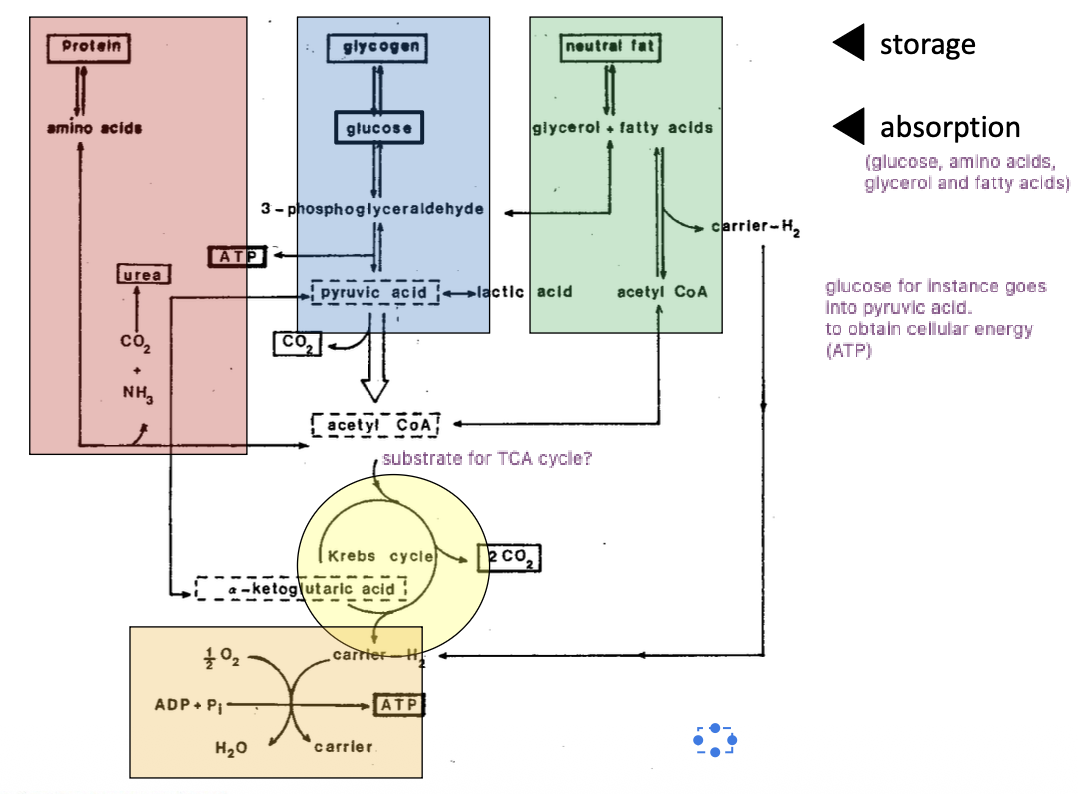
What can glucose be used for or stored as?
It can produce ATP or be stored as glycogen.
What are amino acids used for?
Building proteins, or when needed, contributing to energy metabolism.
What are the main components of triaclycerol (TG)?
Glycerol and free fatty acids.
What happens during the postprandial phase?
Digestion - absorption - storage: after a meal, nutrients are used and excess nutrients can be stored.
What does input > needs mean?
Anabolic or catabolic disposal. Nutrient supply exceeds immediate needs, allowing storage or conversion.
What happens during the post absorptive phase?
Also known as utilisation. Nutrient input decreases and stored fuels are mobilised (turnover, interconversion, oxidation).
What does input < needs mean?
Mobilisation (turnover, interconversion, oxidation). Mobilisation = releasing stored nutrients so the body can use them. Input is less than you need = metabolise nutrients.
What is glycogen?
A storage form of glucose found mainly in the liver and muscles.
What is anabolism? Give an example
Building larger molecules; e.g. amino acids joined to form proteins.
What is catabolism? Give an example.
Breaking down molecules; e.g. glucose breakdown to produce ATP.
What do PP and PA mean?
PP: postprandial, after a meal. PA: postabsorptive, after nutrient absorption.
What is the main difference between postprandial and postabsorptive phases?
Postprandial phase: processing and storage. Input exceeds what you at that point need in terms of energy) → you start storing nutrients: storage, interconversion, oxidation.
Postabsorptive phase: the input is way less than what you need, and therefore you need to mobilise the nutrients. meaning: turnover, conversions, and oxidation.

What is physiological adaptation?
Adjusting body functions and metabolism to changing conditions and energy needs.
What happens precisely after a meal (post prandial phase)?
Brain: mainly uses glucose under normal conditions.
Liver: stores glucose as glycogen and helps regulate blood glucose
Muscles: store glucose as glycogen and use it for energy
Adipose tissue: stores energy as triaclyglycerol (TG)
Intestine: absorbs nutrients and sends then into circulation
Our body makes sure to store nutrients as good as possible.

What are Thermogenic effects of a meal?
Also known as Diet-induced Thermogenesis (DIT). If your metabolic rate is increased, you produce more heat. The post prandial metabolism increases heat production (5-20% ingested ME). Meaning around 5 to 20% of your ingested metabolizable energy.
Does Diet-induced Thermogenesis (DIT) depend on ingested nutrients?
Yes! proteins > carbohydrates > fat. If you eat more protein, you'll produce more heat following intake of the nutrients.
What is homeostasis?
The ability of an organism to counteract (within limits of the metabolic scope) factors that disturb vital functions.
e.g. the balance in acid and basis in Oxygen supply. If there is not enough oxygen available, you call it hypoxia. This has an detrimental effect on metabolism.
What does the body always try to regulate (homeostasis)?
Glucose concentration in blood
pH in the blood (acid - base balance)
Oxygen supply (cardiac output, respiration). e.g. with hypoxia: has effect on metabolism! e.g. heart rate increases your cardiac output, your heart rate increases, ventilation increases in order to have sufficient amount of oxygen delivered to the tissues.
Body temperature (thermoregulation)
What is the relation between intake and energy expenditure?
See graph. For example, low levels of energy expenditure results likely in overeating.

The settings of metabolism can be influenced by?
Environmental conditions, the nutritional input, and the physiological output.
Why is the digestive tract also called the 'outside world inside'?
Because air etc. still enters the esophagus> it is connected to the outside world, while the bloodstream is not. It is one-way transport and indigestible material does not enter the body
In what two ways can nutrients move through the body?
Via translocation and transformation
What characterises the Digestive tract (GI-tract)?
outside world inside
It’s a hollow tube (7 m), it keeps everything inside this tube
Functional compartments that each have their own role in digestive process
one-way transport
indigestible material doesn’t enter the body
In what three functional regions is the small intestine divided into and what are the functions of these parts?
Duodenum → secretion of CCK, Secretin, GIP, HCO3. Most digestion and absorption takes place in this part. Most absorption of Fe, ions, nutrients, H2O.
Jejunum
Ileum → secretion of PYY, HCO3. absorption of bile acids and vitamin B12.
In all parts motility takes place → segmentation (digestive phase), peristalsis (interdigestive phase, when no food is present, e.g. overnight)
What are the functions of the colon and the rectum?
absorption of water and ions
bacterial fermentation of nonabsorbed nutrients (main role!)
storage of waste and indigestible materials (functional: you do not want to go to the toilet immediately after eating, being able to store it)
elimination of waste & indigestible materials
What are accessory digestive organs?
teeth, tongue, salivary glands
Exocrine pancreas
Liver, gall bladder
What two behaviours drive digestion and absorption?
Secretory behaviour and motor behaviour.
What four components are needed to make sure digestion takes place?
Water, ions, bile acids, enzymes
How do the liver and gall bladder have a role in digestion?
They secrete bile acids etc into the duodenum
Define ‘Accessory digestive organs’
The GI system is supported by the so-called accessory digestive organs. Includes your teeth, tongue, salivary glands, in order to chew the food into smaller pieces. Also exocrine pancreas (releases enzymes) and liver, gall bladder.
What is the right order of organs in the GI?
Mouth> oesophagus > stomach > small intestine > large intestine > rectum > anus
What enzymes are secreted in the mouth?
Salivary amylase, lingual lipase
What enzymes/acids are released in the stomach?
Gastric acid, pepsin, gastric lipase
What enzymes are secreted in the small intestine?
Pancreatic amylase, lipase, phospholipase, trypsin, chymotrypsinl elastin, dipeptidases, disaccharidases.
How long is the small intestine, and how long is the duodenum?
The small intestine is about 5 meters, and the duodenum about 25 cm
What are the primary roles of the colon?
Bacterial fermentation of nonabsorbed nutrients, storage of waste and indigestible materials, elimination of waste and indigestible materials
Why do the villi in the small intestine enhance surface area?
Function villi: absorbing as much as possible and getting it into the body. Villi enhance the surface area. you have more contact between lumen and cells. they enhance absorption; enhancing digestion.
One villi has a single layer of cells. What are the two types of cells in this layer, and what do they do?
There are absorptive enterocytes and mucus secreting goblet cells.
What is the function of goblet cells?
Secrete mucus. This type of cell is coated around the villi in order to protect auto-digestion by the digestive enzymes that are present in the intestine.
What is the lacteal in the villi?
They are the small lymphatic vessel in the villi that absorb dietary fats and transport them as chyle.
What are the 4 layers of the digestive tract (from inside (lumen) to outside) and what are their functions?
Mucosa: secretion and absorption
Submucosa: vascular layer (support)
Muscularis: segmental contractions
Serosa: protective layer
What is the enteric nervous system (ENS)?
Functions without your brain being involved! It is for involuntary activation of intestinal muscles, the ENS is used (without signalling to and from the brain).
What is the difference in muscle between the upper- and lower part of the oesophagus?
The upper part has striated muscle, the lower part has smooth muscle
What is the difference between fungus and antrum (stomach)?
‘fundus’ is the upper part and ‘antrum’ is the lower part of the stomach.
What is 'gut retention time'?
The time between having amino acids in the intestinal lumen and being able to measure them in the portal vein. This happens to amino acids, but it also applies for lipids/triglycerides. For glucose it is really quickly.
Where are microvilli located?
On the membrane of the enterocytes, membrane is not flat but it has all these fingerlike projections. these fingerlike projections are called ‘microvilli’.
What is the 'brush border'?
The microvilli on the enterocytes
What is the total surface area of the small intestine?
250-300 square meters
What are the longitudinal foldings in on the mucosal surface called?
Plicae circularis
Via what nervous systems can gut stimuli evoke responses?
Via the enteric and central nervous systems
What three mechanisms of communication mediate responses in the GI tract?
Endocrine system (release hormones into the circulation)
Neurocrine communication (different neurons released neurotransmitters that effect target cells)
Paracrine communication (from sensor cell to neighbouring cells: really local, not via bloodstream!)
How does the endocrine system mediate responses in the GI tract?
It releases hormones into the circulation and sends them to target cells
How does the neurocrine system mediate responses in the GI tract?
Sensory neurons signal to interneurons, which signal to secretomotorneurons, which release neurotransmitter to target cells
How does the paracrine system mediate responses in the GI tract?
Via local cell-to-cell communication, like somatostatin
At what three different ways can absorption take place?
1. simple diffusion: water or small lipids diffuse over the celmembrane, it ends up in entrocytes
2. facilitated diffusion: some compounds need a carrier that they attach on to transfer in cell and then be released (e.g. with vitamins)
3. active transport: energy invested by enterocyte (cost energy) → you capture everything in the intestine and move it into the cell (even the last glucose molecules in the intestine are this way actively transported to absorb as much as possible from the intestine)