Signs and Symbols in the Holy Qurbana
 Call Kai
 Learn
 Practice Test
 Spaced Repetition
 Match
 Flashcards
 Knowt Play
1/49

Earn XP
Description and Tags
Vocabulary flashcards covering the liturgical places, ministers, sacred objects, vestments, postures, and rites of the Syro-Malabar Holy Qurbana from Lesson 3.
50 Terms
Holy Qurbana
The Eucharistic celebration instituted by Jesus at the Last Supper using bread and wine as symbols of His body and blood of the covenant, offered for the forgiveness of sins.
In which direction is church built
East-west
Three primary sections in the church
The Sanctuary, the Questroma, and the Hykla.

Sanctuary is also called as
Madbaha

Sanctuary has
Altar,
Tabernacle
Bethgazzas
Bethsahade
Bema

The Altar symbolise
throne of the Holy Trinity,
the tomb of Christ,
the sacrificial altar,
the ladder leading to heaven, and
the banquet table.

The Tabernacle
A receptacle used for reserving the Holy Eucharist for Holy Communion outside the Qurbana,
as well as for adoration.
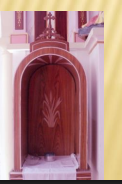
Bethgazzas
Places arranged on either side of the altar for preparing the sacrificial offerings; the term translates to 'nikshepalayam' (treasury).

Bethsahade
arranged at the right side of the sanctuary, used to treasure the relics of martyrs.

The Bema
A raised platform arranged either in the middle of the hykla or adjacent to the questroma
symbolizing the earthly paradise,
equipped with a central table holding a cross and candles,
along with lecterns and chairs.
The Questroma
The area arranged between the sanctuary and the hykla,
built one step higher than the hykla and
separated by railings,
where the choir stands.
The Baptismal Font
A sacred font specially arranged for baptizing candidates,
representing the place where Christians are spiritually born before receiving food from the altar.

The Hykla
The main hall or nave of the church where the faithful assemble,
symbolizing the earth.
The Sacristy
The preparation room where the celebrant and the deacons vest in their sacred vestments and prepare for liturgical celebrations.
The Community (Liturgical)
The congregation of all persons redeemed by Jesus,
serving as a symbol of the Church participating collectively in the holy Qurbana.
The Deacons
Liturgical ministers (altar servers) who represent angels,
assisting the celebrant in ministry and
giving timely directions to guide the congregation's active participation.
The Celebrant
A representative of Christ (priest)and
mediator between God and man
who celebrates the holy Qurbana on behalf of the worshipping community.
Sleeva (Cross)
The cross placed in the sanctuary;
it is a symbol of Jesus Himself, His sacrifice and resurrection, a sign of salvation, an emblem of success, and a sign of glory.
Gospel Book
The liturgical book placed at the right side of the altar,
symbolizing Jesus gloriously seated at the right hand of the heavenly Father.
The Ever-Glowing Lamp
indicate the perpetual presence of Jesus,
the light of the world.
Sacred Vessels
the chalice, paten, and ciborium.
Chalice and Paten
hold the sacred Blood and the sacred Body of Christ, respectively.
Ciborium
used to reserve the consecrated Body of Christ.
Kotina
A sacred vestment symbolic of Christ as well as man renewed in Christ,
discard the old self of evil and embrace the new self of goodness.
Urara
A sacred stole worn around the neck
symbolizing priestly authority,
purity, and
the sacred service entrusted to the minister.
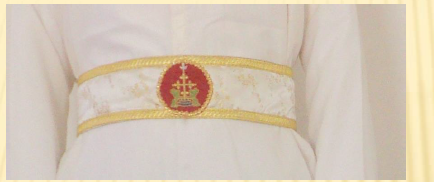
Zunara
belt worn over the kotina
symbolizing chastity and service,
reminding the minister to reject worldly thoughts and
serve God with alertness and mental purity.
Paina (Kappa)
justice and symbolizing the pastoral role of a shepherd.
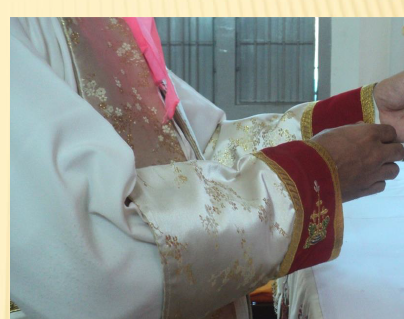
Zande
Sacred cuffs that fasten the sleeves of the kotina, signifying that the minister's hands are
ready for sacred service.
Sosappa
A square sacred veil matching the paina; covering the sacred mysteries signifies
Christ's burial,
arranging it around them signifies His resurrection, and
it represents Christ's shroud,
coffin lid, and
head-dress.
Standing (Liturgical Posture)
signifies resurrection and the heavenly hope of Christians who are freed from sin and death.
Kneeling (Liturgical Posture)
signifies penance, pleading for the remission of debts, and the humble attitude of a repentant sinner seeking divine help.
Sitting (Liturgical Posture)
signifies attentive and careful listening.
Stretching Out Hands (Liturgical Posture)
supplication, prayerful request, and intercession on behalf of others.
Bowing (Liturgical Posture)
express submission, respect, worship, and gratitude.
Exchange of Peace
signifies mutual love, unity, reconciliation, and that the faithful are one body in Christ.
Washing of the Hands
signifies the wiping away of sins and the cleansing and purification of the heart.
Incense
symbolizies prayers rising heavenward, praises to God, forgiveness of sins, reconciliation, penance, respect, and sanctification.
Liturgical Processions
Ritual walks during the Qurbana—including the entrance, the Gospel procession, and the transfer of gifts—that commemorate Christ's incarnation, public life, entry into Jerusalem, and journey to Calvary.
Church Bells
Bells rung to remind the faithful of liturgical timings and to highlight significant moments during the liturgical service.

who are they
deacons

what is this
sleeva cross

what is this
chalice

what is this
ciborium

what is this
paten

what is this vestment called
kotina
what is this
zunara

what is this
urara
what is this
zande

what is this
Paina or kappa

what is this
sosappa