Math Knowledge for Word Problems
 Call Kai
 Learn
 Practice Test
 Spaced Repetition
 Match
 Flashcards
 Knowt Play
1/21

There's no tags or description
Looks like no tags are added yet.
22 Terms
4 times a number
4x
4 more than a number
x + 4
4 less than a number
x -4
4 times the difference of two numbers
4 (x-y)
Sum, And
x + y, addition
Difference
Subtraction, x-y
Product
Multiplication, xy
Number is, Equals to
= equal sign
IS/OF
18 is what percent of 42, of being denominator and is being the numerator.
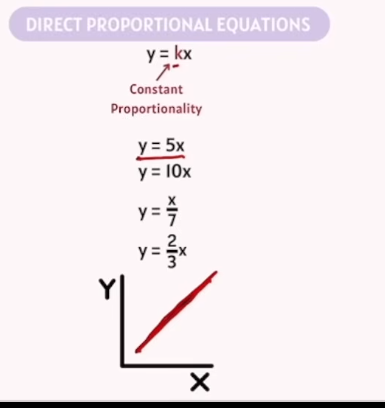
Direct proportion
straight line function, if x moves so does y in proportion. It is linear.
Not directly proportional
Exponential functions, just cause x moves does not mean y moves at the same speed.

Mean
Average data set
Median
middle number of the data set, if two in the middle add together and divide by 2. average of the two.
Mode
most frequent number of the data set
Range
Distance between the lowest value number to the highest value number in a number set.
2 3 4 5 6 7 then range would be 7-2. L - H. L lowest, H Highest.
Shapes of distribution
Symmetry
Bimodial symmetry
You can draw a line in the middle fot he graph and it can split into two.
Bimodal mean is always equal to the median, likewise median is equal to the mean.
Unimodal symmetry
Mound shaped, like a pyramid. Mean, Median, and Mode are all equivalent to each other.
Uniform or rectangular
Every category, value, or group (class) happens roughly the exact same number of times
No mode, since there is no peaks
Skewness
Only one peak
Skewed data is lopsided. Instead of being nicely balanced like a bell curve, the data piles up on one side and stretches out (has a long "tail") on the other.
The "Toe" Trick (from the slide): Look at the little foot mnemonic in the diagram! Whichever direction the toes point tells you the type of skew:
Left-Skewed: The long tail and the toes point to the left.
Right-Skewed: The long tail and the toes point to the right.
=
Correlation/covariance
statistical measure that describes the relationship between two variables