Chapter 6. Eukaryotic Cells
 Call Kai
 Learn
 Practice Test
 Spaced Repetition
 Match
 Flashcards
 Knowt Play
1/3

There's no tags or description
Looks like no tags are added yet.
4 Terms
Introduction
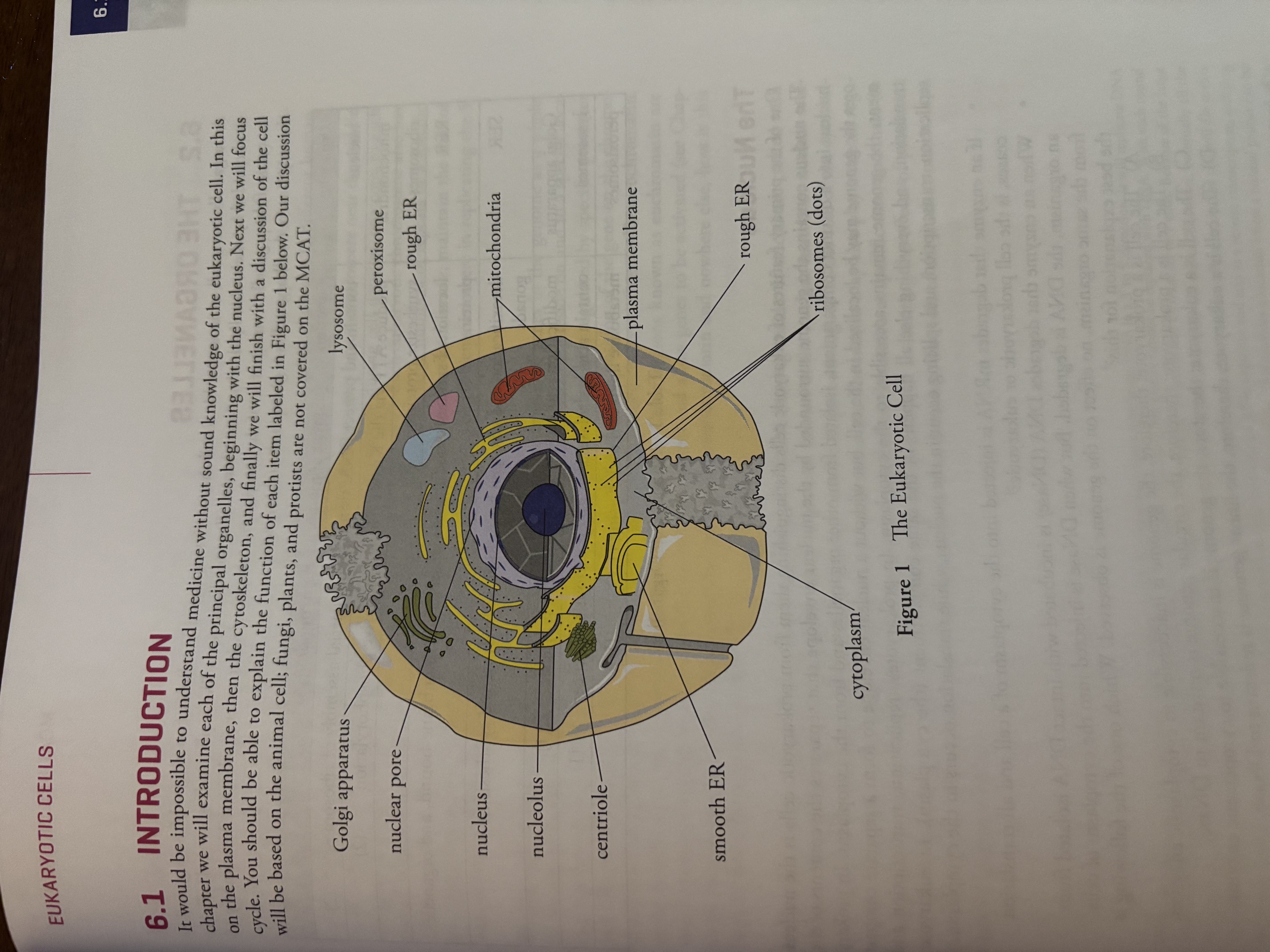
It would be impossible to understand medicine without sound knowledge of the eukaryotic cell. In this chapter we will examine each of the principal organelles, beginning with the nucleus. Next, we will focus on the plasma membrane, then the cytoskeleton, and will finish with a discussion of the cell cycle. You should be able to explain the function of each item labeled in Figure 1 below. Our discussion will be based on the animal cell; fungi, plants, and protists are not covered in the MCAT.
The Organelles
An organelle is a small structure within a cell that carries out specific cellular functions. Most organelles are bounded by their own lipid bilayer membrane. The membrane acts like a plastic bag to sea off the contents of the organelle from the rest of the cytoplasm and control what enters and exists. A summary of the major animal cell is given in the table below.
Organelle | Function | number of membranes surrounding |
Nucleus | contain and protect DNA; transcription; partial assembly of ribosomes | 2 |
Mitochondria | produce ATP via the Krebs Cycle and oxidative phosphorylation | 2 |
ribosomes | synthesize proteins | 0 |
RER | location of synthesis/ modification of secretory, membrane-bound, and organelle proteins | 1 |
SER | detoxification and glycogen breakdown in liver, steroid synthesis in gonads | 1 |
Golgi Apparatus | modification and sorting of protein, some synthesis | 1 |
lysosomes | contain acid hydrolases that digest various substances | 1 |
peroxisomes | metabolize lipids and toxins using H2O2 | 1 |
progress stopped here
d
d
d
d
d