SECTION 01: RESPIRATORY OVERVIEW AND FUNCTION

0.0(0)
Studied by 0 people
call kaiCall Kai
learnLearn
examPractice Test
spaced repetitionSpaced Repetition
heart puzzleMatch
flashcardsFlashcards
GameKnowt Play
Card Sorting

1/13

encourage image

There's no tags or description

Looks like no tags are added yet.

14 Terms

1
New cards

What is the role of the respritory system?

The respiratory system facilitates breathing and allows the body to acquire oxygen, a molecule necessary for metabolic function and cell survival, from the air.

  • includes organs for conduction of air to and from the lungs and gas exchange within the lungs


2
New cards

2 Cyclic Phases: What is inspiration vs. expiration?

1. Inspiration (inhalation): draws oxygen rich air into the lungs

2. Expiration (exhalation): forces oxygen poor air out of the lungs

3
New cards

What are the functional mechanisms of respiration and immunity?

  1. Breathing: inspiration (O₂-rich air enters lungs) and expiration (O₂-poor air exits)

  2. Gas exchange: brings O₂ into blood and removes CO2

  3. Gas conditioning: warms, humidifies, and cleans inhaled air

  4. Sound production: vocal cord vibrations

  5. Olfaction: sense of smell

  6. Defense: traps and removes pathogens and particles


4
New cards

What is gas exchange and the difference between external and internal respiration?

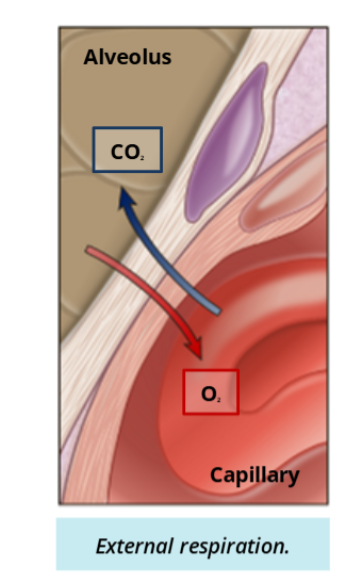
Gas Exchange: Gas exchange involves the movement of gases across membranes.

External respiration: gas exchange between alveoli and pulmonary capillaries; O₂ enters blood and CO₂ enters alveoli for exhalation.
Internal respiration: gas exchange between blood and body cells; O₂ enters cells and CO₂ enters blood.
<p><strong>Gas Exchange:</strong> Gas exchange involves the movement of gases across membranes.</p><p><strong>External respiration</strong>: gas exchange between alveoli and pulmonary capillaries; O₂ enters blood and CO₂ enters alveoli for exhalation.<br><strong>Internal respiration</strong>: gas exchange between blood and body cells; O₂ enters cells and CO₂ enters blood.</p>
5
New cards

What is gas conditioning and how does it work?

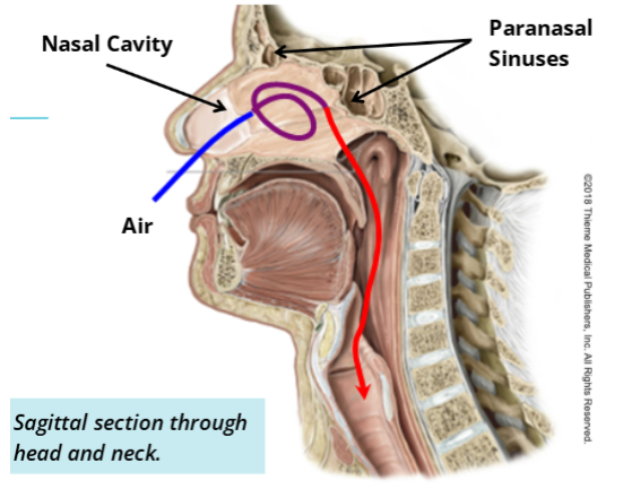
Gas Conditioning: Gases entering the lungs need to be conditioned, or warmed and cleansed, in order to prevent damage to the lungs

Air is swirled through the nasal cavities and paranasal sinuses, where it is warmed and humidified. The mucosal lining of respiratory epithelium traps particles and cleanses the air, protecting the lungs from damage.
<p><strong>Gas Conditioning</strong>: Gases entering the lungs need to be conditioned, or warmed and cleansed, in order to prevent damage to the lungs</p><p>Air is swirled through the <strong>nasal cavities and paranasal sinuses</strong>, where it is <strong>warmed and humidified</strong>. The mucosal lining of respiratory epithelium traps particles and cleanses the air, protecting the lungs from damage.</p>
6
New cards

How does the respiratory system produce sound?

Forceful expiration causes air to pass through the vocal cords in the larynx, making them vibrate. Different vocal cord tensions produce different sounds, with help from the teeth, lips, and tongue.

<p>Forceful expiration causes air to pass through the vocal cords in the larynx, making them vibrate. Different vocal cord tensions produce different sounds, with help from the teeth, lips, and tongue.</p>
7
New cards

How does the respiratory system detect smell (olfaction)?

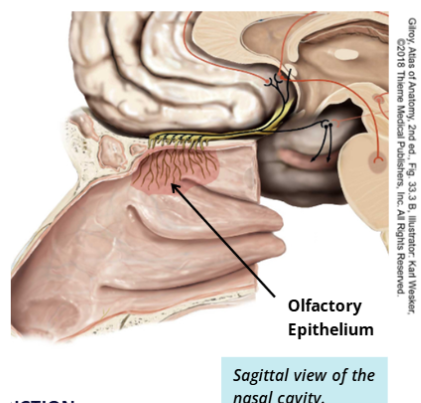
Airborne molecules dissolve in mucus in the nasal cavity, stimulating smell receptors in the olfactory epithelium (at the top of the nasal cavity). Signals travel through the olfactory nerve (CN I) to the brain, producing the sense of smell.
<p>Airborne molecules dissolve in mucus in the nasal cavity, stimulating smell receptors in the olfactory epithelium (at the top of the nasal cavity). Signals travel through the olfactory nerve (CN I) to the brain, producing the sense of smell.</p>
8
New cards

Defense: How does the respiratory system defend against pathogens?

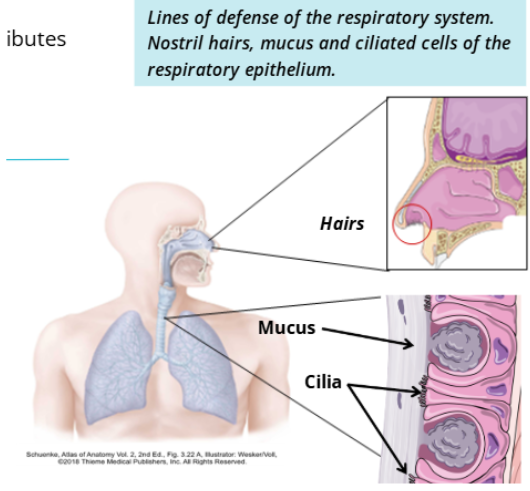
The coarse hairs of the nostrils, ciliated respiratory epithelium, and mucus lining trap inhaled particles and microorganisms, preventing them from entering deeper into the respiratory system and causing infections.
<p>The coarse hairs of the nostrils, ciliated respiratory epithelium, and mucus lining trap inhaled particles and microorganisms, preventing them from entering deeper into the respiratory system and causing infections.</p>
9
New cards

What is respiratory tract epithelium (RTE), and where is it found?

Respiratory tract epithelium (RTE) lines most surfaces from the nasal cavity to the terminal bronchi and plays an important role in defending the respiratory system against inhaled particles and microorganisms.

10
New cards

What is pseudostratified ciliated columnar epithelium?

A type of respiratory epithelium where all cells attach to the basal lamina, but only some reach the surface. Its apical surface is covered in cilia.

<p>A type of respiratory epithelium where all cells attach to the basal lamina, but only some reach the surface. Its apical surface is covered in cilia.</p>
11
New cards

What are cilia, and what are their functions in the respiratory tract?

Cilia are small, fingerlike projections on the apical surface that:

  • Increase surface area for air conditioning (filtering, humidifying, moistening).

  • Sweep mucus containing trapped particles and microorganisms up the respiratory tract and out through the nose or mouth.


12
New cards

What are goblet cells, and what are their functions in the respiratory tract?

Goblet cells are mucus-producing cells scattered throughout the pseudostratified epithelium. They:

  • Stain lightly in histological images due to mucus.

  • Produce mucus that forms a protective layer over the epithelium.

  • Trap inhaled particles and microorganisms.

  • Humidify inhaled air before it reaches the lungs.


13
New cards

Regions of respiratory system:

What is the conducting portion of the respiratory system?

The conducting portion transports air into and out of the lungs, humidifies air, and traps debris.

  • No gas exchange occurs because the walls are too thick for O₂ to enter the blood.

The structures of the conducting portion include:  

• Nose and nasal cavity  

• Paranasal sinuses  

• Pharynx  

• Larynx  

• Trachea  

• Primary, secondary, and tertiary bronchi  

• Terminal bronchioles  

<p>The conducting portion transports air into and out of the lungs, humidifies air, and traps debris.</p><ul><li><p>No gas exchange occurs because the walls <span style="color: rgb(0, 0, 0);">are too thick for O₂ to enter the blood.</span></p></li></ul><p><span style="background-color: inherit; line-height: 20.7px; color: rgb(0, 0, 0);">The structures of the conducting portion include: </span><span style="line-height: 20.7px; color: rgb(0, 0, 0);">&nbsp;</span></p><p class="Paragraph SCXO117483472 BCX0" style="text-align: left;"><span style="background-color: inherit; line-height: 20.7px; color: rgb(0, 0, 0);">• Nose and nasal cavity </span><span style="line-height: 20.7px; color: rgb(0, 0, 0);">&nbsp;</span></p><p class="Paragraph SCXO117483472 BCX0" style="text-align: left;"><span style="background-color: inherit; line-height: 20.7px; color: rgb(0, 0, 0);">• Paranasal sinuses </span><span style="line-height: 20.7px; color: rgb(0, 0, 0);">&nbsp;</span></p><p class="Paragraph SCXO117483472 BCX0" style="text-align: left;"><span style="background-color: inherit; line-height: 20.7px; color: rgb(0, 0, 0);">• Pharynx </span><span style="line-height: 20.7px; color: rgb(0, 0, 0);">&nbsp;</span></p><p class="Paragraph SCXO117483472 BCX0" style="text-align: left;"><span style="background-color: inherit; line-height: 20.7px; color: rgb(0, 0, 0);">• Larynx </span><span style="line-height: 20.7px; color: rgb(0, 0, 0);">&nbsp;</span></p><p class="Paragraph SCXO117483472 BCX0" style="text-align: left;"><span style="background-color: inherit; line-height: 20.7px; color: rgb(0, 0, 0);">• Trachea </span><span style="line-height: 20.7px; color: rgb(0, 0, 0);">&nbsp;</span></p><p class="Paragraph SCXO117483472 BCX0" style="text-align: left;"><span style="background-color: inherit; line-height: 20.7px; color: rgb(0, 0, 0);">• Primary, secondary, and tertiary bronchi </span><span style="line-height: 20.7px; color: rgb(0, 0, 0);">&nbsp;</span></p><p class="Paragraph SCXO117483472 BCX0" style="text-align: left;"><span style="background-color: inherit; line-height: 20.7px; color: rgb(0, 0, 0);">• Terminal bronchioles&nbsp;</span><span style="line-height: 20.7px; color: rgb(0, 0, 0);">&nbsp;</span></p>
14
New cards

Regions of respiratory system:

What is the respiratory portion of the respiratory system?

The respiratory portion is responsible for gas exchange between the lungs and pulmonary capillaries.

  • Thin walls allow O₂ to move from air into the blood and CO₂ to move from blood into the lungs.

The structures that make up the respiratory portion include:  

• Respiratory bronchioles  

• Alveolar ducts  

• Alveolar sacs  

• Alveoli  

<p>The respiratory portion is responsible for gas exchange between the lungs and pulmonary capillaries.</p><ul><li><p><span style="color: rgb(0, 0, 0);">Thin walls allow O₂ to move from air into the blood and CO₂ to move from blood into the lungs.</span></p></li></ul><p><span style="background-color: inherit; line-height: 20.7px; color: rgb(0, 0, 0);">The structures that make up the respiratory portion include: </span><span style="line-height: 20.7px; color: rgb(0, 0, 0);">&nbsp;</span></p><p class="Paragraph SCXO29129702 BCX0" style="text-align: left;"><span style="background-color: inherit; line-height: 20.7px; color: rgb(0, 0, 0);">• Respiratory bronchioles </span><span style="line-height: 20.7px; color: rgb(0, 0, 0);">&nbsp;</span></p><p class="Paragraph SCXO29129702 BCX0" style="text-align: left;"><span style="background-color: inherit; line-height: 20.7px; color: rgb(0, 0, 0);">• Alveolar ducts </span><span style="line-height: 20.7px; color: rgb(0, 0, 0);">&nbsp;</span></p><p class="Paragraph SCXO29129702 BCX0" style="text-align: left;"><span style="background-color: inherit; line-height: 20.7px; color: rgb(0, 0, 0);">•&nbsp;Alveolar sacs </span><span style="line-height: 20.7px; color: rgb(0, 0, 0);">&nbsp;</span></p><p class="Paragraph SCXO29129702 BCX0" style="text-align: left;"><span style="background-color: inherit; line-height: 20.7px; color: rgb(0, 0, 0);">• Alveoli&nbsp;</span><span style="line-height: 20.7px; color: rgb(0, 0, 0);">&nbsp;</span></p>



