Animal Behavior Exam 2
 Call Kai
 Learn
Learn Practice Test
 Spaced Repetition
 Match
Match Flashcards
 Knowt Play
1/140

There's no tags or description
Looks like no tags are added yet.
Name | Mastery | Learn | Test | Matching | Spaced | Call with Kai | Chat |
|---|
No analytics yet
Send a link to your students to track their progress
141 Terms
Studies of Site specific expression of genes how is it done
use staining techniques to locate cells with a genes product or couple gene with another so that activation of the gene is revealed
Prairie vole example of site specific expression
vasopressin receptors on the ventral pallidum in monogamous prairie voles can be visualized and you see more vasopressin receptors in the lateral septum in polygynous montane voles
prairie voles and meadow voles
experiementally increasing the V1a receptors in meadow voles in the ventral pallidum leads to increased monogamous behavior (site specific expression)
ZENK gene in zebra finches
example of site specific expression, at 40 days they start learning their songs, in the forebrain, ZENK is expressed in birds who are exposed to conspecific song and not in those that arent (genes AND environment)
song learning regions in birds regions of the brain how did we discover and visualize
study of site specific expression, actually could see how the genes affect phenotype for each region
quantitative trait locus analysis (QTL)
used to identify/locate possible genes involved in polygenic (quantitative) traits
looking for an association of a “marker gene” on a particular chromosome with variation in a specific trait
if such an association shows up, it suggests that a gene influencing that trait is closely linked with the marker gene
you can use a variety of modern molecular techniques to try to identify the specific gene that is associating with the marker
QTL mapping example
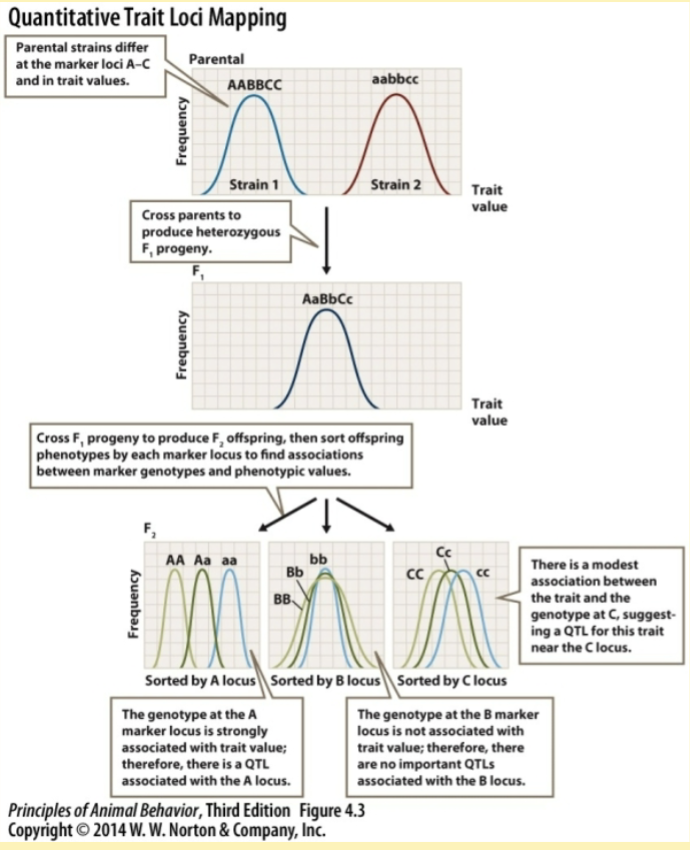
QTL mapping for anxiety in mice
QTLs for anxiety behavior have been found on all nineteen autosomal chromosomes as well as X chromosomes in mice
genome wide association studies
used in large populations to identify multiple genetic variations (SNPs), sequence the whole genome, shows us genes that are correlated and which ones are involved in phenotype
GWAS Study of Dog Behaviors what did they study
looked at 268 whole genome sequences from 130 modern breeds and investigated dog herding, predation, temperament, and trainability
Genes associated with hearding GWAS dog study
found 44 sites on 5 chromosomes associated with herding behavior in dogs, allows us to see which genes are involved in polygenic traits
microarray analysis
allows us to analyze the activity of a large set of genes by detecting certain products (messenger RNAs) made when those genes have been “turned on”
developmental sequence of worker honeybee behavior

only live 4-5 weeks, foraging is most dangerous is this due to the activation of different genes?
honeybee microarray analysis results
gene activity (in worker brain) of forager gene correlates with behavioral activity

“DNA is both inherited and environmentally responsible”
even if you remove foragers or nurses bees will switch expression to fill that gap regardless of age

conclusions regarding behavioral genetics
there is an abundance of evidence that there are genes for behavior (in the proper sense)
these maybe studied using a variety of methods, both classical and molecular (gene therapy, knockout, GWAS, and QTL)
With molecular methods, we are beginning to understand not only how differences in alleles correlate with differences in traits but increasingly also how genes exert their developmental influences on behavior
behavioral genetics belongs to which of Tinbergens categories
development
historically, discussion of behavior development were usually about whether a behavior was…
instinctive or learned, these were considered by both comparative psychologists, and ethologists, to be two mutually exclusive types that all behaviors fell into
traditional dichotomies and what is the correct frame of mind
Instinctive vs. Learned, Genetic vs. Environmental, Nature vs. Nurture (from shakespeare “on whose nature nurture could never stick”)
modern consensus in instinct and learning
behaviors fall along a continuum from entirely learned (human languages) to entirely instinctive (cricket songs) with many in the middle (bird songs)
the first ethological textbook was
Tinbergens The Study of Instinct
Lorenz’s list (first 3) of the characteristics of instinctive behaviors (not learned and not modifiable)
part of early ethologists ideas about instinct
instinctive behaviors are genetically programmed
instinctive behaviors are not learned
instinctive behaviors are not modifiable as a result of learning or experience
Lorenz’s second 3 characteristics of instinctive behaviors
instinctive behaviors are fixed action patterns FAPs (highly stereotyped, dont vary between individuals or over time with and individual
Instinctive behaviors are released by simple, specific stimuli
animals have an inherent need to perform instinctive behaviors; motivation builds up over time since last performance (even vacuum behaviors may occur)
vacuum behavior and example
behaviors done without stimuli when built up and not done for awhile
beaver making dam from christmas presents an decorations
how to determine whether a behavior was instinctive or learned?
carry out a deprivation (Kaspar Hauser) experiment
rear animal without exposure to the relevant stimulus
if it shows normal behavior the behavior was instinctive, if it does not show normal behavior, the behavior was learned
flaw in deprivation experiement
if it doesn’t work, 1. have you identified the correct stimulus and 2. it could be due to trauma of the experience or something else rather than lack of learning you dont really know
Sonograms of eastern pheobe example
example of deprivation experiment, the sonograms of the controls and deafened birds were the same
Harry Harlows monkeys what did it tell us
was the animal so messed up from the manipulation that it couldnt show the correct behavior?
didnt develop the ability to socialize with other monkeys
the monkeys that grew up without mothers didnt mother their own children
monkeys who even received 15 minutes of socialization a day were fine
Harry Harlows traumatized monkeys
effects of deprivation, especially social deprivation can cause even instinctive behaviors to be abnormal
so if deprivation results in normal behavior, we know the behavior was instictive, but if the deprivation results in abnormal behavior, we dont know whether that reflects a lack of learning or is the result of a general traumatic effect
Cross fostering experiments; and mice example
when you swap children of two similar species
swapped oldfield mice and deer mice babies, the cross fostered mice acted like their parents
how are time of burrowing and length of burrows related in oldfield and deer mice?
they are separate but linked traits with clear dominance and recessive aspects
An experiment that undermined right ideas about instinctive behaviors
Jack Hailmans study of pecking behavior by laughing gull chicks about how “instinct is learned”
Hailmans Study what did he do
paid close attention to laughing gull chicks behavior right after hatching (Tinbergen usually waited two days before observing behavior)
the instinctive behavior changed a lot over the first few days due to learning
Hailman Study results
through practice, chicks get better at hitting what they are aiming at
through trial and error learning, the chicks learn to restrict their pecking to the correct stimulus (maturation PLUS learning from practice)
used different versions of “gull” looking things and the less it looked like a gull on future days the less it pecked at it but day 1 it pecked pretty uniformly besides like the super deformed one
a modern view of instincts
instinctive behaviors are ones that appear in a functional form the first time they occur, without any required exposure beforehand to a specific environmental stimulus. No other assumptions or attributes necessary
mot mot study what is it an example of and what is it
example of instinctive behavior, yellow and red ringed things triggered young mot mots to not peck, but stripes in line with the log it pecked 2/3 amount of times and pecked the same when the pattern wasnt uniform across the whole stick (pecked less on yellow and red ring side than blank side)
Ultimate explanations for instinctive behaviors (why instinct over learning)
nervous system economy
short life spans
constant environments
fitness consequences of getting things right the first time
No Squirrel Can Fly
traditional beliefs about learning among comparative psychologists
learning is unconstrained
all learning is reversible
for learning to occur, the relevant stimuli must be very closely linked in time
learning usually requires repeated exposure
unicorns really can repeat
study that challenged beliefs about learning by comparative psychologists
John Garcias study of taste aversion learning in rats
John Garcias rat study results
rats acquired an aversion even if they became nauseous an hour later
Aversions were acquired with only one exposure
aversions were not reversible
rats could acquire aversions to tastes if associated with nausea but could not learn other associations
Garcias results regarding not being able to learn other associations rats

used a shuttle box for shock (pain)
taste + nausea and sound + shock but not the other combos
do all species learn aversions?
No! vampire bats dont
Vampire bat study
the vampire bat consumed the same amount of fluid regardless of if it was an immediate, delayed, or asychronous toxin, or saline. Insectivorous bats learned taste aversion to the immediate and delayed toxin.
Why? blood is blood, and some insects are poisonous
Is learning an adaptation? Who referred to this as “preparedness’? How does evolution play into this?
Rats could only learn natural connections and vampire bats dont learn aversions. Martin Seligman.
Evolution seems to have resulted in different species having different learning capabilities, related to their environmental challenges, rather than more or less of a “general ability.”
food caching in birds black capped chickadee and pinyon jay
example of learning as a adaptation, after storage spent a lot more time looking in hoard sites compared to before
pinyon jays differed by sex, females deteriorated but males dont get worse and males also payed attention to where their mate stored their seeds
sphexish behavior
animals can therefore look extremely intelligent in one context but act like stupid robots in another context names after digger wasp Sphex (when Fabre stole their bug that they placed in their nest and put it away in the same spot the digger wasp didnt know where to look no matter how many times it showed up in the same spot)
sphexish behavior beewolves example
tinbergen found out its physical landmarks that the beewolves use to identify their nests
modern definition of learning
durable modification of behavior in response to specific experience, no other assumptions or attributes are necessary
stephens learning model
when is learning worth it?

types of one stimulus learning
sensitization and habituation
early example of habitiuation
spider reacting less strongly to a tuning fork that touches her web after repeated exposure
Wolfgang Schleits Study of Classical Ethology
studied previously studied “instinctive fear response” to birds of prey stimuli in young birds (geese, ducks, turkeys) and thought it may be due to habituation not instict
he found rapid habituation occurs to all stimuli in the first couple of days and attributed tinbergens results to differential habituation of the chicks
Eric Kandel aplysia habituation
gill withdrawal reflex, studied at the cellular level, the more water jets that were shot at the aplysia the less it withdrew,
sensory neuron comes to release less NT at synapse with the motor neuron thus motor neuron fails to order gill withdrawal
sensitization in aplysia eric kandel
develops only later in life, interneurons are involved, when the head was poked that caused the interneuron to release more NT and when the siphon was poked the sensory neuron released more NT causing more vigorous gill withdrawal
habituation
waning of response with repeated presentation of a neutral stimulus
sensitization
accentuation of response due to prior presentation of a noxious stimulus (more likely to respond)
Association learning
the animal learns to respond appropriately when two stimuli are reliably associated. Often two major classes of association are recognized.
the simplest scheme of learning lists only two schemes
one stimulus learning and association learning
classical pavlovian conditioning
the animal learns tan association between two external stimuli
operant skinnerian conditioning
trial and error learning, instrumental learning, the animal learns an association between its actions and their consequences
Classical Conditioning Paradigm
Unconditioned stimulus (US) → Unconditioned respose (UR)
Conditioned Stimulus (CS) → Unconditioned Response (UR) MUST BE IN THAT ORDER
CS Alone → CR (CR need not be the same as the UR! Could be something else)
Betta siamese fighting fish
Brightly colored, present mirror think themselves are a rival and threaten it. Can condition them to respond to themselves in the mirror. Then shine a light and show the mirror. Then you just need the light and they will respond to assume a rival is coming. Some responded when light turned on and some would wait until the light went off, some went over to mirror and waited until after light and mirror shows up then responded.
CR just has to be
something new and relevant to the situation
Raushers study of pipevine swallowtail
pipeline swallowtail caterpillars eat only pipline leaves and females only lay eggs on pipevine leaves
Problem: different species of pipevine, with differently-shaped leaves, are out at different times of the year - how does female know what to look for?
Solution: Land randomly on leaves use innate reaction to pipevine leaf chemicals to identify current pipevine leaf chemicals; learn its shape; carry out efficient visual search (learn tase shape association)
Its inherently rewaring to get the buzz of chemicals from the correct leaf or is it learning the relationship between leaf and reward (classical conditioning)
Operant Conditioning associate with who
Skinner and Skinner box
Reinforcement (operant conditioning)
Increases performance of the behavior
provide positive stimulus (positive reinforcement)
remove aversive stimulus (negative reinforcement)
Punishment (operant conditioning)
decrease performance of a behavior
administer aversive stimulus (positive punishment)
remove positive stimulus (negative reinforcement)
Errors in Entomolgy textbook
confused classical and operant conditioning
Pavlov got nobel prize for physiology
he got he reinforcement terminology wrong
Lewis’s study of nectaring by cabbage whites (butterflies)
Lotus corniculatus and vicia cracca flowers (very different one yellow one purple) - operant conditioning
have to learn how to work the flower if using different flowers
First exposure to VC: took 12s to obtain nectar
Second exposure to VC: 2s to obtain nectar
First exposure to LC: took 12 s to obtain nectar
Second exposure to LC: took only 2s to obtain nectar!
Re-expose to VC: took 12s to obtain nectar
reexpose to LC: took 12 s
Conclusions: cabbage whites quickly learn how to operate a flower but can only remember one flower at a time
Latent learning rats
rats which are hungry but not thirsty are given forced runs in a t maze leading to food in one arm and water in the other if subsequently tested when thirsty what do they do?
according to skinner they wouldnt learn unless they got a reinforcement (so should be random)
But ran to water → despite the lack of immediate reward, they did learn the location of the water in their first run thorugh the maze their leanring was only demostrated after a latency period thus latent learning
other perspectives on rat study besides latent learning rat study
some consider this just operant conditioning with a delayed reward other say that acquiriing useful information about he environment can be rewarding in itself
some list spatial learning separately
insight learning what is it and who
ability to use advanced cognitive processes to determine the correct solution withotu reandom trial and error (as in operant conditioning)
advocated by Wolfgang Kohler, founder of gestalt psychology who carried out famous studies in Tenerife with Sultan chimp
Wolfgang Kohler chimps
chimps could have flashes of insight
release chimp into room and give them a problem and watch them try to solve the problem ex. suspend banana from ceiling, jump and try to reach banana then get really angry by situation but then suddenly start stacking boxes to get banana → insight
criticism of chimp study
the chimps had already done problem solving tasks in that room so had developed other approaches for new problems (shortening time to solve problem)
trial and error has to be physical (mental trial and error of how to get it) “learning set learning” or “learning how to learn”
perhaps just operant conditioning with mental (virtual) trial and error
very active area is “cognitive ethology” to try to get in the mind of animals
most behaviors involve…
both innate and learned aspects
new technology in birdsong research
portable reel to reel tape recorders (to “capture” sound), sound spectrographs (sonographs), (which reproduce sounds on paper as measurable sonograms, allowing quantitative study of animal vocalizations)
Peter Marler WM Thorpes student, became a leading figure in this area
Why did ethologists suspect that songs were learned from birds and not instinctive?
songs were complex and varied between individuals (unlike calls, which are simple, repetitive vocalizations)
Two male winter wrong sonograms, what must it involve?
have syllables in songs, very complex and very different while they have a lot of the same syllabes differ in how they put them together→ must involve learning
Marler and Peters study of Swamp and Song sparrow
Swamp sparrow is repetative buzz, song sparrow has a bit more complex
did deprivation study to find innate song
repepetive buzz swamp and some whistles for song but still had skeletal elements of more complex full song
If you played tape recording of opposite species song or of same species (heterospecific)
still sang innate song
Live (heterospecific) bird they learn some of the other species song
It is easier to learn conspecific song
Conclusion of white crowned sparrow and strawberry finch
they learned both strawberry finch and the white crowned sparrow when exposed to strawberry finch live tutor
sensitive period for song learning in birds long billed marsh wren graph
another innate aspect of song learning, 2-9 weeks for long billed wren, there are certain times where learning is more likely to take place than another times
why was the graph bimodal and not bell curve? the sample size effect
two more treatments marler and peters and what was each manipulation missing
early deafening by cutting the auditory nerve before sensitive period; should sing innate song but didnt just squack, Missing:
Missing:cant hear themselves still (which would be enough to get innate song)
late deafening by cutting auditory nerve after senseitive period but before bird starts singing. outcome: permanent subsong (babbling); normal birds trotted out a lot of syllables until final order and lower syllables “crystallized”
Missing: cant hear what theyre trying to do so cant get feedback from themselves
auditory template model
period during when birds are susceptible to other birds songs “template stage” and specifically look for songs that match their crude template(days 10-50) called the memorization phase
day 150 they start singing their song called “plastic song” which starts up do to testosterone and then full song around day 200 called the motor phase

exceptions to auditory template model
some “open learners” can add new songs during a new sensitive period each year
species wiht the largest repertoires add songs continuously; many are mimics such as mockingbirds, mynahs
at the other extreme, some birds have totally instinctive songs
Brood parasites what do they do, and what speiceis
they deposit their young in others nests, host can be intra- (same species) or inter (different) specific
mostly birds and social insects
Cuckoos (Eurasia), Whydahs or widowbirds, and cowbirds
European cuckoos what is it an example of and what do they do?
brood parasite; parasitize numerous species of hosts
Female cuckoo will spy on nests and pick up host egg and replace it with her egg (females can only lay 1 egg a day)
They make different eggs that look like the host eggs
Chicks hatch and the cuckoo will kick out the competition
how do cuckoos develop song?
completely instinctive since they grow up in other birds nests and males go back to africa after mating
whydahs what are they and what do they do
brood parasites; usually parasitize close relatives
use different host races (species?) because have to mate with another bird of same type
have to match the host species in looks as well as the egg and their gate
Have evolved different looks based on the host species that they infiltrate
how do whydahs differ from cuckoos
dont expel host chicks and have to compete and mimic host chicks gape, their songs are totally learned and not instictive
how do whydahs learn song?
learn the hosts song and are totally learned for the males to sing it and females to prefer it
Indigobird (whydah) study new song
when given new input of bengalee finch to see if they would still learn the song and they did
can all birds distiguish between their eggs and parasite eggs or just hosts? how were cuckoo host species determined?
a mismatched egg will get thrown out
species can distinguish between eggs whether or not their are parasitized or not (hosts and non hosts did it) → there are other species that used to be hosts that outcompeted the cuckoo
how do cuckoos mate and whats the pattern?
davies and collegues origionally thought it was based on natal habitat but DNA fingerprinting showed that females mate with males randomly with respect to habitat or host
solution is unusual ZZ/ZW sex determination system (females are hetergametic)
egg trait genes are on the W chromosome - males dont have this and are therefore irrelevant
brown-headed cowbirds: name origin, what type of species
name comes from habit fo following cows (bison) to catch flushed insects
a classic edge species (thrive w people and are in two diff habitats)
very generalist parasite lacking egg or chick mimicry
what does deprivation experiment of brown headed cowbirds show?
effects of male dominance: isolated birds sing “potent songs” , but socially reared males sing less potent songs because the older, more dominant males attack them and they learn not to sing potent songs until they are older and become dominant themselves
so birds reared alone sing potent songs
audience feedback in cowbirds (California and Indiana cowbirds)
california and indiana cowbird populations have different innate songs. Indana females are unresponsive to potent california male songs. But after several weeks of being housed in the same room, in visual and acoustic contact, Indianan femles show copulation sociciataion postures to california males. California males learned Indiana songs by operant conditioning by response to females.
cowbirds instictive or learned song?
Both!! Can change based on interaction with other males or with females.
cuckoo rubenstein example eggs
foreign eggs were more likely to be rejected the more they differed in color from the hosts eggs but as foreign eggs increased in number, host required greater difference to reject them
imprinting definition
early learning by an animal of its parents and species characteristics, associated with Konrad Lorenz
Konrad Lorenz why did he do imprinting, his students, and what are the 2 forms
as a means to an end to be able to study them closely (thought it was a permanent thing), his student studied it as a unique form of learning in its own right
filial (learn and attach to parents) and sexual (learn characteristics of the opposite sex for later sexual behavior)
Characteristics of imprinting
occurs early in life
requires a somewhat specific range of stimuli to be effective
occurs only during a critical or sensitive period
is sometimes not reversible
an active not passive process
Early Stimuli (specific stimuli) Create (critial period) Active (active process) Impressions (is sometimes reversible)