TEAS Chemical Bonds/ chemistry
 Call Kai
 Learn
 Practice Test
 Spaced Repetition
 Match
 Flashcards
 Knowt Play
1/33

There's no tags or description
Looks like no tags are added yet.
34 Terms
🧪 PART 1: First, what is chemical bonding?
Imagine atoms are little building blocks.
Everything around you is made of atoms:
Water
Air
Your body
Food
Medicine
Your cells
Atoms can connect to other atoms to form substances.
Chemical bond = a connection between atoms.
Think of it like holding hands. Two atoms connect to each other, and that connection is called a chemical bond.

🧪 PART 2: What are valence electrons?
First, remember:
Electrons = tiny negatively charged particles inside an atom.
Electrons move around the nucleus in energy levels (shells).
Outermost shell = the very last energy level, the one farthest from the center.
Now, here's the important part:
Valence electrons = electrons in the OUTERMOST shell of an atom.
Think of an atom like a house with different floors.
First floor = inner shell.
Second floor = outer shell.
The people on the top floor = valence electrons.
Why do we care about these electrons?
Because valence electrons determine how an atom bonds with other atoms.
In other words, they help determine how an atom reacts with other elements.
Memory trick:
VALENCE = VERY OUTSIDE.
Valence electrons live on the outside!


🧪 PART 3: What is the octet rule?
This is probably the MOST important part of your reading.
Let's break down the word first.
Octo = eight.
Octopus = eight arms.
Octagon = eight sides.
Octet = eight.
Octet rule = atoms tend to become stable by having 8 electrons in their outermost shell.
Think of it like this:
Imagine an atom has 8 seats at a table.
Its goal is to fill all 8 seats to become stable.
Why eight?
Having a full outer shell generally gives the atom a more stable electron arrangement, similar to the noble gases.
Remember: FULL OUTER SHELL = STABLE ATOM.

🧪 PART 4: How do atoms get 8 electrons?
This is where bonding happens!
Atoms can do THREE things:
1. LOSE electrons
An atom gives away electrons to another atom.
Memory trick: LOSE = GIVE AWAY.
2. GAIN electrons
An atom receives electrons from another atom.
Memory trick: GAIN = GET MORE.
3. SHARE electrons
Two atoms share electrons with each other.
Memory trick: SHARE = SPLIT THE USE.
So remember:
LOSE, GAIN, OR SHARE = ways atoms become stable!
We'll learn ionic and covalent bonds more deeply next.
🧪 PART 5: Understanding your periodic table picture
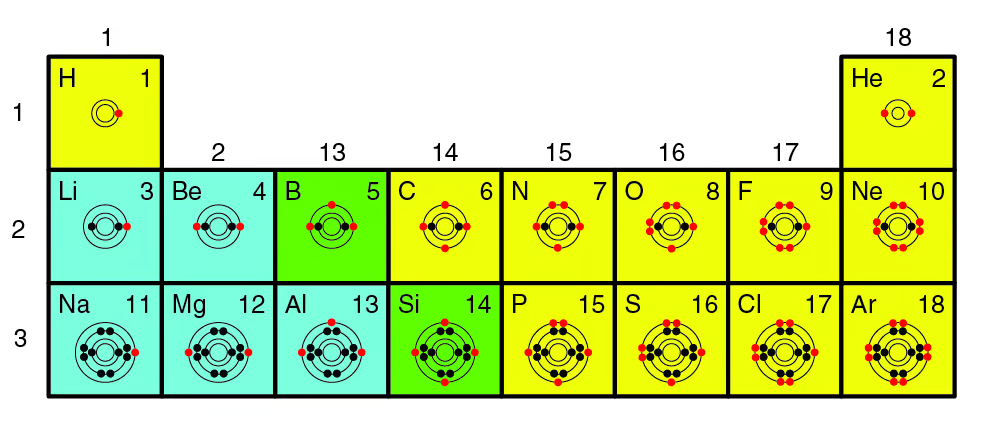
Your first picture uses colors to separate elements into three groups.
Metal
Metalloid
Nonmetal
For now, remember:
Metals: usually lose electrons.
Nonmetals: usually gain or share electrons.
Metalloids: have properties of both metals and nonmetals.
This will help you understand why different atoms bond.
The special group: Noble gases
Look at the far-right column of your periodic table:
The special group: Noble gases
Look at the far-right column of your periodic table:
These elements are called noble gases.
Examples:
Helium (He)
Neon (Ne)
Argon (Ar)
Why are they special?
They already have a full outer electron shell!
That means they are already stable and generally don't need to gain, lose, or share electrons.
Memory trick: Noble gases are already FULL. They don't need anything!
Important TEAS exception: Helium
Most noble gases have 8 valence electrons.
BUT helium has only 2.
Why?
Because its first shell can only hold 2 electrons. Once it has 2, it's full!
Remember:
Helium = 2
Other main-group noble gases = 8


🧠 PART 6: The easiest way to read the second picture
RED DOTS = VALENCE ELECTRONS.
Let's look at a few examples:
Lithium (Li)
Has 1 valence electron.
It tends to LOSE 1 electron.
⭐ PART 7: TEAS cheat sheet — memorize this!
Word | Super easy meaning |
|---|---|
Atom | Tiny building block of matter |
Electron | Negatively charged particle |
Energy level/shell | Area where electrons are found |
Outermost shell | Last electron shell |
Valence electrons | Electrons in the outermost shell |
Chemical bond | Connection between atoms |
Stable | In a comfortable, lower-energy arrangement |
Octet | Eight |
Octet rule | Atoms tend to seek 8 outer electrons |
Noble gases | Elements with full outer shells |
Compound | Substance made from different elements chemically bonded |
The 5 things to remember
Valence electrons are on the OUTSIDE.
Valence electrons determine bonding.
Atoms tend to become stable.
The octet rule = 8 outer electrons.
Atoms can LOSE, GAIN, or SHARE electrons.
The two BIG types of chemical bonds:
Ionic bonds = electrons are transferred (given away).
Covalent bonds = electrons are shared.

1. Where are valence electrons located?
in the outermost shell
Valence electrons are the electrons in the outermost energy level.
2. What does the octet rule mean?
Atoms tend to have 8 outer electrons
Octet means eight. The rule describes the tendency to achieve 8 valence electrons.
3. Which three things can atoms do to become stable?
Lose, gain, or share electrons
Atoms change how they use their electrons: they can lose, gain, or share them.
Why are noble gases generally unreactive?
They have full outer shells
Their outer electron shells are already full.
5. How many valence electrons does helium have?
2
Helium is the exception because its first shell is full with just 2 electrons.
🧪 PART 1: The BIG idea
Atoms want to become STABLE.
And how do they try to become stable?
They want a FULL outer electron shell.
Usually, that means 8 valence electrons (the octet rule).
But different atoms have different numbers of electrons in their outer shells.
Some have 1. Some have 7. Some already have 8.
That's why atoms interact with each other!

🧪 PART 2: Metals vs. nonmetals
Your reading says metals tend to LOSE electrons, while nonmetals tend to GAIN or SHARE electrons.
Let's make that easy.
METALS = usually GIVE AWAY electrons
Metals usually have fewer outer electrons.
They can lose those electrons to reveal a full shell underneath.
Memory trick: METALS LET GO!
NONMETALS = usually GAIN or SHARE electrons
Nonmetals often have more outer electrons and are closer to having 8.
Memory trick: NONMETALS NEED MORE!
For example:
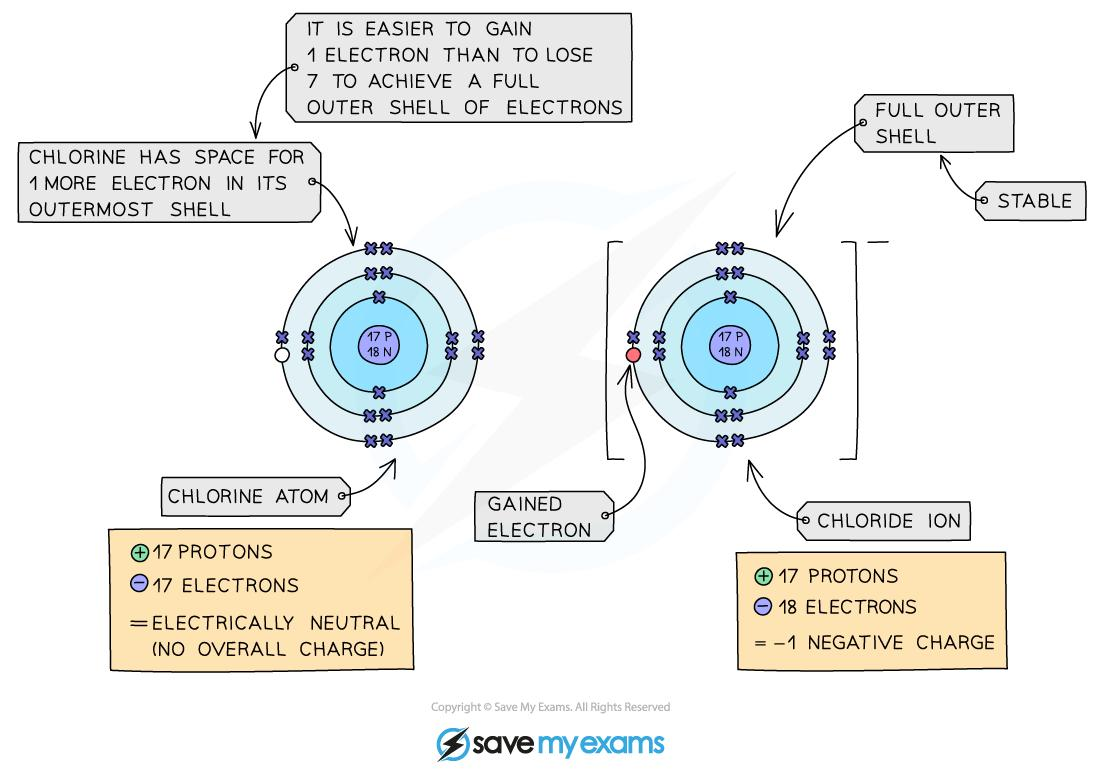
Sodium (Na) has 1 outer electron.
Chlorine (Cl) has 7 outer electrons.
Sodium wants to get rid of 1.
Chlorine needs 1 more.
See the problem? They are a PERFECT match!


🧪 PART 3: Let's understand YOUR picture (Sodium + Chlorine)
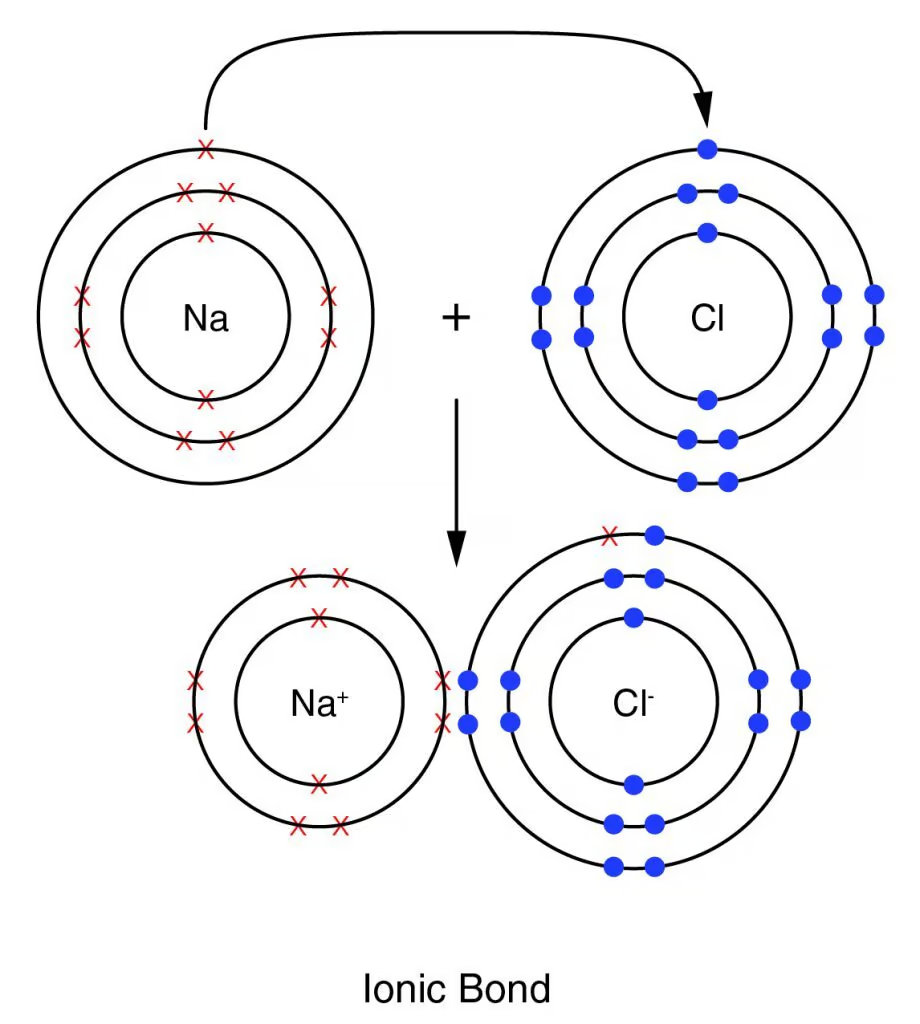
We're going to follow the picture step by step.
Step 1: Meet Sodium (Na)
Sodium is a METAL.
It has 11 electrons arranged like this:
First shell: 2 electrons
Second shell: 8 electrons
Third shell: 1 electron
So sodium has 1 valence electron.
Look at the red X on the outside of your picture.
That's the electron sodium wants to give away!
Step 2: Meet Chlorine (Cl)
Chlorine is a NONMETAL.
It has 17 electrons:
First shell: 2 electrons
Second shell: 8 electrons
Third shell: 7 electrons
So chlorine has 7 valence electrons.
It needs just ONE MORE to reach 8!

Step 3: Sodium gives its electron to Chlorine!
Watch what happens!
Na
Sodium
Has 1 to give
1 electron
Cl
Chlorine
Needs 1
Sodium transfers its one outer electron to chlorine.
Now look what happens:
Sodium LOSES 1 electron.
Chlorine GAINS 1 electron.
Both now have full outer shells!
Atom | Before | After |
|---|---|---|
Sodium | 1 outer electron | 8 outer electrons |
Chlorine | 7 outer electrons | 8 outer electrons |
BOTH BECOME STABLE!
🧪 PART 4: Why does Na become Na+ and Cl become Cl-?
Remember:
Protons = positive (+).
Electrons = negative (-).
An atom normally has equal numbers of protons and electrons, so its overall charge is neutral.
But when electrons move, the charge can change!
Na → Na+
Sodium LOSES an electron.
It loses one negative charge.
Now it has more protons than electrons, so it becomes POSITIVE.
Na+ = positive ion
Cl → Cl-
Chlorine GAINS an electron.
It gains one negative charge.
Now it has more electrons than protons, so it becomes NEGATIVE.
Cl- = negative ion
What is an ion?
Ion = an atom that has gained or lost electrons and now has an electrical charge.
Easy memory trick:
Lose negative electrons = become POSITIVE.
Gain negative electrons = become NEGATIVE.
Think of it this way:
If you TAKE AWAY something negative, you become more positive!
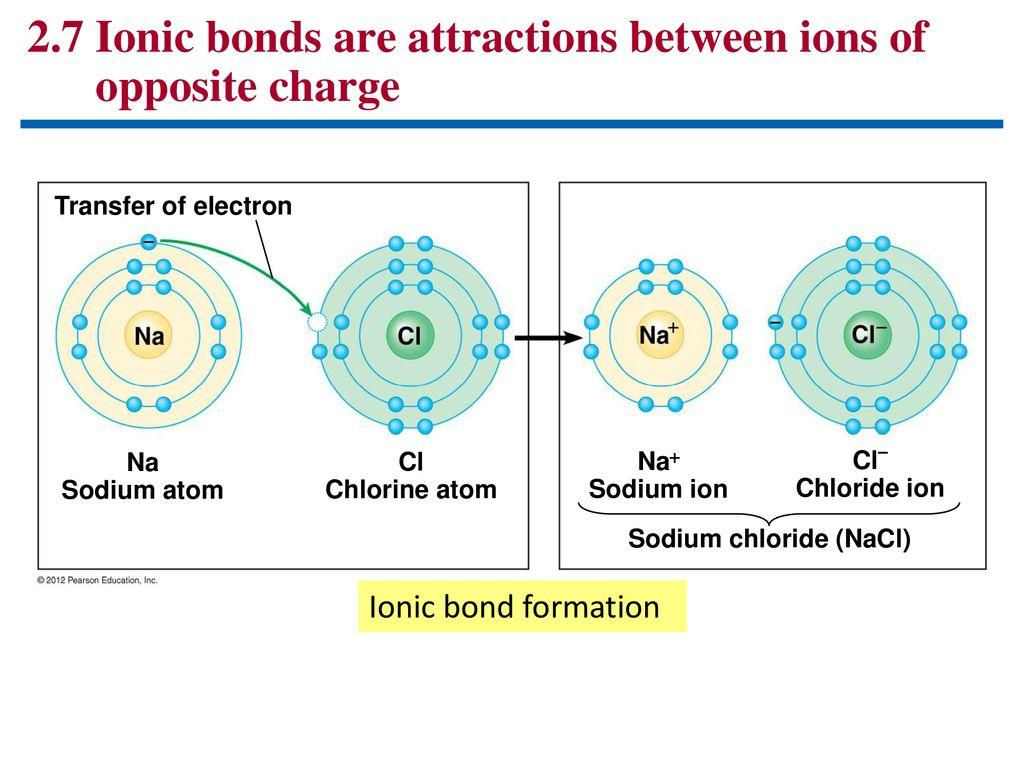
🧪 PART 5: What is an ionic bond?
a bond formed when electrons are transferred from one atom to another, creating oppositely charged ions that attract each other.
Let's simplify that:
Sodium gives away an electron.
Chlorine receives the electron.
Sodium becomes positive (+).
Chlorine becomes negative (-).
Opposite charges attract!
Just like magnets with opposite poles.
That attraction is what holds them together.
The result is sodium chloride (NaCl), which is common table salt.
MEMORY TRICK: IONIC = I GIVE!
An electron is transferred from one atom to another.

🧪 PART 6: What is a covalent bond?
Remember:
Ionic = GIVE or TAKE electrons.
Covalent = SHARE electrons!
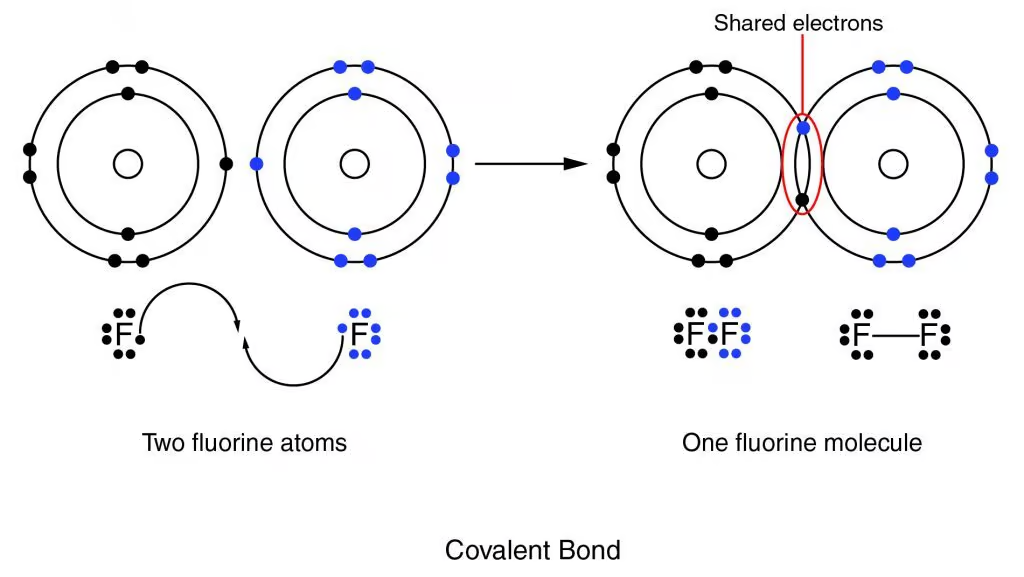
Covalent bond = two atoms share electrons.
Usually, this happens between two nonmetals.
Imagine two children sharing one toy instead of one child giving it away permanently.
Both atoms use the shared electrons to help fill their outer shells.
For example, hydrogen atoms can share electrons to form hydrogen gas (H₂).
Another important example is water (H₂O).
Oxygen shares electrons with two hydrogen atoms.
MEMORY TRICK: COVALENT = COOPERATE!
They SHARE instead of transferring electrons.

⭐ PART 7: Ionic vs. Covalent — SIDE-BY-SIDE CHEAT SHEET
This is what I really want you to memorize for the TEAS.
Ionic bond | Covalent bond | |
|---|---|---|
What happens? | Electrons TRANSFER | Electrons SHARE |
Who bonds? | Metal + nonmetal | Nonmetal + nonmetal (usually) |
What happens to electrons? | One gives, one receives | Both share |
What forms? | Positive and negative ions | Molecules (in common examples) |
Example | NaCl (salt) | H₂O (water) |
The easiest memory trick EVER
IONIC
TRANSFER
Give and receive electrons.
COVALENT
SHARE
Share electrons together.
🧠 PART 8: Your complete TEAS cheat sheet
1. Metals
Usually lose electrons.
Usually have fewer valence electrons.
Become positive ions when they lose electrons.
2. Nonmetals
Usually gain or share electrons.
Often have more valence electrons.
Become negative ions when they gain electrons.
3. Ionic bonding
Electrons are TRANSFERRED.
Usually metal + nonmetal.
Creates positive and negative ions.
Opposite charges attract.
Example: NaCl (table salt).
4. Covalent bonding
Electrons are SHARED.
Usually nonmetal + nonmetal.
Example: H₂O (water).
5. Octet rule
Atoms tend to become stable with 8 valence electrons.
Helium is an exception: it is stable with 2.
IONIC = electrons move from one atom to another.
COVALENT = atoms share electrons.
What happens during an ionic bond?
Electrons are transferred
Ionic = transfer. One atom gives electrons and another receives them.
2. Sodium loses one electron. What charge does it become?
Positive (+)
Losing a negative electron leaves sodium with a positive charge.
3. What type of bond usually forms between two nonmetals?
Covalent bonds
involve sharing electrons, usually between nonmetals.
4. In the NaCl diagram, which atom gives away the electron?
Sodium
Sodium is the metal and gives away its one outer electron.
5. Chlorine has 7 valence electrons. What does it need to reach an octet?
1 more electron
7 + 1 = 8. Chlorine needs just one more!
6. What is an ion?
An atom with an electrical charge
An ion forms when an atom gains or loses electrons.
7. Which is an example of an ionic compound?
NaCl
Sodium chloride is formed through electron transfer between sodium and chlorine.
If chlorine GAINS one electron, what happens?
It becomes negative (-)
Chlorine GAINS a negative electron, so it becomes negative (Cl⁻).
Electrons are negative.
🧪 1. Remember: Protons vs. Electrons
An atom has:
Protons = POSITIVE (+)
Electrons = NEGATIVE (-)
Neutrons = NEUTRAL (no charge)
Think of protons as plus signs and electrons as minus signs.
🧪 2. Sodium starts out NEUTRAL
Sodium (Na) has:
11 protons (+)
11 electrons (-)
The positive and negative charges cancel each other out!
Before losing an electron
+11
Protons
+
−11
Electrons
=
0
Neutral
🧪 3. Now sodium LOSES one electron!
Here's the important part:
When sodium loses an electron:
It STILL has 11 protons (+).
But now it only has 10 electrons (-).
It lost one NEGATIVE charge!

THAT'S WHY IT BECOMES POSITIVE!
It has more positive protons than negative electrons.
🧠 THE MEMORY TRICK
LOSE a negative = become POSITIVE.
GAIN a negative = become NEGATIVE.
Think of it like this:
Take away a negative → more positive.
Add a negative → more negative.
You can use this trick for ANY atom!