UNIT 2. NUCLEAR ACID STRUCTURE & FUNCTION
 Call Kai
 Learn
 Practice Test
 Spaced Repetition
 Match
 Flashcards
 Knowt Play
1/85

There's no tags or description
Looks like no tags are added yet.
86 Terms
nucleotide
Building block of DNA and RNA
phosphate group
pentose sugar
nitrogenous base
3 composition of nucleotides
Pentose Sugar
3 composition of nucleotides:
Ribose and deoxyribose
Adenine
Guanine
Cytosine
5 bases seen in DNA and RNA:
found both in DNA and RNA
Uracil
pyrimidine that is special to RNA, can’t be found in DNA
Thymine
pyrimidine that is only found in DNA, not in RNA
Adenine
Guanine
Purines
Cytosine
Uracil (RNA)
Thymine
Pyrimidines
Deoxyribonucleic Acid (DNA)
Composed of phosphate group, nitrogenous base and deoxyribose
Exists as a double – helix
Has directionality
5’ to 3’ Directionality
based on the connection of phosphate group to pentose sugar of DNA
sense/coding strand
5’ to 3’ strand
Not used as the template during transcription
Antisense/ Template Strand
3’ to 5’ strand
Complementary to the mRNA sequence
Used by RNA polymerase during transcription
Hydrogen Bonds
Nitrogen bases are bound through ____________
A-T/ A-U = 2 H-bonds
C-G = 3 H-bonds
A-T/ A-U = ____________
C-G = ____________
10 base pair
For physiological DNA that we have, Each turn of the helix has ____________
B-form
A-from
Z-from
3 Forms of DNA:
B-form
3 Forms of DNA:
Closest form to the one found in the physiological environment
Relatively high humidity (92%)
Aqueous form of DNA found in aqueous environment
A-form
3 Forms of DNA:
Lower humidity (75%)
Dehydrated form
z-form
3 Forms of DNA:
Left-handed helix
Usually man-made sequences
Pitch
Refers to the length of one complete turn of the DNA helix
measured in Angstrom (A)
chromosomes ;
nucleus
In eukaryotes, DNA is packed into ______________ and enclosed by the ________.
Ribonucleic Acid (RNA)
Single-stranded nucleotides with 5’ to 3’ directionality
Composed of a phosphate group, a pentose sugar (ribose) and bases (Adenine, Uracil, Cytosine, Guanine)
RNA molecules
Function as gene intermediates and for gene expression control through ______________
mRNA
rRNA
tRNA
3 Major Kinds of RNA:
messenger RNA (mRNA)
Major Kinds of RNA:
Product of DNA transcription
most code for proteins — Those that are not coding are either RNA regulatory elements or they can be other things
ribosomal RNA (rRNA)
Major Kinds of RNA:
Form the basic structure of ribosomes
catalyse protein synthesis
They form loops and hairpins so they bind to each other and form this higher order of structure for their rRNA
Transfer RNA (tRNA)
Major Kinds of RNA:
Looped structures that bring amino acids to the ribosomes during protein synthesis
small nuclear RNA (snRNA)
Other Kinds of RNA:
For nuclear processing like splicing (of RNA)
small nucleolar RNA (snoRNA)
Other Kinds of RNA:
For processing and chemically modifying rRNAs
Found in nucleolus
microRNA (miRNA)
Other Kinds of RNA:
Regulate gene expression usually by selective silencing of mRNA
They usually do this by attaching themselves to the untranslated regions of gene
small interfering RNA (siRNA)
Other Kinds of RNA:
Silence expression by degrading select mRNAs
can help make compact chromosome structures
A lot of this are used to make compact chromosomes structures as well as like x – chromosome inactivation
Gene
Sequence of DNA which codes for an RNA product
Product can be protein-coding, a regulatory RNA molecule, tRNA, rRNA, etc.
control elements
Genes are generally flanked by _________________
upstream = before the gene
downstream = after the gene
Control Elements:
_____________ = before the gene
_____________ = after the gene
Regulatory elements
Control Elements:
modulate transcription
can be negative or positive
Positive (Enhancers)= increase transcription rate
Negative (silencers) = decrease transcription rate
Regulatory Elements:
____________________ = increase transcription rate
____________________ = decrease transcription rate
Constitutively Expressed Genes
Facultative Genes
Types of Genes based on expression:
Constitutive / Housekeeping Genes
Types of Genes based on expression:
Constitutively expressed means that they are always on, always needed by the cells
Expression is constant, not influenced by external signals
Ex: beta-actin in cytoskeleton, ubiqiutin in ubiquitin proteosome pathway
Facultative Genes
Types of Genes based on expression:
Expressed only when needed
Turned on or off depending on cell type, environment, or signals
Ex: genes for lactose metabolism in bacteria, stress response proteins, hormone-induced genes
Prokaryotic cell
No nucleus
No membrane bound organelles
No chromosomes
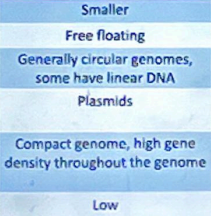
plasmids
Prokaryotes have Extrachromosomal DNA called ___________ for Antibiotic resistance, virulence, metabolism
nuclear region
in prokaryotes, There’s a _____________ where the DNA is, and plasmid scattered around the cytoplasm
T
There are simple eukaryotes that have smaller genomes compared to prokaryotes, but generally prokaryotes will always have a shorter genome
T or F
Prokaryotic genome is generally shorter than eukaryotes.
Prokaryotic Genome
Generally exist as a single, circular piece of DNA (unipartite)
shorter than eukaryotes
Very compact in nature
Some genes have no space between them
Generally no discontinuous genes
Generally low copy numbers with very few repeats
multipartite genome
A small subset of prokaryotes have multiple DNA pieces that may be either circular or linear
Allows gene specialization and adaptation
Vibrio, Brucella, Burkholderia
Examples of multipartite genome
Operon
Adjacent genes under the control of the same promoter and make use of the same regulatory elements
are transcribed together as one mRNA.
Usually encodes proteins in the same biochemical pathway.
T
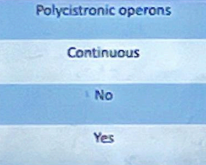
No introns → genes are continuous, all DNA sequences are functional.
Efficiency: Genome is small, so every gene is important.
T or F
Prokaryotic genome has no introns, and thus, they do not have any discontinuous strand.
E. coli (K12)
Example of Prokaryotic whole genome
4.6 million nucleotide pairs
Very small genome
There’s an origin of replication and point of termination
Example of a unipartite genome
Polycistronic Operons
An operon that produces one mRNA encoding several proteins.
Proteins are usually part of the same biochemical pathway, so expressing them together is efficient.
Controlled by:
Single promoter
Same regulatory elements
Lactose (lac) Operon
Tryptophan (trp) Operon
2 Examples of Polycistronic Operons
Lactose (lac) Operon
2 Examples of Polycistronic Operons:
Famous model in molecular biology
used in blue-white assay
Turning on the operon allows the cell to take in and digest lactose.
lacZ
lacY
lacA
3 Genes of lactose operon
β-galactosidase
3 Genes of lactose operon:
lacZ: ________________ → breaks down lactose into glucose & galactose
Lactose permease
3 Genes of lactose operon:
lacY: _______________ → transports lactose into the cell
Transacetylase
3 Genes of lactose operon:
lacA: ______________ → helps lactose metabolism
Tryptophan (trp) Operon
2 Examples of Polycistronic Operons:
Express different genes for tryptophan production
Genes are expressed together because all are needed in the same pathway.
Activator
PROKARYOTIC GENE STRUCTURE:
attaches to the enhancer (positive) to increase transcription
Repressor
PROKARYOTIC GENE STRUCTURE:
sticks to the silences (negative) to put down transcription
Operator
PROKARYOTIC GENE STRUCTURE:
regulatory element specific for operons, used by repressors.
Promoter
PROKARYOTIC GENE STRUCTURE:
Sequence where RNA polymerase and transcription factors bind to start transcription.
5’ Untranslated Region (5’ UTR)
PROKARYOTIC GENE STRUCTURE:
Part of transcript but is not translated into the protein
still important
contains sequences for signal peptides, ribosome binding sites, termination signals
Open Reading Frame (ORF)
PROKARYOTIC GENE STRUCTURE:
A sequence of DNA or mRNA that can potentially code for a protein.
Starts with a start codon (AUG) and ends with a stop codon (UAA, UAG, UGA).
Each ORF corresponds to one protein in an operon.
the ribosome binding site
PROKARYOTIC GENE STRUCTURE:
After transcription, you’ll have ______________________ because you’ll need this because this is what the ribosome would recognize and attach to
Termination signals
PROKARYOTIC GENE STRUCTURE:
__________________ stop translation of each ORF.
Coupling of Transcription & Translation
In prokaryotes, transcription and translation occur in the same place (no nucleus).
Translation can start as soon as RNA emerges from RNA polymerase.
nucleus
mitochondria
chloroplast
EUKARYOTIC GENOME:
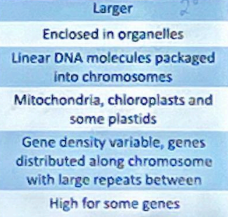
DNA is compartmentalized into the
whole (eukaryotic) genome
EUKARYOTIC GENOME:
includes the nuclear DNA sequences and the organelle DNA sequences
linear chromosomes
EUKARYOTIC GENOME:
DNA is present as ___________________.
T
T or F
Eukaryotic Genes are distributed along the chromosome arms with gene density variable with each chromosome.
Multigene Families
EUKARYOTIC GENOME:
Groups of genes that are identical or very similar in sequence.
Often have high copy numbers, meaning multiple copies exist in the genome.
Examples:
Globin genes → code for hemoglobin subunits
Aldolase genes → involved in glycolysis
T
T or F
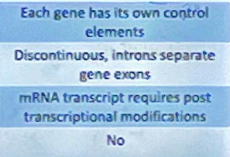
Eukaryotic Genome have introns making genes generally discontinuous.
F
No operons so each gene has its own promoter and control region
T or F
Eukaryotic genome have operons and each gene also has its own promoter and control region.
Organelle Genome
EUKARYOTIC GENOME:
Generally circular DNA molecules. o There are exceptions, but in general, they have circular DNA molecules similar to prokaryotes
They have variable sizes that are generally not affected by organism complexity.
Generally compact with very little space between genes
Yeast Mitochondrial Genome
ORGANELLE GENOME:
circular DNA
Genes for oxidative phosphorylation and the ETC (electron transport chain)
Genes for transcription and translation
expression occurs in the matrix
Chloroplast Genome
ORGANELLE GENOME:
Genes for photosynthesis
Genes for transcription and translation
expression occurs in the stroma
Proximal
Core
Parts of promoter
Splicing
5’-G Capping
3’ Poly-A Tail
Post transcriptional modifications:
Splicing
Post transcriptional modifications:
Introns are removed, exons joined together.
This produces a continuous coding sequence for the protein.
Occurs in the nucleus.
5’ G cap
Post transcriptional modifications:
Added to the 5′ end of mRNA.
Protects mRNA from degradation.
Helps ribosome recognize the mRNA for translation
3’ Poly-A Tail
Post transcriptional modifications:
Added to the 3′ end of mRNA.
Marks the molecule as mature mRNA.
Stabilizes mRNA and protects it from degradation.
Helps mRNA exit the nucleus and reach the cytoplasm for translation.
Signal Peptide
Short sequence in mRNA/protein that directs the protein to its proper location (e.g., nucleus, membrane, or secretion).
“locator”
Prokaryotic Genome
Prokaryotic Genome
Eukaryotic Genome
Eukaryotic Genome