Human Anatomy and Physiology I - Exam 1 Review
 Call Kai
 Learn
 Practice Test
 Spaced Repetition
 Match
 Flashcards
 Knowt Play
1/50

Earn XP
Description and Tags
Vocabulary practice flashcards based on Human Anatomy and Physiology I Lecture Exam 1 material, covering homeostasis, cellular chemistry, transport kinetics, histology, and cellular respiration.
Name | Mastery | Learn | Test | Matching | Spaced | Call with Kai | Chat |
|---|
No analytics yet
Send a link to your students to track their progress
51 Terms
Organ
The simplest anatomical structure formed by the union and organization of more than one tissue type.
glycogenesis within the liver
Negative feedback is a concept such that an increase in blood sugar is compensated for by
cutaneous vasoconstriction and shivering
What would be the MOST effective response to a low core body temperature on a cold day?
afferent / sensors
Relative to a homeostatic system, which of these two terms are correctly paired?
Anabolism
Metabolic pathways that construct complex molecules from simpler building blocks, exemplified by protein translation.
Circulatory System
“Distribution of nutrients, oxygen and wastes” is a principal function of the _____ system.
Digestive System
The gallbladder and pancreas are a part of which organ system?
Gallbladder
The digestive system includes the
Polar Molecule
A molecule characterized by an uneven distribution of electrical charge, such as water (H2O).
pH Scale
A logarithmic measure of hydrogen ion concentration where normal human blood measures approximately 7.4, and a solution with a pH of 5 has 100 times more hydrogen ions (H+) than a solution with a pH of 7.
HCO3- increases and an acidosis develops
Knowing that H2O+CO2⇌H++HCO3− ; What happens when you hold your breath and carbon dioxide increases?
Protein, mitochondrion, adipocyte, connective tissue, stomach
Which of the following lists examples of body structures from the simplest to the most complex?
Elemental Abundance in the Human Body
The proportional ranking of elements by total body weight, in which calcium is more abundant than sodium.
Triglycerides
Lipid molecules composed of a single three-carbon glycerol molecule covalently bonded to three fatty acids.
Phospholipids
Amphipathic lipid molecules that form the foundational bilayer matrix of the plasma membrane.
Saturated Fatty Acids
Lipid chains lacking double bonds that are found in the highest proportion within animal fat stores, are typically solid at room temperature, and are considered less healthy dietary fats.
Peptide Bond
A covalent bond formed between the amino group and the carboxylic acid group of adjacent amino acids during protein synthesis.
Potassium Ion (K+)
Which of these ions are found at higher concentrations inside the cell in comparison to the outside?
Plasma Membrane Components
The primary structural constituents forming the cell membrane, including phospholipids, cholesterol, and membrane proteins (excluding triglycerides).
Rate-Limiting Enzyme
A single enzyme that dictates and restricts the overall rate or flux of an entire metabolic pathway when pathway activity is less necessary.
Carrier-Mediated Transport
A transport process across the plasma membrane relying on integral carrier proteins, primarily used by large polar molecules and subject to saturation kinetics.
Chloride Electrochemical Gradient
The dual driving forces on chloride ions (Cl−) in a typical resting human cell, where the chemical concentration gradient favors inward movement and the electrical gradient favors outward movement.
Calcium Influx
The passive inward flow of calcium ions (Ca2+) that occurs universally in human cells upon the sudden opening of calcium channels due to its steep electrochemical gradient.
Interstitium
The extracellular fluid-filled tissue space that directly surrounds and bathes cells.
Sodium-Potassium ATPase (Na+/K+-ATPase)
A primary active transport membrane pump that consumes one molecule of ATP to transport three sodium ions (3Na+) outward and two potassium ions (2K+) inward.
Hypotonic Solution
A solution with a lower osmolarity than intracellular fluid (such as a 250mOsm solution) that causes water to enter a red blood cell, making it expand or swell.
Saturation Kinetics
The kinetic property where transport rates reach a maximal plateau due to a finite number of transporter binding sites; observed in primary active transport, secondary active transport, and facilitated diffusion.
facilitated diffusion
Glucose movement into a typical cell utilizing the glucose transporter (GLUT) occurs via ________.
Epithelial Tissue
The internal lining of the stomach is an example of which primary tissue type?
Connective
Blood is an example of which primary tissue type?
Pseudostratified Epithelial
This tissue type is

Dense Regular Connective Tissue
A connective tissue dominated by parallel bundles of collagen fibers that provides tensile resistance along a single direction, serving as the primary structural component of tendons.
Cartilage Connective Tissue
This tissue type is
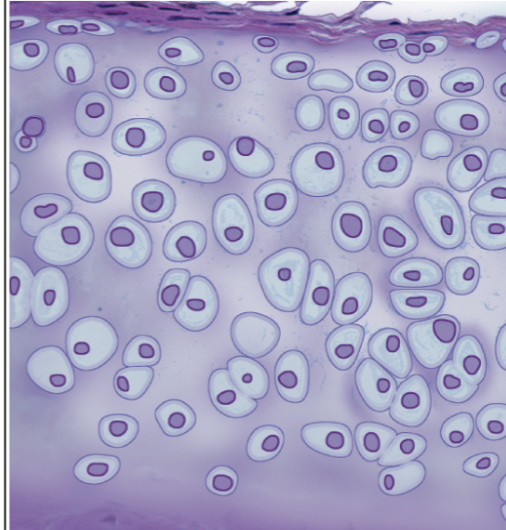
Neurons and Neuroglia
The two primary cell types found within nervous tissue include
unicellular gland / mucus
goblet cells are a type of ___________ and secrete
________.
Transitional Epithelium/urinary
The bladder is lined internally by ________ and this organ is part of the _________ system
Connective Tissue Extracellular Matrix
The non-cellular component of connective tissue, composed of an amorphous ground substance and a fibrous protein component.
Exocrine Gland
What gland does not secrete hormones but has ducts
Simple Tubular / exocrine
The sweat gland shown to the right can be structurally categorized as a ___________ gland and is a type of ________ gland

NADH and FADH2
During oxidation of fuels by the mitochondria, which molecule(s) reduces the electron transport chain?
Electron Transport Chain
The terminal stage of mitochondrial cellular respiration where molecular oxygen (O2) is consumed as the final electron acceptor.
Carbon Stoichiometry of Metabolic Intermediates
The carbon backbone chain length of key energy metabolites: glucose contains 6 carbons, lactate contains 3 carbons, and acetyl-CoA contains 2 carbons.
6/3/2
Glucose is a ___ carbon molecule, lactate is a _____ carbon molecule, and Acetyle CoA is a ___ carbon molecule.
carbohydrates
The only source of fuel for anaerobic metabolism is:
Protein Translation
Which of these is an example of anabolism?
glycerol / fatty acids
Triglycerides are molecules consisting of one 3-carbon compound called ________ bound to three ________
Triglycerides
Which of these IS NOT an important component of the plasma membrane?
inward / outward
The chemical gradient for chloride ion favors movement ________ and the electrical gradient favors movement ____________ in a normal human cell
calcium will move inward if a calcium channel is suddenly opened
Relative to the four ions, sodium, potassium, chloride, and calcium; which statement is absolutely true in all human cells.
250 mOsm solution
Which solution would cause a human blood cell to expand if the blood cell was placed within the solution?
collagen fibers / tendons
_______ are the primary extracellular component of dense regular connective tissue and this type of tissue is an important component of ______________.