PSYCH 3313 EXAM #2: chapter 5; Genetics and Brain Development
 Call Kai
 Learn
Learn Practice Test
 Spaced Repetition
 Match
Match Flashcards
 Knowt Play
1/60

There's no tags or description
Looks like no tags are added yet.
Name | Mastery | Learn | Test | Matching | Spaced | Call with Kai | Chat |
|---|
No analytics yet
Send a link to your students to track their progress
61 Terms
behavioral genetics: family linkage
-family studies
-twin studies (monozygotic; identical) + (dizygotic; fraternal)
-adoption studies
-sibling studies
**identical quadrulets with schizophrenia; NIMH: National Institute of Mental Health; names started with each letter? -2 = hospitalized with the illness, one held a job! environmental factors? mom = overwhelmed, dad = absuive and controlling + they traveled the country for shows

Behavioral Genetics
-find a gene everyone in family is carrying ==> behavior associated with it?
-mutations linked to behaviors? hypothesis with this?
-ancestory.com = SOOO much data for research; really good!
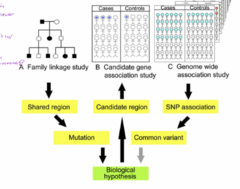
overview: Genetic Modification approaches
-control in genetics experiments = "wild type" --> this is unmanipulated gene!!
-optogenetics
-transgenic models (knockout, knockdown, knock-in)
-CRISPR-CAS 9 Gene Editing
-Retroviral Gene Therapy
optogenetics
opsin: light senstive protein
**with a button = changes light**
-so much more repeated experimental data with just switching a light on and off = switches protein on and off; super easy method!!
-controlled a mouse with putting light in hypothalamus; turned light on = mouse thristy, turned off = not thristy mouse!

knockout, knockdown, knock-in
have to do with gene delted, gene reduced, gene added
Knockout (KO)
-gene deleted!
--gene is completely removed! the mouse makes zero copies of that protein
--used to find out what a gene does by seeing what breaks without it
**what happens when protein = gone?
ex: knockout dopamine = animal wouldn't survive! --> knockdown = reduces it and see what happens --> next term!

Knockdown (KD)
-gene reduced! (not removed)
--the gene is still there, just dialed down --> usually via siRNA/shRNA
--partial and often reversible!
--useful when a full knockout would be lethal
**reduces amount of gene = reduces amount of protein made!

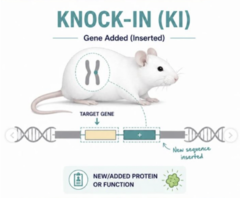
Knock-in (KI)
-gene added! (inserted)
--a new or modified sequence is inserted -- like a GFP reporter, a specific mutation, or a humanized gene version
--used for gain-of-function or reporter/tagging studies
CRISPR-Cas9 Gene Editing
1) Search: a CRISPR molecule finds a precise location in the target DNA
2) Cut: The CRISPR enzyme cuts the target DNA at the point found by the guide
3) Edit: A new custom sequence can be added when the DNA is repaired
**GOOD: couples having a kid; remove the bad gene so the kid doesn't have the bad gene!
OR
**BAD: picking specific traits for children to have ex: blue eyes + blond hair; populations = hurt by this!!

Huntington's disease successfully treated for first time
**75% of symptoms = lowered! rlly good! closest we have EVER gotten
With CRISPR???

Retroviral Gene Therapy
around before CRISPR!
1) a virus enters a host cell
2) virus inserts its DNA into the host's DNA
3) the cell makes virus genes and proteins as it reads its own DNA
**slower mechanism than CRISPR?
--SOME viruses --> inject their DNA into their host!

Genetic Mutations
**not neccessary bad things! depend on context if BAD or GOOD
-spontangeous or in response to radiation, chemicals, or other mutagens
-positive, neutral, or negative effects depending on context
-may be tissue specific or wide-spread

mutation discussion: Sickle Cell Trait
trait: typically no health consequences or symptoms
disease: significantly impacts a person's health and causes many symptoms
**red blood cell = looks like a sickle cell**
WHY NOT SELECTED OUT OF POPULATIONS?
-because some environments = GOOD to have trait
*forested area with mosquitos carrying disease = advantage!
*colorado areas = distavantage!

Single Nucleotide Polymorphisms (SNP)
CHANGE AT EXACTLY ONE NUCLEOTIDE! (ONE LETTER!!)
**nucleotide = triplet codons (3 nucleotides together)
---we have sooooo many nucleotides in our bodies!

SNP example: Cilantro taste
does cilantro taste like soap to you?
-cilantro soap gene; for the soapy taste of cilantro, the gene turned out to be an odor receptor instead of a taste receptor --> the OR6A2 gene **this is a SNP ("snip")
-odor receptors = the olfactory receptor proteins are receptors on the surface of certain cells that can bind with specific molecules. when the odorant molecule binds to the receptor, it triggers actions within the cell, causing signals to be sent to the olfactory center in the brain

SNP example: APoE4 and Alzheimer's Risk
documentary with Chris Hemsworth with Disney; underwent genetic testing on camera; found two copies of a specific allele = higher 80% chance of Alzeheimer's --> this is a SNP example

closer look at APOE genes
APOE s2: may reduce alzheimer's risk; if disease develops, onset is typically later. present in 5-10% of people
APOE s3: most common allele; generally has a neural effect on Alzheimer's risk
APOE s4: increases Alzheimer's risk and is linked to earlier onset; present in 15-25% of people; 2-5% carry two copies

Copy Number Variations (CNV)
**should have 2 copies of genes!!!
but... shown in picture, some genes =
-control (2 copies of a gene!)
-deletion (lost of a gene)
-duplication (1 extra copie of genes)
-inversion (switching genes around)
-insertion (extra gene)
copies of a gene means you have 2 alleles for that gene (one inherited from your mother and one from your father)

CNV example: Huntington's Disease
-copy variation! "repeat" disease
--too many repeats = will have Huntington's disease!

CNV example: Trisomy 21 (Down Syndrome)
-3 copies of 21st chromosome

next topic;
heritability and concordance
heritability
**ALL ABOUT RANGE; SPREAD OF DATA! **don't care about mean, etc. individuals = NO
-contribution of genetics to the range of variation of a trait observed in a population
-heritability always refers to a population, not to individuals
-heritability cannot be assessed without taking the environment into account!

heritability example
average number of fingers = 5; human trait
-range established on this trait!
--genetic reasons for less than 5 or more than 5? not common
--environmental reasons = more than 5 = surgery + toxins?; less than 5 = accidents
*Attending less than 5 Finger Club; ask the members; why do you have less than 5 fingers? --> MORE LIKELY DUE TO ENVIRONMENTAL ISSUES!!

heritability values
- 0 = genes play no role in phenotypical differences
--example: environmental toxin!!
- X = X% of the population variation we see in a trait can be accounted for by genetic differences
- 100 = genetics are completely responsible for pehnotypical differences
--example: Huntington's disease (CNV disease)(copy number variation)
heritability in context
-lower heritability = MORE TO ENVIRONMENTAL FACTORS
-higher heritability = EXPLAINED BY GENETICS; reason for trait? = gene!

concordance
-from twin studies **all about twins**
-concordance = a match(or agreement) of a trait **concordance = agreement**
-discordance = a non-match (or disagreement) of a trait

using concordance to make hypotheses about heritability
**monozygotic twins = due to genetics
**dizygotic twins = more due to environmental exposure!!
**LOOK AT PICTURE!!!!

Next topic is...
epigenetics!
what is epigenetics?
**definition; the study of how your behaviors and environment can cause changes that affect how your genes work, without changing your actual DNA sequence
based on fact!! ---> we know we have DNA sequence born with! (unless use CRISPR etc.) --> BUT look at environmental exposure... changes how silienced/amplified DNA is
**this is NOT changing actual sequence/nucleotides(thats a mutation)

closer look at mechanisms of epigenetics
-DNA methylation
-Histone Modification --> wraps around DNA; tightly wound DNA = less likely translated/transcribed! **loose DNA = easily translated/transcribed**
-RNA based mechanisms (silencing or activating)

environmental factors linked to epigenetic changes
-all possible ways with different behavior choices; LOOK AT THE PICTURE!!
**if you weight lift frequently?? = epigenetic changes = makes it easier to lift weights; changes how trait expressed

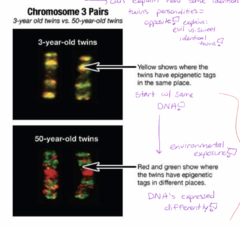
epigenetics and twin differences!
epigenetics = can explain how some identical twins personalities = oppsites! --> explains; evil vs. sweet identical twins.
--one twin = played sports? --> lots of injuries, ate bad food? this twin = arthritis, other twin = no problem with arthritis
**picture shows; how twins start with similar DNA and then later in life with environmental exposures; DNA's are expressed differently!!
next topic is...
gene x environment interactions
nurture OR nature
**NOT GOOD REPRESENTATION!!
behavior = entirely genetic AND environment --> NOT OR; each gene in our bodies are exposed to BOTH in different ways
example of Gene x Environment interaction: MAOA-L "warrior" gene
-some people have gene = no problem with conduct problems(immoral kids) because environment = HUGE!
--kids with bad environment (trauma) + conduct gene = immoral expression is shown!!

Example of Gene x Environment Interaction: Serotonin Transporter
-number of stressul life events; (seen in photo) = MAJOR impact on life!
**D picture shows zero life events? as increases --> genotype = MORE influenced on genes!

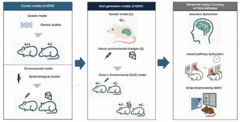
Moving towards Gene x Environment interactions: ADHD example
ADHD = not a single gene!!!
NOW onto next topic...
The Neural Tube; (childhood)
Stages of prenatal development
Germinal; "G" --> To Grow
Embryonic: seeing neuro system
Fetal: 9 weeks til birth

Germinal Development and Differentiation
Germinal; relating to the earliest stage of development, a new beginning, or the seed of future growth
-ectoderm (outer layer)
--epidermis of skin and its derivatives
--epithelial lining of mouth and anus
--cornea and lens of eye
--nervous system
-mesoderm (middle layer)
--notochord
--skeletal system
--muscular system
-endoderm (inner layer)
--liver
--pancreas
--thymus
--throid and parathyroid glands
**LOOK AT PICTURE!

Closing the neural tube
Look at picture!!
1) Neutral plate border, neutral plate, and ectoderm
2) CONVERGENCE; Neutral crest!
3) ectoderm; neutral crest cell (from components of the PNS) + neutral tube is formed!! (forms this tube that closes!)
4) Epidermis is formed, somites (mesoderm-dervied)

Embryonic Development and Differentiation
**LOOK AT PICTURE; shows how the embryo develops 3 weeks to 11 weeks
-Embryo at 3 weeks;
a) Forebrain
b) Midbrain
c) Hindbrain
-Embryo at 7 weeks
a) FOREBRAIN
i) Telencephalon
ii) Diencephalon
b) MIDBRAIN
i) Mesencephalon
c) HINDBRAIN
i) Metencephalon
ii) Myelencephalon
-Embryo at 11 weeks
a) FOREBRAIN
i) Telencephalon
-Cerebrum (breathing, heart rate; makes sense 1st structure to develop!)
ii) Diencephalon
-Thalamus
b) MIDBRAIN
i) Mesencephalon
-Parts of brainstem
c) HINDBRAIN
i) Metencephalon
-Pons + Cerebellum
ii) Myelencephalon
-Medulla Oblongata
**familiarize with WHICH REGION(embryonic brain regions) --> GROUP STRUCTURE(more specific part)

next topic is onto....
Stages of Brain Development
Overview: stages of neural development
**VERY OVERLAPPING STAGES**
-Neurogenesis 1) make cells
-Migration 2) put cells in useful places
-Differentiation 3) one put them in place? = different jobs?
-Circuit Formation 4) talk to each other?
-Neuron Death (Apoptosis) 5) cell death
-Pruning and Rearrangement of connections 6) Adolescence + adulthood = rearrganging then!!
Timeline of development stages
**SHOWS OVERLAPPING
-synaptic pruning = more with overlapping! **peak at 13 years?

Following one neuron
Neurogenesis: how to make a neuron!
**Proliferation; neural stem cell, blood vessel, astrocyte, neural progenitor cells
**Differentiation; migration, neuroblasts
**Survival; immature neuron, mature neuron, TO CA3
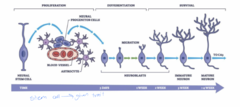
Making the cells: Neurogenesis
-proliferation via stem cells near ventricular zone (early brain development)
--neural progenitor cells
--glial progenitor cells
**200,000 cells in body at beginning

Moving the cells: Migration
-migration guided by radial glia
-INSIDE-OUT layer develpment (deep layers first, superficial layers last)
**inside-out; fill inside then spread out to!
--cells fill out deeper layer 1st then make it to the front

Specializing the cells: Differentiation (spinal cord has 2 different differentations)
-Dorsal half: sensory neurons (BMP protein, Dorsal root in spinal cord)
-Ventral half: motor neurons (Sonic Hedgehog Protein, Ventral root in spinal cord)
**Sonic Headgehod producing cells: Motor because runs rlly fast; because this cell moves FAST
**motor protein they encounter = different proteins = cells differs functions!!
**look at overlapping in picture!!

Connecting the cells: Axon Growth
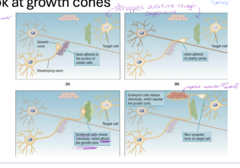
-Growth cones:
--Fliopodia: long-finger like; has surface receptors to detect attractive or repulsive cues
**fingers; sampling environment for clues; "go near this, avoid this" **middle = like palm of hand**
--Lamellipodia: flat, sheet like extensions from core of growth cones and generate forward motion
**FLIOPODIA + LAMELLIPODIA = BOTH LABELED IN PICTURE!!!

closer look at growth cones
-neurotrophins (come send me messages "im ready") as attractants!
**repellent molecules; GET AWAY --> LOOK AT PICTURE!!
1) Axon adheres to the surface of certain cells
2) Axon adheres to nearby axons
3) Guidepost cells release chemicals, which attract the growth cone
4) Guidepost cells release chemicals, which repulse the growth cone + new synapses form on target cell
Connecting the cells: synapse development
1) axon outgrowth/path finding
**growth cone: hand sampling looking for repellent or good chemicals
2) synapse differentiation
**more use of synapse; likely keep using it
3) postsynaptic receptor field formation
**use it or lose it --> keep using connections! or lose it
4) synapse maturation

connecting the cells: synapse formation and refinement
synapse formation:
--synapse generistas; wiring up with others!
--dense gogli stains in 6months to 2years because OVERWHELMINGLY CONNECTIONS; tries to make connections with EVERYTHING
synaptic pruning:
-refinement; what connections using? which to get RID of?
**LOOK AT PHOTO**

improving the network: synaptic refinement
**LOOK AT CHART!!!!
apoptosis: **too late getting to target? not forming anything useful? DIE** **reducing cells = improves connections of cells left**
what is removed?
entire neurons (programmed cell death)
primary purpose?
eliminate redundant or damaged cells
timing?
prenatal and early post-natal development
synaptic pruning: "pruning a rosebush"
what is removed?
specific axon branches and dendrites
primary purpose?
refine neural circuits by removing weak, unused, or inefficient connections
timing?
peaks from early childhood through adolescence **around age 13!! losing brain connections!! = healthy!!!
synaptic rearrangement: **refine connections + becoming smarter for future career; harder when older to do this!
what is removed?
pattern of connections
primary purpose?
replace old with new, more efficient synapses based on experiences
timing?
continuous throughout life (highest in youth)

closer look at synaptic refinement
**younger = connecting to everything! sooo many connections!!
after pruning = WANT MOST USEFUL ONES!!

practice: who has the most neurons? whos engaging in most synaptic functions... etc.
infant = trying to start and make connections!
toddler age 2-3 years = has the most neurons!
teenager around 16 years = most pruning happening!
adults around 45 years = most myleination in their brain!
**LOOK AT PICTURE**

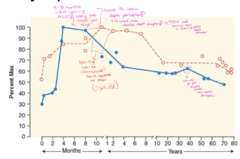
practice: synaptic refinement in V1 and PFC
solid blue = # of synapses in visual cortex (how connect they are?)
dashed orange = # of synapses in prefrontal cortex (brain's central command center for executive functions, personality, and complex decision-making)
**LOOK AT PHOTO;
solid blue line;
4-8 months; infants learning alot; seeing SOO many new things; have to learn depth perception with crawling, then relearn depth perception with walking!
dashed orange line;
learning how to communicate; how to negotitate with others (3 years old), around 40 years old = time when alot of people get reading glasses = new depth perception developed?
speeding up cells: myelination
Look at photo

closer look at myelination
-occurs in rostral direction starting with spinal cord, then hindbrain, midbrain, and forebrain
-begins at 23 gestational weeks, burst around birth
-prefrontal cortex not completely myelinated until early adulthood (21-25)
**increase of white matter (myelinated) --> as we get older!!!

is it true that the brain continues developing until age 25?
NO!!
-females = around 21-22
-males = around 24-25
continue myleination into late 30s!!!!
**the brain in adolescence and adulthood =
NOT ON EXAM #2!!!!