BIO185
 Note
Note Call Kai
 Learn
Learn Practice Test
 Spaced Repetition
 Match
Match Flashcards
 Knowt Play
1/138

There's no tags or description
Looks like no tags are added yet.
Name | Mastery | Learn | Test | Matching | Spaced | Call with Kai | Chat |
|---|
No analytics yet
Send a link to your students to track their progress
139 Terms
What are prokaryotes?
The first organisms to evolve
What is evolution?
Changes in DNA
What evidence exists to support evolution?
Comparing animal/insect lifespans, hemoglobin levels, and embryos
What are the two scales of evolution study?
Macroevolution (longer time frames) and microevolution (shorter time frames).
What is population genetics?
The study of genetic changes in populations.
What defines a population?
A group of individuals of the same species capable of interbreeding and producing fertile offspring.
What is a gene pool?
The sum of all alleles for all genes in a population.
What does P represent in allele frequency?
Frequency of the dominant allele (A).
What does Q represent in allele frequency?
Frequency of the recessive allele (a).
What is the Genotype Frequency Equation?
P^2 + 2PQ + Q^2 = 1
What does p^2 represent in genotype frequency?
Frequency of homozygous dominant genotype (AA)
What does 2pq represent in genotype frequency?
Frequency of heterozygous genotype (Aa)
What does q^2 represent in genotype frequency?
Frequency of homozygous recessive genotype (aa).
What is the Allele Equation?
P + Q = 1
What does Hardy-Weinberg Equilibrium imply?
A population’s allele and genotype frequencies are inherently stable.
What is the null hypothesis of microevolution?
Hardy-Weinberg Equilibrium.
What happens if observed frequencies differ from Hardy-Weinberg predictions?
The population is evolving.
How do you calculate q from q^2?
Take the square root of q^2.
What is the first step in using Hardy-Weinberg equations?
Determine the allele frequencies, dominant allele (p) and recessive allele (q)
What information is needed to calculate expected genotype frequencies?
Number of individuals with different phenotypes.
The only source of new alleles
Mutations
What introduces variation?
Genetic Mutation
Smaller populations have the ____ fluctuation (genetic drift )
most
Larger populations have the ______ fluctuation (genetic drift)
least
Which of these is true about a population in Hardy-Weinberg equilibrium?
Natural selection is not occurring in this population.
What is true about genetic drift?
In a large population, many more generations are required before the allele is eliminated or fixed
What does “Bottleneck” do?
It reduces genetic diversity by significantly decreasing population size.
What is similar between mutations and genetic drift?
They are both random processes.
Small Population of colonizers —→ Genetic Drift
Founder Effect
What is Founder Effect?
Founder effect occurs when a SMALL number of individuals establish a new population, leading to REDUCED genetic diversity and an increased chance of certain alleles becoming fixed.
Movement of alleles among populations
Gene Flow
Low Gene flow leads to
Evolution
Death Valley has resulted in many species of pupfish, each endemic to one pond, which resulted from…
Disruption in gene flow
Natural Selection is the same as Evolution
False
Which of the following is false about natural selection?
It explains how life started.
Which of the following has the effect of increasing the rate of evolution?
strong selective pressures
Aleles can be transferred through the movement of fertile individuals or gametes (pollen, migration, seed dispersal)
True
What are the requirements of Natural Selection?
All of the above
Organisms with favorable traits survive _____ and reproduce _____
longer, more
Natural Selection = ___________
Adaptation
Morphology, physiology, or behavioral trait that gives organisms an advantage to cope with the environment
Adaptation
Adaptations evolve based on need, for example, Giraffes evolved long necks because they needed to reach the tall leaves
False
How do adaptations evolve?
They have to exist as a phenotype with an underlying genotype
Acclimatization _____ evolution.
is not
Going to a high elevation location, mountains, since there’s thinner oxygen, your body produces fewer red blood cells.
Acclimatization
Shifts in an allele’s frequency in a consistent direction, so individuals at one end of a range of phenotypic variation become more common over time
Directional Selection
Selection that favors the intermediate phenotype
Stabilizing Selection
Intermediate phenotypes selected against, favors both phenotype extremes, and can lead to speciation
Disruptive Selection
Common traits are favored by selection
Positive frequency-dependent selection
Rare traits are favored by selection
Negative frequency-dependent selection
Predation in fish – the uncommon prey stands out and is eaten, while common prey gets to escape
Positive frequency-dependent selection
The rarer form of the parasite is more successful at biting the prey
Negative frequency-dependent selection
Which of the following is true about positive frequency-dependent selection?
It favors common traits.
Which process increases genetic variation?
heterozygote advantage
In most natural populations, individuals do not have an equal chance of mating
Non-Random Mating
The environment selects for traits that increase the likelihood of reproductive success
Sexual Selection
Variation in reproductive success is high in ____ and low in _____
males, females
Selection of a sex for the other sex, and often manifests in sexual dimorphism
Intrasexual Selection
To increase fitness, they should maximize the number of matings
Males
To increase fitness, they should maximize the quality of their offspring
Females
Natural selection affects sexual selection traits
True
_______ usually exhibit reversed sexual selection, while _______ usually do not exhibit sexual selection
Polyandrous species, Monogamous species
Is unselfish behavior or traits
Altruism
A vampire bat feeds another bat only if it’s received a meal from that bat before
Reciprocal Altruism
Natural selection favors traits that help relatives
Kin Selection
Personal reproductive success is measured as the number of offspring that survive and reproduce.
Direct Fitness
Reproductive success of relatives that share genes with the individual
Indirect Fitness
The total genetic contribution of an individual to the next generation
Inclusive Fitness
Which is a difference between sexual selection and natural selection?
Natural selection favors adaptive traits; sexual selection favors non-adaptive traits.
Kin selection favors traits that maximize both
inclusive fitness, indirect fitness
Which species concept would you use to determine the different species of bacteria that live in your large intestine? (All bacteria have one of three morphologies: round, rod-shaped, or spiral-shaped).
genetic
One species of cicada mates once every 13 years; another species of cicada mates once every 17 years. These two species live in the same habitat but do not interbreed. Which reproductive isolation separates the two species?
temporal
Downsides: It can be challenging to differentiate species that occupy the same habitat and perform similar roles in life
Ecological Species Concepts
Downsides: Individuals within a species may vary significantly in appearance due to environmental factors, making it hard to distinguish species based solely using…
Morphological Species Concept
Downside: Based on reproduction. Not everything has reproduction. Extinct organisms, fossils, etc
Biological Species Concepts
Reproductive seasons/periods are different
Temporal Isolation
When species are reproductively isolated from others due to differences in behavior
Behavioral Isolation
If physical parts of a species aren’t compatible
Mechanical Isolation
Important in aquatic organisms due to them squirting eggs and squirting out sperm into water
Gametic Isolation
Reduced Hybrid Viabilitys means…
Decreased likelihood of survival
Chance event physically separates population into subgroups
Geographic Isolation
Isolated populations begin to diverge due to mutation, genetic drift, and selection
Divergence
Eventually the two populations are genetically isolated from one another
Genetic Isolation
Sympatric Speciation is through _____, and are isolated ______, not ________
habitat specialization, genetically, geographically
Two groups of flys were raised for eight generations. One group fed maltose and the other fed starch. In the end, starch-based flies want to mate with starch-based flies, and maltose-based flies want to mate with other maltose-based flies
Reproductive Isolation
Sexual selection can lead to reproductive isolation and sympatric speciation
True
The formation of a new species without geographic isolation, occurring in the same habitat
Sympatric Speciation
Speciation due to geographic isolation (e.g., mountains, rivers, or distance separating populations)
Allopatric Speciation
Which of the following is false about genetic drift?
It introduces variation into a population.
Natural rate of extinction as environments change
Background Extinction
Large numbers of species and lineages die out over a short period
Mass Extinction
The rapid diversification of an ancestral species into many new forms
Adaptive Radiation
Suggests some traits evolved independently, not due to ancestral character or relationship, but due to convergent evolution
Homoplasy
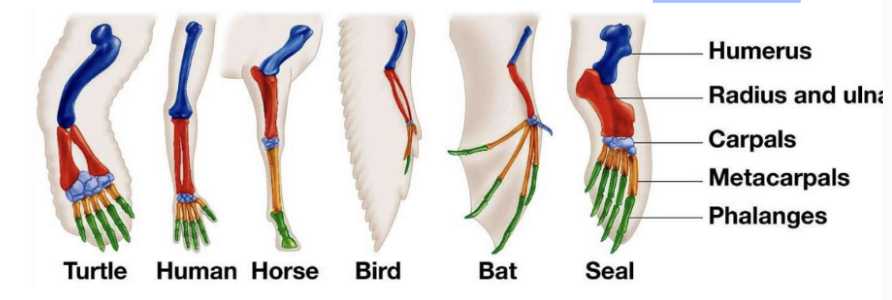
This leads to the evolution of homologous structures
Divergence
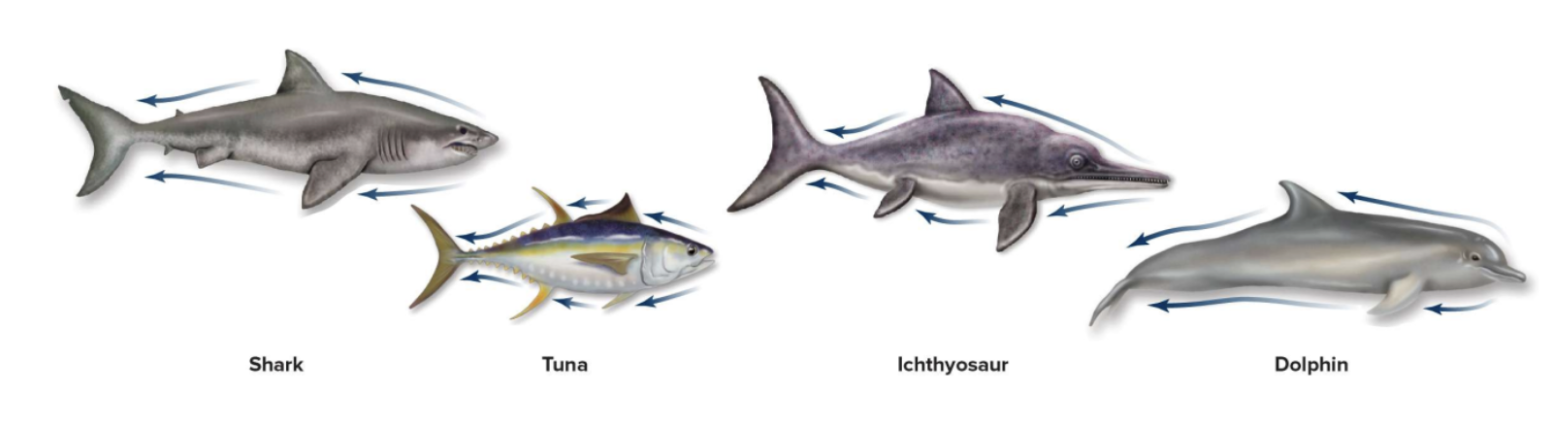
This leads to the evolution of analogous characters
Convergence
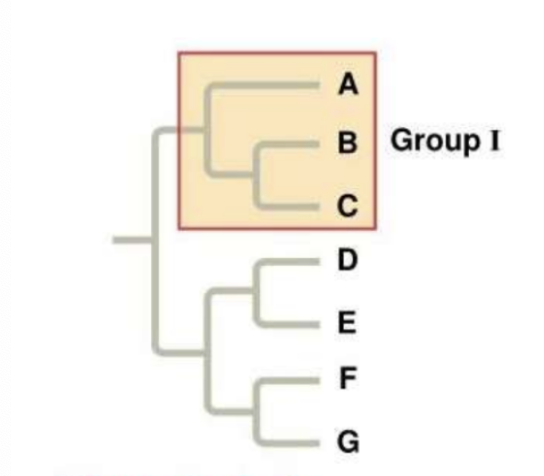
An evolutionary unit that includes an ancestral population and all of its descendants but no others (also called a lineage, or clade)
Monophyletic Group
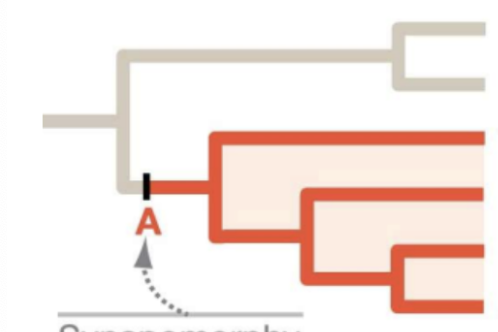
What is A? It’s definition is a shared, derived, trait
Synapomorphy
Similarity in organisms due to common ancestry
Homology
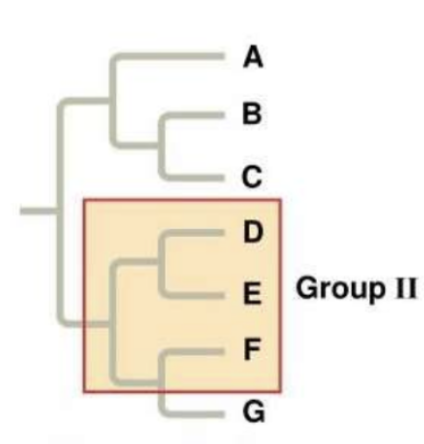
What is Group II?
Paraphyletic Group
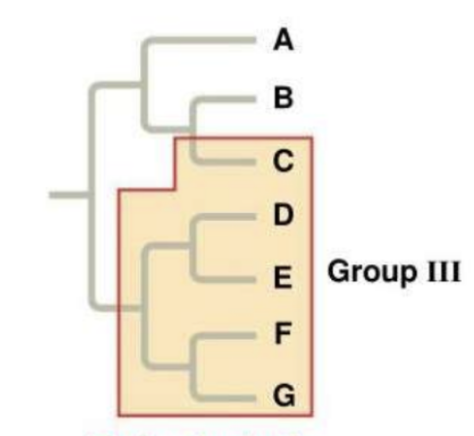
What is Group III?
Polyphyletic Group