Local Flora Final
 Call Kai
 Learn
 Practice Test
 Spaced Repetition
 Match
 Flashcards
 Knowt Play
1/59

There's no tags or description
Looks like no tags are added yet.
60 Terms
Draw the cladogram representing the main plant groups and where they diverge
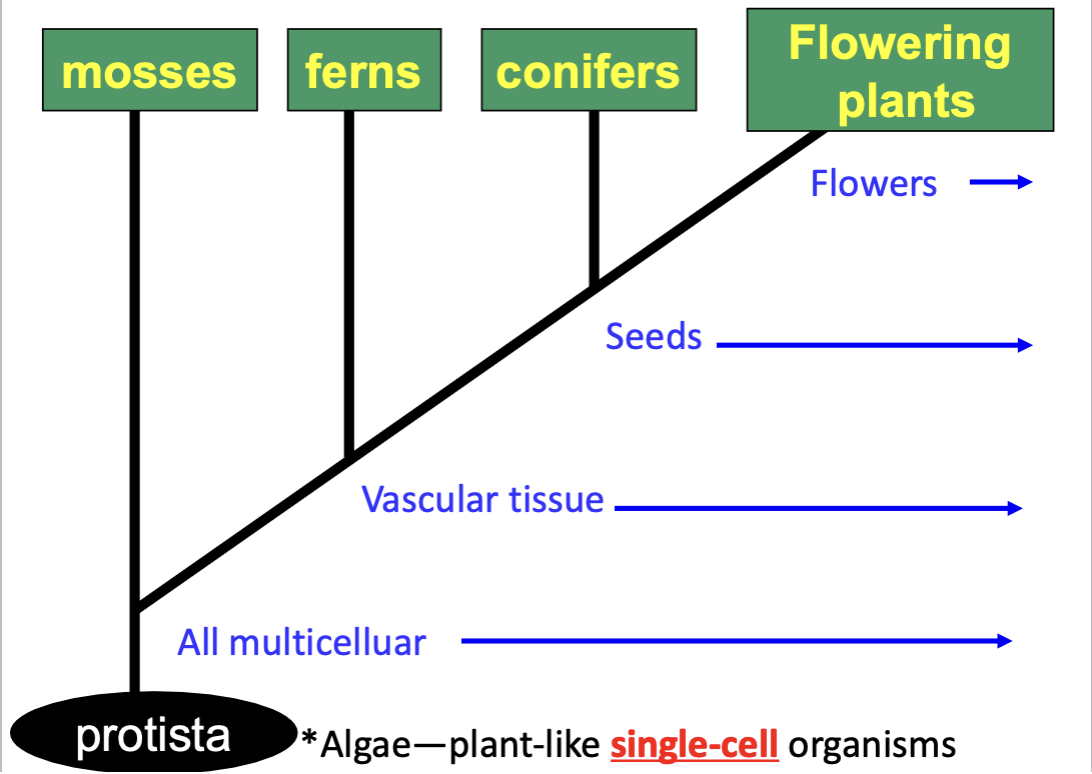
Characteristics of the main plant groups
Non-vascular: lack xylem and phloem, absorb water through cell surfaces, no true roots, leaves, or stem; have rhizoids instead, reproduce via spores, mosses, liverworts, and hornworts.
Seedless vascular plants: have xylem and phloem, possess true roots and leaves, reproduce via haploid spores, ferns, horsetails, clubmosses, whisk ferns.
Gymnosperms: vascular seed plants, naked seeds not enclosed in a fruit, cones instead of fruit, narrow leaves, wind pollinated, coniferous trees, ginkos, cycads.
Angiosperms: flowering vascular plants, seed enclosed in a fruit, advanced reproduction/vascular tissue, double fertilization, monocots and dicots.
What did plants evolve from?
Algae
Advantages to enclosed seed
Increased dispersal, protection
Advantages to broad leaves?
More surface area for photosynthesis, allows for more energy storage for winter dormancy
Functions of xylem and phloem
Transporting water and nutrients
Xylem carries water and nutrients up the plant while phloem disperses water and nutrients throughout the plant
Characteristics of monocots
Less diverse, less than five percent of species woody, 1 cotyledon, parallel veined, scattered primary vascular bundle, floral parts in sets of 3 or 4, adventitious roots.
Monocots or dicots more advanced? Why?
Monocots are more advanced although modern science might disagree
Monocots have more efficient photosynthesis, are more resistant to disturbance, single cotyledon means less initial energy needed, annuals have a quicker life cycle
Characteristics of dicots?
More diverse, 50% of species are woody, 2 cotyledons (rarely 1,3, or 4), net veined, primary vascular bundle in a ring, floral parts in sets of 4 or 5, primary and adventitious roots.
Why are dicots more diverse than monocots?
Growth forms, reproductive structures, leaves and roots allow them to exploit more niches
Asteraceae characteristics
Composite flowers, largest family of dicots, largest family overall
Orchidaceae characteristics
Largest family of monocots
Fabaceae characteristics
Beans legumes
Apocarpous vs syncarpous
Apocarpous = carpels separate in single individual pistils
Syncarpous = carpels fused resulting in compound
Monocolpate vs. Tricolpate pollen
Monosulcate = boat shaped, one long furrow/germinal aperture - typically monocots
Tricolpate = globosesymmectrical, three germinal apertures - typically dicots
Grasses, rushes, and sedges collectively called?
Graminiods
Grasses, sedges, rushes families
Poaceae, cyberaceae, juncaceae
Which graminiod family is the most diverse?
Poaceae
C3 pathway what plants use it?
Most temperate plants except many grasses
What are the mesophyll cells in C3 system?
Just under the leaf surface, fix carbon into C3
C4 pathway what plants use it?
Warm season grasses
How C4 differs from C3
Carbon fixation split between mesophyll cells and bundle sheath cells, no worrying about photorespiration
Mesophyll cells take CO2 and convert it into a C4 ‘shuttle’ molecule
Bundle sheath cells surround leaf vein, contain chloroplasts, take converted C4 molecules and complete Calvin cycle by fixation directly by the enzyme
CAM pathway what plants use it?
Succulents and ‘air plants’ epiphytes
CAM pathway how does it differ?
Stomata closed during the day to prevent water loss. Fixes CO2 during night, stores in large vacuoles until released in the day
C3 vs C4 vs CAM productivity and optimal temp. range
Optimum Temperature:
C 3 15 – 25 C (60-77°F)
C 4 30 – 40 C (86-100°F
CAM 35 C (95°F)
What is photorespiration?
An energy-consuming process in which the fixation enzyme fixes to O2 instead of CO2 occurs in C3 plants under high stress conditions resulting in CO2 release
Cool vs warm season grasses
Cool season: sod forming, green earlier, survives heavy grazing, monoculture (Kentucky bluegrass, orchard grass)
Warm season: clump forming, grow rapidly, extensive root systems, dependable forage (switchgrass, big bluestem)
Differences between how bunch grass and sod grass spread
Sod: have extensive rhizomes (underground) or stolens (aboveground)
Bunch: have tillers which remain within the leaf sheath of the original plant or corms which form from crown and store energy
Brassicaceae
Mustard family
Four petals, four sepals
annuals/biennals
broccoli, cabbage, kale
All edible
Do well in disturbed areas
C3
Seed pods split on both sides to expose a clear membrane come from a raceme
Unique smell and taste
contain glucosinolates (mustard oils)
Lamiaceae
Mint family
Perennial herbs very resilient
Wild mint, dead nettle, peppermint, wild basil, dittany, etc
Square stems and opposite leaves
Seed capsule contains four nutlets
Aromatic qualities
Some c3 some c4
5 united petals 2 lobes up 3 down, 4 stamens 2 long, 2 short
Apiaceae
Carrot/parsley family
Annual, biennial, and perennial herbs and forbs
Poison hemlock, wild carrot (queen annes lace)
Compound umbel consisting of umbellets radiating from central point of the stalk
Hollow stem
Most dangerous poisonous plants, plus some edible
Some invasive, moist waste areas
c3 and c4
Fabaceae
Beans legumes
Annual, biennial, perennial herbs, forms, and trees
Indigo, vetch, honey locust, trick trefoil
Irregular flowers, 5 petals form banner, wings, and keel
Pea like pods which splits along one side
Often have pinnately compound leaf
Fix. nitrogen
c3 and c4
Liliaceae
Lily family
Perennial forbs
All the lilies
3 petals, 3 sepals - all same color
6 stamens all same height, pistil w/three part stigma
Parallel veins
Malvaceae
Mallow family
Swamp rose mallow, hibiscus, hollyhock
5 separate petals, column of stamens
3-5 partially united sepals often surrounded by bracts
mucilaginous texture - slimy when crushed
Only cotton poisonous, the rest edible with medicinal properties
c4 and c3
Asteraceae
Sunflower family
Predominately annual herbs and forbs
Asters, sunflowers, ironweed, goldenrods
Composite flowers in disk heads
Some have lots of bracts, some have tiny flowers
Largest family
Great seed producers
Poaceae
Grass family
Annuals and perennials
Corn, sorgum, grass…
Petaless flowers (spikelets)
Leaves flat and have a sheath
Round stems remain hollow in the center with swollen nodes or joints
Wind pollinated
Cyperaceae
Sedge family
Triangle stem usually
Solid stem not hollow
Closed leaf sheath
No lumpy nodes
Junaceae
Rush family
Round solid stem
Flowers like lilies, 3 petals 3 sepals, but tiny
Typhaceae
Cattail family
Not a graminoid
Flat leaves and hot-dog on a stick appearance
Alismataceae
Arrowhead family
Perennial herbs and forbs
Aquatic species
3 white petals, 3 green sepals
Basal leaves erect or floating
Najadaceae
Water nymph family
Aquatic
Submerged pollination
Male and female flowers
Toothed and linear leaves with stipules or sheathes
Potamogetonaceae
Pondweed family
Perennial herbs and forbs
Aquatic fresh and salt water
Pondweed, ditch grass, eel grass
4 tepals where petals and sepals are indistinguishable
Lemnaceae
Duckweeds
Aquatic
Worlds smallest flowering plant
Leaves and flowers float, roots hang underwater
Easily dispersed as whole plants
Primary vs secondary xylem
Primary: formed from procambium during primary growth. Responsible for increasing length and growing new leaves, roots, etc. Found in all vascular plants.
Secondary: Formed from vascular cambium during secondary growth. Includes sapwood and heartwood. Responsible for girth and provides major mechanical support. Only found in woody plants
Tree vs shrub vs vine
Trees: tall (greater than 15’), single main trunk and canopy of branches
Shrubs: woody stems >15’, produce multiple stems, branching closer to the ground
Vine: climbing woody plants that use other trees and structures for support
Deciduous vs evergreen
Deciduous species are mostly all dicots and allow for continual growth, cambium goes dormant in the fall and reactivates in the spring, xylem vessels produced in spring larger to allow for rapid sap flow
Why do woody plants dominate vegetation when in favorable growth conditions?
Large permanent stems, stable root stems = ability to grow tall and capture the most sunlight
Led to continuous cycle of co-evolution between plants and animals
What was the Angiosperm terrestrial revolution and when did it occur?
100-50 MYA
Broad leaved trees dominated ability to rapidly grow leaves in spring and shed in the fall very advantageous for fluctuating temperatures during Neogene era
Xeric vs mesic vs hydric
Xeric - upland forest adapted for drier conditions (many oaks and hickories) -unglaciated region of Ohio
Mesic - “middle” forset not to dry or wet; glacial plains (beech, maple, poplar)
Hydric - riparian forest; swamp (ash, elm, maples)
What is mesophication?
Positive feedback cycle where fire suppression causes open, fire-adapted forests (oak-hickory) to transition into closed canopy, moist forests dominated by shade tolerant species (red maple, sugar maple, sweet gum…)
Moss characteristics and benefits
See slide on non-vascular plants
Pioneer species:
• Jumpstart succession
• Erosion control
• Provide micro-habitats
• Some accumulate to become BOGS and store carbon
What are lichens? Ecological role?
a composite life form
– Symbiotic partnership between a fungi (mycobiont) and a photosynthetic partner (photbiont)
– Poikilohydric (can dry out completely, then rapidly resume…)
– serve similar ecological role as moss
• Known to colonize extreme environments
• Bio-indicators (absorb water and nutrients directly from the air)
• Micro-habitats
• Food source
• Soil forming and N fixing
Basic fern anatomy

Fern Characteristics
See seedless vascular plants slide
need water to reproduce
Gymnosperm divisions
Coniferphyta - evergreens, wind pollenated
Ginko - 1 species, functionally extinct, females stink
Gnetophyta - most closely related to angiosperms, have a species which photosynthesizes through stem
Cycads - only one species native to North America, male and female cones pollenated by insects
Conifers
naked seeds, all species woody
Pinaceae, Cupressaceae, Taxaceae
Pinaceae most widely distributed
Native vs non-native vs invasive
Native - this is where they’re from, occurred in Ohio before European settlement
non-native - not native but not causing problems
invasive - non-native and pushing out native species causing problems
Methods of introduction to North America/Ohio
• Erosion control
• Horticulture
• Forage crops
• Medicinal use
• …by accident
wildlife use
Impacts of invasive plants to different ecosystems?
Wetlands: single invasive species crowd out all other native species
Forests: Several invasive plant species replace spring wildflowers (and some warm season species, too)
Grasslands can be overcome by Johnson grass and spotted knapweed. In Ohio – reclaimed strip mines planted in crown vetch and lespedeza for erosion control
Can you name three invasive plants from the “Top 10”?
Japanese honeysuckle
Japanese knotweed
Autumn olive
Buckthorn
Purple loosestrife
Garlic mustard
Multiflora rose
Bush honeysuckle
Reed canary grass
Phragmites