RBT Exam Practice - Section 1 (Domain A: Data Collection and Graphing)
 Call Kai
 Learn
 Practice Test
 Spaced Repetition
 Match
 Flashcards
 Knowt Play
1/51

Earn XP
Description and Tags
Includes Content outlined in the RBT test outline
52 Terms
Continuous Measurement
When every instance of a target behavior is recorded throughout the observation period.
What are the 4 types of continuous measurement?
Frequency, Duration, Inter-Response Time (IRT), and Latency.
Continuous Measurement: Frequency
The exact amount of times a target behavior occurs during an observation period (Client eloped 5 times)
Continuous Measurement: Duration
How long a behavior lasts from start to finish ( Client engaged in tantrum for 4 minutes, 37 seconds).
Continuous Measurement: Latency
The elapsed time between the instruction and the onset of the target behavior (Client responded “dog” 7 minutes, 24 seconds after given the directive “What is this?”)
Continuous Measurement: Inter-Response Time (IRT)
Amount of time between two consecutive instances of the same behavior (3 minutes elapsed between client eating two bites of food)
Discontinuous Measurement
Records some, but not all instances of behavior; It allows efficient data collection when continuous measurement procedures are not practical.
Discontinuous Measurement: Partial Interval Recording
Records whether the behavior occurred at any point during a specified Interval, tends to overestimate occurrence of behavior, useful for high frequency behavior targeted for reduction ( Client flapped his hands during a 1-minute interval)
Discontinuous Measurement: Whole Interval Recording
Records whether the behavior occurred throughout the entirety of a specified interval, tends to underestimate occurrence of behavior, useful when increasing behavior to be sustained (Client rolled toy cars throughout the entirety of a 1-minute interval)
Discontinuous Measurement: Momentary Time Sampling
Records whether behavior occurred at the precise moment an interval ends, provides most accurate estimate when short intervals are used, practical for group settings (Client flapped his hands at the end of a 1-minute interval)
Permanent Product Recording
measures the lasting effect or result of a behavior. Data is collected after the behavior occurs using the physical or digital product left behind.
Permanent Product
Something that can be counted, reviewed, or evaluated after the behavior occurs (i.e., completed assignments, written answers, art projects, clean dishes, assembled items)
X-Axis
Representation of time (session number, calendar date) (Horizontal axis)
Y-Axis
Measure of behavior being tracked (count, rate, duration, percentage) (Vertical Line)
Condition Change Line
A solid vertical line indicating a change in the overall treatment condition
Phase Change Line
A dashed vertical line indicating change within a single condition
Data Point
Symbol that represents a specific measurement of behavior during a particular time
Data Path
The line that connects successive data points within a condition, illustrates trajectory of behavior over time
Immediacy of Change
How quickly behavior shifts after a condition change
Behavior
Anything a person says or does that can be observed, repeated, or measured
Stimulus
Any event in the environment that can be experienced through the senses
Operational Definition
A specific and objective description of a behavior, written so that two trained observers can agree on occurrences of the behavior.
Onset
The moment a defined behavior begins.
Offset
The moment a defined behavior ends
Environment
Anything that we perceive through the senses.
Topography
The physical form or shape of a behavior (what it looks or sounds like)
Measurability
The quantifiable aspect of a behavior, whether it be duration, latency, or intensity
Clarity
The behavior is defined in unambiguous, specific terms
Response Class
A group of different behaviors that share the same function.
Count
refers to the number of times a behavior occurs. It is a direct measure with no calculations
Rate
The number of times a specific behavior or event occurs divided by the length of the observation period (time). Rate = Count / Time
Total Duration
Total length of time a behavior occurred. Total = instance + instance
Mean Duration
Average length of time a behavior occurred. Mean = Total Duration / Instances
Percent Correct
A summary measure used when behavior is recorded across defined opportunities (trials). Percent correct = (Number Correct / Total Trials) x 100
Trials to Criterian
How many learning opportunities or trials it takes for a learner to reach a specific performance goal.
Mastery Criterion
A specific rule that defines when a skill is considered learned, usually stated as a certain level of performance across sessions.
Level
General position of data on the y-axis, gauges overall magnitude of behavior during a condition
High Level
Behavior occurs frequently or at high intensity
Low Level
Behavior occurs less often or at low intensity
Trend
Overall direction of data across time, reflects direction in which behavior is moving

Ascending trend
Behavior is increasing

Descending Trend
Behavior is decreasing
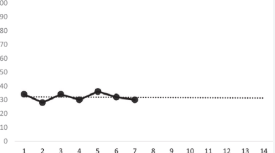
Stability
Behavior is not changing or minimally changed
Variability
Degree of data fluctuation within a condition, evaluated alongside level and trend

High Variability
difficult to interpret behavior change as result of intervention, environment, or natural fluctuation

Low Variability
stronger evidence that changes in level or trend are meaningful
Immediacy of change
How quickly a behavior shifts after a condition change
Immediate Shift
Stronger evidence of treatment effect
Deloayed/Gradual Shift
Weaker evidence of treatment effect
Procedural Fidelity (Integrity)
Implementing every step/phase of a treatment plan exactly as written, without altering, omitting, or adding elements
Treatment drift
Gradual shift away from treatment procedure, may include skipping steps, prompting errors, reinforcement errors, and/or incorrect error correction
Reliability
Collecting data accurately, timely, and/or objectively with clear standards