Lecture 2: Plant Propagation (9/1)
 Call Kai
 Learn
 Practice Test
 Spaced Repetition
 Match
 Flashcards
 Knowt Play
1/23

There's no tags or description
Looks like no tags are added yet.
24 Terms
Do layers L1, L2, and L3 layers divide in one or all planes?
L1: one plane (anticlinal)
L2: one plane (anticlinal)
L3: all planes (sectorial)
What are the L1 and L2 layers called, and the L3 layer?
L1 + L2: tunica
L3: corpus

Periclinal chimera: layer, spatial distribution, vegetative stability
Layer: one layer (L1, L2, or L3)
Spatial distribution: top of shoot apex
Vegetative stability: relatively stable, most common chimera in horticulture

Mericlinal chimera: layer, spatial distribution, vegetative stability
Layer: one layer
Spatial distribution: side of shoot apex
Vegetative stability: unstable

Sectorial chimera: layer, spatial distribution, vegetative stability
Layer: multiple
Spatial distribution: top of shoot apex
Vegetative stability: unstable
What does the L1 layer give rise to?
The colorless epidermis
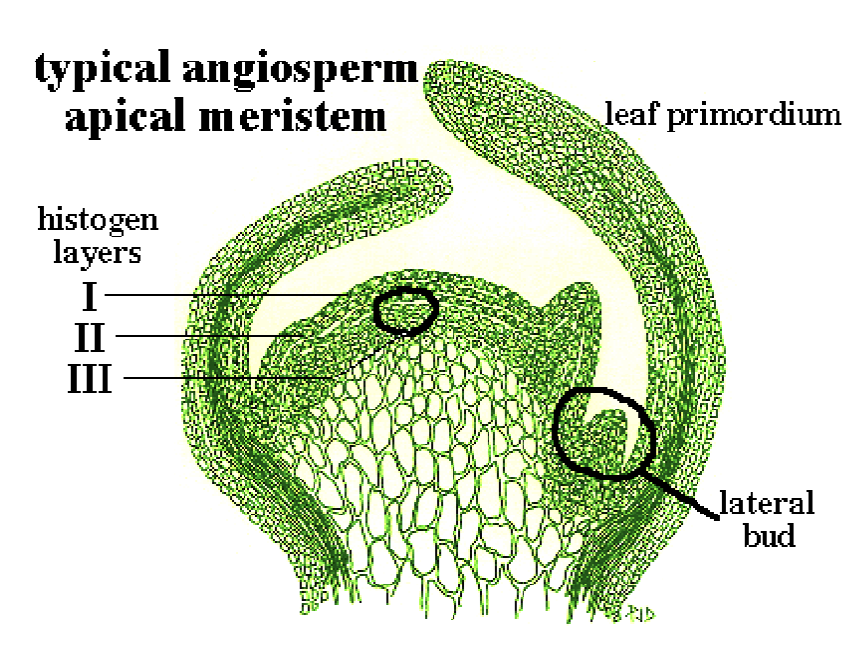
What does the L2 layer give rise to?
Sub-epidermal palisade mesophyll and abaxial spongy mesophyll cells. Also produces pollen cells

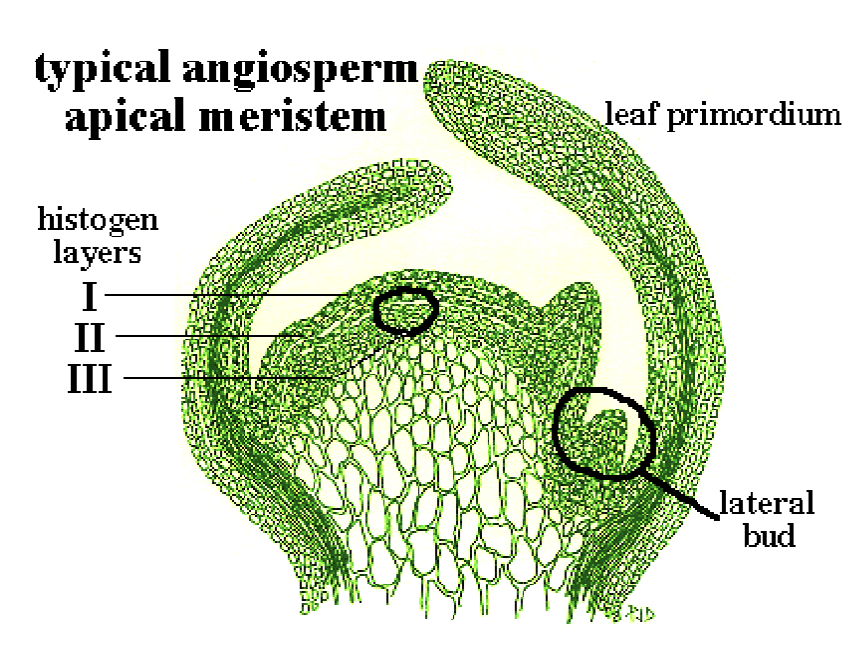
What does the L3 layer give rise to?
Upper and middle layers of spongy mesophyll. Does not contribute to leaf margins
Invasion
When a mutation on one layer of the apical meristem moves into another layer
What do L1:L2:L3 look like on plants?
Mutations on the L1 don’t have much of a difference
Mutations on L2 affect leaf margins
Mutations on L3 affect the center of the leaf

How do you know whether something is a periclinal chimera?
Uniform pale margin all the way around the leaf (L2 mutant)
Solid pale center/midrib with green margins (L3 mutant)
Every node produces the same patterned foliage. Stable indefinitely through stem cuttings.

How do you know whether something is a mericlinal chimera?
Only one half or edge of the leaf exhibits the variegation/mutation.

How do you know whether something is a sectorial chimera?
An entire vertical segment of the stem, leaf, flower, or fruit is completely replaced by the mutant tissue
Typically short-lived

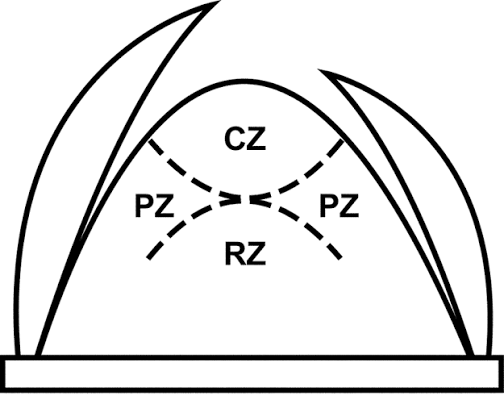
Where are the central zone, peripheral zone, and rib zone on a meristem?
Why are stock plants kept to juvenile growth?
Because juvenile tissue typically forms adventitious roots more easily
What area of a plant is distal vs. proximal? How does this relate to polarity in rooting?
Proximal is near the middle of the plant while distal is toward either side (root/shoot)
Cuttings form roots at the proximal side

Canal theory
The flow of auxin through cells of high auxin content (source) towards cells of low auxin content (sink) polarizes and upregulates auxin transport . This leads to channeling/ canalization of auxin through files of cells
Auxin (roles)
Elongation and bending
Apical dominance and apical meristem development
Vascular differentiation and root formation
Fruit development
Gibberellins (roles)
Seed germination, flowering, pollen and fruit development, dormancy
Antagonistic towards ABA
Cytokinins (roles)
Cell division, delaying leaf senescence, breaking apical dominance, breaking dormancy
Ethylene (roles)
Ripening, senescence and abscission, breaking seed dormancy, promoting flowering (in some species), stress responses
Abscisic acid (roles)
Promotes senescence, induces dormancy, stomatal closure
Antagonistic towards GA
What is callus made up of?
Unorganized mass of parenchyma cells
What is the difference between periclinal and mericlinal chimeras?
A periclinal chimera covers the entirety of the apex, while a mericlinal chimera only covers part of it