l25 - gastro
 Call Kai
 Learn
 Practice Test
 Spaced Repetition
 Match
 Flashcards
 Knowt Play
1/44

There's no tags or description
Looks like no tags are added yet.
45 Terms
what is SECRETION normally driven by?
chloride
what is ABSORPTION normally driven by?
sodium
what do we ALWAYS want to maintain?
our extracellular fluid
what are the HOMEOSTATIC functions of the kidney?
so our kidneys maintain…
electrolyte balance
Na+, K+, Ca2+, PO4
acid-base balance
so controlling blood pH by regulating [H+] and [HCO3-]
fluid balance
control how much water is retained or excreted > this helps to regulate hydration and blood pressure
what metabolic function does the kidney have?
the kidneys can carry out gluconeogenesis
so the kidneys can produce glucose from non-carbohydrate substances such as amino acids
what is the functional unit of the kidney?
the NEPHRON
it filters blood, reabsorbs useful substances, and helps to produce urine
describe some BASIC kidney anatomy
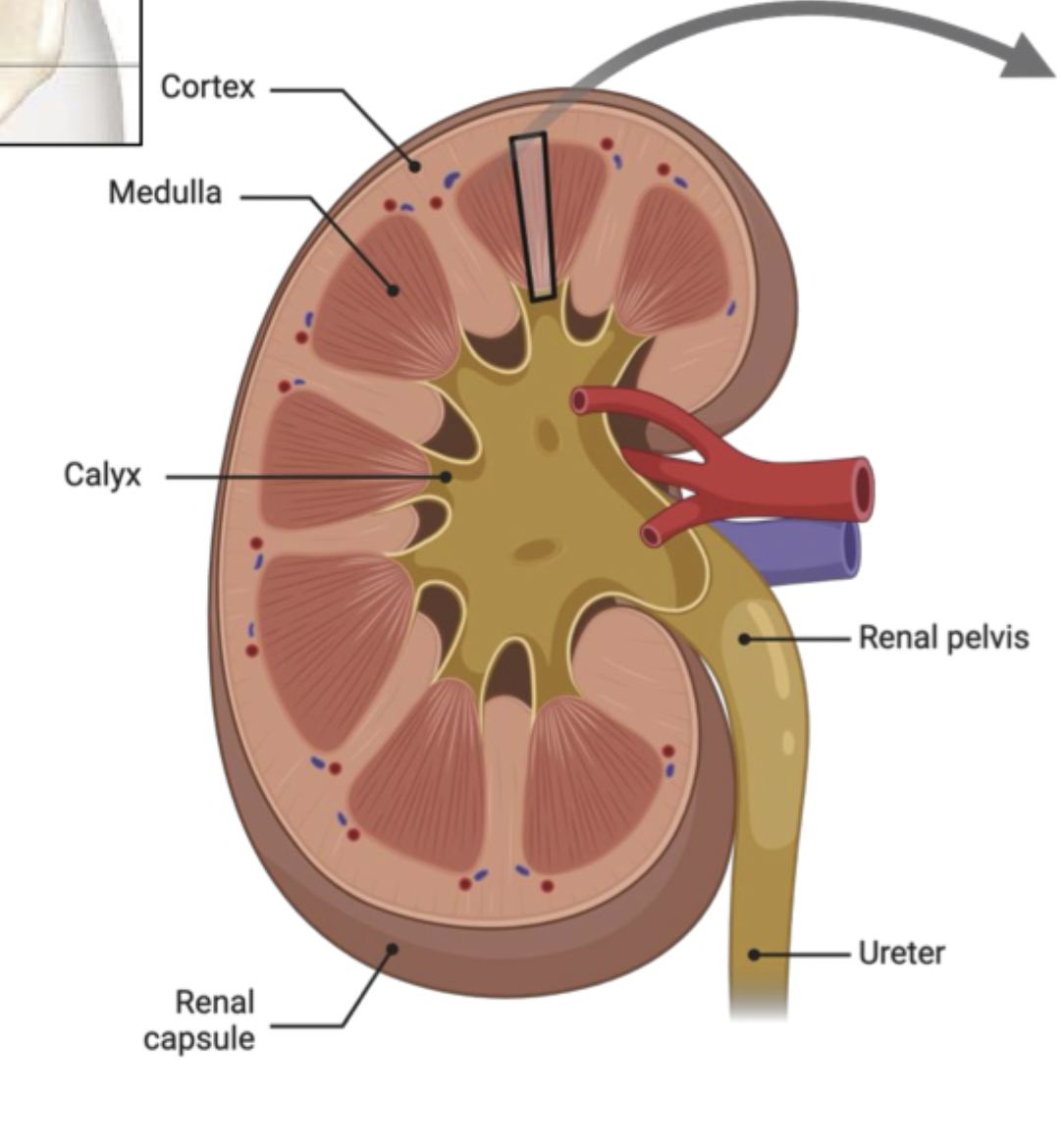
the kidney has 2 major region
cortex
this is the OUTER region of the kidney
medulla
this is the INNER region of the kidney
what types of nephron do we have?
we have TWO types of nephron
cortical nephrons
these have their glomerulus located in the OUTER cortex
have shorter loops of henle
contribute to filtration and reabsorption
juxtamedullary nephrons
glomerulus located near the cortex medullary boundary
have longer loops of henle which descend deep down into the medulla
very important for the concentration of urine. longer loop of henle = more concentrated urine = the more water you can preserve

whats the sequence of the nephron?
glomerukus > PCT > loop of henle > thick ascending limb > distal convuluted tubule > cortical collecting duct > collecting duct

glomerulus?
this is a network of capillaries, and it is where blood fitlration occurs
proximal convuluted tubule?
reabsorbs MOST of the water and the useful substances > so BULK REABSORPTION occurs here
this is 30% of the nephron length
loop of henle?
concentrates urine
distal convuluted tubule?
fine tunes ELECTROLYTES and pH
under hormonal regulation
cortical collecting duct/collecting duct?
fine tunes WATER reabsorption
under hormonal regulation
what OVERALL supplies the kidneys with blood?
the renal arteries.
What is the pathway of blood flow through the kidney?
renal artery > affarent arterioles > glomerular capillaries > efferent arterioles > peritbular capillaries > vasa recta > renal veins

how do the kidneys decide what stays in the body/blood, and what is excreted out into the urine?
filtration - substance moves OUT of the blood, and into the nephron at the glomerulus
reabsorption - this is when substance moves OUT of the nephron, and back INTO the blood
secretion - this is when AFTER filtration, so after the glomerulus, the substance moves from the bloodinto the nephron
what is significant about filtration at the glomerulus?
MANY substances are filtered at a constant rate at the glomerulus
EXCEPT for any substance which is bound to protein
if bound to protein - this substance will NOT be filtered into the glomerulus. it will just remain in the blood
what 3 basic processes so we have when it comes to the nephron?
susbstances need to be entirely secreted
filtration + secretion
so these substances the kidney is VERY GOOD at removing
e.g. PAH - however this represents a LOT of drugs
substances which partly reabsorbed
filtration + mostly reabsorption and SOMETIMES secretion
e.g. Na+/K+
substances which need to be entirely reabsorbed
filtration + COMPLETE reabsorption
e.g. glucose
**KNOW THESE PHOTOS

explain the process of PAH going through the nephron
a SMALL amount is initially filtered through the glomerulus
but then, the REST of the PAH is secreted from the blood into the tubules
therefore, almost 100% of the PAH which goes through our kidneys will be excreted into the urine
THIS IS FILTRATION + SECRETION
what can PAH/drugs which are entirely secreted into the urine good for?
BECAUSE certain things, such as PAH, are removed SO effeciently from the body, we can use it to estimate how much plasma flows through our kidneys - effectie renal plasma flow
explain the process of Na+/K+ going through the nephron?
Na+ and K+ need to be regulated by the body very carefully because they can effect blood volume and therefore blood pressure
they are initially filtered at the glomerulus
but then MAJORITY of them are absorbed back into the blood
depending on the bodies needs, some MAY be secreted into the nephron if we e.g. need to low our blood volume/blood pressure
the amount remaining in the nephron is excreted
**this is important that the body can do this as the body needs to be able to carefully regulate its electrolyte concentration
THIS IS FILTRATION + MAJORITY REABSORPTION - AND SOMETIMES SECRETION
explain the process of glucose going through the nephron?
we have certain things which are valuable to our body which we do NOT want to lose any of
glucose is initially filtered at the glomerulus
it is then COMPLETELY reabsorbed back into the blood - primarily in the proximal convuluted tubule
therefore there should normally be NO glucose excreted into the urine
how does the glomerulus decide whats filtered and whats not?
its based off of SIZE
so small things can be filtered such as: water, electrolytes, glucose, amino acids, urea, and other small molecukes
and big things CANNOT be filtered, such as: proteins, red blood cells, white blood cells, platelets, or anything else which is too large to pass
How do you work out what is excreted into the urine?

is the glomerulus selective?
no - its only thing it really filters based off of is SIZE - apart from that, will not select against anything
regulation of the proximal convuluted tubule?
this is LARGELY unregulated because its primary function is bulk rebabsorption - so it does not need to be specific or perfect
this is LEAKY EPITHELIA
describe the structure and function of the loop of henle
descending limb
this section is HIGHLY permeable to water
so water leaves the nephron via osmosis and is reabsorbed into the body
this also then CONCENTRATES the tubular fluid
ascending limb
this is essentially IMPERMEABLE to water
tight epithelia
NaCl is absorbed here through specific transporters
this causes our tubular fluid to become more DILUTE
so depending on the regulation of what goes on here, when the tubular fluid leaves the loop of henle, it can either be more concentrated or more dilute
how does the loop of henle regulate what it reabsorbs?
tight junctions and specific transporter expressionn
does the distal convuluted tubule reabsorb a lot?
NO - only small volumes
its main function is the fine tuning of electrolytes and pH
does the collecting duct reabsorb a lot?
NO - only small volumes
its main function is the fine tuning of water reabsorption
epithelia of the loop of henle?
it VARIES
epithelia of the distal convuluted tubule and the collecting duct?
TIGHT epithelia
how much of what is filtered into our glomerulus actually gets excreted?
ONLY 1% of the filtered load gets excreted
what can the reabsorption that happens in the PCT be split into?
TWO stages
early proximal convuluted tubule > this is when 90% of filtered glucose is reabsorbed
late proximal convuluted tubule > this is when 10% of filtered glucose is reabsorbed
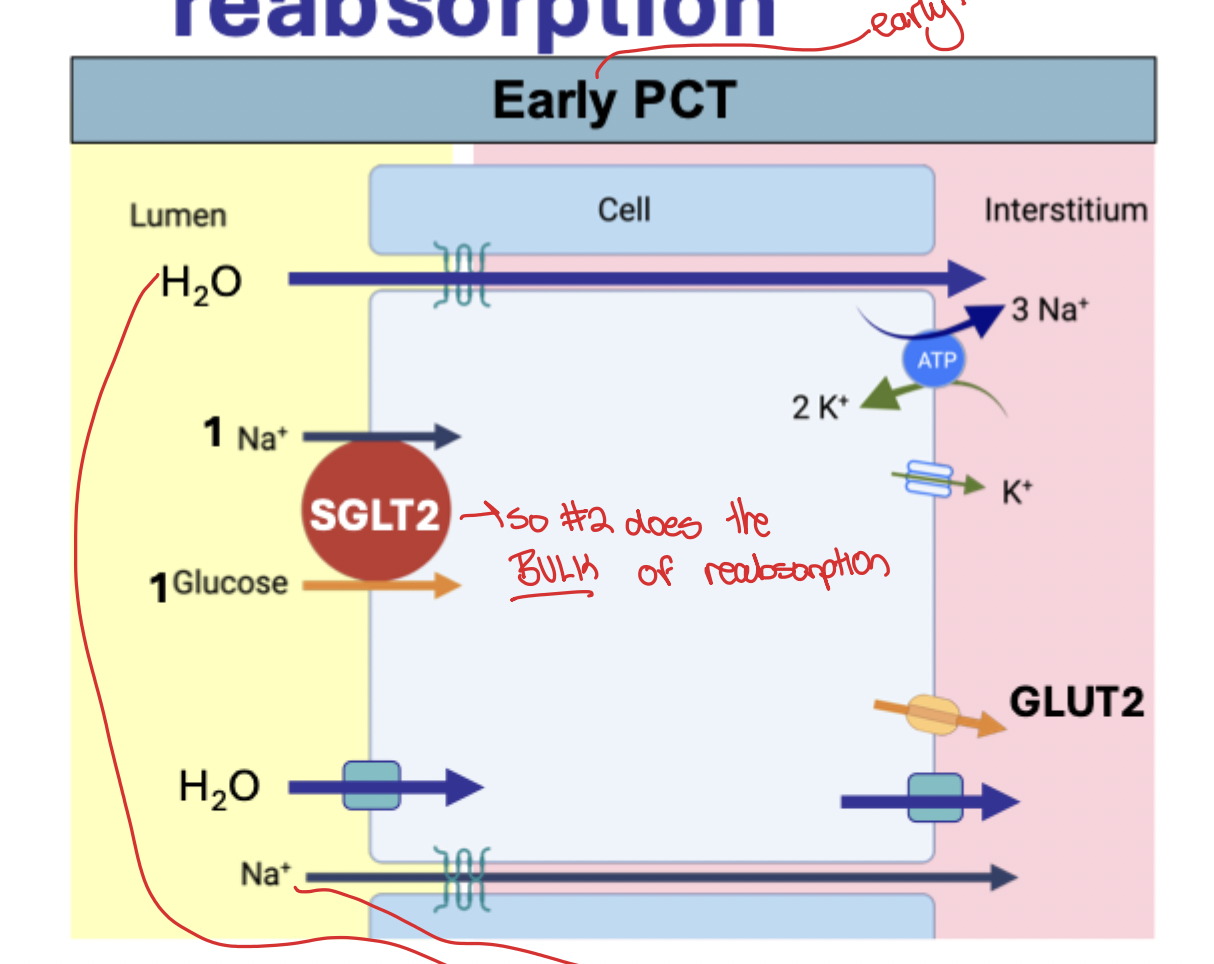
explain the epithelial transport that takes place in the EARLY proximal convuluted tubule - glucose reabsorption
the primary transporter is an SGLT2 transporter
this transporter has HIGH capacity, but LOW affinity - meaning it can transport LARGE amounts of glucose, but it is not as effecient when we have low concentrations of glucose
one Na+ in, and one glucose molecule in
glucose leaves through a basolateral GLUT2 channel
H2O can be rebabsorbed here through aquaporins
Na+/K+ ATPase maintains the Na+ gradient so that SGLT2 can continue to work
K+ leak channel
**water and sodium can follow paracellularly
whats glucosuria and why can it occur?
this is glucose in the urine
It can occur when blood glucose becomes so high that the kidney's glucose transporters become saturated and cannot reabsorb all the filtered glucose
this is why people with diabetes can end up with glucosuria - because they cannot absorb glucose into their cells, so they end up with excessive amounts in their blood
the normal person should not have glucose in their blood as the bodies cells will always be able to absorb it
explain the epithelial transport that takes place in the LATE proximal convuluted tubule - glucose reabsorption
the primary transporter is an SGLT1 transporter
this transporter has LOW capacity, but HIGB affinity - meaning it is only able to transport SMALL amounts, but it is very effective at absorbing ALL of these last amounts
TWO Na+ in, and one glucose molecule in
glucose leaves through a basolateral GLUT1 channel
H2O can be rebabsorbed here through aquaporins
Na+/K+ ATPase maintains the Na+ gradient so that SGLT1 can continue to work
K+ leak channel
**water and sodium can follow paracellularly

Which GLUT transporter works with SGLT1 in the kidney compared with the intestine?
In the kidney (late PCT), SGLT1 works with GLUT1, whereas in the small intestine, SGLT1 works with GLUT2 to reabsorb glucose.
SO IT CAN BE A BIT CONFUSING
What is osmolarity?
The concentration of dissolved particles, such as sodium and other solutes, in a fluid.
How do changes in water and sodium affect ECF osmolarity?
More water decreases osmolarity, while more sodium increases osmolarity, assuming other factors remain constant.
so a change in either water or sodium is going to affect our osmolarity of our ECF
but we do NOT WANT OUR ECF OSMOLARITY TO CHANGE!!
How do the kidneys maintain water and sodium homeostasis?
By adjusting how much water and sodium are reabsorbed into the blood or excreted in urine.
What does aldosterone do in the kidneys?
Increases sodium reabsorption, which helps retain water and maintain blood volume and pressure.
What does ADH (vasopressin) do in the kidneys?
Increases water reabsorption, reducing water loss in urine and helping regulate ECF osmolarity.
How do the kidneys respond when the body is dehydrated?
They increase water reabsorption, mainly through ADH, producing less, more concentrated urine
so this is why you can drink differing amounts of water, and it does not matter - the kidneys will always adjust for it