4. Dyslipidemia - Systemic Disease Fall 2026
 Call Kai
 Learn
Learn Practice Test
 Spaced Repetition
 Match
Match Flashcards
 Knowt Play
1/115

There's no tags or description
Looks like no tags are added yet.
Name | Mastery | Learn | Test | Matching | Spaced | Call with Kai | Chat |
|---|
No analytics yet
Send a link to your students to track their progress
116 Terms
What is hyperlipoproteinemia?
High levels of lipoproteins in the blood
What are lipoproteins?
They carry lipids (cholesterol and triglycerides) in the bloodstream
What transports dietary triglycerides?
Chylomicrons
What is VLDL?
Very Low Density Lipoprotein
What is the function of VLDL?
Transport triglycerides synthesized by the liver
What is IDL?
Intermediate Density Lipoproteins
How does IDL relate to VLDL?
VLDL remnant after transporting triglycerides
What is LDL?
Low density lipoprotein; "Bad cholesterol"
What is the function of LDL?
Transports LDL to the cells
What is HDL?
High density lipoprotein; "Good cholesterol"
What is the function of HDL?
Removes excess cholesterol from the body
What are the atherogenic lipoprotein particles?
VLDL, IDL, LDL
**dangerous and can cause lipid deposition in arteries
What is dyslipidemia?
Abnormal amount of lipid in the blood
What are common causes of dyslipidemia?
-High Total Cholesterol
-High LDL
-High Triglycerides
-Low HDL
-Any combo of the above metrics
What is hypercholesterolemia?
High cholesterol levels in the blood, specifically LDL cholesterol
What is hypercholesterolemia a major risk factor for?
development of atherosclerosis
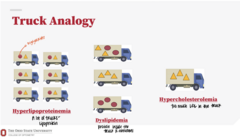
Truck Analogy for Hyperlipoproteinemia, Dyslipidemia, and Hypercholesterolemia (Pic)
Truck Analogy for Hyperlipoproteinemia, Dyslipidemia, and Hypercholesterolemia (Pic)
Dyslipidemia is one of the most important _____ cardiovascular risk factors worldwide
modifiable
____% of adults (>25yo) have elevated cholesterol levels globally
40
1 in ____ adults in the US are on a Statin therapy
5
How does the risk of dyslipidemia relate to age?
Increases with age
What is primary dyslipidemia?
Genetic: Dx at a young age, and fam hx of lipid metabolism conditions
What is secondary dyslipidemia?
D/t underlying disease that affect lipid and lipoprotein metabolism
What are the 3 classifications of primary dyslipidemia?
-Familial hypercholesterolemia
-Familial combined hyperlipidemia
-Familial hypertriglyceridemia
What is Familial hypercholesterolemia?
Autosomal dominant defect in LDL receptor leading to increases LDL in the blood
What is Familial combined hyperlipidemia?
Most common genetic dyslipidemia; leads to elevated LDL, VLDL and triglycerides
What is Familial hypertriglyceridemia?
Excess VLDL; Leads to increased triglycerides and risk of pancreatitis
What are common causes of secondary dyslipidemia?
-Endocrine/Metabolic Causes
-Chronic Kidney Disease
-Excessive Alcohol Use
-Systemic Corticostereoid Therapy
What are endocrine/metabolic causes that lead to secondary dyslipidemia?
DM, Hypothyroidism, Obesity, Metabolic Syndrome
How does Hypothyroidism lead to secondary dyslipidemia?
reducing the number and activity of liver low-density lipoprotein (LDL) receptors; reduced LDL clearance from the blood
How does obesity and metabolic syndrome lead to secondary dyslipidemia?
Obesity and metabolic syndrome lead to secondary dyslipidemia primarily through insulin resistance and the overproduction and impaired clearance of blood fat particles
What are the risk factors for dyslipidemia?
-Genetics
-Obesity
-DM
-Thyroid disease (Hypothyroidism)
-Kidney Disease
-Alcohol
-Corticosteroids
True or False:
A lipid screening is recommended at routine preventative medical care visits
true
At what age should you start screening for dyslipidemia?
>40yo
If risk factors are present, should you start screening for dyslipidemia earlier than 40yo?
Yes
What are the 2 major systemic manifestations of dyslipidemia?
-Atherosclerotic CVD
-Acute pancreatitis
What is the cause of Atherosclerotic CVD?
Elevated atherogenic lipoproteins (LDL)
Can CVD lead to death? How?
CVD --> Coronary Artery Disease --> Cerebrovascular Disease, Carotid Artery Disease, Peripheral Artery Disease --> Heart Attack, Stroke, Death
How does dyslipidemia lead to acute pancreatitis?
Very high levels of triglycerides (>1000mg/dL) and excess chylomicrons
What is the appearance of the blood when levels of triglycerides are >1000mg/dL?
milky blood, lipemic blood
What are the symptoms of acute pancreatitis d/t high levels of triglycerides in the blood?
Severe abdominal pain, N/V
What are the ocular manifestations of dyslipidemia?
-Lipemia Retinalis
-RAO, RVO
-Hollenhorst plaques
-Corneal Arcus
-Xanthelasma

What is Lipemia Retinalis?
a rare eye finding caused by very high levels of triglycerides in the blood (>1000mg/dL)

There is typically a ____ cause to Lipemia Retinalis?
genetic

What is the appearance of the retina with Lipemia Retinalis?
Milky white vessels

How is VA with Lipemia Retinalis?
Typically good

What is the risk with Lipemia Retinalis?
Risk of pancreatitis

What is the treatment for Lipemia Retinalis?
Lower TG levels

Will Lipemia Retinalis likely resolve when TG levels lower?
Yes

True or False:
Patients with dyslipidemia are at risk for RVO and RAO
true

Why are patients with dyslipidemia at risk for RVO and RAO?
d/t atherosclerosis (retinal artery thickening and stiffening)
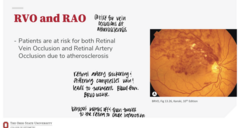
When retinal arteries thicken/stiffen, how does this lead to a RVO?
Compress vein and lead to turbulent blood flow

How does atherosclerosis lead to a RAO?
Emboli breaks off and then travels to the retina to cause an infarction

What is corneal arcus?
Grey-white ring around the cornea (stroma)
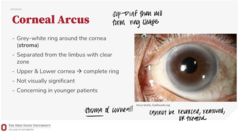
What is the appearance of corneal arcus?
-Separated from the limbus with a clear zone
-Will start at the upper and lower cornea and then form a complete ring

Is arcus visually significant?
No

When is arcus concerning?
In younger patients

Can arcus be removed, reversed or treated?
No

What is xanthelasma?
Yellow deposits in the medial parts of the upper and lower eyelids
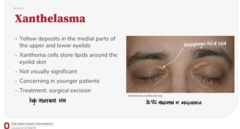
What are xanthelasma made of?
Cells that store lipids around the eyelid

Are xanthelasma visually significant?
No

When are xanthelasma concerning?
In younger patients
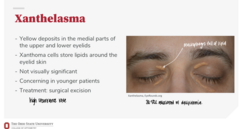
What is the treatment for xanthelasma?
Surgical excision -- will probably recur
How to diagnose dyslipidemia?
Lipid profile (typically non fasting)
What does a lipid profile entail?
-Total Cholesterol
-Triglyceride
-LDL-C
-HDL-C
-Non-HDL Cholesterol
-Apolipoprotein B (ApoB)
What is Non-HDL Cholesterol?
Total cholesterol minus HDL
What is Apolipoprotein B (ApoB)?
Estimates # of atherogenic lipoprotein particles
What does a fingerstick do to measure dyslipidemia?
Quick measurement of total cholesterol and HDL

Lipid Panel Reference Ranges
Total Cholesterol
< 200 desireable

Lipid Panel Reference Ranges
LDL Cholesterol
<100 Optimal
100-129 Near Optimal
130-159 Borderline
160+ High

Lipid Panel Reference Ranges
HDL Cholesterol
≥40 Men
≥50 Women

Lipid Panel Reference Ranges
Triglycerides
<150 Normal
-150-200 Borderline High
-200-499 High
->500 Very High

Lipid Panel Reference Ranges
Non-HDL Cholesterol
<130 desireable
What are additional labs that can be ordered for patients with dyslipidemia?
-TSH for hypothyroidism
-Glucose/A1C for DM/Insulin resistance
-Liver Function Tests (AST, ALT, ALP, bilirubin)
-Creatin Kinase for Myopathy or Muscle Disorders
What is the physical examination that should be performed on a patient with dyslipidemia?
-Xanthelasma/Arcus?
-Fundus exam
-Auscultation of carotids and femoral arteries
How to incorporate the ASCVD Risk Calculator into Dx of dyslipidemia?
Incorporates multiple modifiable & non-modifiable CV risk factors to estimate an individual's risk (age, sex, hypertension, DM, lipid values, smoking)
What does the ASCVD Risk Calculator calculate the risk of?
Estimates future risk (10 and 30 year) risk of CV complications (such as MI or stroke)
What does the ASCVD Risk Calculator help guide?
preventative therapy decisions

ASCVD Risk Calculator (Pic)
ASCVD Risk Calculator (Pic)
2018 Risk Categories of ASCVD
Low risk Treatments
Lifestyle advice only
2018 Risk Categories of ASCVD
Borderline Risk Treatments
usually lifestyle advise (maybe consider a treatment)
2018 Risk Categories of ASCVD
Intermediate Risk Treatments
Start stain to lower cholesterol
2018 Risk Categories of ASCVD
High Risk Treatments
Needs statin, usually high-intensity
If ASCVD risk is above ____ statin therapy is recommended
7.5%
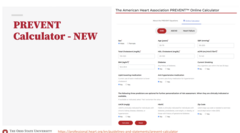
What is the PREVENT Calculator?
-Replaces the Pooled Cohort Equations for current primary prevention risk assessment
-Incorporates CV-Kidney-Metabolic Health
-Does not include Race

What is the function of the PREVENT Calculator?
Estimates 10 year and 30 year risk of cardiovascular events

PREVENT Calculator (Pic)
PREVENT Calculator (Pic)

2018 Guidelines vs 2026 Guidlines for Dyslipidemia
Risk model in 2018
Pooled Cohort Equations (PCE)

2018 Guidelines vs 2026 Guidlines for Dyslipidemia
Risk model in 2026
PREVENT-ASCVD

2018 Guidelines vs 2026 Guidlines for Dyslipidemia
2018 10 year risk categories
-Low =

2018 Guidelines vs 2026 Guidlines for Dyslipidemia
2026 10 year risk categories
-Low =

2018 Guidelines vs 2026 Guidlines for Dyslipidemia
Race Included in 2018?
Yes
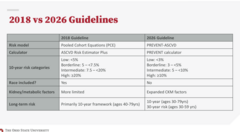
2018 Guidelines vs 2026 Guidlines for Dyslipidemia
Race Included in 2026?
No

2018 Guidelines vs 2026 Guidlines for Dyslipidemia
Kidney Metabolic Factors in 2018
More limited

2018 Guidelines vs 2026 Guidlines for Dyslipidemia
Kidney Metabolic Factors in 2026
Expanded CKM factors

2018 Guidelines vs 2026 Guidlines for Dyslipidemia
Long term risk 2018
Primarily a 10yr framework

2018 Guidelines vs 2026 Guidlines for Dyslipidemia
Long term risk 2026
10 and 30 year risk framework
PREVENT 2026 Treatment Guidelines
Low risk (
Lifestyle optimization
PREVENT 2026 Treatment Guidelines
Borderline Risk
Lifestyle optimization (maybe consider treatment)
PREVENT 2026 Treatment Guidelines
Intermediate Risk
Lifestyle optimization + lipid-lowering therapy