Unit 2: Equilibrium
 Call Kai
 Learn
 Practice Test
 Spaced Repetition
 Match
 Flashcards
 Knowt Play
1/41

There's no tags or description
Looks like no tags are added yet.
Name | Mastery | Learn | Test | Matching | Spaced | Call with Kai | Chat |
|---|
No analytics yet
Send a link to your students to track their progress
42 Terms
Chemical equilibrium
How complete is rxn
Four characteristics of chemical equilibrium
For a closed system (no escape)
Initial no products, high reactants
Overtime [prod] increases, [reactants] decrease
Eventually concentrations stabilize
Why does equilibrium occur?
Raectants decomposing → products
AND
products recombining → reactants
Dynamic equalibrium
When rates of forward and reverse rxn are equal
Dynamic
Always moving as bonds are breaking constantly and reforming
Equilibrium constant

Large k=? Small k=?
Many products, mostly reactants
Kc ad Kp
Molar concn and partial pressure
Kp formula
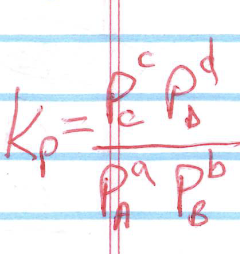
K
Equilibrium at play
All equilibrium systems are what systems?
ALL CLOSED
K3
k1 x k2

Constant for reverse rxns
1/k
How is k related to temperature?
Constant at a given temp
How is k satisfied? How many k are there?
Initial reactant/product concentrations (so different concentrations can) will always change (“equilibrate””) to satisfy K causing reactions to shift.
ONLY ONE K, but many conditions to satisfy it
Le Chatelier’s Principle (LCP)
If external influence upsets and equilibrium the system will shift to correct the upset and restore equilibrium.

What happens if you add D? Remove A? Remove D? Add A?
Left, left, right, right

What happens if you add heat? cool (remove heat)?
Left, right
Heterogeneous equilibria
solids, liquids, gases
What is not included in equilibrium expressions? Why?
Liquids and solids are not included since there concentration does not change effectively. Only gases and dissolved species will change their conc and so are in eqm expression.
The meaning of K tells us about…
Tendency for the rxn to go to completion
If a given concentration represents an equilibrium state
The shift needed to reach eqm
How can rxns tendency be found?
Large k → large completion → mostly products
Small k → small completion → mostly reactants
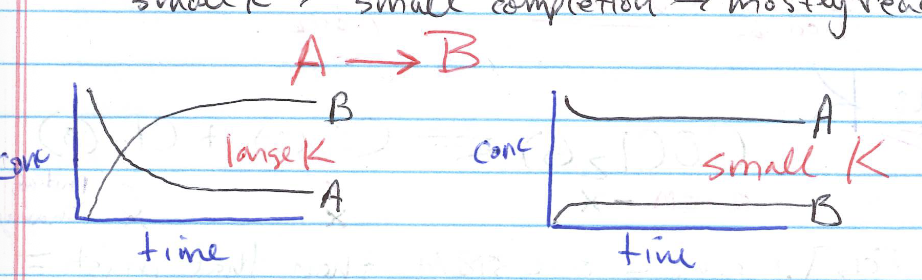
How would you know if a given conc represents an eqm state?
Test condn and if k not equal then not at eqm
Q
The initial value calculatd call the reaction quotient
Q > K
Too many prodcuts causing a shift left to reactants
Q < K
too feww products causing a shift right to products
Q=K
at eqm
How can we solve for concentrations when we have x?
Quadratic equation but YUCK, only use if neccesary for refined answer
Succesive guesses (repeated guesses of x so you calculate K until right answers arise which means spreadhssets are good for this but use if refined answer needed (but cumbersome)
Neglect x from denominator since its so small
5 % rule
neglected / [A]o x 100% if x < or = 5% then neglecting was ok!
Rule of thumb for 5% rule
If [A]o and K differ by > or = 10³ try neglecting
Dalton’s Law of Partial Pressure
Total P = P1 + P2 + P3+…
How does volume affect eqm?
The conc and partial pressures also change
How do we know volume’s effect on eqm?
Using Q to predict is still valid here. Can also use a qualitative approach thinking in terms of volume.
When vol of gaseous rxn container is reduced the eqm system itself will also?
Reduce its vol to relieve the stress

LCP explanation for vol changes
V of system reduces by shifting eqm to reduce mols of gas → reduces eqm vol → relive P and stress
If inc. container vol then eqm will?
Inc its vol by shifting to side of rxn with more mol gas
If dec. container vol then eqm will?
Dec its vol by shifting to side of rxn with less mol gas.
Effect of temp change on eqm
It is known that Tchange will change K (temperature dependent constant)
How does temp affect eqm in exothermic rxn?
LCP says if T inc; heat added → rxn shift left to remove extra heat and restore eqm since you treat heat as a product ([prod] dec. and [reactants] inc.)

How does temp affect K in exothermic rxn
K will dec if T inc
K will inc if T dec
How does temp affect eqm in endothermic rxn?
LCP says if inc T → shift right to consume excess heat causing [prod] inc and [reactant] dec
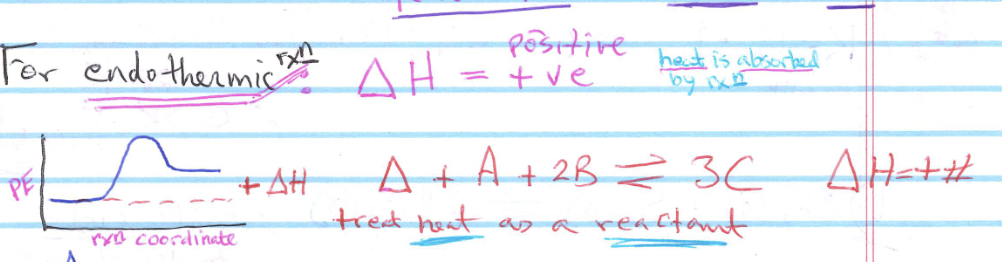
How does temp affect K in endothermic rxn
K will inc if T inc
K will dec if T dec