chem c14 halogen derivatives
 Call Kai
 Learn
 Practice Test
 Spaced Repetition
 Match
 Flashcards
 Knowt Play
1/15

There's no tags or description
Looks like no tags are added yet.
16 Terms
What is a halogenoalkane and how is the C–X bond described?
A halogenoalkane (RX) has one or more halogen atoms bonded to a sp³ hybridised carbon of an alkyl group.
The C–X bond is polar because halogen is more electronegative than carbon: \( C^{\delta+} - X^{\delta-} \)
This makes the carbon electron-deficient and susceptible to nucleophilic attack.
How are halogenoalkanes classified?
Primary (1°): one alkyl group on the carbon bearing X
Secondary (2°): two alkyl groups on the carbon bearing X
Tertiary (3°): three alkyl groups on the carbon bearing X
What is a nucleophile?
A nucleophile is a species that donates an electron pair to an electron-deficient atom to form a covalent bond.
Examples of anionic nucleophiles: \( OH^- \), \( CN^- \), \( X^- \) Examples of neutral nucleophiles: \( NH_3 \), \( H_2O \)
What is a nucleophile?
A nucleophile is a species that donates an electron pair to an electron-deficient atom to form a covalent bond.
Examples of anionic nucleophiles: \( OH^- \), \( CN^- \), \( X^- \) Examples of neutral nucleophiles: \( NH_3 \), \( H_2O \)
Describe the SN1 mechanism
Substitution, Nucleophilic, Unimolecular — two steps.
Step 1 (slow): ( C-X ) undergoes heterolytic fission → carbocation intermediate (trigonal planar)
Step 2 (fast): Nucleophile attacks from either face → gives racemic mixture
Rate equation: rate = k[RX], overall order = 1
What are the stereochemical outcomes of SN2 vs SN1?
SN2: backside attack → inversion of configuration → one enantiomer (optically active product)
SN1: carbocation attacked from both faces equally → racemisation → racemic mixture (optically inactive)
What is the order of reactivity of halogenoalkanes RX (same R) towards nucleophilic substitution?
R-F < R-Cl < R-Br < R-I
(slowest → fastest)
Because C–X bond strength decreases down Group 17: C-F > C-Cl > C-Br > C-I
The weaker the C–X bond, the faster the rate of substitution.
What is the order of reactivity of halogenoalkanes (same X) towards SN2 vs SN1?
SN2 (less steric hindrance favoured): ( CH_3X > 1°RX > 2°RX > 3°RX ) (fastest → slowest)
SN1 (more stable carbocation favoured): ( CH_3X < 1°RX < 2°RX < 3°RX ) (slowest → fastest)
Which mechanism does each class of halogenoalkane favour?
Methyl / 1° RX → SN2 (less steric hindrance; unstable carbocation)
2° RX → SN2 and/or SN1 (use kinetics/stereochemistry data to determine)
3° RX → SN1 (stable carbocation; too much steric hindrance for SN2)
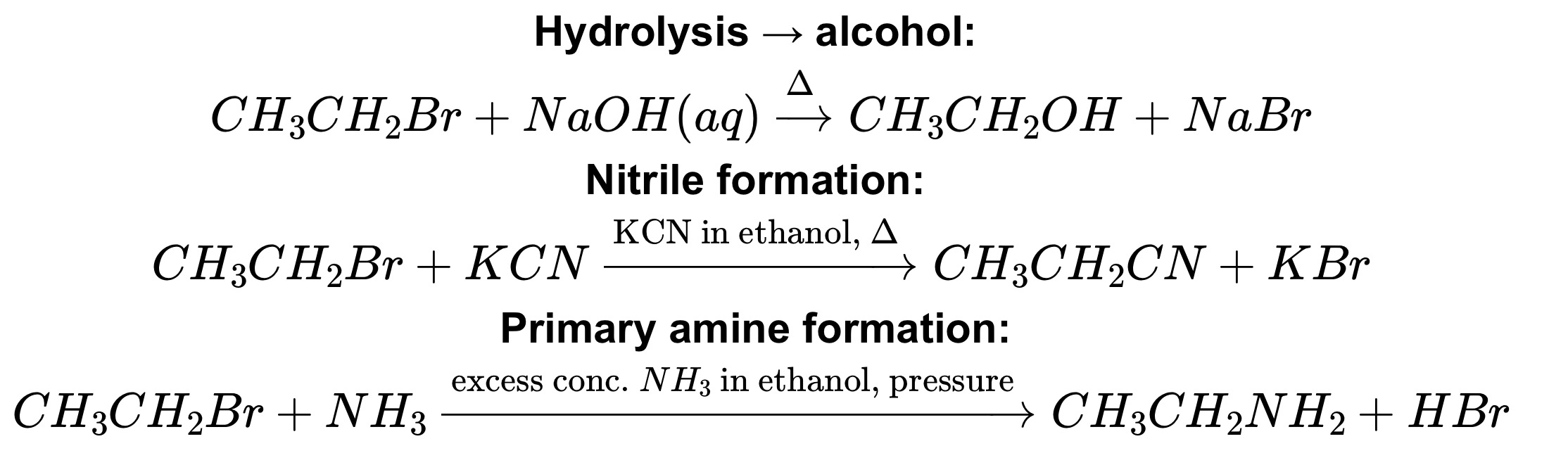
What are the three nucleophilic substitution reactions of bromoethane and their conditions?
Hydrolysis → alcohol: \( CH_3CH_2Br + NaOH(aq) \xrightarrow{\Delta} CH_3CH_2OH + NaBr \)
Nitrile formation: \( CH_3CH_2Br + KCN \xrightarrow{\text{KCN in ethanol, } \Delta} CH_3CH_2CN + KBr \)
Primary amine formation: \( CH_3CH_2Br + NH_3 \xrightarrow{\text{excess conc. } NH_3 \text{ in ethanol, pressure}} CH_3CH_2NH_2 + HBr \)
What is the elimination reaction of halogenoalkanes and its conditions?
Loss of HX to form an alkene: \( C-C \xrightarrow{NaOH \text{ in ethanol, } \Delta} C=C + HX \)
\( OH^- \) acts as a base (not nucleophile) in ethanolic medium.
Saytzeff's rule: the major product is the most substituted alkene

How do you choose between substitution and elimination for halogenoalkanes?
NaOH(aq), heat → nucleophilic substitution (\( OH^- \) acts as nucleophile)
NaOH in ethanol, heat → elimination (\( OH^- \) acts as base)
Why are halogenoarenes (e.g. chlorobenzene) unreactive towards nucleophilic substitution?
Two reasons:
Partial double bond character: lone pair on X delocalises into the benzene π system → C–X bond is strengthened, harder to break
Steric hindrance and electronic repulsion: benzene ring blocks backside attack (no SN2); π electron cloud repels incoming nucleophile; no stable carbocation formed (no SN1)
What is the 4-step test to distinguish between R–Cl, R–Br and R–I?
Add NaOH(aq) to RX and heat → hydrolyses C–X bond to give \( X^- \)
Cool the mixture
Acidify with dilute \( HNO_3 \) (removes excess NaOH)
Add \( AgNO_3(aq) \)
Results:
R–Cl → white precipitate of AgCl
R–Br → pale cream precipitate of AgBr
R–I → yellow precipitate of AgI
Halogenoarene / fluoroalkane → no precipitate
Why are CFCs harmful to the ozone layer?
CFCs are stable and reach the stratosphere where UV radiation causes homolytic fission of the C–Cl bond: \( CCl_2F_2 \xrightarrow{uv} \cdot CClF_2 + Cl\cdot \)
\( Cl\cdot \) then catalytically destroys ozone:
\( Cl\cdot + O_3 \rightarrow ClO\cdot + O_2 \)
\( ClO\cdot + O\cdot \rightarrow Cl\cdot + O_2 \)
\( Cl\cdot \) is regenerated → chain reaction destroys thousands of \( O_3 \) molecules per \( Cl\cdot \)
What are the replacements for CFCs and their trade-offs?
HCFCs: contain C–H bonds → broken down at lower altitudes → less ozone depletion than CFCs, but still some
HFCs: no Cl or Br → zero ozone depletion potential (ODP = 0), but are potent greenhouse gases (high GWP)
Both are interim solutions; research into better alternatives is ongoing. 🌍