Physiology 2.4: Higher functions pt. 1
 Call Kai
 Learn
Learn Practice Test
 Spaced Repetition
 Match
Match Flashcards
 Knowt Play
1/68

There's no tags or description
Looks like no tags are added yet.
Name | Mastery | Learn | Test | Matching | Spaced | Call with Kai | Chat |
|---|
No analytics yet
Send a link to your students to track their progress
69 Terms
describe brain organization
100 billion neurons
brain weighs 3 pounds
whare the major parts of the cerebrum
frontal lobe
temporal lobe
brain stem
cerebellum
occipital lobe
parietal lobe
describe the frontal lobe
planning
reasoning
problem-solving
recognizing
regulating emotion
social skill
describe the temporal lobe
understanding language
processing auditory information
organizing information
memory and learning
describe the brain stem
regulates breathing, body temperature, heart
describe the parietal lobe
recognizing sensation, body position, recognizing objects, spatial judgements, understanding time
describe the occipital lobe
integrating and processing visual information
describe the cerebellum
controls balance and muscle coordination
describe the organization of the cerebral cortex
surface layer of gray matter
neocortex
newest region
90% of cerebral cortex
made by 6 cellular layers
archicortex
paleocortex
what is the neocortex
newest and largest outer layer of the brain
forms top layer of cerebral hemispheres and surrounds deeper brain structures

what is the neocortex formed by
archicortex
paleocortex

what are the two types of cells in the cerebral cortex
stellate cells
dendrites projecting in all directions
process local information, receive direct sensory information from thalamus
pyramidal cells
axon that passes out of area into white matter
excitatory neuron sending long-distance axons to other brain regions
describe the protective layers of the central nervous system
hair, skin, skull
meninges
cerebrosinal fluid
BBB
describe the meningeal layers
meningeal layer of the brain cushion and protect delicate neural tissue
dura mater
form the venous sinus
arachnoid mater
pia matter

describe cerebrospinal fluid
shock absorbing
provides stable environment for generating nerve impulses
medium for exchanging nutrients and waste between blood and tissue
what generates cerospinal fluid
ependymal cells
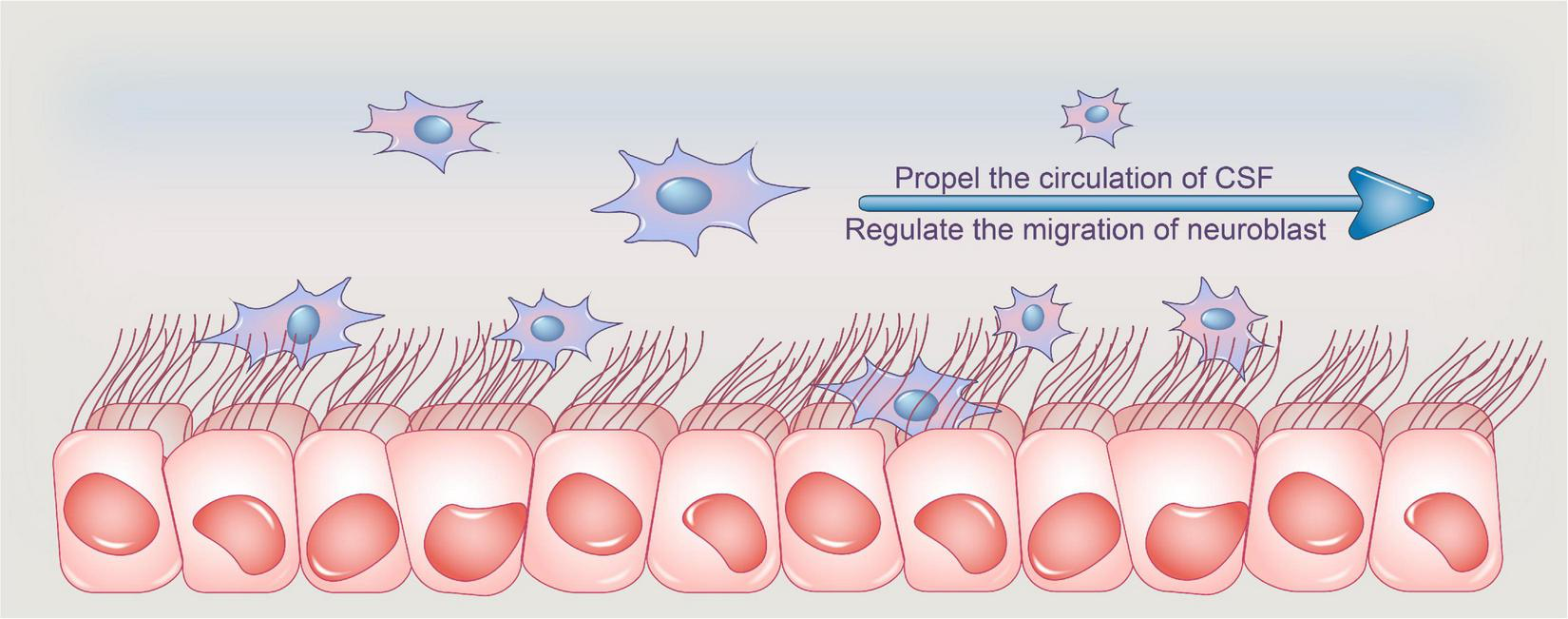
describe the blood brain barrier
tight junctions formed by astrocytes on capillaries and sinuses
limits permeability
what percentage of the blood pumped by heart goes to brain
15%
what percentage of body’s glucose is used by brain
half
in the brain, what moves glucose from plasma and into the brain
membrane transporters
what does the blood brain barrier protect the brain from
hormones and circulating chemicals
protects CNS from
chemical fluctuations
entry of harmful substances
entry of molecules that could act as neurotransmitters
what can cross the blood brain barrier
O2
CO2
alcohol
steroid
H2O
how can consciousness be defined/assessed
by behavior
from maximum attentiveness to comatose
pattern of brain activity that can be record electrically
EEG
whats an EEG
records electrical activity using electrodes attached to head
originates in pyramidal cells of cortex
meausred in microvolt (µV)
what does EEG measure
state of consciousness from the electrical activity of brain
measures summed postsynaptic potentials (PSPs)
measures the electrical activity of pyramidal neurons firing in cerebral cortex
synced from thalamus firing rhythmic, oscillatory signals
simultaneous PSPs reinforce each other rather than cancelling out

describe the waveform characteristics of EEG
amplitude
from 0.5 to 100 microvolts (uV)
frequency
from 1 to 40 hertz (Hz)
vary with state of consciousness (calm, alert, sleeping)
what is an alpha rhythm (consciousness state and frequency)
awake state
relaxed with eyes closed
decreased attention
8-13 Hz

what is a beta rhythm
awake state and active
prominent when paying attention or thinking hard
more than 16 — 31 Hz

what is SMR rhythm
physical stillness but calm and alert
12—15 Hz
what is Mu wave
completely relaxed and still
7.5 —12 Hz
what is gamma wave
very alert and attentive
32-100 Hz
what is theta rhythm
sleeping state
4-7 Hz

what is delta rhythm
sleeping state
0.5-4 Hz

summarize the EEG patterns from low to high frequency
delta wave (0.1 — 3 Hz)
stage 3 and 4 of slow wave sleep
theta wave (4 — 7 Hz)
stage 1 of slow wave sleep
alpha wave (8 — 15 Hz)
drowsy, eyes closed
mu wave (7.5 — 12.5 Hz)
completely relaxed
SMR wave (12.5 — 15.5 Hz)
alert but still
beta wave (16 — 31 Hz)
active
gamma wave (32 — 100 Hz)
full capacity
as you fall asleep, you go from alpha to ___ amplitudes and ____ frequency
higher amplitude
lower frequency
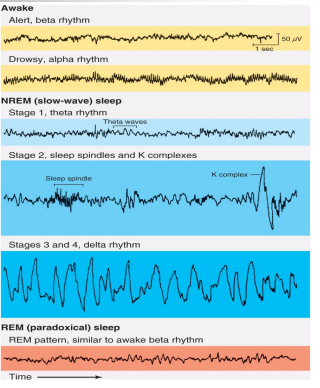
stage 3 and 4 sleep, characterized by __ rhythm, is considered…
delta wave
slow wave sleep

describe non-REM state
4 stages with increasing amounts of theta to delta
then reverse from stage 4 back to stage 1
describe REM sleep
rapid eye movement
higher frequency
lower amplitude

REM sleep is similar to what rhythm?
beta rhythm

as the night goes on… REM sleep gets ___
longer
non-REM sleep stages drop out

how many cycles of REM sleep do healthy adults get
4 to 6

what happens during REM sleep
increased sympathetic activity
increased HR, BP, and respiration
decrease in muscle control
except eyes
if we played out our dreams its dangerous
a lot of dreaming

during REM sleep, it is harder to ___ but more likely to___
harder to arouse
more likely to awake spontaneously
whats the purpose of hypotonia
protect the dream from acting out his dreams and harming himself/others
what are the brain areas that control consciousness
reticular activating system
hypothalamus
describe the reticular activating system and its role in controlling consciousness
network of neurons spanning the midbrain, pons, and medulla
primary control for wakefulness and consciousness
describe the hypothalamus and its role in controlling consciousness
preoptic area
promotes NREM and slow-wave sleep (SWS)
releases GABA that suppresses arousal
posterior hypothalamus
promotes wakefulness
produces orexin (on-switch for consciousness)
suprachiasmatic nucleus
regulator of circadian rhythm
light data to synchronize internal biological clock
describe the preoptic area in the hypothalamus
promotes NREM and slow-wave sleep (SWS)
releases GABA that suppresses arousal
describe the posterior hypothalamus in the hypothalamus
promotes wakefulness
produces orexin (on-switch for consciousness)
describe the suprachiasmatic nuclus in the hypothalamus
regulator of circadian rhythm
uses light data to synchronize internal biological clock
what is the purpose of sleep
repair time
consolidation of learned information
conservation of energy (were not hunting this hour)
what are some sleep-wake cycle disorders
insomnia, bedwetting, sleepwalking, sleep apnea, and narcolepsy
describe epilepsy
abnormal synchronization of cortical neurons
complete loss of control of brain
can spike up to 1000 uV
describe coma
severe or total decrease of mental function
little EEG activity
describe brain death
absolute no brain activity
describe fMRI
assesses brain activity in specific areas

describe CT
X-ray of brain structure, not very detailed and doesn’t show activity
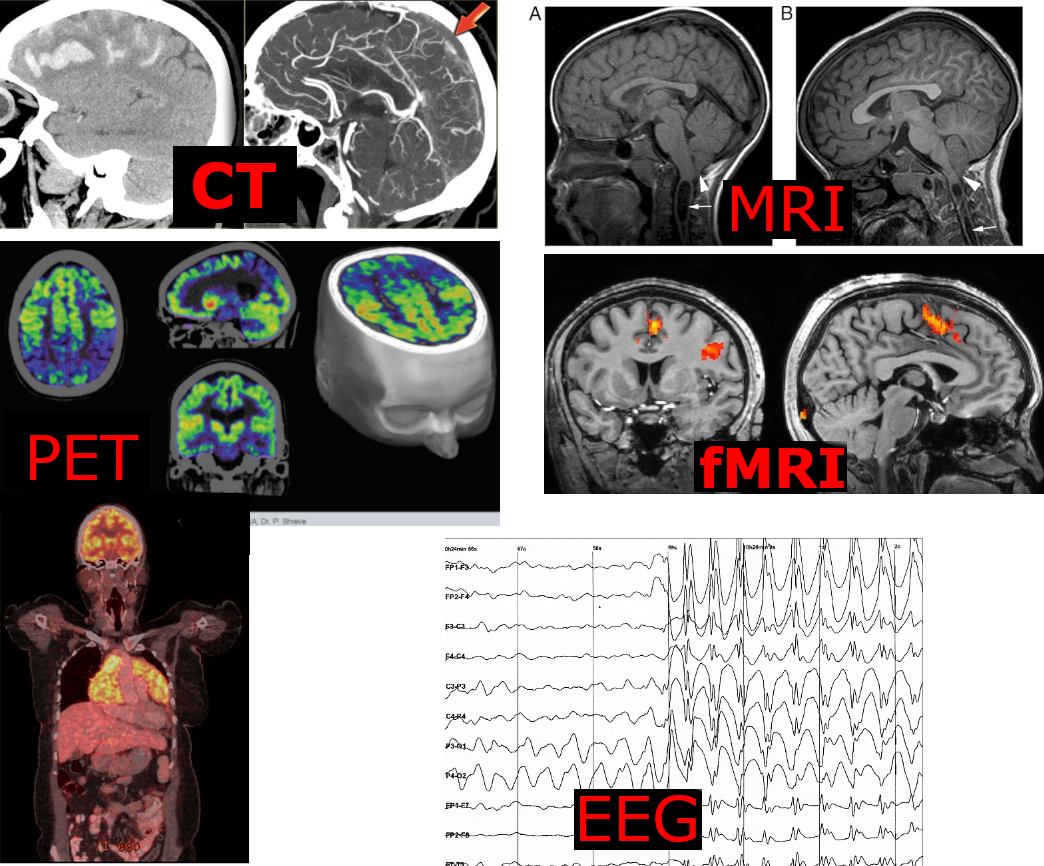
describe PET scan
injection of radioactive glucose
assess glucose activity in brain regions
metabolic changes

what are the pros and cons of an EEG
pros
easy to be installed
not invasive
accessible
cons
low spatial resolution
cannot identify specific locations
cannot measure activity below cortex
what is the hypothesized cause of EEG activity
synchronized postsynaptic potentials from millions of pyramidal neurons in cerebral cortex
what are the 4 basic frequency patterns of an EEG
Beta
Alpha
Theta
Delta
what are the differences between NREM and REM sleep
NREM
makes up most of total sleep
consists of 3 distinct stages N1, N2, and N3
from light drowsiness to slow-wave sleep
physical restoration, tissue repair, immune system support
HR and BP decrease
REM
dream sleep
resembles beta waves
eye movement and muscle paralysis
cogntive and emotional processing, memory consolidation
HR and BP increase
the number of cycles in a sleeping period
4 to 6
each cycle lasts 70 to 120 minutes
switches from non-REM to REM sleep
early cycles features more deep non-REM sleep while later cycles feature longer periods ot REM
What is slow wave sleep?
N3 sleep
the deepest stage of NREM sleep
high-amplitude delta brain waves
HR, BP, temperature drop and muscles relax
functions: physical restoration, immune support, memory consolidation
when do sleep spindles and k complexes occur
stage 2 of non-REM sleep
what areas of the brain influence sleep
hypothalamus
brainstem
basal forebrain
thalamus and cerebral cortex
describe lateral hypothalamus role in wakefulness
releases orexin
on-switch
what are the main wake-promoting transmitters
norepinephrine
orexin
serotonin
acetylcholine
dopamine
what are the man sleep-promoting transmitters
GABA
Glycine